
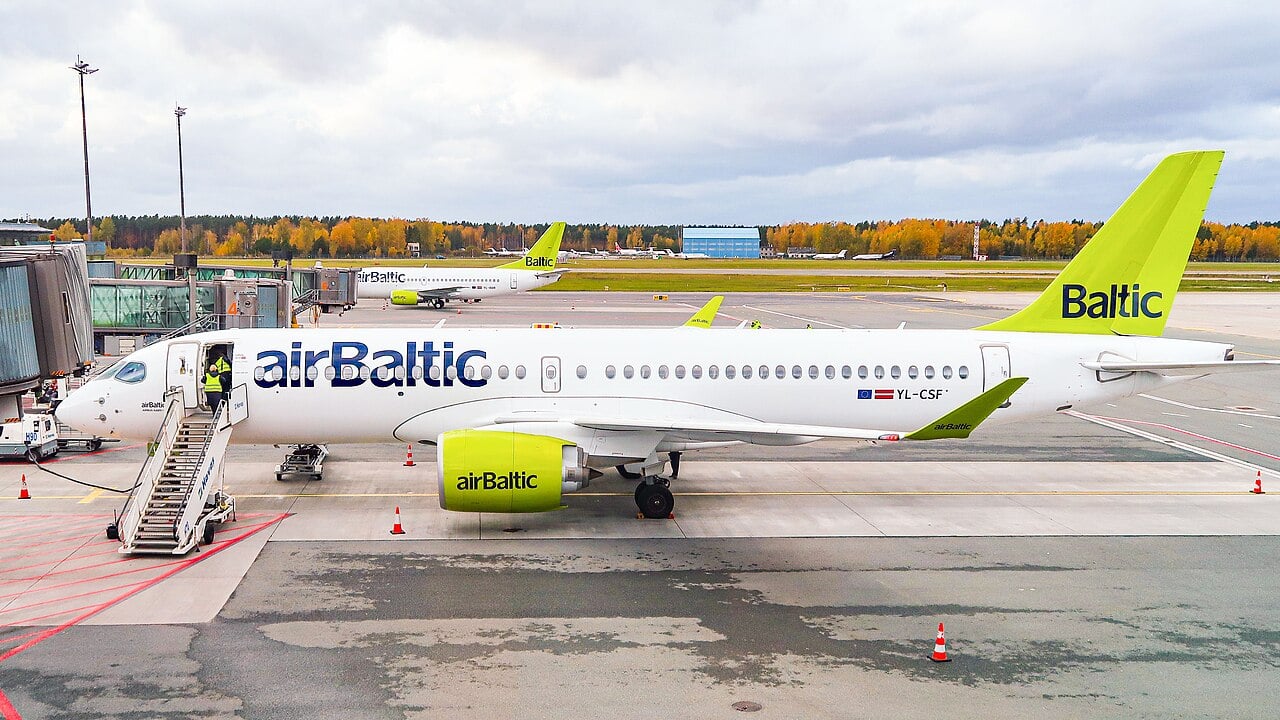
If you flew airBaltic this autumn and checked in online, somebody you have never heard of may have your name, your booking number and your flight details.
On Sunday 15 November 2026 the Latvian carrier confirmed that unauthorised access had been found in the systems of an external IT service provider, affecting roughly 618,000 passenger bookings. The records belong to passengers who registered online for airBaltic flights between 18 July and 12 November 2026. About 11,800 of those bookings cover flights that have not yet happened — a figure the airline said may change as the investigation runs on.
airBaltic says its own IT systems were not touched, that payment data and travel documents were not affected, and that flights are operating normally. It has not named the provider.
It is also, as of this month, not remotely alone.
Kurzinfo
WHO — airBaltic, the Latvian flag carrier, Riga-based and the world’s largest operator of the Airbus A220-300.
Was — unauthorised access at an external IT service provider, affecting about 618,000 booking records (PNRs).
Wann — passengers who registered online for flights between 18 July and 12 November 2026. Announced 15 November 2026.
Data involved — names, booking numbers and flight information. airBaltic says payment data, travel documents and other sensitive information were not affected.
Still to fly — about 11,800 affected bookings cover future flights. Online booking management and online check-in are disabled for those; airport check-in is free of charge.
Notified — the airline and the provider informed the relevant supervisory authorities, including Cert.lv. Passenger questions go to gdpr@airbaltic.com.
Separate from — the Amadeus booking-display incident that has hit at least ten other carriers since late October. No source has linked the two.
What was taken, and what it is good for
On the face of it this is the mildest category of breach. No card numbers. No passport scans. A name, a six-character booking reference and an itinerary.
That is precisely what makes it dangerous, and airBaltic said so itself. The airline warned that the information could be used in fraudulent messages posing as airBaltic or another travel provider, or in attempts to access or change bookings. It told passengers to treat unexpected emails, texts and calls about their booking with suspicion — particularly offers of compensation or refunds.
A fraudster who already knows your name, your flight number and the date you are travelling does not need to guess at anything. The usual tell of a phishing message — that it is vague, that it could be about anybody — is gone. This is why airBaltic switched off online booking management and online check-in for the affected reservations rather than leaving them open, and why it is absorbing the airport check-in fee for the passengers concerned.
Everyone else can still use the airline’s online services as normal.
The other story: ten airlines and one booking screen
airBaltic’s incident arrived in the middle of a far larger one, and the two should not be confused. No source has connected them.
Since late October 2026, Amadeus IT Group — the Spanish technology company whose systems sit behind the bookings of a very large share of the world’s airlines — has been notifying carriers of unauthorised access to booking data. The access is reported to have run from August 2023 to September 2026. Three years.
The confirmed list has grown steadily: Cathay Pacific, Japan Airlines, Japan Transocean Air, All Nippon Airways, Korean Air, Asiana, Malaysia Airlines, Singapore Airlines, Condor and Finnair. Qantas has said it is still investigating. Caribbean Airlines confirmed on 15 November that some of its customers’ booking information may have been accessed.
The per-airline numbers, each confirmed by the carrier concerned rather than by Amadeus, give a sense of the shape of it: Cathay Pacific about 53,000 bookings, Japan Airlines about 92,000 customers, Singapore Airlines 46,000 records, ANA 37,800, Finnair about 116,000. SAS told the Swedish data protection authority that booking records for 350,164 people were involved. These are not a running total and should not be added up — the airlines count different things, and several have published no figure at all.
Cathay Pacific said the access was obtained using login credentials assigned to its system account, and that in the majority of cases the information involved was “booking reference, passenger name, and flight details.” Japan Airlines reported that about 2,000 of its affected customers had passport numbers exposed.
A summary of the Amadeus incident and the carriers affected, from the Cybersecurity Today channel.
The supplier is the attack surface
There is a pattern here and it is not about aviation security in the sense the phrase usually carries. Nobody got near an aircraft.
What both stories show is that an airline’s passenger data does not live in one place that the airline controls. It is distributed across global distribution systems, reservation hosts, check-in platforms, loyalty databases, contact-centre tooling and whichever third parties handle the parts the airline does not want to build. Every one of those is an entry point, and the airline is liable for all of them.
Note how carefully each affected carrier has phrased its disclosure. airBaltic: its own IT systems were not affected. Singapore Airlines: its IT systems were not breached. Finnair, through its chief information security officer, in the sharpest version of the sentiment so far:
All of those statements are true, and all of them are beside the point for the passenger. From the seat, there is no distinction between the airline and the company the airline hired. The booking reference is the same booking reference.
Under GDPR the distinction is not academic for the airline either. A carrier is the data controller; the supplier is usually a processor; and the controller carries the notification obligation and the regulatory exposure regardless of whose server was open. That is why airBaltic, not its provider, is the one writing to 618,000 people.
What a passenger should actually do
Nothing dramatic, and that is worth saying plainly, because the breach-advice industry tends to reach for the panic button.
No card numbers were taken in either incident, so there is no card to cancel. The realistic risk is a convincing phishing message. The defence is boring and effective: do not act on an inbound message about a booking. If an email, text or call claims there is a problem with your flight, a refund waiting or compensation owed, close it and go to the airline’s own app or website yourself. Airlines do not ask for card details by text, and they do not need you to confirm your booking reference — they already have it.
airBaltic passengers with affected bookings will find online check-in switched off. That is the airline protecting the reservation, not a fault. Check in at the airport; it will not cost anything.
And if you are one of the roughly 618,000, the airline’s data protection specialist can be reached at gdpr@airbaltic.com.
Sources: airBaltic statement of 15 November 2026 as reported by Terminair, aeroTELEGRAPH and ERR; The Record; TechRadar; Cybernews; Paddle Your Own Kanoo; Aviation A2Z; Finnair and Cathay Pacific statements.



0 Comments