
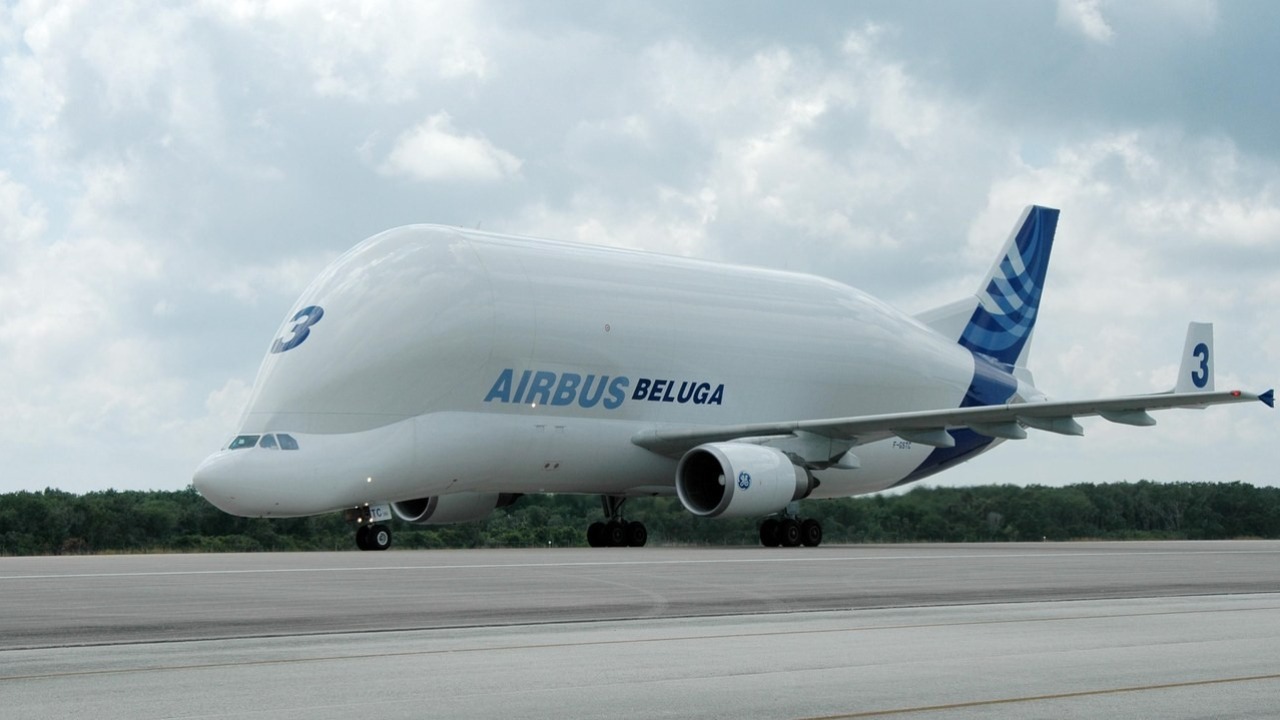
On the morning of 29 January 2026 a fat white airliner with a cockpit where its chin should be made a low pass over the Airbus wing factory at Broughton in North Wales, swung round and landed for the last time. It had flown in from Bordeaux. Over the previous quarter of a century, according to Airbus, that one aircraft had carried around 1,700 wings and made some 13,300 journeys between the company’s factories.
Its registration was F-GSTF, the fifth and last BelugaST to be built. Airbus is turning it into a classroom. Its job, flying giant pieces of unfinished aircraft around Europe, has passed to a bigger, grinning successor, the BelugaXL.
The Airbus Beluga is one of the oddest-looking aircraft in regular service anywhere, and it exists for a reason that has little to do with aviation and everything to do with European politics. Airbus does not build its aircraft in one place. So for more than fifty years it has had to fly them to themselves.
Kurzinfo
BelugaST: Airbus A300-600ST Super Transporter, based on the A300-600; five built, first flight 13 September 1994, in service from January 1996
BelugaXL: Airbus A330-743L, based on the A330-200; six built, first flight 19 July 2018, first operational flight 9 January 2020
Vorgänger: Aero Spacelines Super Guppy, flown by Airbus from the early 1970s until October 1997
Motoren: BelugaST: two General Electric CF6; BelugaXL: two Rolls-Royce Trent 700
Kapazität: BelugaST up to 47 tonnes; the BelugaXL has about 30 per cent more capacity and carries two A350 wings where the ST carried one
Netzwerk: Eleven Airbus sites around Europe, including Toulouse, Hamburg, Broughton and Bremen
Charter side-line: Airbus Beluga Transport, the BelugaST airline, gained its French AOC in November 2023 and was closed in January 2025
Retirement: BelugaST 5 (F-GSTF) made its final flight on 29 January 2026; from mid-2027 the BelugaXL is to be Airbus’s only component transporter
An aircraft built in four countries
Airbus grew out of a consortium of French, German, Spanish and British aerospace companies, and each partner wanted a meaningful share of the work. The answer was to divide the aircraft by section. The arrangement has survived every merger since: broadly, wings come from the UK, fuselage sections from Germany, tail parts from Spain, and the nose and centre section from France, with final assembly in Toulouse or Hamburg.
That is a fine way to share out jobs and a terrible way to move freight. A wing for a widebody is too long for most roads, a fuselage barrel too wide for rail tunnels, and the main assembly line in Toulouse sits far from the sea. Early on, Airbus moved parts by road. As production grew, it took to the air.
The aircraft it chose were second-hand oddities from America. From the early 1970s, Airbus flew its sections in Super Guppies, the bulbous outsize freighters that Aero Spacelines had built on the bones of Boeing Stratocruiser-family airframes to carry rocket stages for NASA.
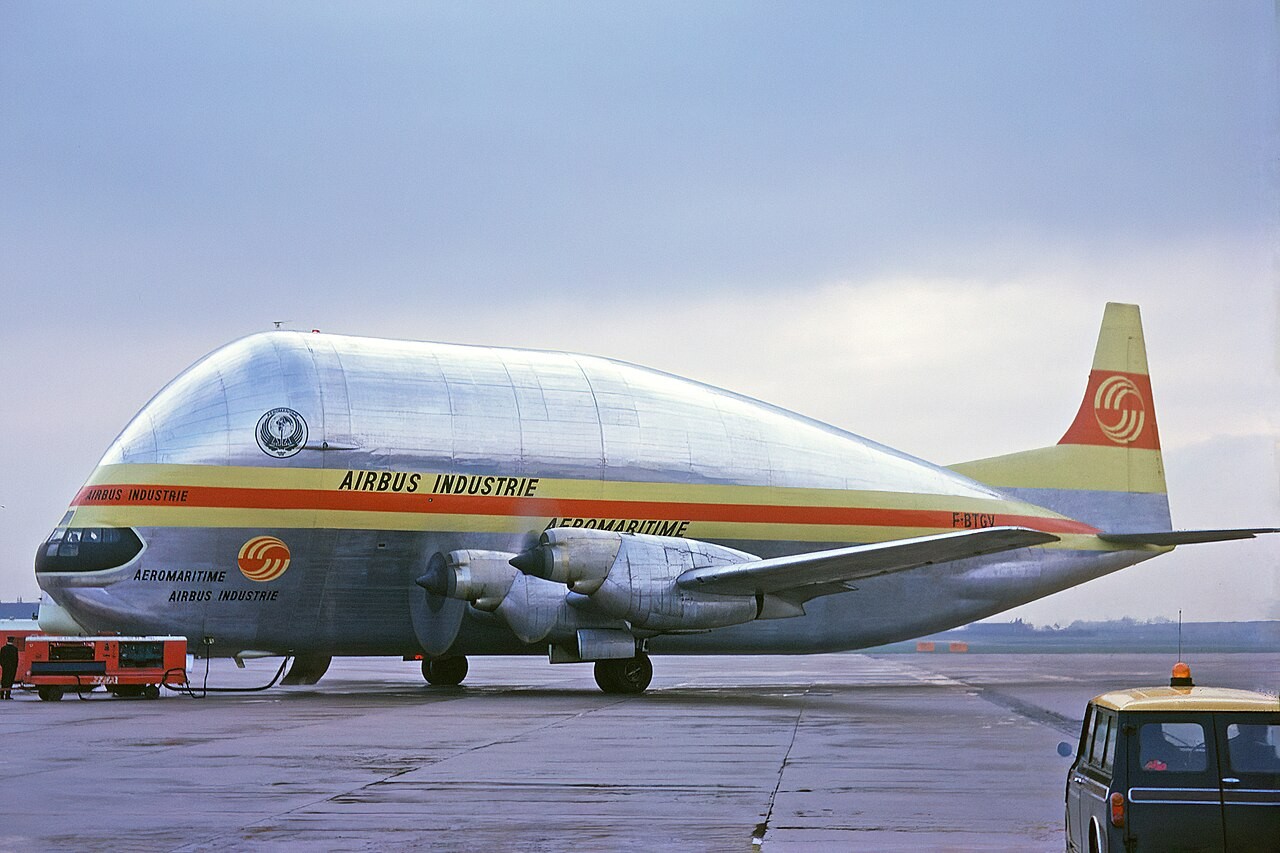
The Guppy years produced the best joke in the business: every Airbus, the saying went, was delivered on the wings of a Boeing. The Guppies were also ageing, increasingly costly to keep flying and too small for the wings Airbus was planning next. (Their remarkable American back story, Apollo hardware and all, is told in our feature on the flying whales that built Apollo.)
Building a whale from an A300
In 1991 Aérospatiale and DASA, two of the Airbus partners, set up a joint company, Super Airbus Transport International, to build a replacement. Rather than buy a giant off the shelf, they took the airliner they knew best, the A300-600, and rebuilt it.
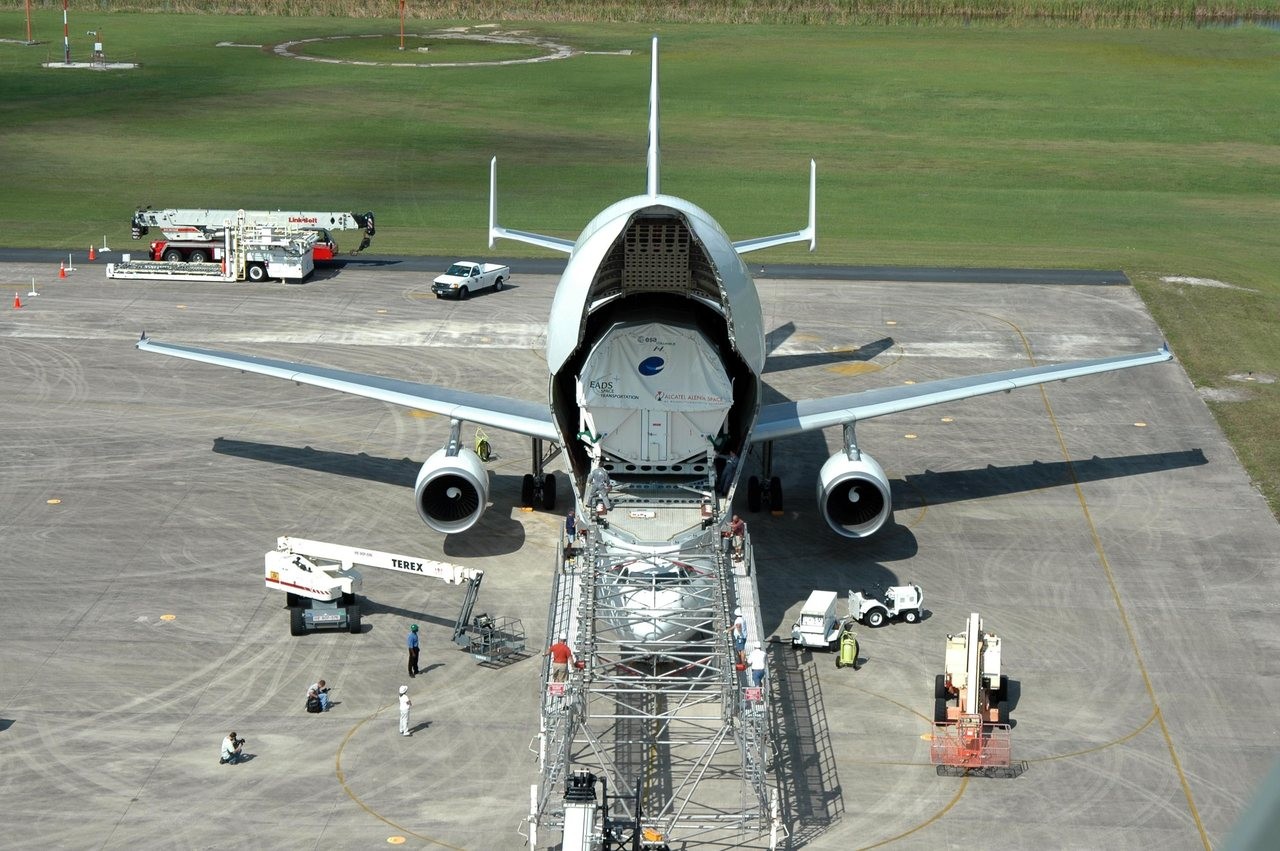
The wings, engines, landing gear and lower fuselage stayed standard A300. Everything above the floor was cut away and replaced by an enormous bulging upper fuselage, the hump that gives the type its nickname. At the front sits a hinged cargo door, the whole upper nose swinging up out of the way. To make that possible, the cockpit was moved down below the level of the cargo floor, which is why a Beluga appears to be looking at you from under a raised eyebrow.
Dropping the flight deck had a practical payoff. On the Super Guppy, the flight controls, wiring and hydraulics running through the hinged nose had to be disconnected and reconnected every time it was swung open. On the Beluga, the cockpit never moves, so loading is far quicker.
The first aircraft flew on 13 September 1994. The type entered service in January 1996, and by late 1997 the Super Guppies were gone. Five Belugas were built in all, registered F-GSTA to F-GSTF; the last, BelugaST 5, entered service in December 2000.
The Points Guy’s tour of a BelugaXL, inside and out: a rare look at the aircraft that now carries Airbus’s wings around Europe.
Built for volume, not weight
The first thing anyone notices about the Airbus Beluga is its size. The second, if they know freighters, is how little it can lift. The BelugaST’s maximum payload is about 47 tonnes, a fraction of what a military heavy-lifter such as the Antonov An-124 oder die Lockheed C-5 Galaxy will carry.
That is the point. An aircraft wing is mostly air. What it needs is length and cross-section, not tonnage, and a Beluga hold is shaped around exactly that: a tall, round tube with a flat floor and a door the full width of the hold. The type was designed around the largest components Airbus was planning to build when it was launched, notably the wings of the bigger A340 variants.
The same shape turned out to be useful for things that had nothing to do with Airbus. In 1997 a BelugaST flew a record-setting load: a chemical tank for a merchant ship. In 1999 one flew Eugène Delacroix’s painting Liberty Leading the People, upright in a protective container, from Paris to Tokyo. In 2006 another delivered Europe’s Columbus laboratory module for the International Space Station to NASA’s Kennedy Space Center.
The airline nobody needed
When its successor arrived, Airbus tried to give the old whales a second career. In January 2022 it announced it would offer the BelugaST fleet to outside customers for outsize cargo. Within weeks the market looked even more promising: Russia’s invasion of Ukraine took the Russian-operated An-124s out of the Western charter market, and the only An-225 was destroyed.
Airbus Beluga Transport got its own French air operator’s certificate in November 2023. It lasted about fourteen months. In January 2025 Airbus told FlightGlobal it had decided to terminate the business, and suspended all BelugaST flights. Industry coverage since has pointed to limited demand: the Beluga’s modest payload, its operating costs and its awkward loading made it a hard sell against freighters such as the An-124.
Late in 2025 Airbus said it was looking for permanent homes for the five aircraft in museums, exhibition spaces and education rather than sending them for scrap. F-GSTF was the first to go, flying into Broughton on 29 January 2026 to become a science, technology, engineering and maths centre for schools.
The aircraft flew its last mission with Airbus pilot Didier Puxeddu at the controls. For crews, the Beluga was never just a freighter.
BelugaXL: same trick, bigger whale
By the mid-2010s the original fleet had a problem it could not fix: production rates. The BelugaST could carry only one A350 wing per trip, and Airbus was planning to build far more A350s and single-aisle jets. In November 2014 Airbus launched a replacement, and once again it chose to convert one of its own aircraft rather than buy someone else’s.
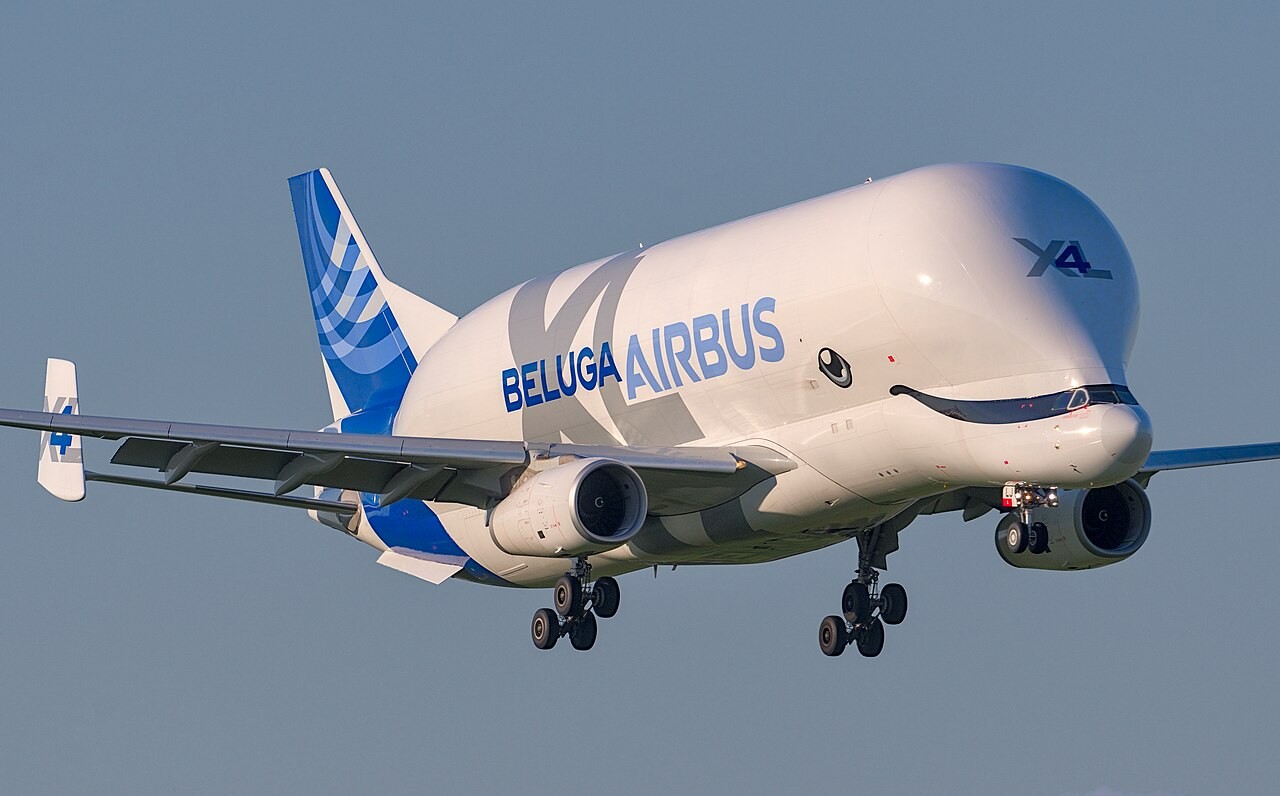
The BelugaXL, officially the A330-743L, is built on an A330 airframe, keeping its wings, engines and lower fuselage, with a new bulging upper fuselage, a lowered cockpit and an upward-opening nose door in the same pattern as before. Its two Rolls-Royce Trent 700s replace the BelugaST’s General Electric CF6s. The upper fuselage is longer and wider than the old one, and the result is around 30 per cent more capacity. The headline number for Airbus is simpler: a BelugaST could carry one A350 wing, a BelugaXL carries two.
There was a neat bit of symmetry in how the new whale came together. When the first section of the first BelugaXL arrived at Toulouse in November 2016, it came by BelugaST.
The first BelugaXL flew from Toulouse on 19 July 2018. EASA type certification followed in November 2019, and on 9 January 2020 the type flew its first operational mission. Airbus eventually built six.
They are impossible to mistake. Airbus painted them with a pair of eyes and a broad grin across the nose, which on the ground makes the XL look like a cartoon and on short final looks faintly alarming.
Why not just use a ship?
Airbus does move a great deal by sea and road. Most of the A380’s enormous fuselage sections never fitted a Beluga and travelled by ship and road instead. But for the steady daily flow of wings, fuselage barrels and tail sections between Broughton, Bremen, Hamburg, Toulouse and the other sites, speed and predictability matter more than tonnage.
A flight takes hours where a sea and road journey takes days. Factories building at rates of dozens of aircraft a month cannot keep a fortnight of parts sitting in ships at sea, and a schedule that depends on tides and road permits is a schedule waiting to slip. The Airbus Beluga turns a scattered European industrial map into something that behaves like a single, very long factory floor.
That is also why the company keeps building its own. Off-the-shelf freighters are optimised for weight; Airbus needs volume. Its own airliners already have the wings, engines, certification basis and maintenance support it needs. All it has to add is the whale.
The last of the STs
Airbus says that from mid-2027 the BelugaXL will be the only aircraft moving its components between its eleven European sites. The remaining BelugaSTs are on their way to new homes, and F-GSTF is already parked for good at Broughton, where its first visitors will be schoolchildren rather than wing spars.
Thirty years ago Airbus solved a political problem with an aeroplane, and the solution worked so well that it has never stopped flying. Somewhere over the Bay of Biscay right now, there is probably a whale with a smile on its face carrying the wings of an aircraft that does not exist yet.
Sources: Airbus press release, An iconic Airbus BelugaST readies for new mission in the UK, 29 January 2026; Wikipedia, Airbus Beluga and Airbus BelugaXL; Flightradar24 blog, The Airbus Beluga ST: A Whale of a Story, 29 January 2026; FlightGlobal, Airbus begins BelugaXL operations, 13 January 2020, and Airbus to close A300-600ST Beluga airline just 14 months after gaining AOC, 24 January 2025; Aerospace Global News, 27 January 2026; Airways Magazine, 2 February 2026; Aviation A2Z, 29 January 2026; NASA Kennedy Space Center image archive (KSC-06pd0950, KSC-06pd0954); Airbus on X.
0 Comments