
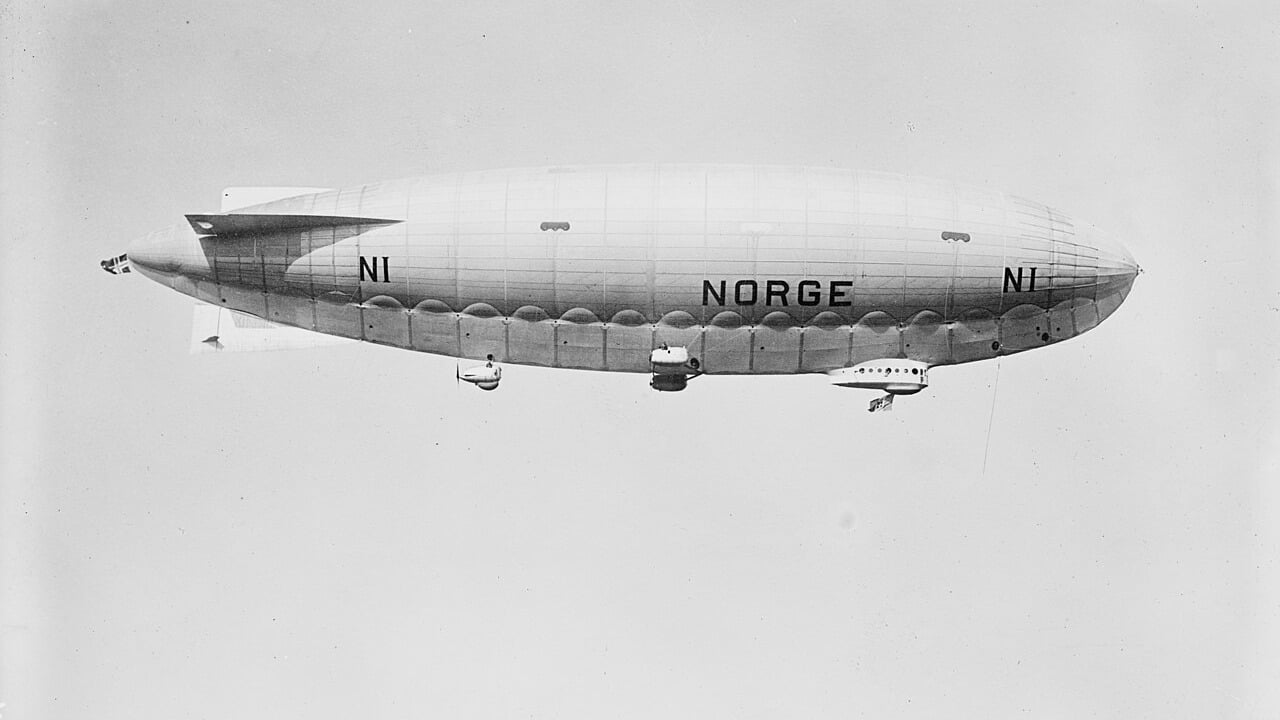
At 1.25 in the morning, Greenwich time, on 12 May 1926, sixteen men in a cramped, unheated cabin slung under a hydrogen airship looked down at a featureless sheet of ice. They were over the North Pole. Out of the gondola went three flags, Norwegian, American and Italian, fluttering down to the ice. Then the airship Norge kept going, towards a coast nobody aboard could see.
Two days and a storm later, Norge came down on the sea ice beside the small Alaskan settlement of Teller. It was the first verified trip of any kind to the North Pole, and the first crossing of the Arctic Ocean from Europe to America by air. It was also the start of a feud that would end, two years later, in tragedy.
Kurzinfo
- Airship: Norge (ex-N1), Italian semi-rigid designed by Umberto Nobile
- Expedition: Amundsen-Ellsworth-Nobile Transpolar Flight, 1926
- Eigentümer: Norwegian Aviation Society
- Länge: 106 m, hydrogen-filled, three engines
- Abgereist: Ny-Ålesund, Svalbard, 09:55 on 11 May 1926
- North Pole: 01:25 GMT, 12 May 1926; Norwegian, US and Italian flags dropped
- Gelandet: Teller, Alaska, 14 May 1926, after about 72 hours aloft
- Crew: 16 men, plus Nobile’s dog Titina
Three men, one airship
The expedition had three fathers. Roald Amundsen, the Norwegian who had led the first party to the South Pole in 1911, was expedition leader. Lincoln Ellsworth, a wealthy American adventurer, put in 100,000 dollars, according to the Fram Museum in Oslo. Umberto Nobile, the Italian engineer who had designed the airship, would fly it.
Amundsen had already tried the Arctic by aeroplane. In 1925, he and Ellsworth took two Dornier Wal flying boats, N24 and N25, north from Svalbard. One was wrecked on the ice, and the six men only just made it home in the other. The lesson stuck. An airship, they reasoned, could carry more, stay up longer and have an engine repaired in flight, while an aeroplane forced down in thick fog on the ice faced what they called “certain death”.
Hjalmar Riiser-Larsen, who had trained on airships in England, recommended Nobile’s semi-rigid N1. The Norwegian Aviation Society became its owner, and at a ceremony in the hangar at Ciampino, outside Rome, on 29 March 1926, the N1 was renamed Norge, Norwegian for “Norway”. Benito Mussolini attended, an early sign of the politics that would cloud the flight.
Rome to the edge of the Arctic
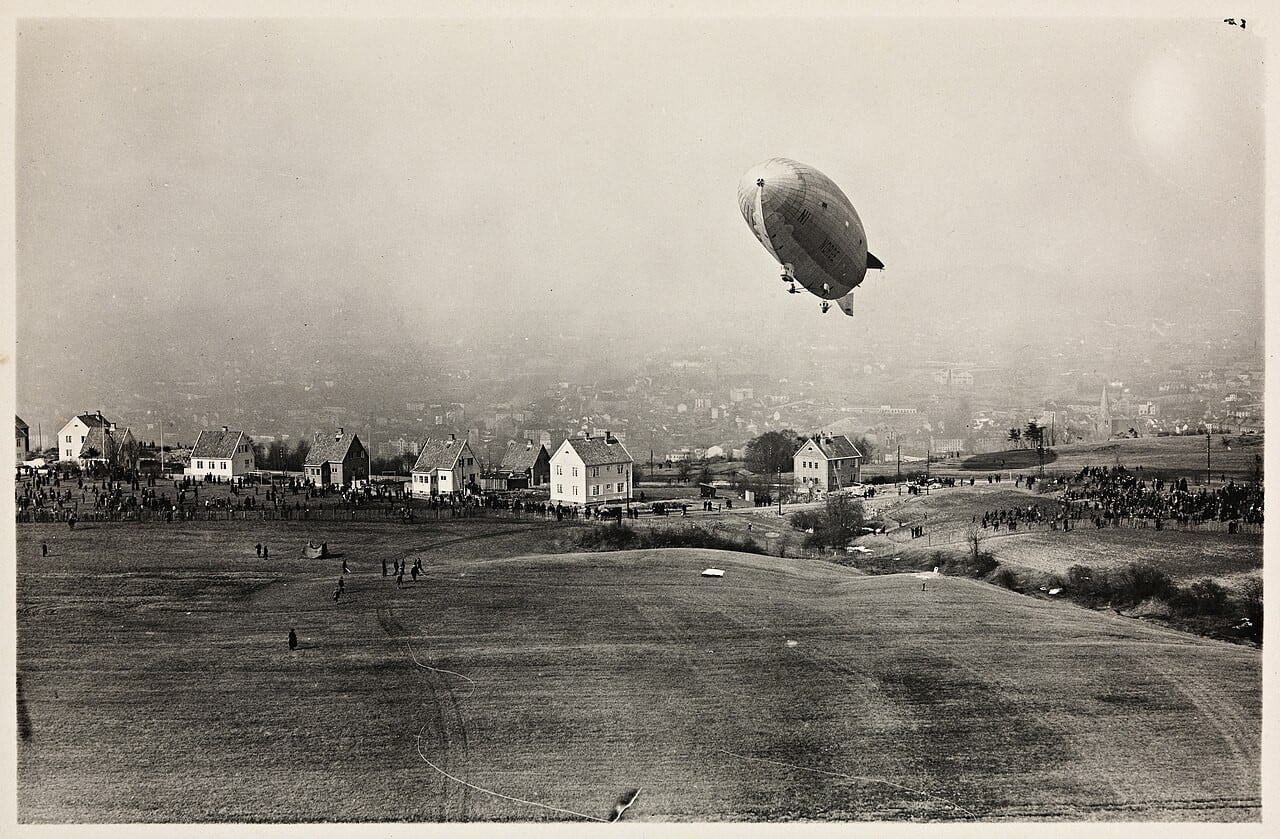
Norge was 106 metres long, with a hydrogen-filled envelope and a walkway keel under it so the crew could reach the three engines. Getting her to the Arctic was a journey in itself. With no way to fly non-stop, she hopped between mooring masts: Pulham in England, Ekeberg in Oslo, Gatchina near Leningrad, and Vadsø in northern Norway, where the mast still stands.
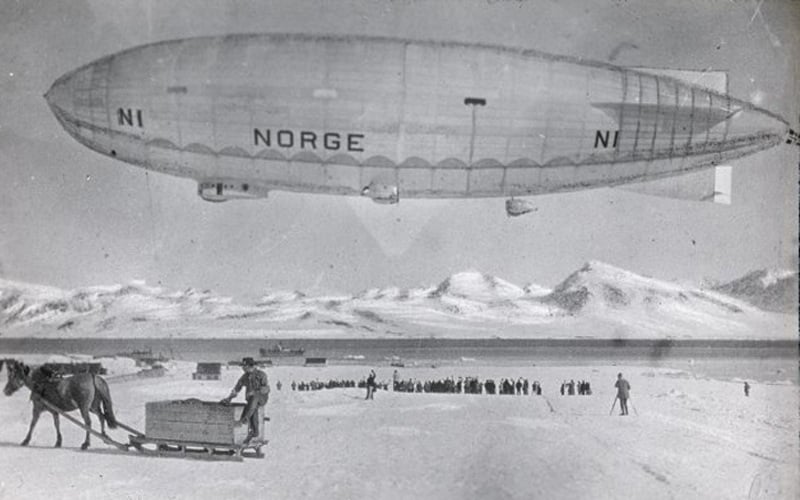
She reached Ny-Ålesund at King’s Bay, Svalbard, on 7 May 1926. A hangar and a 35-metre mooring mast had been built there through the dark Arctic winter, and some 4,800 cylinders of hydrogen shipped in. Waiting on the shore was an American rival: Richard E. Byrd, whose expedition had arrived with a Fokker trimotor called Josephine Ford.
British Pathé newsreel footage of the polar airship Norge in 1926.
Byrd and his pilot Floyd Bennett took off on 9 May and returned about 16 hours later, claiming to have reached the Pole. That claim, like Frederick Cook’s in 1908 and Robert Peary’s in 1909, has since been seriously disputed. Amundsen insisted it was never a race. His goal was bigger: to cross the whole unexplored Arctic Ocean and look for land in the blank space between the Pole and Alaska.
Over the top of the world
Norge cast off from Ny-Ålesund at 09:55 on 11 May 1926. Aboard were 16 men, among them Amundsen, Ellsworth, Nobile, Riiser-Larsen, the Swedish meteorologist Finn Malmgren, the journalist Fredrik Ramm, a team of Italian mechanics and Oscar Wisting, Amundsen’s companion at the South Pole. Nobile’s little dog Titina came too.
At 01:25 GMT on 12 May they reached the Pole. Amundsen and Wisting became the first men to reach both poles. The Norwegian, American and Italian flags went over the side, and the airship turned for Alaska. Ahead lay unknown territory, and Amundsen took a seat at the front of the cabin to watch for any land in the blank space on the map.
Then came the hard part. Past the Pole, Norge ran into thick fog. Ice built up on the airship, and lumps of it flung off the propellers ripped into the envelope’s outer fabric. The crew made running repairs from the keel. At 06:45 GMT on 13 May they saw land and passed over Wainwright, Alaska, where Amundsen and Oskar Omdal even recognised the little house they had built during an earlier stay.
Landing at Teller
The flight was not over. A gale pushed Norge west across the Bering Strait, probably close to the Siberian coast, before she battled back towards Alaska. Unsure of their exact position and buffeted by storm winds, the crew decided to land as soon as they could. They chose an ice-covered bay beside Teller, north-west of Nome, and set down on 14 May after about 72 hours in the air.
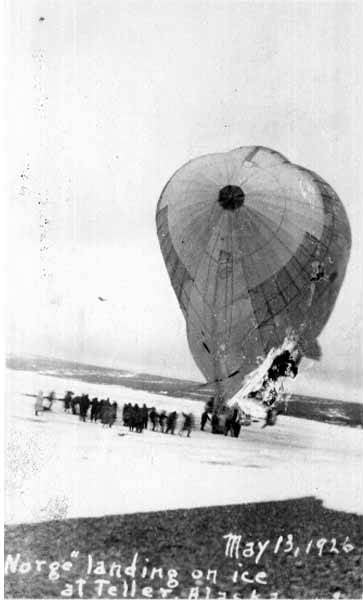
To the Inupiat villagers of Teller, it was an astonishing sight. HistoryNet’s account of the landing quotes Betty Pinson, then 14, who remembered the crew handing out cookies, candy and Italian oranges.
The airship never flew again. Norge was dismantled and crated, and the plan to ship her back to Italy came to nothing. The building in Teller where her parts were stored still stands and is listed on the US National Register of Historic Places. The Henry Ford museum puts the flight at nearly 3,200 miles and more than 70 hours aloft, the first flight across the Arctic.
Film of Norge’s flight over the Polar Sea, from the National Library of Norway (Nasjonalbiblioteket).
Glory, quarrels and the Italia
Success did not bring harmony. Amundsen had not expected Nobile and the airship to draw so much of the attention, and the two men fell out bitterly. Nobile was promoted to general and celebrated in Mussolini’s Italy. In 1928 he flew north again in a sister ship, the Italia, which crashed on the ice on the way back from the Pole.
Amundsen put the grudge aside and flew out to help in a Latham 47 flying boat. He disappeared on 18 June 1928 with his crew, and no trace beyond a wing float and a fuel tank was ever found. Shortly before his last flight, Amundsen had spoken of the Arctic sky.
Hjalmar Riiser-Larsen, one of Norge’s pilots, saw further than the quarrels. In his account of the flight, quoted by the Fram Museum, he looked ahead to a time when aircraft would cross the Arctic as a matter of routine.
He was right. Polar routes between Europe, Asia and North America became a normal part of airline flying, over the same frozen ocean that Norge crossed into the unknown in May 1926.
The Explorers Club on the N1 Norge and the story of Arctic airship exploration.
Byrd’s flight still has its defenders, and Cook’s and Peary’s claims have theirs. But Norge needs no defending. Sixteen men and a small dog floated over the North Pole and on across the top of the world, and everyone could check where they had been.
Sources: Fram Museum (The Norge Flight 1926), The Henry Ford (Roald Amundsen Over the North Pole), HistoryNet, Norsk Teknisk Museum, National Library of Norway
Header photo: Bain News Service / Wikimedia Commons, public domain


0 Comments