
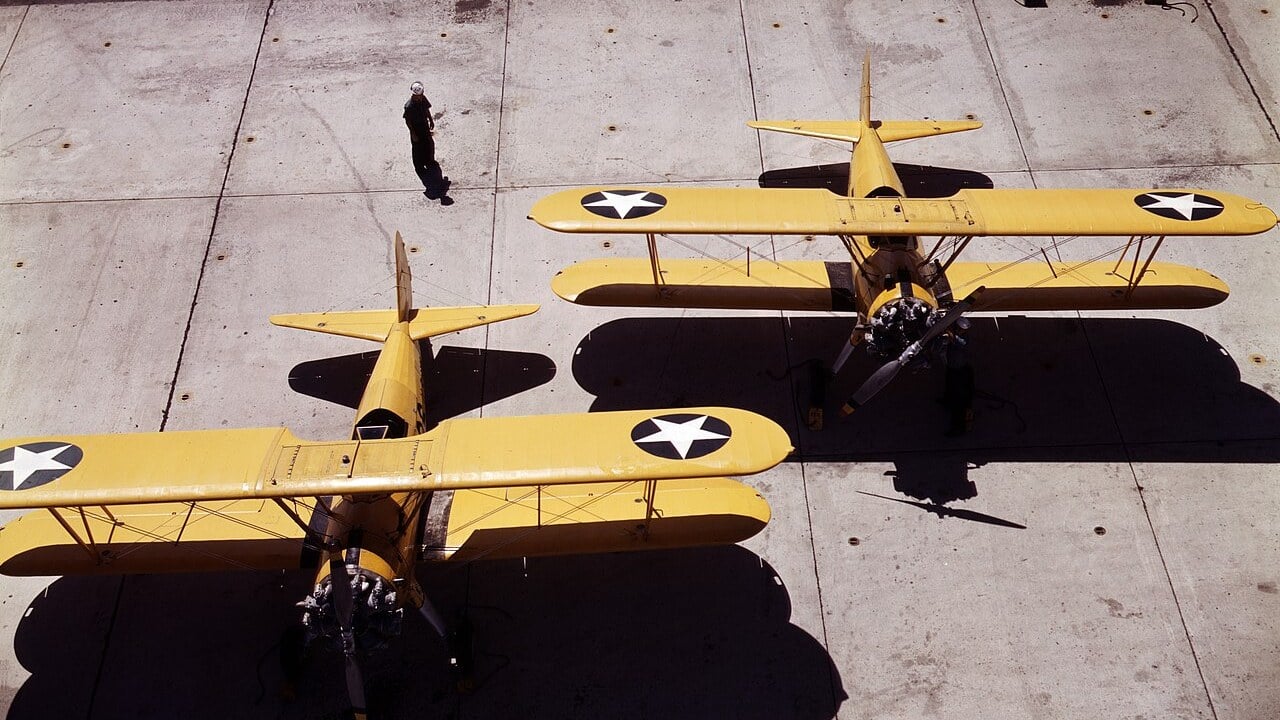
Before they flew Mustangs over Berlin or Hellcats over the Pacific, many thousands of American cadets met their first military aircraft: a big, noisy, forgiving biplane with two open cockpits, a radial engine and a habit of punishing sloppy feet on landing. The Army called it the PT-13 or PT-17, the Navy the N2S, the Canadians the Kaydet. Almost everyone else just called it the Stearman.
More than 10,000 were built. The Smithsonian sums up its role in one line: along with the Fairchild and Ryan trainers, the Kaydet was the backbone of US Army and Navy primary flight training in the Second World War.
Kurzinfo
- Typ: Two-seat primary trainer biplane, tandem open cockpits
- Names: Army PT-13, PT-17, PT-18; Navy NS and N2S; RCAF Kaydet (PT-27)
- Gebaut: More than 10,000
- Army adoption: 1936, as the PT-13
- 10,000th trainer: Delivered 27 July 1944
- PT-13D engine: Lycoming R-680, 220 hp
- PT-13D performance: 125 mph top speed, 450-mile range, 14,000 ft ceiling
- Nach dem Krieg: Crop dusting, aerobatics, wing walking, warbird flying
A civil design that went to war
The aircraft grew out of a design by Lloyd Stearman’s company, drawn up in 1933 with the civil market in mind. The Model 70 prototype flew in early 1934 and was evaluated by both services. The Navy bought a version as the NS-1, and in 1936 the US Army Air Corps adopted the improved Model 75 as the PT-13. Boeing, which took over the Stearman company in the 1930s, kept building it in Wichita.
It was a conventional machine by design. Student and instructor sat in tandem open cockpits, the fixed undercarriage was big and sturdy, and the radial engine usually sat uncowled in the nose. Nothing about it was clever, and that was the point: a primary trainer had to survive thousands of hard landings by nervous 20-year-olds.
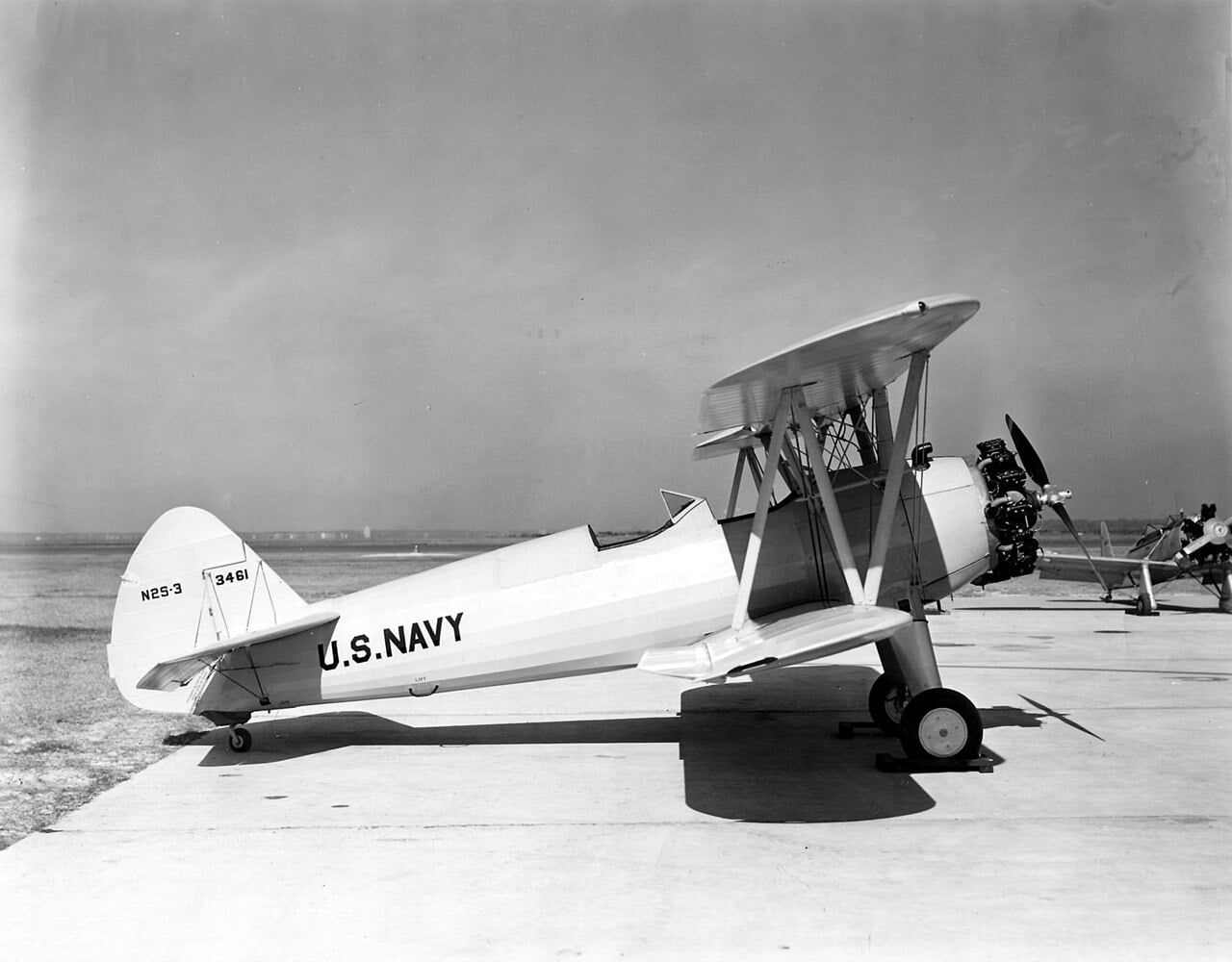
The Army’s designations changed with the engine fitted. PT-13s used Lycoming radials, PT-17s Continentals and PT-18s Jacobs engines. The museum’s PT-13D, for example, used a 220-horsepower Lycoming R-680, giving a top speed of 125 mph, a range of 450 miles and a service ceiling of 14,000 feet. Aircraft supplied to the Royal Canadian Air Force under Lend-Lease, designated PT-27, gained an enclosed canopy for the Canadian winter.
Yellow Perils by the thousand
As war approached, orders exploded. The company delivered its 1,000th trainer to the Army in March 1941, and on 27 July 1944 it delivered its 10,000th primary trainer. The Navy’s N2S versions were painted overall yellow, and cadets nicknamed them the “Yellow Peril”.
Primary training was only the first rung. After their hours in the Stearman, Army cadets moved on to basic and then advanced trainers such as the North American T-6 Texan, and Navy cadets followed a similar ladder before reaching operational types. A cadet who could not handle the Stearman rarely got the chance to try anything faster.
A wartime US Navy training film on taxiing and takeoffs in the Stearman, as shown to naval aviation cadets.
The Stearman also achieved something rare. The E75 model served the Army as the PT-13D and the Navy as the N2S-5, the only complete standardisation of a single Army and Navy production design during the war, according to the Smithsonian. Its own N2S-5 was accepted by the Navy on 7 December 1943, exactly two years after Pearl Harbor, and trained naval aviation cadets at Ottumwa, Iowa, until 1946.
For the student, the Stearman was a friendly but honest teacher. It was rugged and forgiving in the air. But its tailwheel layout meant it had to be steered precisely on the ground and on landing, and inattention could end in a ground loop. That is still why pilots who want to learn tailwheel skills seek out Stearmans today, as we explained in our guide to the tailwheel endorsement.
Where the Tuskegee Airmen learned to fly
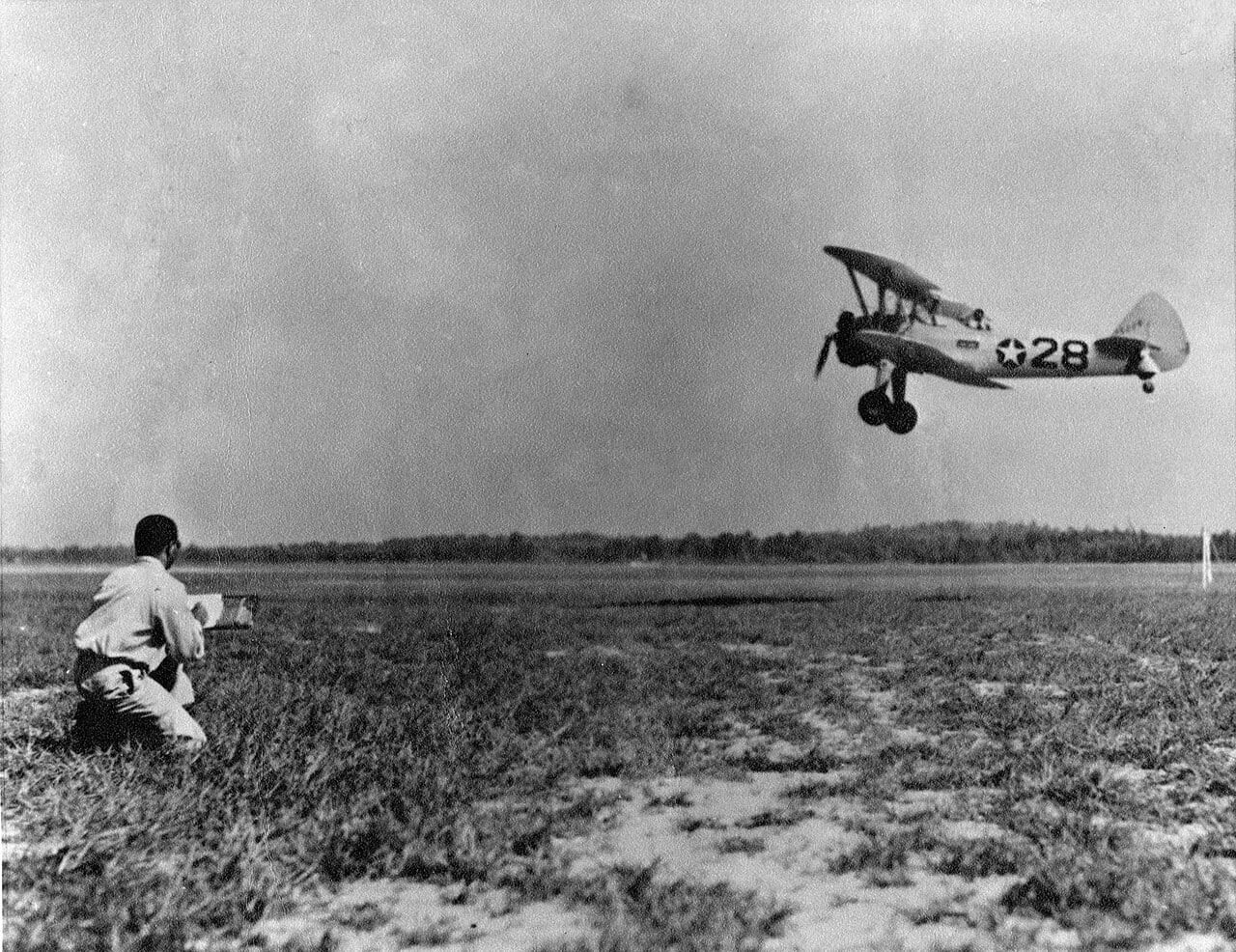
Among the cadets who started in a Stearman were the Tuskegee Airmen, the first Black military pilots in the US armed forces, who took primary training at Tuskegee in Alabama before moving on to advanced trainers and, eventually, the red-tailed P-51 Mustangs that made them famous.
In 2023 the National Museum of the United States Air Force acquired a PT-17 that, according to the museum, is one of only two surviving PT-17s that trained Tuskegee Airmen during the war. It came through an aircraft exchange with the Collings Foundation’s American Heritage Museum.
The Smithsonian’s National Museum of African American History and Culture on “Spirit of Tuskegee”, a Stearman flown at Tuskegee.
Crop duster, airshow star, warbird
After the war, the Army Air Forces replaced the Stearman with newer trainers, and thousands of surplus aircraft were sold to civilians. Many became crop dusters, with a hopper for pesticide or fertiliser in place of the front cockpit and spray bars under the lower wings. A popular modification swapped the engine for a bigger Pratt & Whitney R-985 Wasp Junior.
Others found their way to air shows, where the Stearman’s strength made it a favourite for aerobatics and wing walking. Abroad, Stearmans served air forces from Argentina and Brazil to Israel and the Republic of China, which flew them in Taiwan until 1958.
Airman Magazine’s AIRFRAME episode on the Stearman PT-17.
Today a considerable number still fly, many restored in wartime Army or Navy colours. The National Museum of the US Air Force displays a PT-13D donated by Boeing in 1959, the Smithsonian has its N2S-5 at the Udvar-Hazy Center, and the Tuskegee PT-17 joined the museum’s World War II Gallery. Its closest British and Commonwealth equivalent was the de Havilland Tiger Moth.
The Stearman was never fast, never armed and never famous in the way the fighters were. But almost every American who flew those fighters started here, in an open cockpit, wind in the face, learning to keep a big yellow biplane straight on the runway.
Sources: National Museum of the United States Air Force (Stearman PT-13D fact sheet), Smithsonian National Air and Space Museum, AVweb, US Navy, Wikipedia (Boeing-Stearman Model 75)
Header photo: Howard R. Hollem / Wikimedia Commons, public domain
0 Comments