
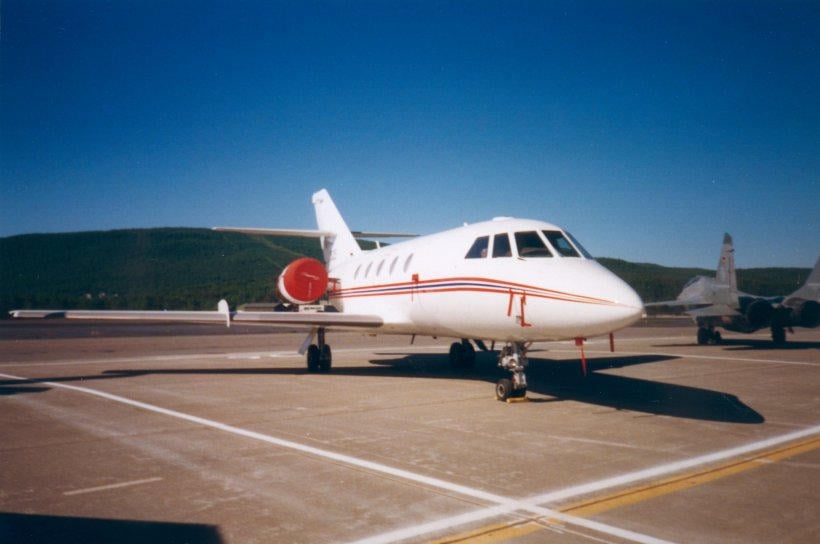
Business jets are built to be quiet, smooth and economical. So a photograph of a Dassault Falcon 20 with a long cone of flame blasting out of one engine looks like a joke or a Photoshop. It is neither. In the late 1980s one Falcon 20, registered N200GT, flew with an afterburning turbofan fitted in its left engine position, the only business jet known to have flown with an afterburner.
The photograph has been doing the rounds on Instagram, where @theaviationcircle tells the story. Because no freely licensed copy of the image exists, we have embedded the original post below.
Falcon 20 N200GT with its afterburning Garrett TFE1042 lit. Image via @theaviationcircle on Instagram.
Kurzinfo
- Flugzeug: Dassault Falcon 20C N200GT, built 1968, construction number 137
- Eigentümer: Garrett Corporation from 1977, later AlliedSignal and Honeywell
- Test engine: Garrett TFE1042 afterburning turbofan, in the left engine position only
- Modification: A titanium heat shield on the tail against the afterburner exhaust
- Wann: Late 1980s; accounts give 1987 for the first flight and 1988 for the main tests
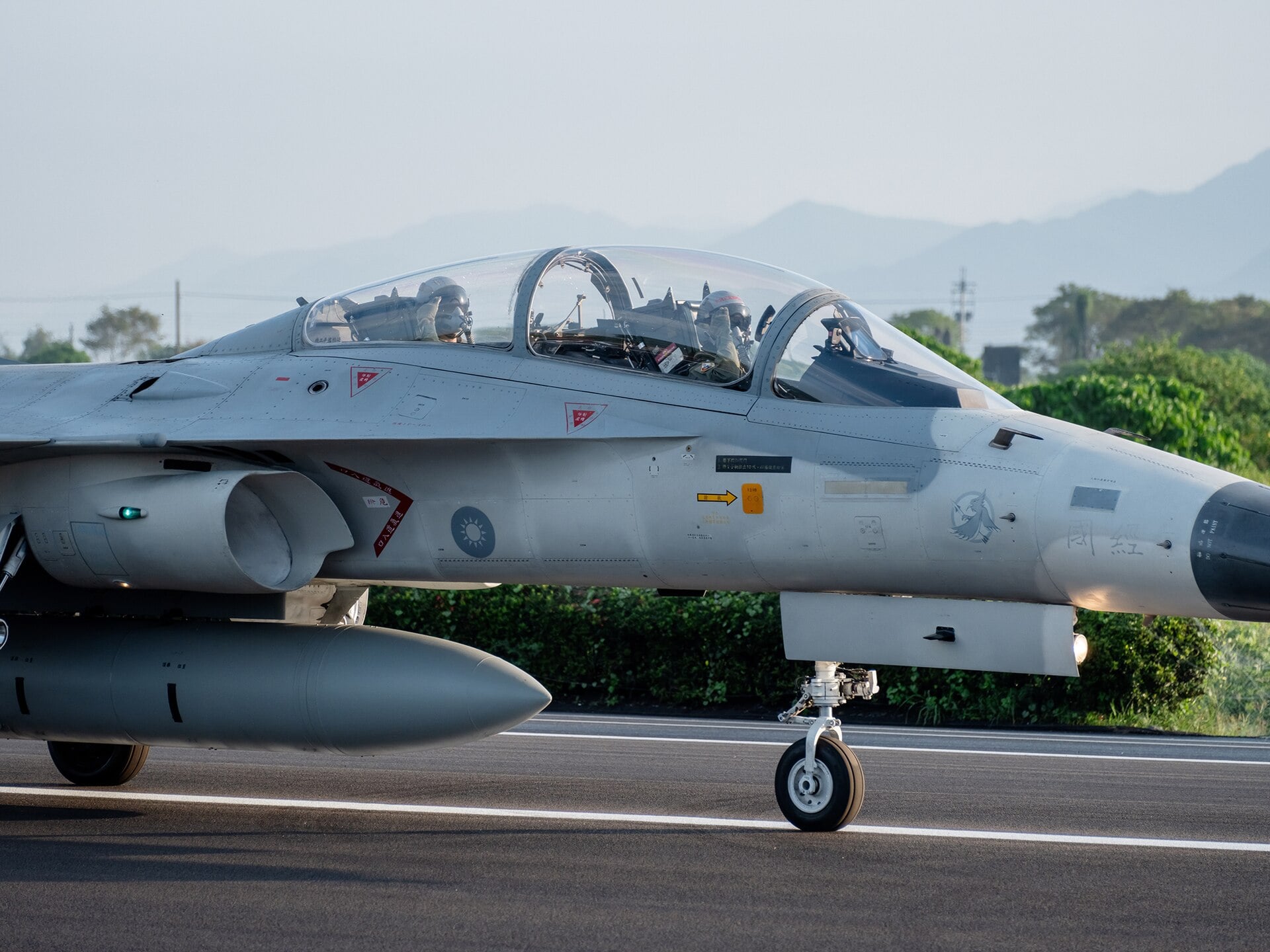
- What the engine became: The F125, powering Taiwan’s F-CK-1 Ching-kuo fighter; the dry F124 powers the L-159 and M-346
A Flying Engine Testbed
N200GT was not a Coast Guard aircraft. According to its registration history, the Falcon 20C left Dassault in 1968, passed through several US owners, and was bought by the Garrett Corporation in May 1977. Garrett, the Phoenix-based engine maker, re-registered it N200GT in January 1983 and used it as a flying testbed. It had already carried a TFE731-5, one of Garrett’s business-jet engines, in test.
A testbed like this lets an engine maker fly a new engine in a real nacelle on a real aircraft while keeping a proven engine on the other side. That is what happened with the TFE1042: only the left engine was replaced, the right one stayed standard, and the tail was given a titanium heat shield to cope with the afterburner plume passing close by.
The TFE1042
The TFE1042 began in 1978 as joint research between Garrett and Volvo Flygmotor of Sweden, aimed at a small, light afterburning turbofan for a new fighter. It first ran for three hours at a Volvo test facility in 1979. Volvo and a later Italian partner, Piaggio, dropped out, and in 1982 Garrett and Taiwan’s Aerospace Industrial Development Corporation (AIDC) set up the International Turbine Engine Corporation, ITEC, to finish the job.
Its customer was Taiwan’s Indigenous Defense Fighter, the F-CK-1 Ching-kuo, which first flew on 28 May 1989 with two of the engines. Thrust figures quoted for the TFE1042 vary with the version: an early standard gave around 4,260 lbf dry and 6,790 lbf with afterburner, while the production F125-GA-100 is rated at 6,100 lbf dry and about 9,500 lbf in reheat. The figures in the Instagram post, about 5,000 and 8,350 lbf, fall between the two and may reflect the development standard flown on the Falcon.
“Developed since 1982, mass-produced in 1990.”
AIDC, Taiwan’s Aerospace Industrial Development Corporation, on the TFE1042 programme
AIDC and ITEC built 325 of the engines by the end of 1998. The non-afterburning version, the F124, went on to power the Czech Aero L-159 ALCA, the Leonardo M-346 trainer and Boeing’s X-45A unmanned combat demonstrator.
Where the Coast Guard Comes In
The Instagram post, and several other accounts including Wikipedia, describe the afterburner flights as a US Coast Guard test programme in 1988. We could not find a primary source for that. The aircraft’s registration history shows it in Garrett’s hands throughout, passing to AlliedSignal after the 1988 merger and later to Honeywell, and the TFE1042 was a fighter engine with no obvious Coast Guard application.
There is a plausible reason the two became linked. The Coast Guard was a major Falcon 20 operator: between 1982 and 1983 it took delivery of 41 HU-25 Guardians, Falcon 20s modified for search and rescue and maritime surveillance. And those Guardians were powered by Garrett engines, the unusual three-spool ATF3. The service retired its last HU-25 in September 2014 after 32 years, ending its jet operations.

Why Put an Afterburner on a Business Jet?
Nobody intended to build an afterburning bizjet. The point was the engine, not the aircraft. A Falcon 20 was a sensible host: a robust twin that could carry test instrumentation and engineers, fly at representative altitudes and speeds, and keep flying safely on its other engine if the prototype had to be shut down. Military engines are often tested on converted airliners and bombers; Garrett used the aircraft it had. Lighting the afterburner simply proved the complete engine, reheat and all, in flight before it went into a fighter.
For how an afterburner works, and why its flame can look blue or orange, see our explainers on the controlled explosion behind every fighter Und afterburner flame colour.
“It remains the only known business jet documented to have flown with an afterburner.”
@theaviationcircle, Instagram, September 2026
Häufig gestellte Fragen
Has a business jet ever flown with an afterburner?
Why did a Falcon 20 have an afterburner?
Did the US Coast Guard fly the afterburning Falcon 20?
What was the Garrett TFE1042?
Which aircraft use the TFE1042 family of engines?
What happened to Falcon 20 N200GT?
Sources: Aircraft registration history for N200GT (Falcon 20C c/n 137); AIDC, “TFE1042 Turbofan Engine (1982 to 1998)”; Wikipedia (Honeywell/ITEC F124, AIDC F-CK-1 Ching-kuo, Dassault Falcon 20, Garrett ATF3); @theaviationcircle on Instagram; SDASM Archives and Wikimedia Commons.


0 Comments