
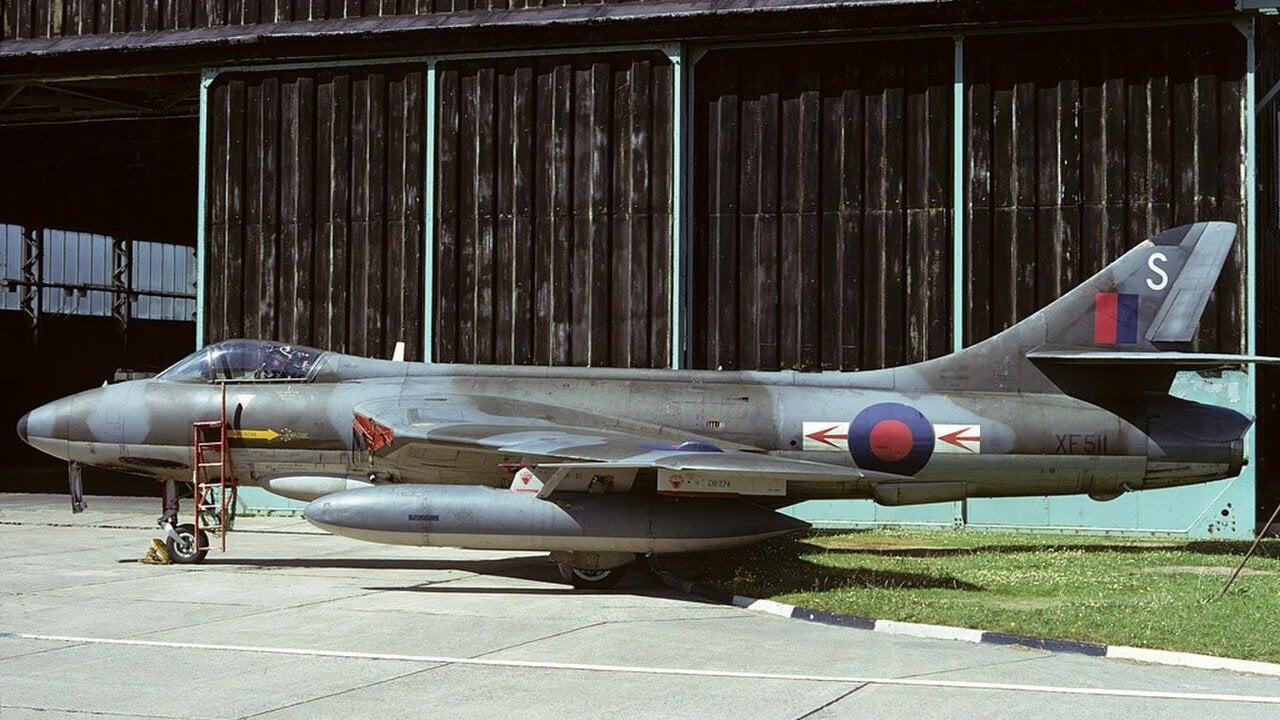
Just after noon on Friday 5 April 1968, staff at Flight magazine's London offices glimpsed something that should not have been there: an RAF jet fighter, wing tanks and all, in a descending turn low over the Thames. Seconds later it went through Tower Bridge, between the road deck and the high walkways, heading downstream at a speed no aircraft had ever attempted there.
The pilot was Flight Lieutenant Alan Pollock of No. 1 Squadron, a 32-year-old flight commander and father of four. He was not drunk, lost or showing off for friends. He was furious that the government had let the Royal Air Force's 50th birthday pass without a single fly-past, and he had decided to give the RAF one himself, in a Hawker Hunter.
Kurzinfo
- Datum: 5 April 1968
- Pilot: Flt Lt Alan Richard Pollock, No. 1 (Fighter) Squadron RAF
- Flugzeug: Hawker Hunter FGA.9, XF442, single-seat
- Route: RAF Tangmere to RAF West Raynham, via London
- Over London: Three circuits of Parliament, wing dip over the RAF Memorial
- Tower Bridge gap: About 200 ft wide and 110 ft deep, per Flight
- Nachher: Inverted passes over Wattisham, Lakenheath and Marham
- Ergebnis: Arrested, then invalided out of the RAF; no court martial
- Gestorben: 1 July 2025, aged 89
A Birthday Nobody Celebrated
The Royal Air Force turned 50 on 1 April 1968, and in the eyes of many of its pilots the government behaved as though it would rather not notice. A decade earlier, the 1957 Defence White Paper of Defence Minister Duncan Sandys had shifted emphasis from manned aircraft to guided missiles. The British aircraft industry was in decline, Harold Wilson's government was cutting defence spending, and morale in the service was low.
According to Flight International at the time, the RAF had been denied a ceremonial fly-past for the anniversary. The Red Arrows had expected to fly over the capital, and a fly-past planned around a Lancaster House dinner with the Queen was cancelled at the last moment as inappropriate. Pilots of the Royal Air Force took it personally.
Alan Pollock was a flight commander in No. 1 (Fighter) Squadron at RAF West Raynham in Norfolk, flying the Hunter FGA.9 in the close-support role. On 1 April he and other squadron pilots marked the anniversary with leaflet raids on other RAF stations. On 4 April they flew a display at RAF Tangmere in West Sussex, which was soon to close.
Off the Formation, Into London
The next day the Hunters headed home to West Raynham, a route that crossed London. Flight later reported that Pollock had led four Hunters on the Tangmere display, and the weather was perfect. He later described the day over the capital as one of those rare gin-clear days when all the colours shout out brightly.
Immediately after take-off, Pollock left his flight. He made a fast, low pass over Dunsfold, Hawker's home airfield. Then he took XF442, a single-seat Hunter FGA.9 converted from an F.6 interceptor and powered by a Rolls-Royce Avon 207, into the heart of London.
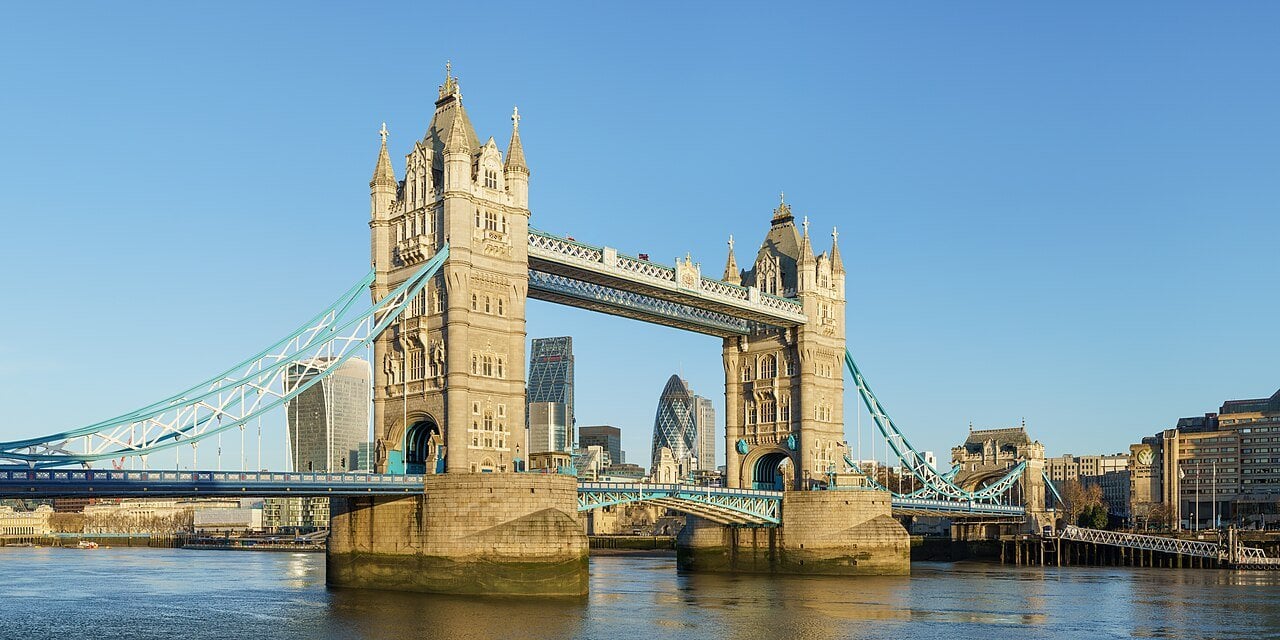
He circled the Houses of Parliament three times, a deliberate protest at the government whose cuts had hit the RAF. He continued to the Royal Air Force Memorial on the Victoria Embankment and dipped his wings over it in salute. Then he followed the river east.
The Right Jet for the Job
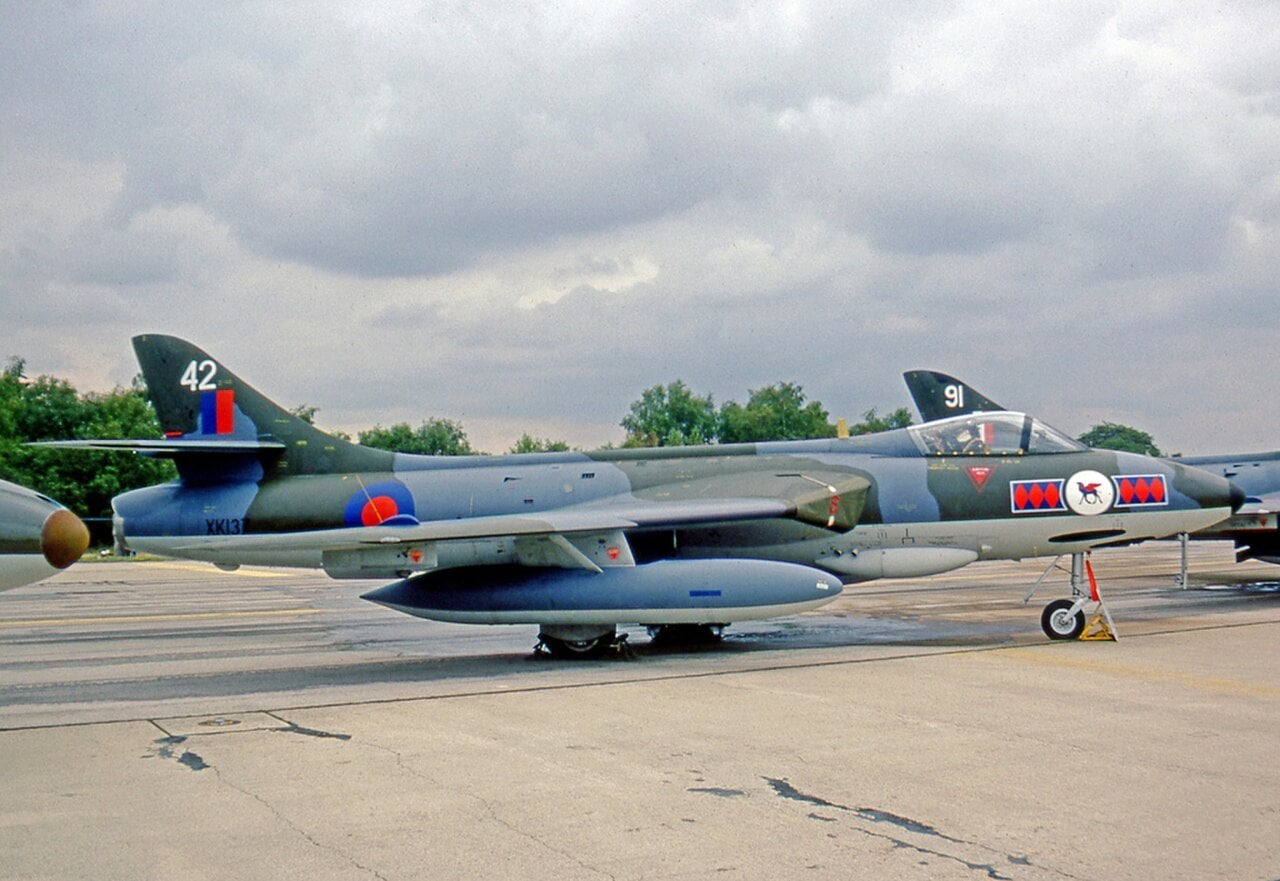
If any aircraft in the RAF was suited to the Hawker Hunter Tower Bridge flight, it was the FGA.9. The Hunter had entered RAF service in 1954 as a single-seat, swept-wing day fighter, and the FGA.9 ground-attack version was developed from the F.6 interceptor for exactly the kind of fast, low-level flying Pollock and his squadron practised every week.
According to This Day in Aviation, its Rolls-Royce Avon 207 turbojet was rated at 10,050 pounds of thrust, enough for a maximum speed of about 702 mph at 15,000 feet, or Mach 0.97. It carried four 30 mm ADEN revolver cannon in a removable gun pack and could add bombs or rockets under the wings for close support. Low-level strike flying was its daily business, which is why Pollock would later say the decision had been made simple by years of it.
Ten Seconds and a Gap in Stone
Flight's reconstruction of the run is precise, and it describes a pilot who was, in the magazine's words, no youthful prankster: a senior flight commander, an Old Cranwellian and a father of four. Pollock followed the bends of the Thames from Waterloo, passing over the two Blackfriars bridges, Southwark Bridge, the Cannon Street railway bridge and London Bridge. After clearing London Bridge he probably had little more than five seconds to line up with the opening, keeping the option to pull up until the last instant in case a tall vehicle, a hanging cradle or a rising bascule blocked the way.
The gap between the road deck and the high-level walkways was, by Flight's figures, about 200 feet wide and 110 feet deep. At jet speed, with underwing tanks hanging below the wings, there was almost no time to correct a mistake.
ITV News: Alan Pollock looks back on the day he flew a Hunter through Tower Bridge.
Staff at Flight's offices glimpsed the jet in a descending, mushing turn just after noon, before it disappeared behind a building. Pollock went through heading downstream, climbed out over the crane-lined Upper Pool and turned to port over the City. Previous flights through Tower Bridge had all been made upstream, the magazine noted, and none in a jet.
Flight also weighed the question everyone was asking: had he planned it? The magazine thought not, pointing out that no photographers had been waiting in position, as they always seemed to be on earlier Tower Bridge stunts. Climbing out to the east, it suggested, may also have kept him clear of the airliners stacked on the approach to Heathrow.
The first, in August 1912, had been Frank McLean in a Short seaplane. Fifty-six years later Pollock became the first to do it in a jet aircraft, and arguably the fastest.
Upside Down Over Three Airfields
Pollock knew exactly what this meant for his career. Expecting to lose his flying status, he decided he might as well finish in style. On the way back to Norfolk, according to Wikipedia, he made low passes upside down at about 200 feet over the airfields at Wattisham, Lakenheath Und Marham.
Shortly after he landed at West Raynham, Flying Officer Roger Gilpin formally arrested him. Flight reported that he was held in close arrest until 7 April, when the Ministry of Defence named him, and released into open arrest. A board of inquiry met at West Raynham on 8 April. An all-party motion of support signed by six MPs was tabled in the House of Commons but ruled unacceptable.
Inside the service, opinions were split. Flight found former and serving RAF members ranging from strongly censorious to frankly admiring, but with one constant theme: that some protest had been called for, ideally one that did not break flying discipline.
The Court Martial That Never Came
The authorities had a problem. A court martial or civil trial would give Pollock a public platform to explain exactly why he had done it, and much of the public might well agree with him. No. 1 Squadron was posted to North Africa without him while he remained on a charge.
In the end he was invalided out of the RAF on medical grounds. The Ministry of Defence said he had been in hospital with pneumonia, and that bringing him to trial would probably damage his health. There was no court martial, and no courtroom speech about defence cuts.
Historian Mark Felton on Pollock's unauthorised flight over London.
Pollock lived to see his flight become one of the great stories of RAF folklore, and in later years he spoke openly about it, including to ITV News. He died on 1 July 2025, aged 89.
XF442 itself outlived its RAF career. The Hunter that went through Tower Bridge was transferred to the Chilean Air Force in April 1982 as J-742, one of many FGA.9s that found second lives with foreign air forces.
Plenty of pilots have flown low over London since, always by permission, in tidy formations on royal occasions. Only one ever took a jet fighter through Tower Bridge, and he did it because nobody would give his air force a birthday party.
Sources: Wikipedia (Hawker Hunter Tower Bridge incident), This Day in Aviation, Flight International (11 and 18 April 1968), ITV News, Mark Felton Productions
0 Comments