
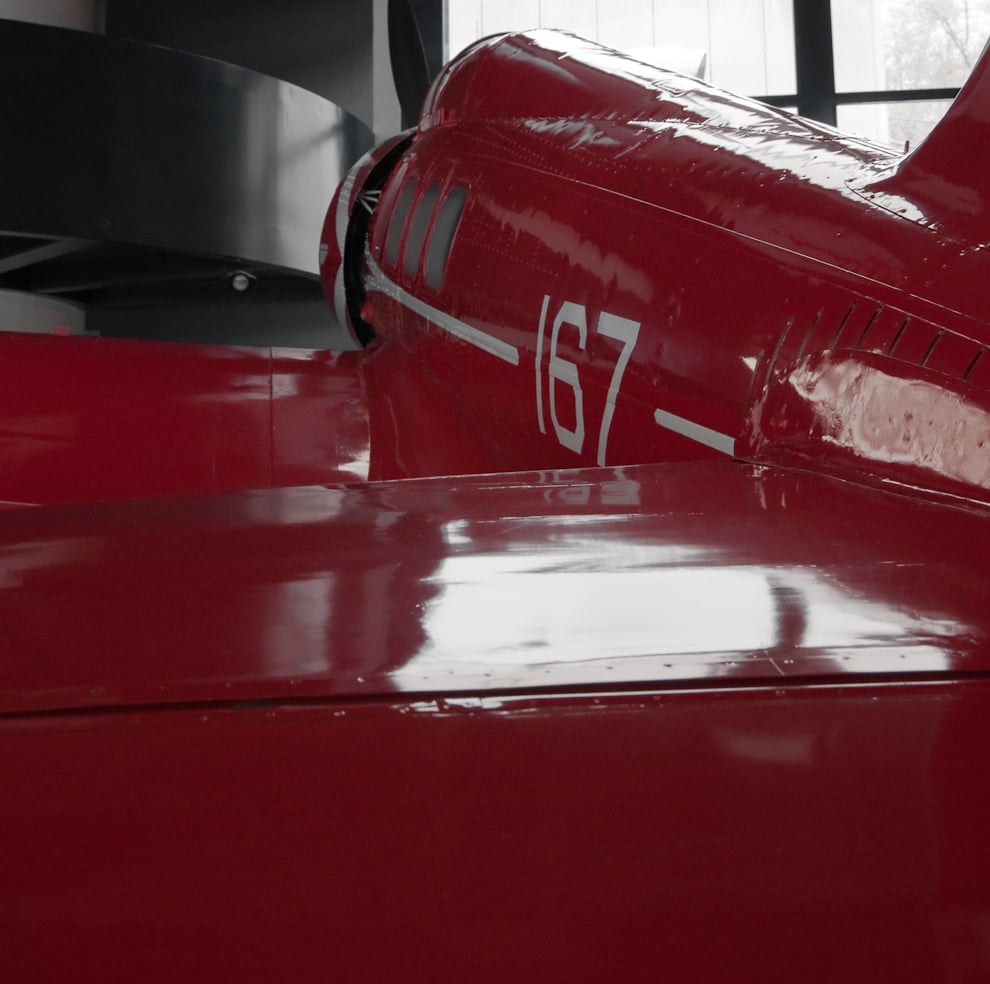
In the aviation hall of the Swiss Museum of Transport in Lucerne hangs a bright red low-wing monoplane with white stripes and Swissair titles. The placard beneath it is headed “Faster than any Fighter-Plane”. It is the Lockheed Orion, the aircraft that gave Swissair the fastest airline service in Europe in 1932, and it is the only Orion left anywhere in the world.
We checked the placard line by line. Most of it holds up. Two claims do not, and the aircraft on display turns out to have a history that is stranger than the sign suggests: it never flew for Swissair at all.
Kurzinfo
- Typ: Lockheed Model 9 Orion, single-engine airliner for 4–6 passengers
- Type approval: 6 May 1931
- Gebaut: 35 (1931–34); one survives
- Swissair aircraft: Two Orion 9Bs, CH-167 and CH-168, delivered April 1932
- Swissair performance: About 360 km/h top speed, 265 km/h cruise (575 hp Wright Cyclone)
- Express service: Zürich–Munich–Vienna from 2 May 1932
- Museum aircraft: Orion 9C Special, c/n 180, the only Orion with a metal fuselage
Europe’s First High-Speed Airliner
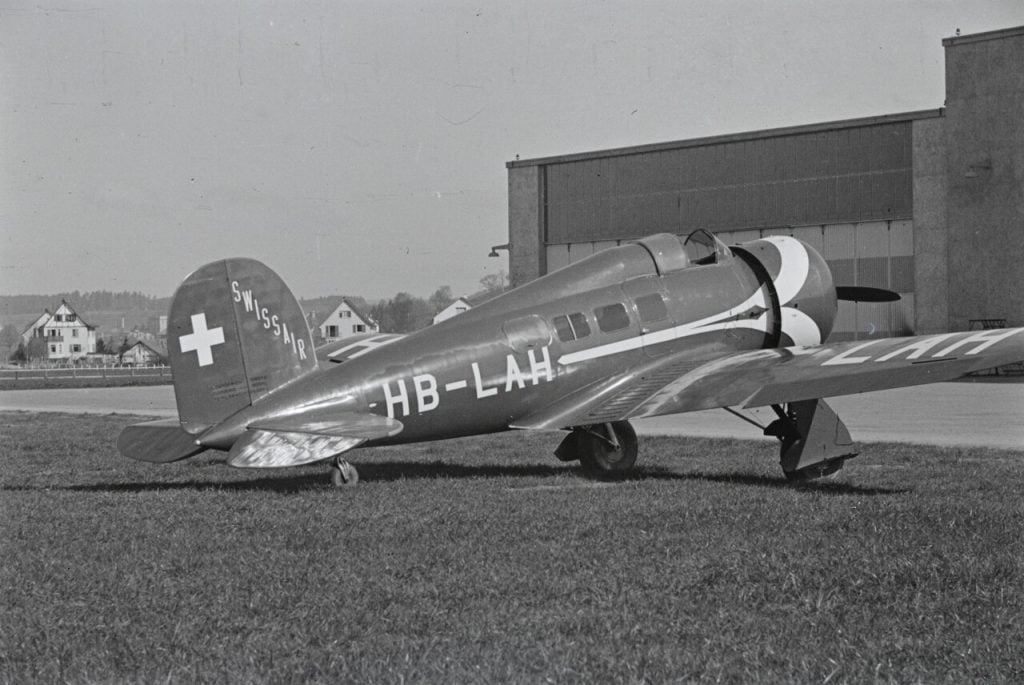
Swissair ordered two Orion 9Bs in 1932 at the urging of its co-founder and operations chief Balz Zimmermann. Powered by 575 hp Wright Cyclone radials, the wooden-fuselaged monoplanes arrived at Dübendorf on 7 April 1932. Swissair fitted only four seats instead of six to leave room for mail.
On 2 May 1932 the Orion opened the new express route from Zürich via Munich to Vienna, covering the 610 km in 140 minutes. From June passengers paid a 10-franc express supplement, and the aircraft still flew with an average load factor of 82 percent; in the first season they carried 1,804 passengers and 11,000 kg of mail. Swiss aviation pioneer Walter Mittelholzer used them for record flights too, from Zürich to Rome and back in eight and a half hours and to Athens and back in fourteen and a half.
Faster Than Any Fighter?
Broadly, yes, at least in Switzerland. The Swiss Air Force’s front-line fighter at the time, the Dewoitine D.27, topped out at about 312 km/h, well short of the Orion’s 360. Contemporary American fighters such as the Boeing P-12 and Curtiss P-6E managed roughly 304 and 311 km/h. Britain’s new Hawker Fury, at about 333 km/h, came closer. “Any fighter” in the world is a strong claim, but the Orion really could outrun most of the fighters of 1932.
“At least twice as fast as all its competitors” does not hold. The Fokker F.VIIb-3m, a workhorse of European airlines, cruised at about 178 km/h; the Orion cruised at around 260 to 265. That is roughly one and a half times as fast, and the museum’s own online article says the Orion was about 100 km/h faster than the aircraft that dominated the market.
Not the First Retractable Undercarriage
The placard says the Orion was the first civil aircraft with retractable wheels. It was not. Boeing’s Monomail mail plane flew with retractable gear on 6 May 1930, and its six-passenger Model 221 version followed in August 1930. Lockheed’s own Altair, the Orion’s sister design, also had retractable gear by September 1930. What the Orion can claim is to have been the first airliner with retractable gear in European airline service.
The Only European Airline
The claim that Swissair was the only European airline to fly the Orion is essentially right: it was the only one to order the type new and run it in regular service. One other Orion, a 9D, was registered in France, but it belonged to the aerobatic pilot Michel Détroyat, not an airline. Swissair replaced its Orions with the ten-seat Clark GA-43 and sold them in the mid-1930s; sources disagree on whether that was 1935, 1936 or early 1937, so the placard’s “until 1936” is a fair approximation. Both ended up on the Republican side in the Spanish Civil War, where their final fate is unknown. The placard’s nickname for them, “Rote Hund” (Red Dog), is plausible for the all-red aircraft, but we could find little contemporary evidence for it.
The Survivor: Jimmy Doolittle’s Shellightning
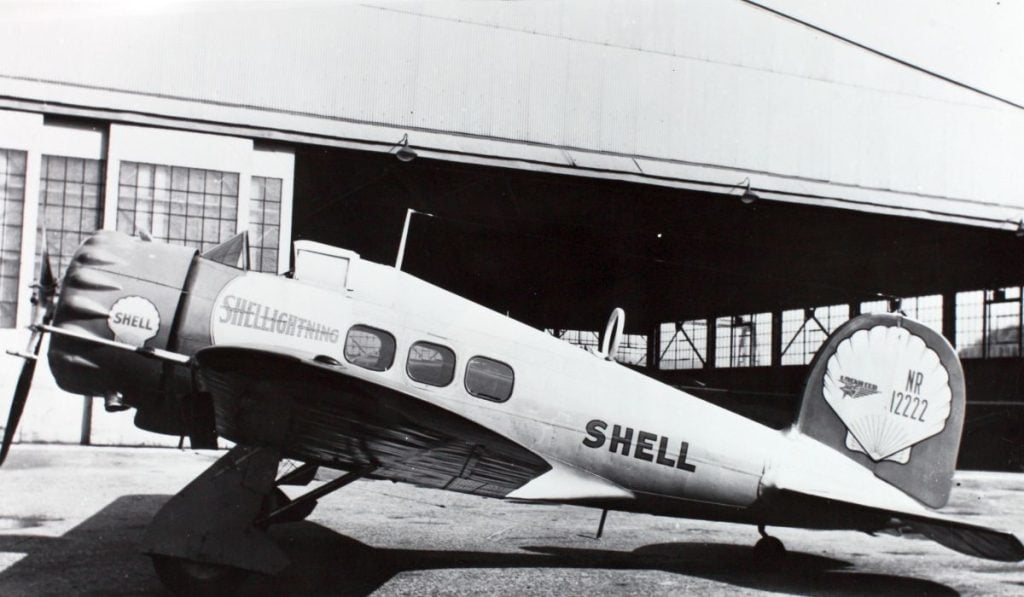
The aircraft in Lucerne is not one of Swissair’s two Orions. It is construction number 180, built at Detroit in 1931 as an experimental Altair, the only one with a light-metal fuselage. Leased to TWA as a mail plane, it made a belly landing at Columbus, Ohio, on 10 October 1931 and was rebuilt at Burbank in 1932 as an Orion 9C. That is the “adulterated” Orion the placard mentions: 34 Orions had spruce fuselages, this one had metal.
Shell Oil then turned it into “Shellightning”, flown mainly by its aviation manager, Jimmy Doolittle, who used it for the George Washington Bicentennial mail flight on 25 June 1932. After damage at St. Louis in 1936, Hollywood stunt pilot Paul Mantz bought it in 1938, rebuilt it in red and white and finished third in the Bendix air races of 1938 and 1939. It passed through several owners, returned to Mantz in 1955 and went to his Tallmantz company in 1962, ending up parked outdoors at Orange County Airport.
Restored by Swissair Volunteers
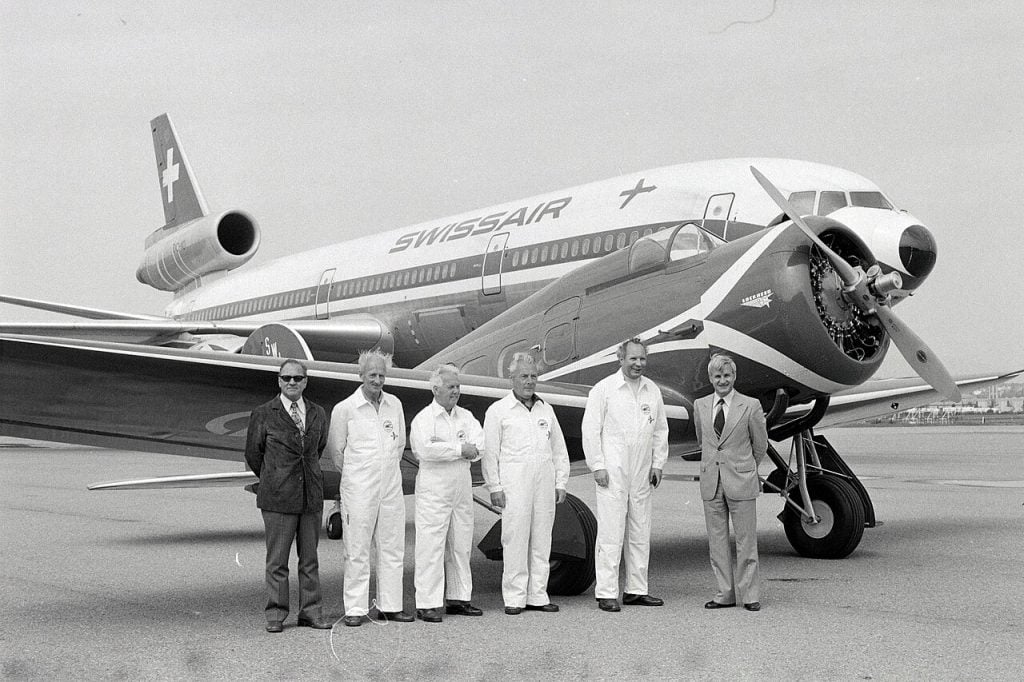
In 1976 the museum’s founding director, Alfred Waldis, bought the Orion after Swissair captain Richi Schilliger tracked it down. With help from Swissair, McDonnell Douglas and Seaboard World Airways it was flown to Frankfurt and trucked to Zürich, arriving on 10 November 1977. A team of 34 former Swissair employees, the “Fokker Team”, then spent more than 10,000 hours restoring it, about 2,500 of them on the engine.
On 10 August 1978 the Orion taxied into the museum under its own power with Schilliger at the controls. Jimmy Doolittle came to see it, alongside Swissair’s chief Armin Baltensweiler. It has worn the red Swissair colours and the registration CH-167 ever since.
Placard Check
Right: the Orion was the fastest airliner of its day in Europe, faster than the fighters of the Swiss Air Force and most others, Swissair opened its express route on 2 May 1932 with a 10-franc supplement, 35 were built and only this one survives, and it does have a metal rather than wooden fuselage. Overstated: “at least twice as fast” (closer to one and a half times) and “most flights completely booked” (82 percent on average). Wrong: the Orion was not the first civil aircraft with retractable gear. Worth adding: the aircraft you are looking at was never a Swissair Orion, but Jimmy Doolittle’s.
Sources: Swiss Museum of Transport (placard; online article “Die Orion 9C Spezial”; collection database); Fokker Team, “Orion im VHS”; Association des Amis du Musée de l’Aviation Militaire (aasm.ch) bulletin; flugzeugforum.de; eusebio.ch (citing Francillon); airhistory.net; General Aviation News (2004); Wikipedia, Lockheed Model 9 Orion, Lockheed Altair, Boeing Monomail, Dewoitine D.27, Hawker Fury, Fokker F.VII, Boeing P-12, Curtiss P-6 Hawk; ETH-Bibliothek Zürich Bildarchiv; San Diego Air & Space Museum
Häufig gestellte Fragen
Was the Lockheed Orion faster than fighter planes?
Was the Lockheed Orion the first airliner with retractable landing gear?
How many Lockheed Orions were built?
Is the Orion in the Swiss Museum of Transport a real Swissair aircraft?
Which airlines flew the Lockheed Orion in Europe?
How fast was Swissair’s Orion express service?
Ähnliche Beiträge
Jimmy Doolittle’s Blind Flight: The 1929 Landing Made on Instruments
Swissair Grounding 2001: The Day Switzerland’s Airline Ran Out of Cash
Mach 2 in Zurich: How ETH’s Wind Tunnels Made Switzerland an Aerodynamics Pioneer
Wiley Post: Der einäugige Pilot, der allein um die Welt flog
0 Comments