
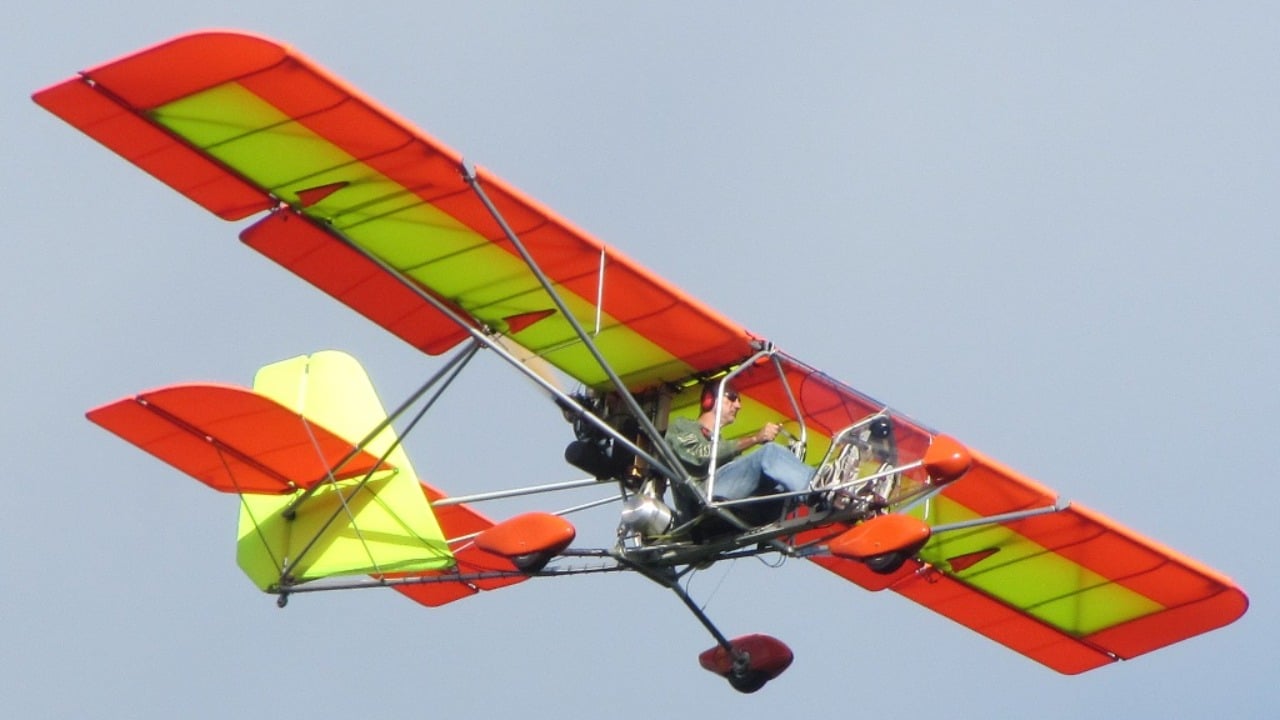
It is one of the most asked questions in American sport aviation, and almost every answer you will find online is wrong in the same interesting way. How high can you fly an ultralight without a licence? People reply with a number. Ten thousand feet, usually. Sometimes eighteen thousand. Sometimes a confident 1,200 feet, which is a misremembered visibility rule wearing a disguise.
The honest answer is that Federal Aviation Regulation Part 103 does not contain an altitude limit. Not a high one, not a low one, not a conditional one. Read all fourteen sections of it — it takes about five minutes — and you will not find a ceiling, because nobody ever wrote one.
That is not a loophole or an oversight. It is the logical consequence of what Part 103 is for, and once you see the design the whole rule reads differently.
Kurzinfo
Altitude limit in Part 103: none. The rule contains no ceiling of any kind
Length of Part 103: 14 sections, about 1,100 words
The four numbers in 103.1(e): 254 lb empty weight, 5 US gallons of fuel, 55 knots calibrated top speed, 24 knots calibrated power-off stall. None is a height
What actually stops the climb: 103.17 airspace, 103.21 visual reference with the surface, 103.23 cloud clearance
Class A: 18,000 ft MSL to FL600 over the 48 contiguous states, and barred without prior ATC authorisation
Supplemental oxygen: 91.211 does not apply, because 91.1(e) excludes Part 103 vehicles from Part 91 entirely
The four famous numbers, and what none of them is
Part 103 defines an ultralight vehicle in 103.1. If it is powered, paragraph (e) says it must weigh less than 254 pounds empty, excluding floats and safety devices intended for deployment in a potentially catastrophic situation; carry no more than 5 US gallons of fuel; be incapable of more than 55 knots calibrated airspeed at full power in level flight; and have a power-off stall speed no greater than 24 knots calibrated.
Those four numbers are the ones everybody quotes, and we have written about the first of them before in the context of the 254-pound problem for ultralight helicopters. Look at them again, though. Weight. Fuel. Top speed. Stall speed. Not one of them is a height. They describe how small and how slow the machine must be, and they stop there.
Search the rest of the part and the pattern holds. The word “altitude” appears exactly once in all of Part 103, in a parenthesis inside the visibility table at 103.23 — “regardless of MSL altitude” — and it is doing grammatical work, not setting a limit. Every other mention of feet in the part is a cloud-clearance distance or a visibility threshold.
So what actually stops you climbing?
Airspace does. 103.17 is the section that matters, and it is one sentence long: no person may operate an ultralight vehicle within Class A, Class B, Class C or Class D airspace, or within the lateral boundaries of the surface area of Class E airspace designated for an airport, unless that person has prior authorisation from the ATC facility having jurisdiction over that airspace.
Notice what that sentence does. It names classes of airspace, not heights. Class B, C and D are lateral boxes around busy airports; you can be barred from one at 2,000 feet and perfectly legal at 12,000 feet two miles away. The only entry on that list that behaves like a ceiling is Class A, which over the 48 contiguous states runs from 18,000 feet MSL to and including flight level 600.
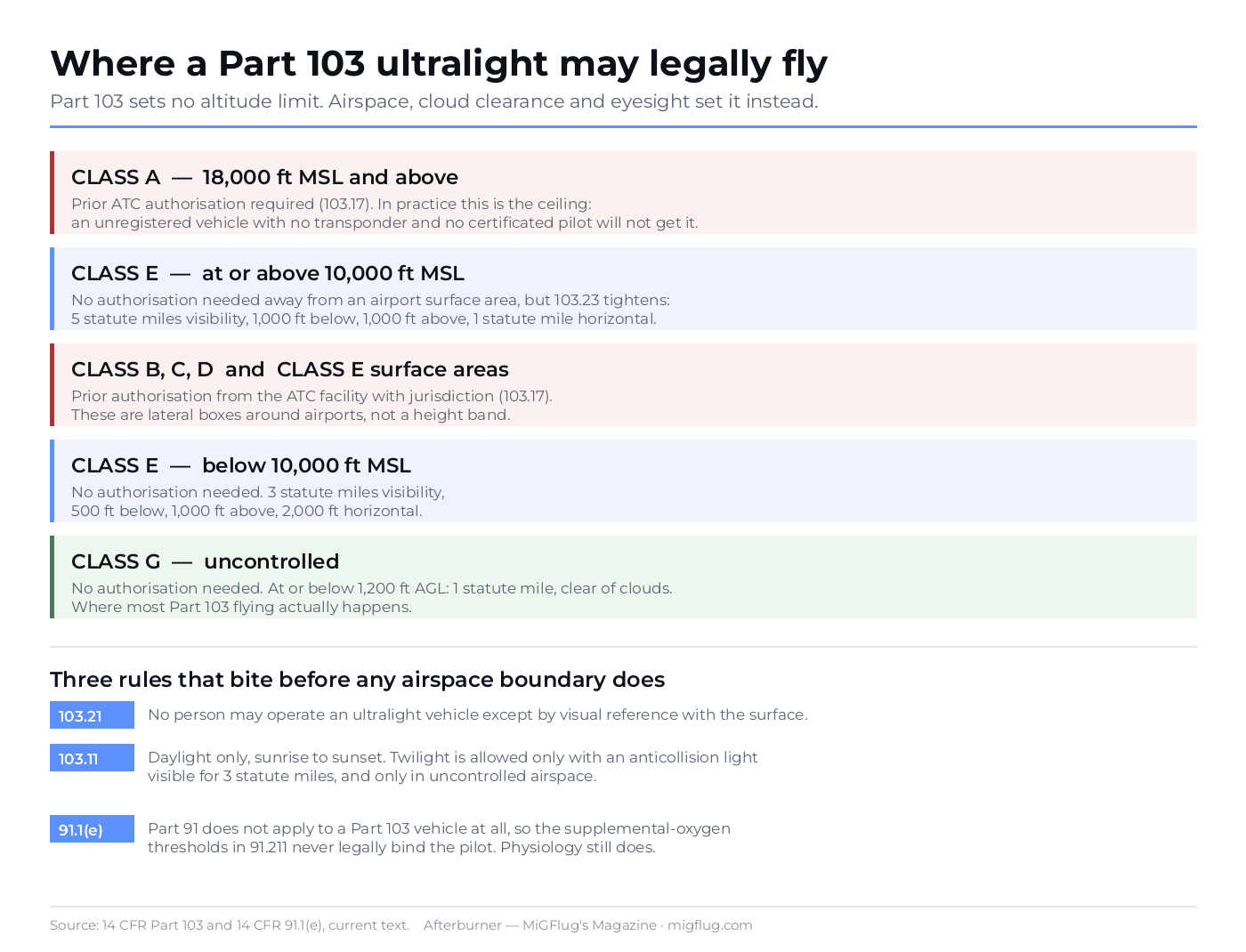
In theory 103.17 lets you ask for Class A. In practice the request has nowhere to land. Class A is positive control airspace where everything is on an IFR clearance with a transponder and an instrument-rated pilot, and a Part 103 vehicle has no registration, no airworthiness certificate, no transponder requirement and no certificated pilot. Under 103.7 it is not required to have any of those things. There is no mechanism by which a controller could sensibly say yes.
Paul Hamilton walks through Part 103 airspace in detail, including the authorisation question that trips most people up.
The rule that really sets your ceiling is nine words long
Before any of that airspace reasoning bites, a much shorter section has already closed the subject. 103.21, in full: No person may operate an ultralight vehicle except by visual reference with the surface.
You must be able to see the ground. Not the horizon, not a cloud deck, the surface. That single sentence rules out climbing through a layer, rules out flying on top, and in practice puts the working ceiling of an ultralight wherever the haze, the cloud base or the sheer smallness of ground features puts it. On a clear day over open country that might be very high indeed. Under a broken layer at 3,000 feet it is 3,000 feet, and no amount of reading the rest of the rule will change that.
And the air gets legally thinner as you go up
103.23 sets flight visibility and distance from clouds by airspace class, and the requirements tighten with height rather than relaxing. In Class G at or below 1,200 feet above the surface you need one statute mile of visibility and must stay clear of clouds — the most permissive line in the table, and where the overwhelming majority of ultralight flying actually happens.
Climb above 10,000 feet MSL and the same table demands five statute miles of flight visibility, 1,000 feet below cloud, 1,000 feet above, and one statute mile horizontally. That is a serious requirement for an open-cockpit machine with no instruments, no heater and a pilot who is, by the rule’s own design, not required to hold any certificate at all.
The oxygen question, and a genuinely surprising answer
Here is where it gets interesting. Everyone knows the supplemental oxygen thresholds: above 12,500 feet cabin pressure altitude the required minimum flight crew needs oxygen for any portion over 30 minutes; above 14,000 feet they need it for the entire time; above 15,000 feet every occupant must be provided with it. Those rules live in 91.211.
They do not apply to you. Part 91 opens with its own applicability section, and 91.1(e) says, in as many words, that this part does not apply to any aircraft or vehicle governed by part 103 of this chapter. The exclusion is explicit and it is total. 91.211 is also written for “a civil aircraft of U.S. registry”, and under 103.7(c) an ultralight vehicle is not required to be registered at all.
So there is no legal oxygen altitude for a Part 103 ultralight, in the same way that there is no legal ceiling. What there is instead is hypoxia, which has never read a regulation and does not care whether the FAA classified your machine as an aircraft or a vehicle. Above about 10,000 feet unpressurised, judgement degrades before the pilot notices; the symptoms arrive in an order that conveniently includes euphoria. An open cockpit at 15,000 feet in winter adds cold that will take your hands away long before it takes your consciousness.
Why the FAA never wrote a number
The absence starts to look deliberate once you read the agency’s own explanation of the rule. Advisory Circular 103-7, The Ultralight Vehicle, issued on 30 January 1984, sets out what the FAA thought it was doing when it created this regime.
That is the entire philosophy in one sentence. The FAA is not trying to keep you alive. It has decided, explicitly and in writing, that keeping you alive is your job. What it is trying to do is something narrower, and the same circular says so directly.
Now go back through the operating rules with that lens and every one of them snaps into focus. No flying over congested areas or open-air assemblies — protects people on the ground. Yield the right of way to all aircraft — protects other airspace users. Daylight only, airspace authorisation, cloud clearance, visual reference with the surface — all of them keep the ultralight where it can see and be seen by everyone else.
An altitude limit protects nobody but the pilot. Climbing to 14,000 feet in an open-cockpit single-seater endangers exactly one person, and Part 103 made a conscious decision that this person is not the FAA’s problem. That is why there is no number. The silence is the policy.
One more thing the photographs will tell you
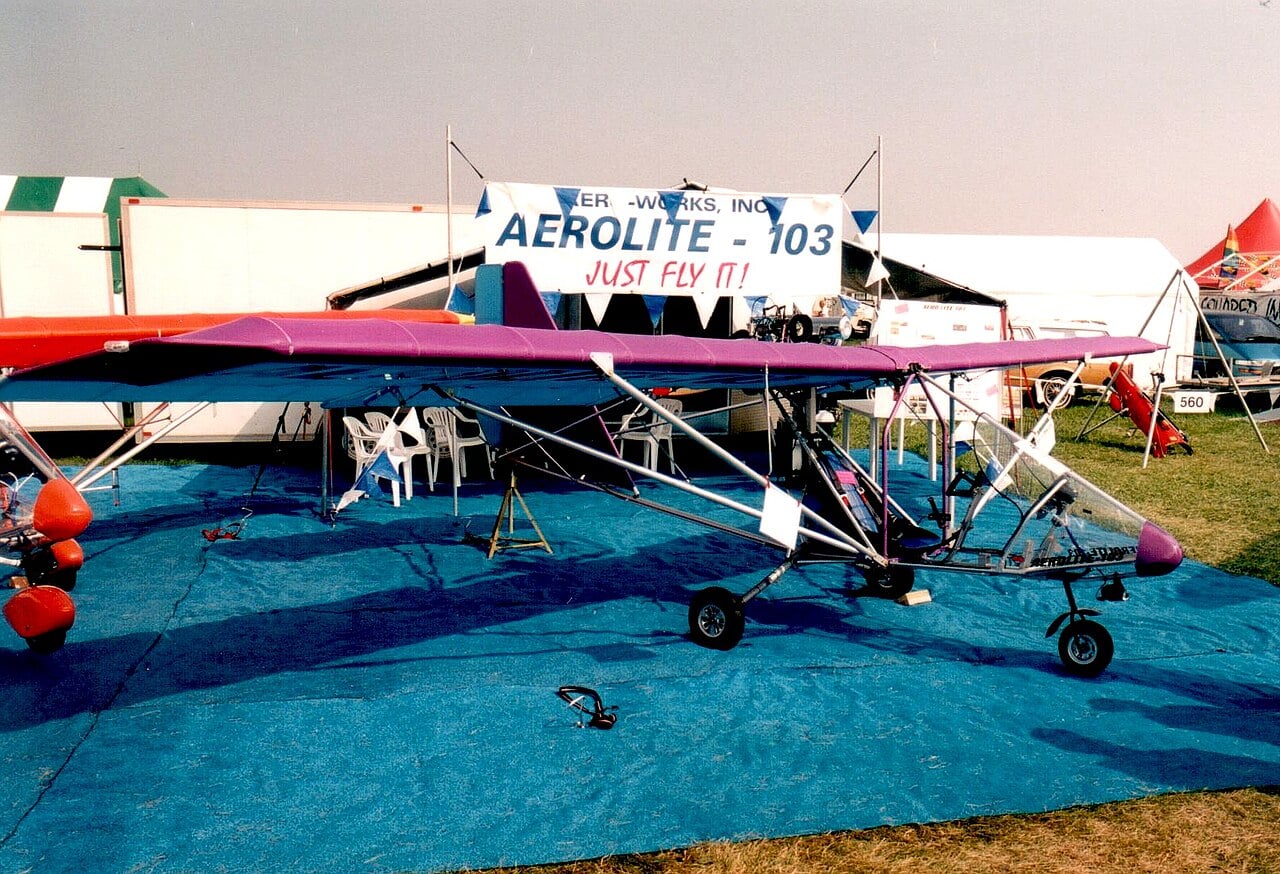
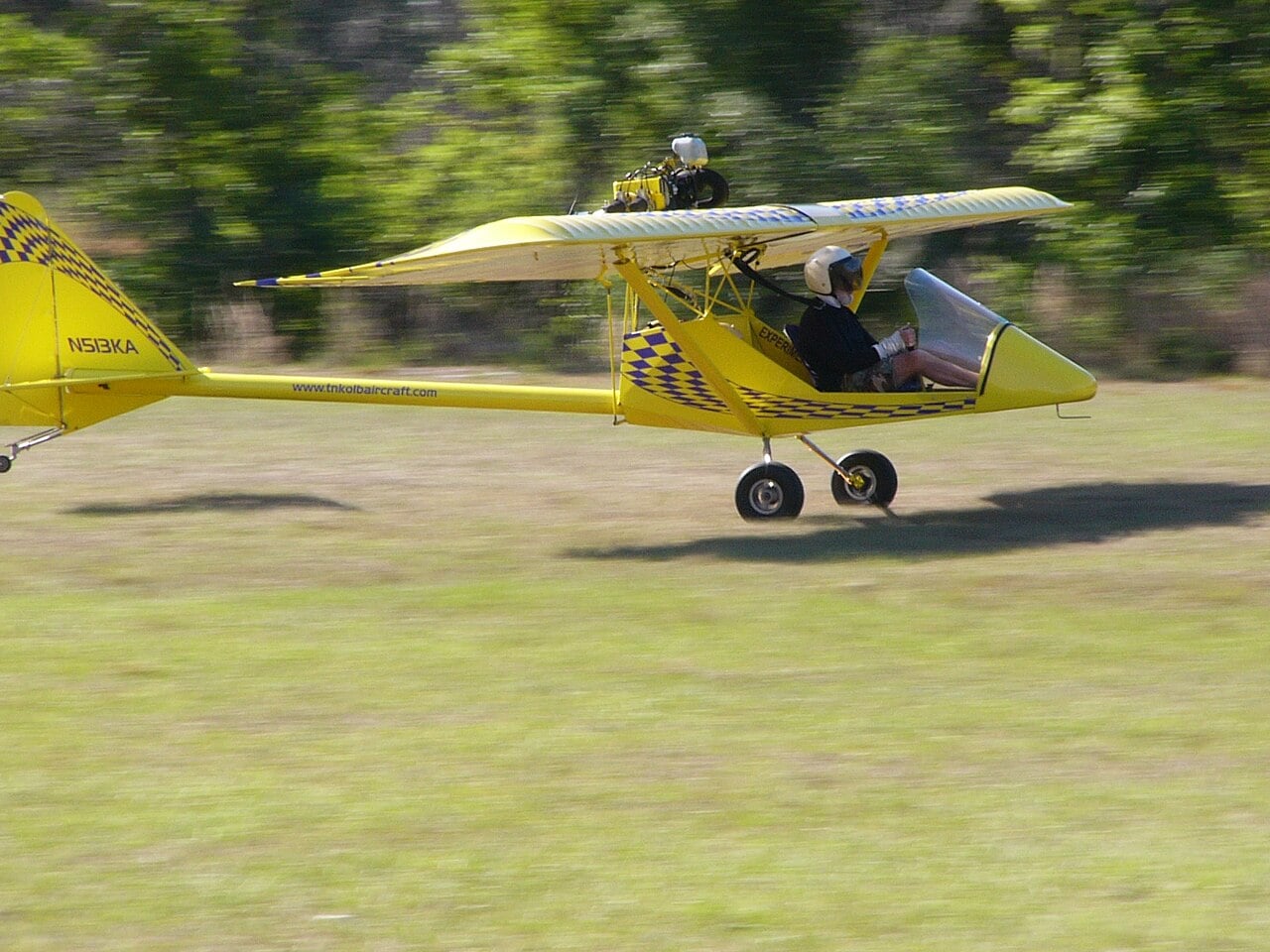
A practical footnote, because it catches people constantly. Not every small, slow, ultralight-looking aeroplane is a Part 103 ultralight. Under 103.7(c), a genuine Part 103 vehicle is not required to be registered or to bear markings of any type — so if you can read a registration on the tail, you are almost certainly not looking at one.
The machines that genuinely qualify are a small and specific population, and the history of how they came to exist at all is a good story in its own right — the first of them were hang gliders that John Moody bolted an engine to in 1975, years before there was any rule to govern them. If you want the broader picture of what the regulation permits, we have covered the whole of Part 103 and what you can fly under it without a licence separately.
A plain-language run through the Part 103 rules, including the parts most summaries skip.
So how high can you actually go?
As high as the airspace, the cloud, your eyesight and your physiology jointly allow, and not one foot higher. In the real world that is a ceiling somewhere below 18,000 feet, usually a great deal below, set on any given afternoon by the weather rather than by the Code of Federal Regulations.
The law gets out of your way at precisely the point where the only person left to protect is you. Whether that is a generous piece of regulatory restraint or an invitation to hurt yourself is a question the FAA answered in 1984 and has not revisited since. It decided you were an adult. The air, unfortunately, has no opinion on the matter at all.
Sources: 14 CFR Part 103; 14 CFR 91.1 and 91.211; 14 CFR 71.33, all current text via the Electronic Code of Federal Regulations; FAA Advisory Circular 103-7, The Ultralight Vehicle (1984).

0 Comments