
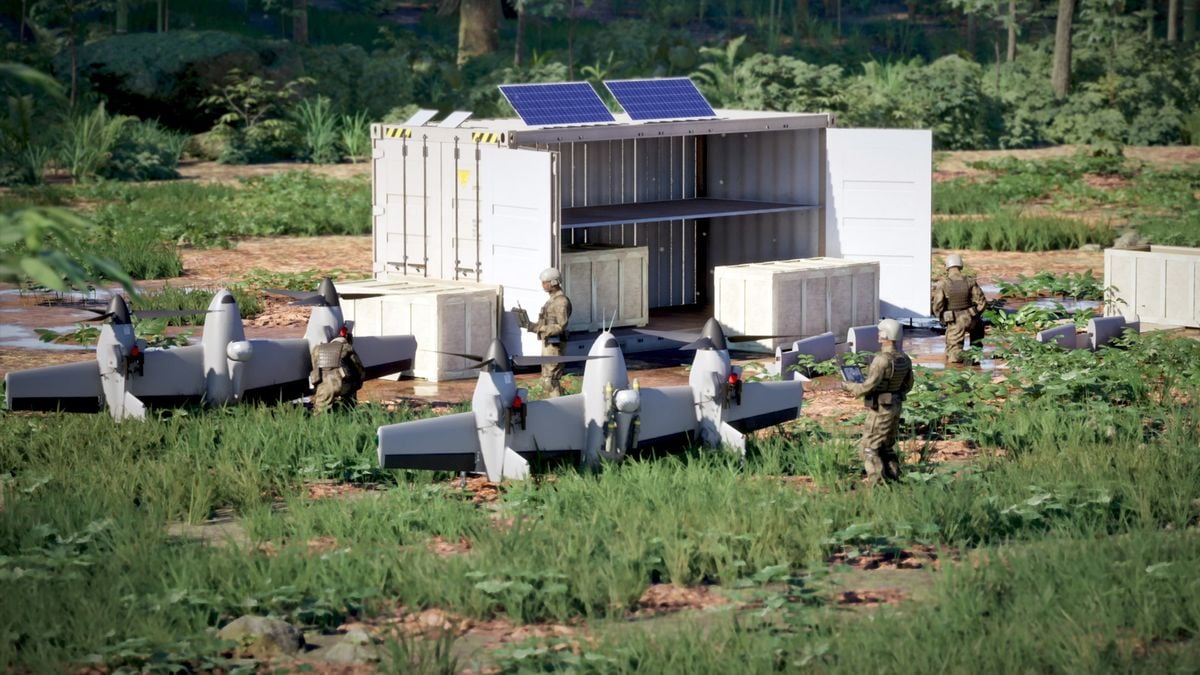
The US Army spent Monday at its biggest trade show of the year, and Sikorsky brought a shipping container. Inside it are four drones.
The Nomad 100 Fast Pack, unveiled on 12 October at the Association of the US Army annual meeting in Washington, is a standard 20-foot ISO container holding four Nomad 100 uncrewed aircraft plus everything needed to fly them: mission-command software, power, communications and maintenance kit. Drop it off a truck or a ship, open the doors, and according to Sikorsky two of the four drones can be ready for a mission in under 15 minutes.
No runway, no hangar and no long logistics tail. That is the point, and it is why a helicopter company is selling drones by the box.
Quick Facts: Sikorsky Nomad 100 Fast Pack
Enthüllt: 12 October 2026, AUSA annual meeting, Washington
Container: Standard 20-foot ISO container
Contents: Four Nomad 100 drones, mission command, power, communications, sustainment equipment
Readiness (planned): Two aircraft in under 15 minutes, two more in 4 to 6 hours
Nomad 100: VTOL "rotor blown wing" drone, 18-ft wingspan, DoD Group 3
Autonomy: Sikorsky MATRIX
Finanzierung: Developed with DARPA funding under the EVADE programme
Orders: Keine angekündigt
What Is in the Box
Sikorsky's description of the kit is short and specific. Four aircraft, the software that plans and commands their missions, a power supply, communications gear and the spares and tools to keep them flying. The company says the container can launch from naval vessels, from tactical vehicle staging areas or from improvised landing zones. When the job is done, the whole thing can be packed up again, loaded onto a suitable transport vehicle and moved somewhere else.
The readiness numbers are for what Sikorsky calls the "planned configuration": two drones mission-ready in under 15 minutes, the other two within four to six hours. Depending on what is fitted, the Nomads can fly intelligence, surveillance, reconnaissance and targeting missions, light attack, or contested logistics, which is military language for carrying supplies where a truck would be shot at.
What the press release does not say matters too. Sikorsky has not said whether a complete Fast Pack has been built yet, and no service has announced an order or an evaluation. The image Sikorsky released with the announcement is a computer rendering.
The Nomad: Half Helicopter, Half Aeroplane
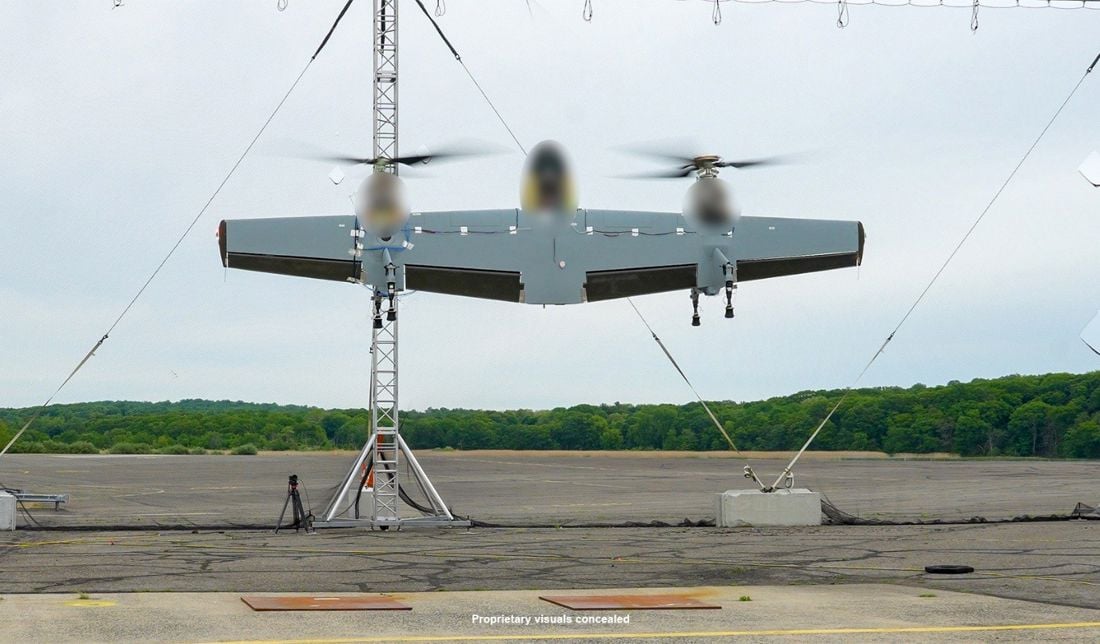
The Nomad family is Sikorsky's take on a long-standing problem: helicopters can land anywhere but are slow and thirsty, while fixed-wing drones are efficient but need a runway or a catapult. Sikorsky's answer is what it calls a "rotor blown wing." Two large proprotors lift the aircraft vertically and let it hover like a helicopter, then the aircraft transitions into wing-borne flight and cruises like an aeroplane, with the endurance that brings.
Sikorsky unveiled the family in October 2025, after extended flight testing of the smaller Nomad 50, which has a 10.3-foot wingspan. The Nomad 100 is the bigger sibling, with an 18-foot wingspan that puts it in the Pentagon's Group 3 drone class. It was developed with funding from DARPA's Early VTOL Aircraft Demonstration (EVADE) programme, and in July 2026 Sikorsky said it had completed initial ground and flight testing ahead of a more intensive campaign at a government test site.
Every Nomad flies on MATRIX, the autonomy software Sikorsky has already flown for years on optionally piloted test helicopters. DARPA chose MATRIX as the autonomy system for all five aircraft in EVADE, so the brain is arguably the most proven part of the package.
Why the Army Cares
Drones that need a runway need an airfield, and airfields are the first thing an enemy targets. The war in Ukraine and the US strikes on Iran have made the same point from opposite directions: fixed bases are easy to find, and anything parked on them is vulnerable. A container that can be dropped in a clearing, flown from, and moved again before anyone finds it fits the US military's push to spread its forces across many small, mobile sites.
Rich Benton, Sikorsky's vice president and general manager, framed the product around demand rather than technology. "Military leaders are challenging industry to expand the inventory of uncrewed aircraft," he said in the announcement. The Fast Pack is Sikorsky's bid to make sure some of that inventory has its name on it.
The company also used AUSA to show its "Black Hawk Next" plans for the UH-60 Black Hawk: a modernised helicopter that Lockheed Martin first set out in May, with GE's T901 engine from the Improved Turbine Engine programme, about 30 percent more main fuel capacity and the same MATRIX autonomy. Lockheed describes it as a hub that can launch and control drones, which is the other half of the same idea. Afterburner covered the wider Black Hawk 2070 roadmap last week.
Lockheed Martin video of an earlier Nomad rotor blown wing demonstrator flying in helicopter and aeroplane modes.
Sources: Lockheed Martin / Sikorsky press release, 12 October 2026; Defense News; Lockheed Martin Nomad product page; DARPA; Defense Daily; FlightGlobal.

0 Comments