
Lev Toropov finished the Second World War in a fighter that finally let him stop running. For much of the war, the Soviet pilot said, the Yaks his regiment flew had left the initiative with the Germans. Then, late in the war, his unit was re-equipped with a new version of the same family: the Yak-9U.
He described the change in a single, unforgettable image, years later, to an interviewer collecting the memories of Soviet veterans.
Der Yakovlev Yak-9 was not the fastest fighter of the war, nor the most elegant. What it was, above all, was everywhere. Between 1942 and 1948, Soviet factories built 16,769 of them, according to the Yakovlev design bureau’s own production records. No other aircraft to carry the Yak name has come close.
Kurzinfo
- Typ: Single-seat, single-engine Soviet fighter
- Designer: Yakovlev design bureau, developed from the Yak-7
- Im Einsatz: From October 1942
- Gebaut: 16,769 from 1942 to 1948 (14,579 during the war)
- Versions: 22 modifications, 15 mass-produced, including Yak-9T, -9K, -9D, -9DD and -9U
- Yak-9U engine: Klimov VK-107A, around 1,650 hp
- Typical armament: One hub-firing cannon (20, 37 or 45 mm) plus machine guns
- Users: Soviet Union, Normandie-Niemen, postwar Eastern Bloc air forces, North Korea
Born from a trainer
The Yak-9 had humble roots. Its direct ancestor was the Yak-7, itself developed from a two-seat advanced trainer, the Yak-7UTI. As aluminium became more available in 1942, Yakovlev’s engineers used lighter metal construction in place of some of the wood, which freed weight for more fuel and heavier guns.
The result entered service in October 1942, and, according to the Museum of Flight in Seattle, first went into combat over Stalingrad late that year. Like most Soviet fighters, it was built to fight low and fast over the front line, where it was more manoeuvrable than the Bf 109. Soviet pilots rated it as comparable to the Bf 109G and the early Fw 190A.
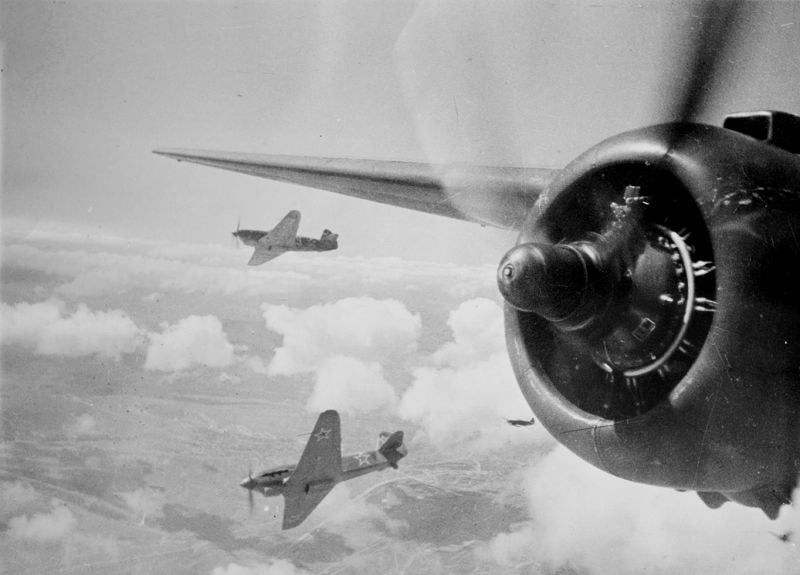
By the Battle of Kursk in the summer of 1943, Yak-9s were helping the Red Army’s air arm wrestle air superiority back from the Luftwaffe. They were also unusually survivable for Soviet fighters of the time: of the 2,550 Yak-9s built by the end of 1943, only 383 were lost in combat.
One airframe, fifteen jobs
Part of the secret of the Yak-9’s numbers was its flexibility. The Yakovlev bureau created 22 modifications, 15 of which went into mass production, using different wings, engines, fuel tanks and guns on what was recognisably the same aircraft.
The Yak-9T moved the cockpit back to make room for a 37 mm cannon firing through the propeller hub; 2,748 were built, and they hunted tanks, ships and bombers alike. The Yak-9K went further with a 45 mm gun whose recoil could throw the pilot around the cockpit. The Yak-9D and Yak-9DD carried more fuel for long-range escort, and a large group of Yak-9DDs was sent to Bari in Italy to support Yugoslav partisans.
Ivan Zvyagin, who flew the Yak-9 after starting the war on the old I-16, remembered the big-gun variants vividly. He also remembered the cost: two of his comrades died in Yak-9 crashes, and he named them to his interviewer decades later.
Dark Skies on the Yak-9, the most abundant fighter of the Yakovlev bureau and its many mass-produced versions.
The French who flew Yaks
Not every Yak-9 pilot was Soviet. In July 1943, during the fighting around Orel, the Free French fighter group Normandie, about fifteen pilots strong, was flying Yak-9s, according to the French Ministry of the Armed Forces. In 1944, after expanding into a regiment, it trained on the long-range Yak-9D at Tula before returning to the front, and Stalin later gave it the honour title “Niemen”.
Pilots such as Joseph Risso, who flew a Yak-9T, became part of one of the most celebrated stories of the Eastern Front. The regiment ended the war on the lighter Yak-3, which its pilots famously flew home to France, a story told on Afterburner in Die Yak-3, die die Franzosen mit nach Hause flogen, um sie zu behalten.
The Yak without an antenna mast
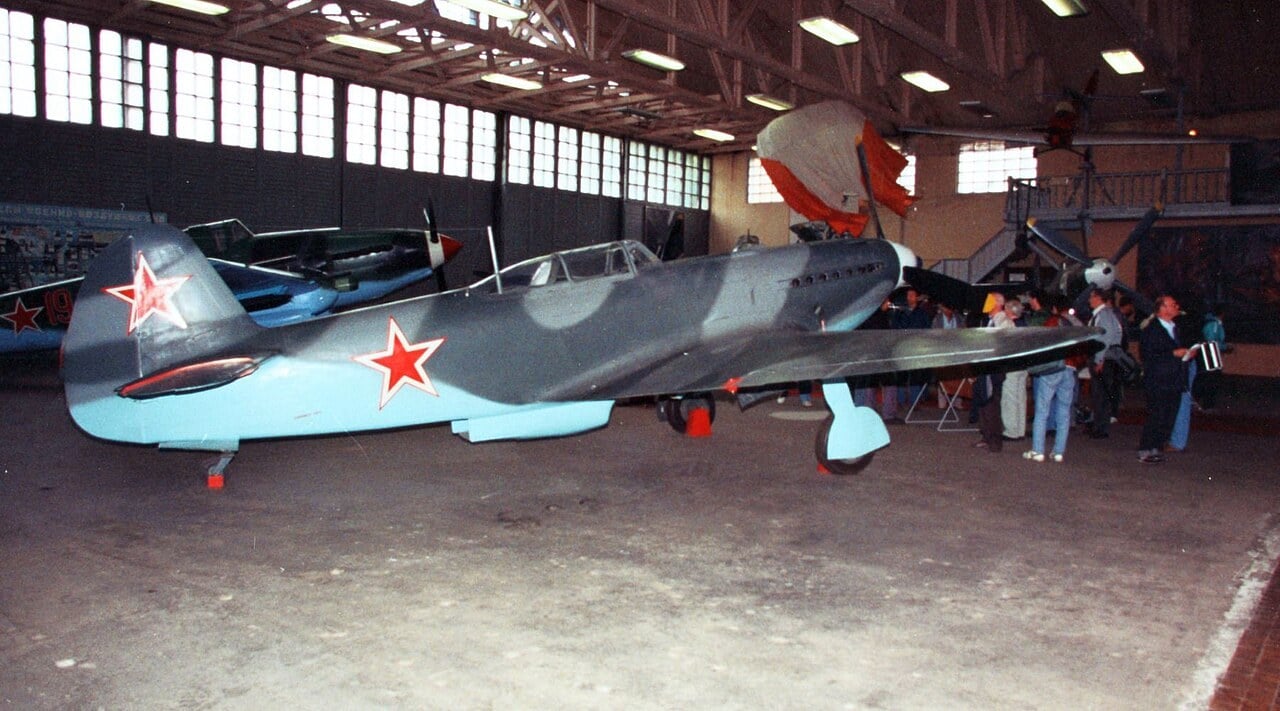
The final wartime version, the Yak-9U, was a different animal. Its Klimov VK-107A engine produced around 1,650 hp, and test flights in 1943 showed a prototype top speed of about 700 km/h at 5,600 m. Early engine trouble was serious, though: overheating, oil leaks and vibration meant that some early production batches flew with the older VK-105 instead.
The first unit to take the Yak-9U into battle, the 163rd Fighter Aviation Regiment, flew 398 sorties between 25 October and 25 December 1944. Its pilots claimed 27 Fw 190s and one Bf 109 for the loss of two Yaks in dogfights. German pilots, the story goes, learned to avoid the Yaks “without antenna mast”, the clean-backed new version.
Paper Skies on the Yak-9T and its 37 mm NS-37 cannon.
This was the aircraft that turned Lev Toropov from mouse into cat. It was not quite the end of the line: after the war, Yakovlev produced the Yak-9P with all-metal wings, the last piston-engined fighter from the bureau.
The Cold War Yak
The Yak-9 did not retire in 1945. Yak-9s harassed Western aircraft in the air corridors to West Berlin, and in 1949 the Soviet Union handed surplus Yak-9Ps to its new allies. One translation of the manual omitted a vital step: the pilot had to hand-crank a small oil pump 25 times before starting the engine. Skipping it caused engine seizures on take-off and several fatal accidents in 1950.
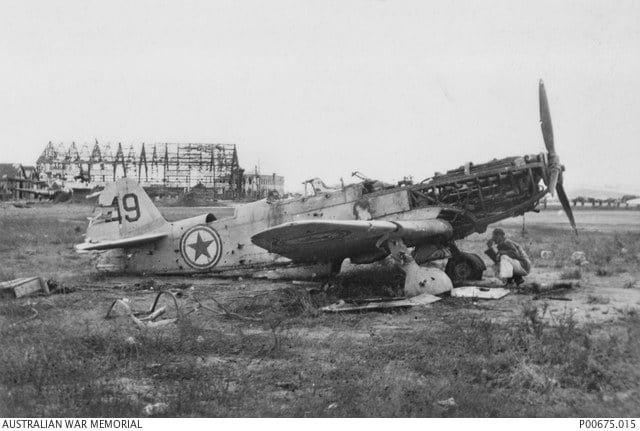
North Korea received Yak-9s in 1949 and still had them when it invaded the South in June 1950. In the first months of the Korean War they flew against United Nations forces, and wrecked Yaks were left behind on captured airfields such as Kimpo.
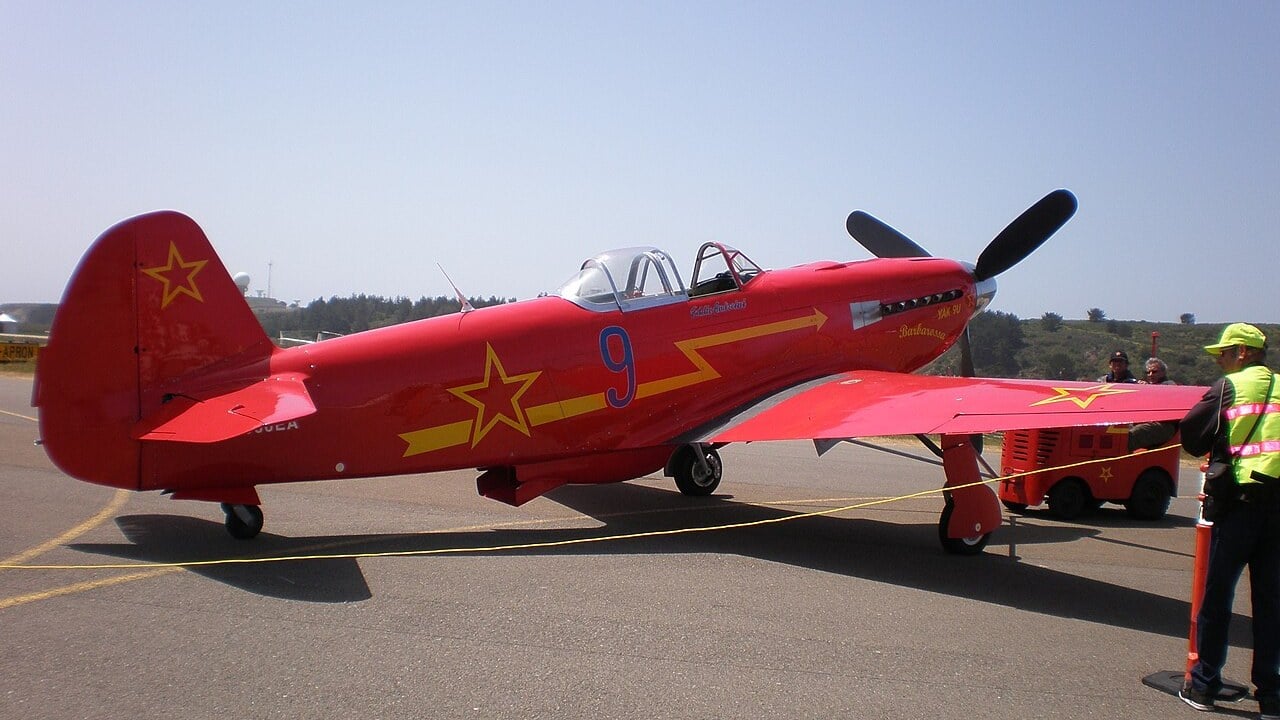
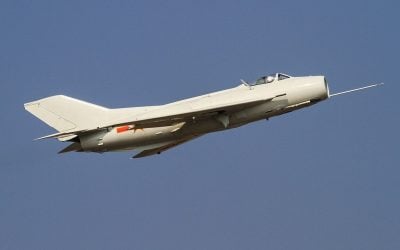
A Yak-9 flying display at the Ocean City Air Show in 2009.
Today, original Yak-9s are rare. The Museum of Flight in Seattle says its rebuilt aircraft is one of about ten survivors worldwide and the only original Yak-9 on display in the West, painted as the Yak-9U of ace Georgy Baevsky. Newly built Yak-9U reproductions fly at airshows.
For the men who flew the real thing, though, the Yak-9 was not a museum piece. It was the fighter that was always there, in its thousands, and in its best form, the one that let them chase.
Sources: Wikipedia (Yakovlev Yak-9; Normandie-Niemen), Yakovlev Design Bureau production records, Museum of Flight, French Ministry of the Armed Forces (Chemins de mémoire), Australian War Memorial, Soviet Warplanes veteran interviews, PilotsPost
0 Comments