
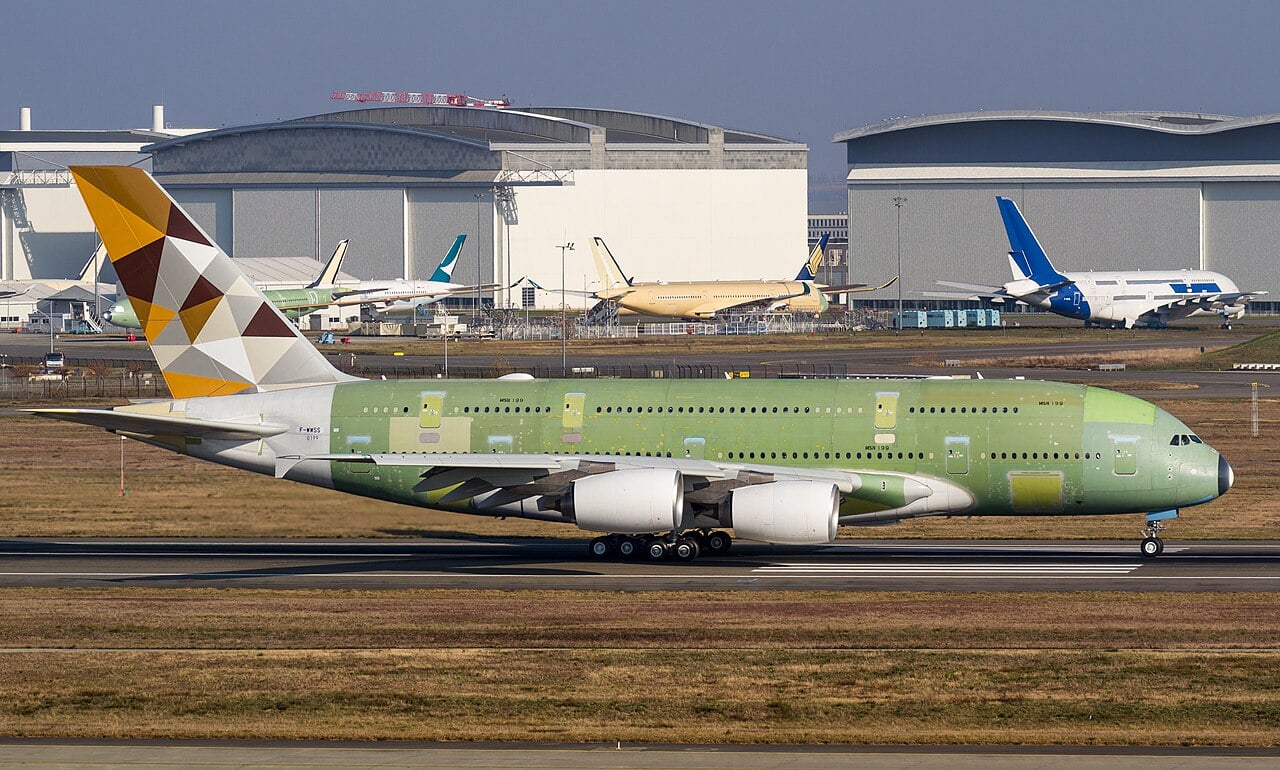
A darkened hangar in Hamburg, a Sunday evening in March 2006, and 873 people sitting in an aeroplane that has never flown with passengers. Nobody in the cabin has been told which doors will open. Half of them will not. There are blankets and bags scattered in the aisles on purpose.
Then the lights go out, and a crew of twenty has ninety seconds to get everybody onto the ground.
This is the single most theatrical thing that happens in aircraft certification, and it is also one of the most widely misread. The ninety-second rule is not a prediction of how long a real evacuation takes. It is a controlled comparison, run under conditions chosen for repeatability rather than realism — and the regulator says so in as many words.
Datos rápidos
The rule: 14 CFR 25.803(c) — aircraft with more than 44 seats must be shown to evacuate everyone in 90 seconds
The conditions: Appendix J to Part 25 — darkness, half the exits, carry-on obstructions in the aisles, nobody told which doors will open
Who is in the seats: At least 40 per cent female, at least 35 per cent over 50, at least 15 per cent female and over 50, plus three life-size dolls standing in for infants
Where 90 seconds came from: Amendment 25-15, effective 24 October 1967. The earlier operator standard, from 1965, was 120 seconds
Injury rate in full-scale tests: 269 injuries among 5,797 participants across 19 demonstrations between 1972 and 1991 — 4.5 per cent
The biggest test ever run: 873 people off an Airbus A380 in about 80 seconds, using 8 of its 16 exits
The escape clause: The FAA may accept a combination of analysis and partial testing instead of a full demonstration
What the Regulation Actually Says
The requirement lives in one sentence of Part 25, the airworthiness code for transport aeroplanes. It applies to anything with more than 44 passenger seats, and it is short enough to read in full.
Two phrases in there do a lot of work. Maximum seating capacity means the aeroplane is tested in its densest certified layout, not the one an airline happens to fit. And simulated emergency conditions points at Appendix J, which is where the rule stops being a sentence and becomes a piece of stagecraft.
Appendix J: The Rules of the Performance
Appendix J is nineteen lettered paragraphs of conditions, and almost every one of them exists because somebody once tried to make the test easier. Exterior light must be no greater than 0.3 foot-candles before the aircraft’s own emergency lighting comes on. The landing gear is down and the aircraft sits in a normal attitude. Every internal door and curtain is in the takeoff configuration. About half the normal quantity of carry-on bags, blankets and pillows is strewn through the aisles and exit routes to create what the regulation calls “minor obstructions”.
The passenger load is specified by demographics rather than by convenience: at least 40 per cent female, at least 35 per cent over 50 years of age, at least 15 per cent both female and over 50, plus three life-size dolls carried as simulated infants under two. Employees of the applicant may not sit next to an emergency exit. Mechanics and training staff may not take part at all.
The cleverest condition is paragraph (p): only one exit from each pair may be used, and the aircraft must be configured so that the occupants cannot tell which ones until the demonstration starts. Pair that with paragraph (m) — no participant may have taken part in this kind of demonstration in the previous six months, and the applicant may not rehearse or describe it — and the test is trying hard to buy a single honest look at an aircraft nobody in the cabin knows.
The clock stops when the last occupant is on the ground. Not at the door. Not on the slide.
Footage from the A380 demonstration at Hamburg-Finkenwerder in March 2006, the largest full-scale evacuation test ever conducted.
873 People, Eight Doors, About Eighty Seconds
The A380 test remains the benchmark. Airbus loaded 853 volunteers and 20 crew into the aircraft in a darkened hangar and got all 873 out in about eighty seconds, using eight of the sixteen exits. One volunteer broke a leg. Around thirty more picked up minor injuries, several of them friction burns from the slides.
That injury tally is not an aberration, and it is the reason the demonstration has been quietly retreating from the certification process for thirty years. The FAA’s own accounting, published in the Federal Register, found 269 injuries among 5,797 participants across 19 full-scale demonstrations between 1972 and 1991 — a rate of 4.5 per cent. Of 216 injured people for whom the injury type was recorded, 13 suffered fractures, 63 sprains or strains, 32 contusions and 108 lacerations or abrasions. The Office of Technology Assessment put the average rate higher still, at about 6 per cent.
The Demonstration That Changed the Rules
On 26 October 1991, two unsuccessful evacuation demonstrations were run on an aircraft seeking an increased seating capacity. During one of them a participant was seriously injured. The FAA’s later account of the episode is blunt about the outcome: in a demonstration involving a McDonnell Douglas MD-11 configured for 410 passengers, a participant was seriously injured, resulting in paralysis.
When McDonnell Douglas came back for a second attempt on 11 and 12 December 1992, the slides had been replaced with level platforms and gently sloped ramps, and the outside of the aircraft was lit. The FAA tasked its Aviation Rulemaking Advisory Committee to find ways to eliminate or minimise injuries to demonstration participants, and the work that followed produced the Appendix J we have now — and, more consequentially, the sentence in 25.803(c) that allows a combination of analysis and testing to stand in for the real thing when the Administrator is satisfied it provides equivalent data.
Most modern aircraft are certified that way. The full-scale demonstration is now the exception rather than the rule, which is precisely why the A380 run in 2006 drew television cameras.
What It Does Not Prove
The FAA has never claimed the ninety seconds predicts a real accident. Its own wording is that the standard “is intended to demonstrate emergency evacuation capability under a consistent set of prescribed conditions but is not intended to demonstrate that all passengers can be evacuated under all conceivable emergency conditions”. That is a comparison standard, not a promise.
Japan Airlines flight 516 showed the difference. When the Airbus A350 collided with a Coast Guard aircraft at Tokyo Haneda on 2 January 2024, there were 379 people on board: the captain, eleven other crew and 367 passengers. The cabin crew judged conditions outside most of their assigned exits to be unusable. The L1 and R1 doors were opened at approximately 17:51:30, roughly four minutes after the collision at 17:47:27. The L4 door was opened at around 17:55. Three slides, out of eight doors.
Everyone got off. One passenger fell while evacuating and was seriously hurt. Nothing about that night resembled the stopwatch in Hamburg — and yet the design discipline the stopwatch enforces, exits sized and spaced so that half of them are enough, is a large part of why 379 people walked away from a burning aeroplane.
A walk through what the ninety-second standard does and does not cover, and why cabin crew count exits before the aircraft moves.
The Criticism That Will Not Go Away
The standing complaint is that the test has not kept up with the cabin. Passengers now travel with roll-aboard bags they demonstrably try to retrieve, with pets, and in seats that have moved closer together. The Appendix J demographic mix is a 1990s picture of a passenger load. And the aircraft in the hangar is clean, level, un-burnt and not full of smoke.
In 2020 the Department of Transportation’s Inspector General examined how the FAA maintains the standard at all, and the finding was uncomfortable.
A second angle on the A380 demonstration. Watch how much of the ninety seconds is spent not on the slides but in the aisles.
Why the Number Survives
For all of that, the ninety seconds has earned its place, because of what it forces designers to do rather than what it predicts. An aircraft that must empty through half its exits in a minute and a half cannot have too few doors, cannot put them in the wrong places, cannot have aisles that choke, and cannot have slides that take too long to inflate. Every one of those constraints is still working on the day the test is nothing like reality.
The stopwatch is a crude instrument. The cabin it produced is not.
Sources: 14 CFR 25.803 and Appendix J to Part 25, via the Electronic Code of Federal Regulations; Federal Register, “Revision of Emergency Evacuation Demonstration Procedures To Improve Participant Safety”, 69 FR 67490, 17 November 2004 (regulatory history, injury statistics and the 1991 demonstrations); US Department of Transportation Office of Inspector General, “FAA’s Process for Updating Its Aircraft Evacuation Standards Lacks Data”, 16 September 2020; Japan Transport Safety Board interim report on the 2 January 2024 Haneda runway collision, 25 December 2024; NBC News reporting on the Airbus A380 evacuation demonstration, March 2006.


0 Comments