
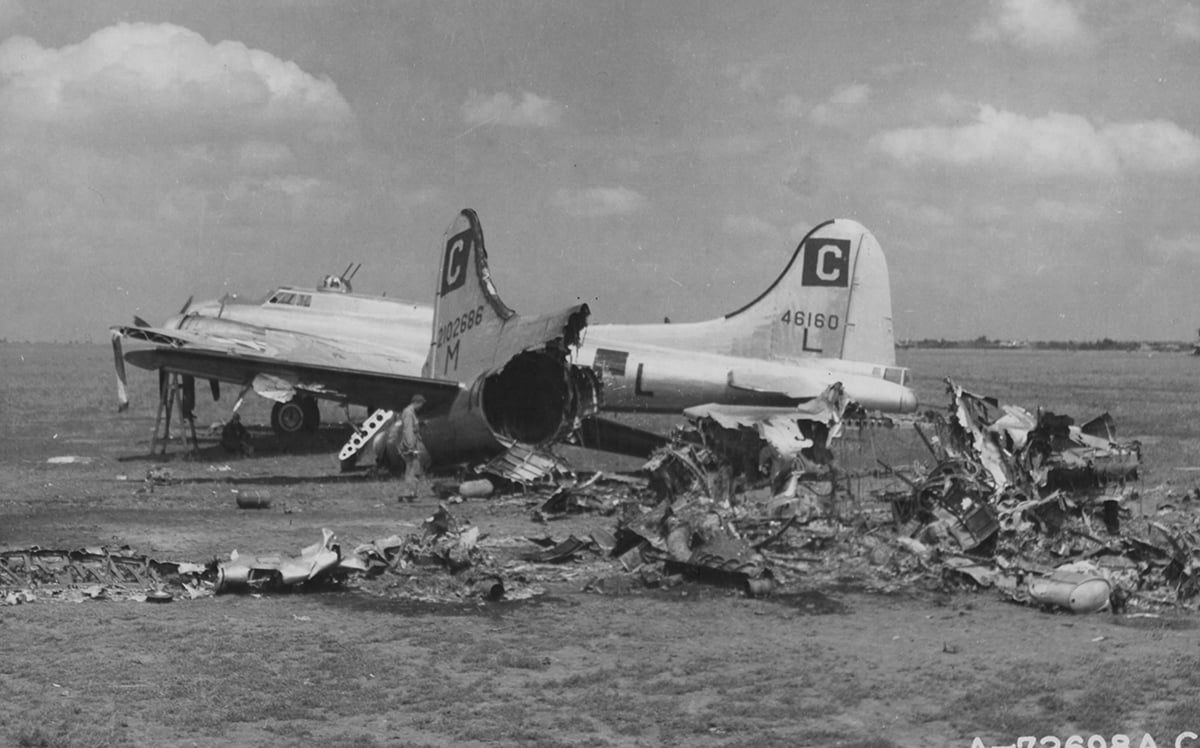
On 2 June 1944, B-17s of the Fifteenth Air Force bombed marshalling yards in Hungary and then kept going east. They landed in Ukraine, at three Soviet airfields the Red Army had handed over to the Americans. It was the first time in the war that a foreign air force had been allowed to operate from bases inside Russia under its own command.
Nineteen days later, the Luftwaffe found one of those bases and destroyed most of the aeroplanes on it in about two hours, without losing a single aircraft.
Datos rápidos
Operación: Frantic — seven shuttle-bombing operations, June to September 1944
Soviet bases: Poltava and Mirgorod (bombers), Piryatin (fighters), all in the Ukrainian SSR
Aeronave: B-17 Flying Fortress, escorted by P-51 Mustangs and P-38 Lightnings
Escala: around 1,030 aircraft deployed, 2,207 sorties flown to or from Ukraine, 24 targets attacked
The Poltava raid: night of 21/22 June 1944
Losses at Poltava: 43 of 73 B-17s destroyed or written off, 26 more damaged
German losses that night: ninguno
Why the bases existed at all
Shuttle bombing solved a geometry problem. Bombers flying from Britain or Italy could only reach so far into eastern Germany and the Balkans before they had to turn round. If they could land in the Soviet Union instead, re-arm, and bomb something else on the way back, the reachable map got considerably larger.
Getting Soviet agreement took over a year. Stalin gave the final go-ahead in February 1944, and the Americans laid 12,393 tons of shipped-in pierced steel planking to turn Poltava into something a loaded Fortress could use.
The night of 21 June
On 21 June, B-17s from England bombed a synthetic oil plant south of Berlin and flew on to Ukraine. Seventy-three of them parked at Poltava. A German reconnaissance aircraft shadowed them the whole way and watched them land.
That night, He 111s and Ju 88s of KG 4, KG 27, KG 53 and KG 55 took off from fields around Minsk. Estimates of how many actually reached the target vary between roughly 75 and 150 bombers, with the strike led by Oberstleutnant Wilhelm Antrup of KG 55. Pathfinder flares went up over the field around half past midnight. The first bombs fell ten minutes later, and the attack ran for about two hours.
The Fortresses were parked in the open, well spaced but entirely unprotected. The Germans bombed methodically, then came back with anti-personnel bomblets to make firefighting and salvage lethal.
The arithmetic of the disaster
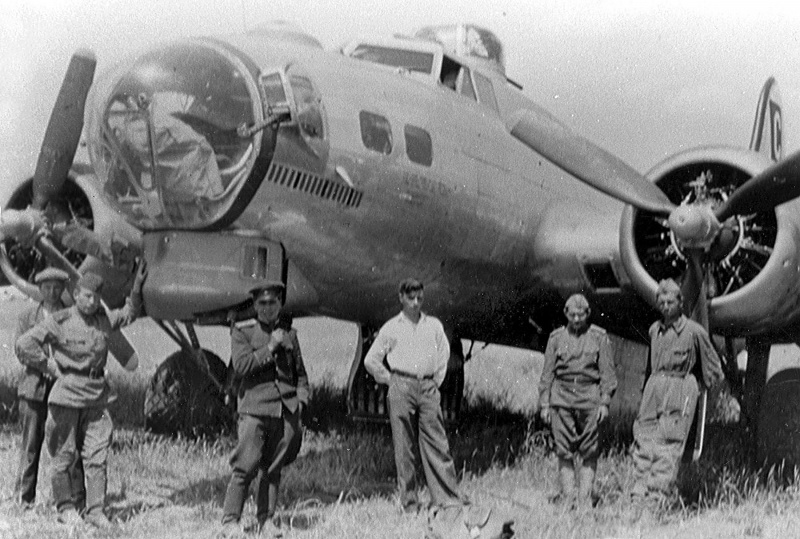
The figures deserve care, because they are quoted inconsistently. The USAAF Eastern Command’s own internal history records 43 Fortresses destroyed or damaged beyond repair and 26 heavily damaged but repairable — that is 69 of the 73 aircraft on the field hit in one night. Three days later, nine were serviceable. Some secondary accounts give 47 destroyed; the 43 figure is the one from the official record.
Also lost: three C-47s, a photo-reconnaissance F-5, more than 450,000 gallons of high-octane aviation fuel, over 3,200 bombs and 1,360,000 rounds of ammunition. American casualties were remarkably light — two men killed, including co-pilot Joseph Lukacek — because the crews sheltered in slit trenches away from the aircraft. Soviet losses were much worse, around 25 killed, because Soviet work parties were ordered to fight the fires while the raid was still in progress.
What made it worse was the defence. Soviet gunners fired some 28,000 rounds into the dark and hit nothing. American fighters at Piryatin were not cleared to take off.
What it was really for
Frantic limped on until September 1944, finishing with a supply drop to Warsaw. Militarily it never justified itself: the official U.S. history is candid that some targets "would probably not have been regarded as worth making but for the desire to use those bases".
Because the point was never really the bombing. It was the precedent — Americans operating from Soviet soil, an alliance made physical. Poltava demonstrated how thin that was, and the mutual suspicion that followed outlasted the war by four decades.
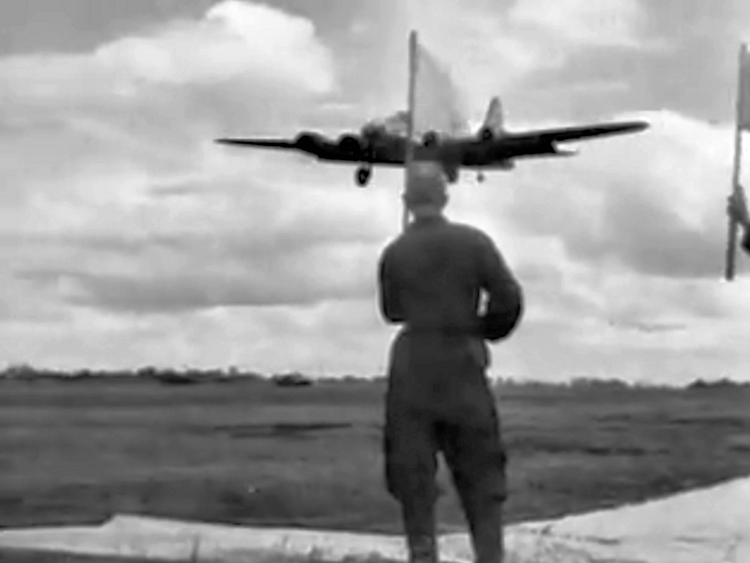
The wartime U.S. War Department film about the shuttle missions survives, and the arrival footage above is taken from it.
A modern documentary treatment of the operation and the raid follows.
And a longer archival compilation of the shuttle missions themselves.
Preguntas frecuentes
What was Operation Frantic?
Why did the Americans need bases in the Soviet Union?
What happened at Poltava on 21 June 1944?
How many B-17s were destroyed at Poltava?
Did the Germans lose any aircraft in the raid?
Was Operation Frantic a success?
Sources: National Museum of the United States Air Force; John T. Correll, "The Poltava Debacle", Air Force Magazine, 2011; USAAF Eastern Command internal history; Maj. Gen. John R. Deane, The Strange Alliance, 1947; Mark J. Conversino, Fighting With the Soviets, 1997.
0 Comments