
The most expensive part of the biggest conventional bomb in the American inventory is not the explosive. It is the pipe it lives in.
On 10 September 2026 the US Air Force awarded a combined $149 million to four companies to keep making those pipes: hardened steel cases for large penetrating warheads. There is no prime contractor, no household name and no fanfare. The work went to forging and machining shops in Ohio and Pennsylvania, and it will run until 2033 if the options are taken up.
It is one of the least glamorous contract notices the Pentagon has issued this month, and it tells you rather a lot about where American strategy has ended up.
Datos rápidos
| Award date | 10 September 2026 |
| Valor | $149 million combined |
| Alcance | Large penetrator warhead case assembly production, full-scale and subscale |
| Ganadores | Superior Forge and Steel (Lima, Ohio); Ellwood National Forge (Irvine, Pennsylvania); Faxon Machining (Cincinnati, Ohio); Grand Valley Manufacturing (Titusville, Pennsylvania) |
| Contract type | Firm-fixed-price, cost-type indefinite-delivery, indefinite-quantity |
| Contracting office | Air Force Life Cycle Management Center, Attack Weapons Branch, Eglin Air Force Base, Florida |
| Offers received | Cuatro |
| Completion | 7 September 2033 if the option is exercised |
| Obligated so far | $10,000 in FY2026 research and development funding |
| Current weapon | GBU-57/B Massive Ordnance Penetrator, roughly 13,600 kg (30,000 lb), carried only by the B-2 Spirit |
What a penetrator case actually is
A bunker buster does its work in two stages, and the first one is purely structural. The weapon has to arrive at the target at high speed, punch through many metres of rock and reinforced concrete, and still be intact enough that the fuze can fire the charge inside at the right depth. If the case collapses on impact, everything else is irrelevant.
That case is a single enormous forging of hardened steel with an extremely thick wall and a comparatively small cavity. Making one is a metallurgy problem, not an ordnance problem, which is exactly why the Air Force went to forging houses rather than to a bomb manufacturer. Superior Forge and Steel, Ellwood National Forge, Faxon Machining and Grand Valley Manufacturing are not defence primes. They are companies that know how to make very large pieces of steel behave.
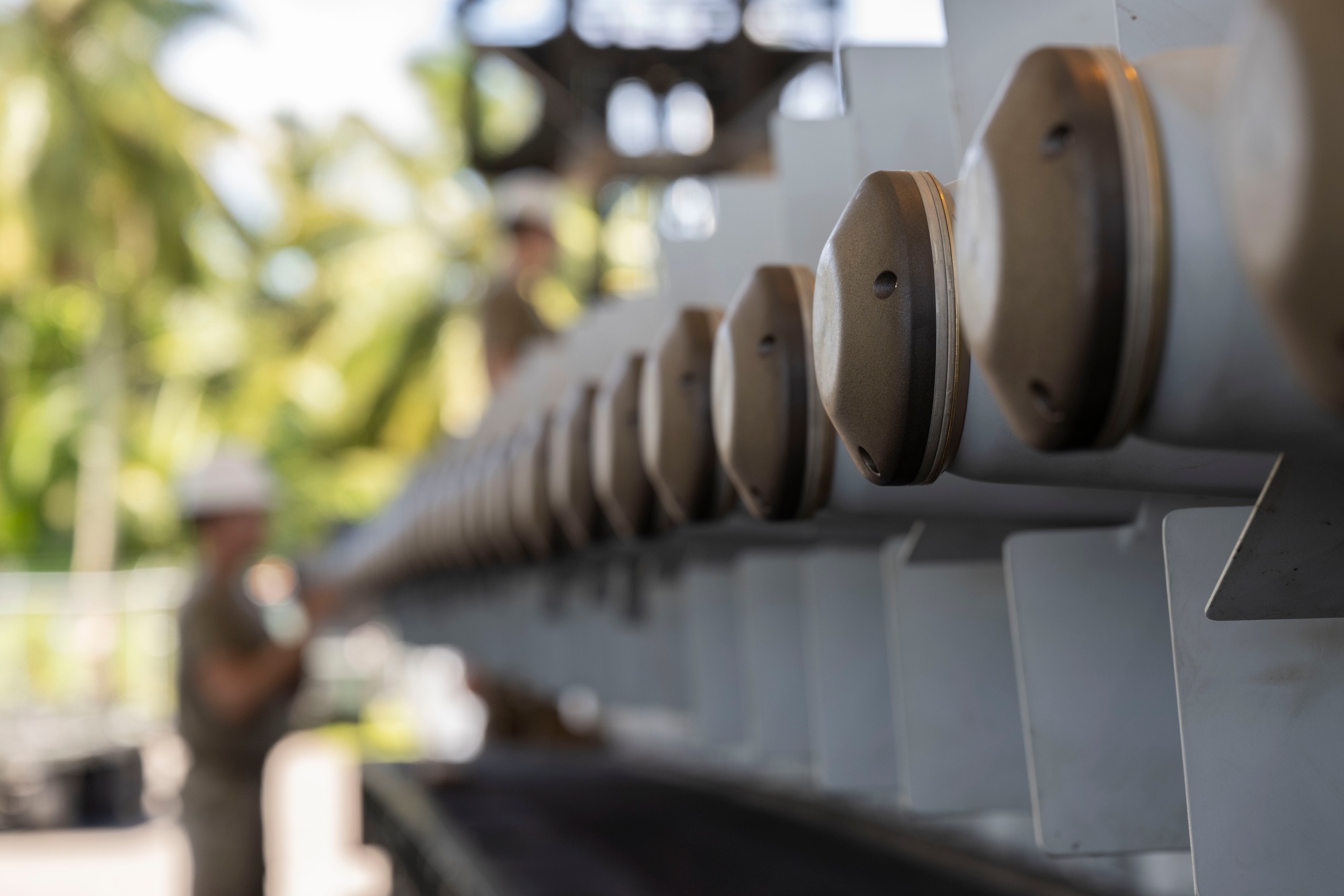
The Air Force also asked for subscale versions, which are used for testing. You cannot iterate on a penetrator design by dropping full-size weapons at $3 million a go, so a serious penetrator programme consumes a steady stream of smaller test articles. That line item is the quiet confirmation that development work is continuing, not just production.
The weapon everybody is thinking about
The Air Force's existing weapon in this class is the GBU-57/B Massive Ordnance Penetrator, a roughly 30,000-pound bomb built by Boeing. Published figures for the explosive filling vary between about 2,400 and 2,700 kg, which tells you how much of that thirty thousand pounds is simply steel.
When the Chairman of the Joint Chiefs of Staff described the weapon after the June 2025 strikes on Iran, he did so with almost aggressive plainness.
Note the phrase “dropped only by the B-2”. Only the Espíritu B-2 can carry the MOP, two at a time, and the B-2 fleet is small enough that every airframe matters. That is the single most important constraint on the entire capability, and it is why the B-21 Raider's weapons bay dimensions have attracted so much attention.
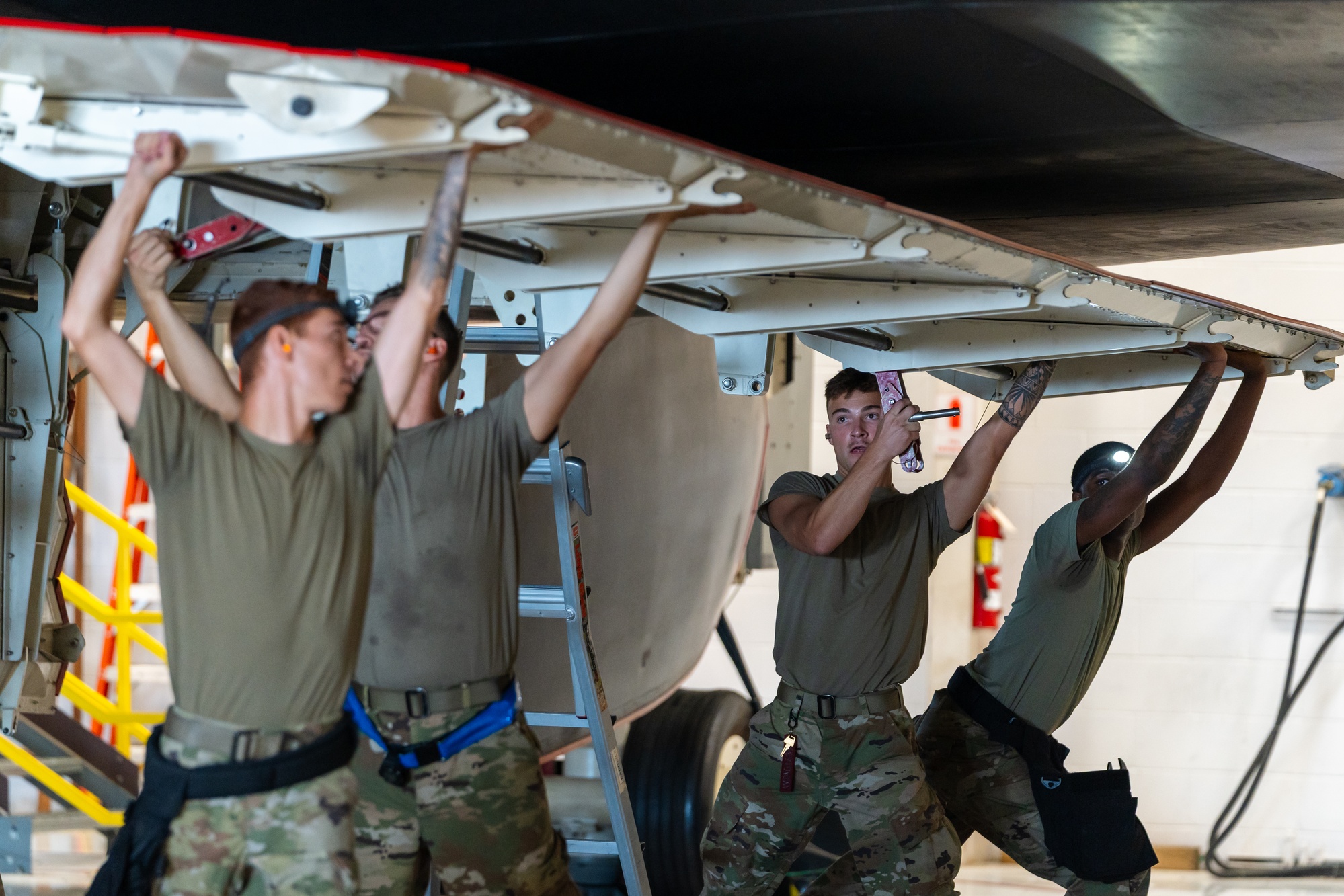
During Operation Midnight Hammer in June 2025, B-2s dropped twelve MOPs on the Iranian enrichment facility at Fordow and two more on an underground section at Natanz. Caine described fuzes programmed individually for each weapon, each with its own impact angle and final heading, and the first bomb tasked simply with removing a concrete cap the Iranians had poured over the ventilation shafts.
Which programme is this actually for?
Here the notice is deliberately unhelpful. The Air Force did not say whether the cases are for the MOP, for its successor, or for both.
That successor exists. In September 2025 the Air Force awarded Applied Research Associates a two-year design and prototyping contract for a Next Generation Penetrator, with Boeing partnered on the tail kit. The intent is a weapon that does the MOP's job without needing the MOP's carrier, which in practice means something smaller and more widely droppable.
An eight-year, four-supplier, indefinite-quantity arrangement for warhead cases in full-scale and subscale sizes fits both readings. What it does not fit is a capability anybody expects to wind down. The Air Force has just told four steel shops to keep the furnaces warm until 2033.
Preguntas frecuentes
What did the US Air Force buy for $149 million in September 2026?
What is the GBU-57 Massive Ordnance Penetrator?
Which aircraft can drop the Massive Ordnance Penetrator?
Why does the warhead case matter more than the explosive?
Is there a replacement for the Massive Ordnance Penetrator?
Where were Massive Ordnance Penetrators used against Iran?
Sources: US Air Force contract announcements via Defence Blog; The War Zone; Pentagon press conference remarks by Gen. Dan Caine.



0 Comments