
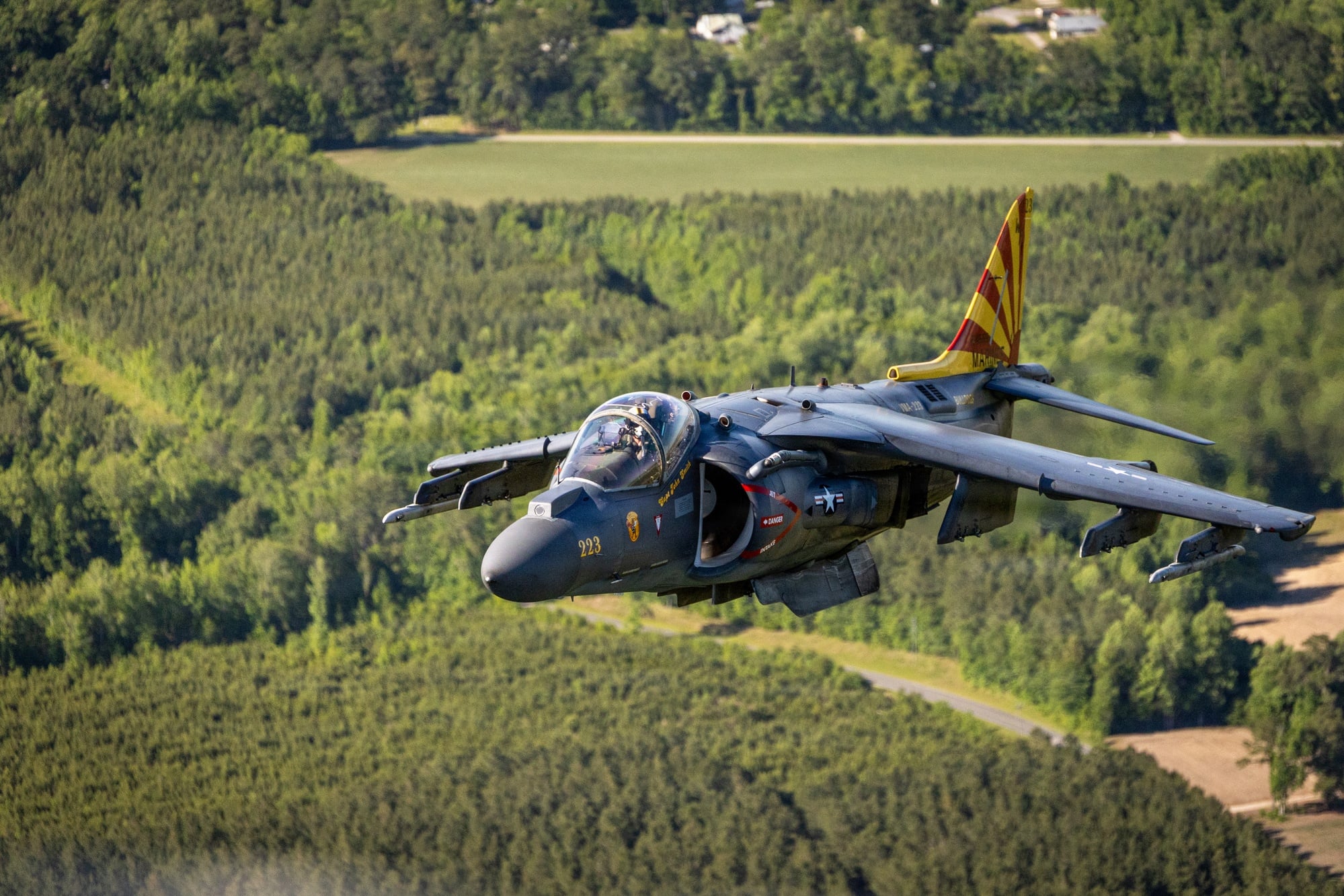
There was no flypast for this one. No water cannon, no speeches, no crowd on the ramp at Cherry Point. Marines took the wings off it, pulled the classified boxes out, put it on a flatbed and drove it to Florida.
The aircraft is BuNo 166288, modex WP-18, and it is the last AV-8B Harrier II Boeing ever built for the United States Marine Corps. Delivered in September 2003, it flew more than 5,800 hours from amphibious assault ships and expeditionary strips before ending its career with Marine Attack Squadron 223, the Bulldogs, at MCAS Cherry Point. It is now at the National Naval Aviation Museum at NAS Pensacola. Its Rolls-Royce F402-RR-408 has been pulled and will go on a stand of its own, because the engine is really the whole story of the aeroplane.
The Navy released the images on 9 September. They were taken on 22 July. That gap is the tell: this was a logistics move, not an event.
Datos rápidos
Estructura de avión: AV-8B Harrier II+, BuNo 166288, modex WP-18, the last built for the USMC
Entregado: September 2003, by Boeing
Flight hours: More than 5,800
Final squadron: VMA-223 “Bulldogs”, MAG-14, 2nd Marine Aircraft Wing, MCAS Cherry Point
Nuevo hogar: National Naval Aviation Museum, NAS Pensacola, Florida
USMC Harrier sundown: 3 June 2026, Cherry Point, with a five-ship flypast
Sustituido por: F-35B Lightning II
Harrier service with the USMC: AV-8A from 1971, AV-8B from January 1985, so roughly 55 years
The ceremony was in June
The Marine Corps formally retired the Harrier on 3 June 2026 at Cherry Point, with a five-ship flypast of four single-seaters and a TAV-8B trainer and a water cannon salute. VMA-223 flew the type’s last official Marine flight that day. Between them, VMA-223 and VMA-231 had accounted for the last 39 airframes on strength. Individual jets have been trickling out to museums and to the boneyard ever since, which is why Harriers have still been visible in American skies through the summer.
The final operational deployment had ended only two weeks before the ceremony. A VMA-223 detachment sailed with the Iwo Jima Amphibious Ready Group and the 22nd Marine Expeditionary Unit on Operation Southern Spear, the Caribbean counter-narcotics mission, and came home on 20 May 2026.
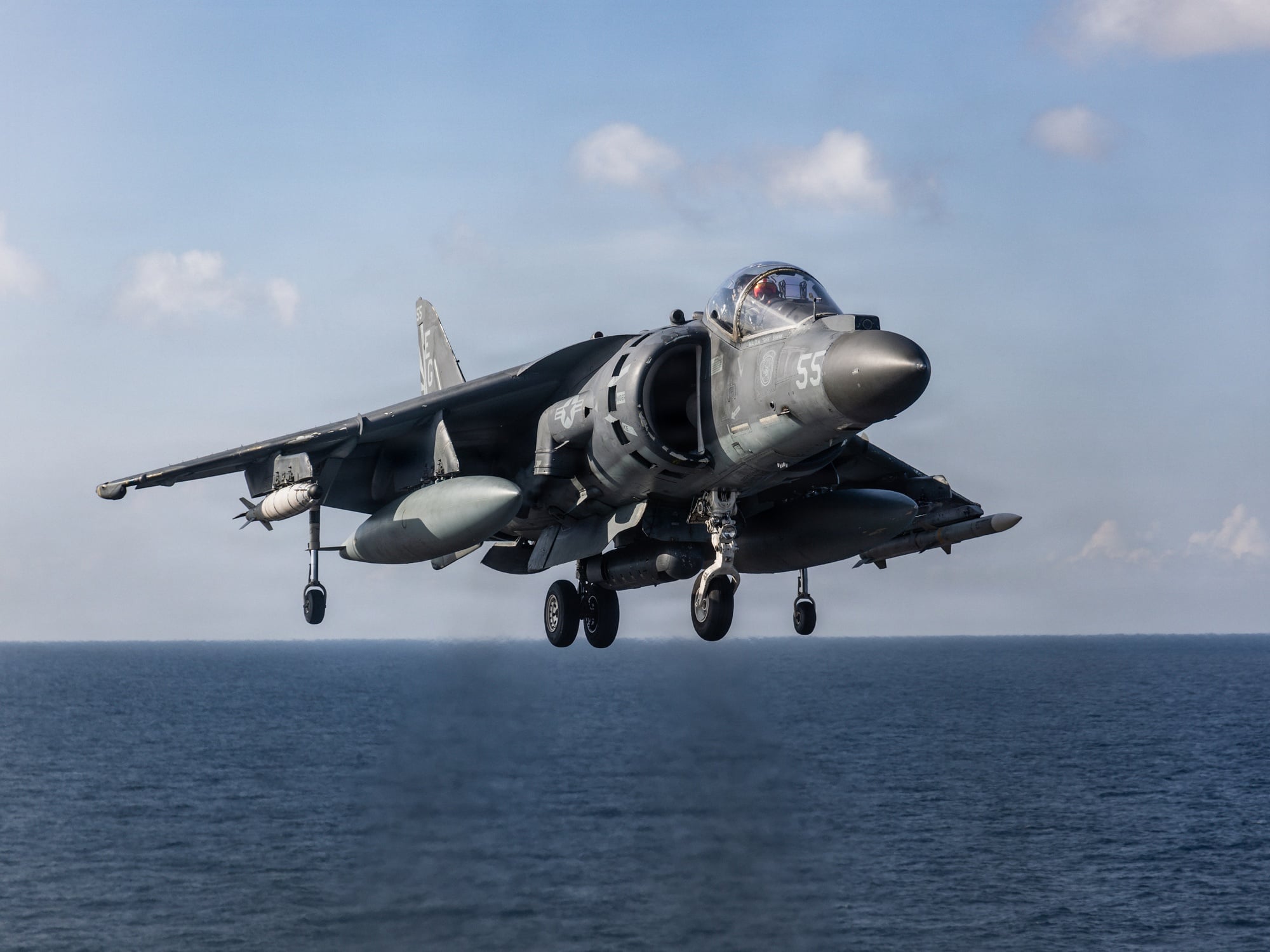
Moving 166288 fell to Pablo “Louie” Sanchez, a retired gunnery sergeant who has worked the AV-8B programme since 1989 and now leads the Harrier Museum Task Force. VMA-223 maintainers Staff Sgt. Christian Regueira and Gunnery Sgt. Bradley Birchfield put the aircraft back together in Pensacola.
Forty years of doing something nothing else could do
The YAV-8B first flew on 9 November 1978 and the AV-8B entered Marine service in January 1985. Production ran until 2003, which is how 166288 came to be last off the line.
Its combat debut was Desert Storm, on 17 January 1991. Eighty-six AV-8Bs flew around 3,380 sorties and roughly 4,100 hours, holding mission availability above 90 per cent while operating from austere sites close to the front. Five were lost to surface-to-air missiles and two Marine pilots were killed. Norman Schwarzkopf later named the AV-8B among the seven weapons he considered crucial to the campaign.
Then came Kosovo, Iraq and Afghanistan, where the Harrier became the Corps’ workhorse for close air support. On 14 September 2012, fourteen years ago today, a Taliban assault on Camp Bastion destroyed VMA-211’s Harriers on the ground and killed the squadron’s commanding officer, Lt. Col. Christopher “Otis” Raible, and Sgt. Bradley Atwell. It remains the worst single loss of US aircraft since Vietnam.
What actually happens to a Harrier on its way to a museum: demilitarisation, disassembly and reassembly, covered in detail by the Wings Over the Rockies Air and Space Museum.
The safety record, honestly
No account of the Harrier is complete without the accident rate, and it deserves better than the folklore. In December 2002 the Los Angeles Times published “The Vertical Vision”, a four-part investigation by Alan C. Miller and Kevin Sack which won the 2003 Pulitzer Prize for National Reporting. It documented 148 accidents and 45 people killed, and found the Harrier had the highest major accident rate of any aircraft then in service with any US military branch. Congress held hearings. The nickname that attached itself to the aircraft was not affectionate.
The rebuttal is legitimate and comes from people who know the aircraft. The historian Lon Nordeen has pointed out that other Marine single-engine strike aircraft, the A-4 Skyhawk and the A-7 Corsair II among them, recorded higher accident rates than the Harrier did. Accidents also cluster in take-off and landing, and the Harrier by design spends a far greater proportion of its life in those regimes than a conventional jet. The raw number is documented. What it means is arguable.
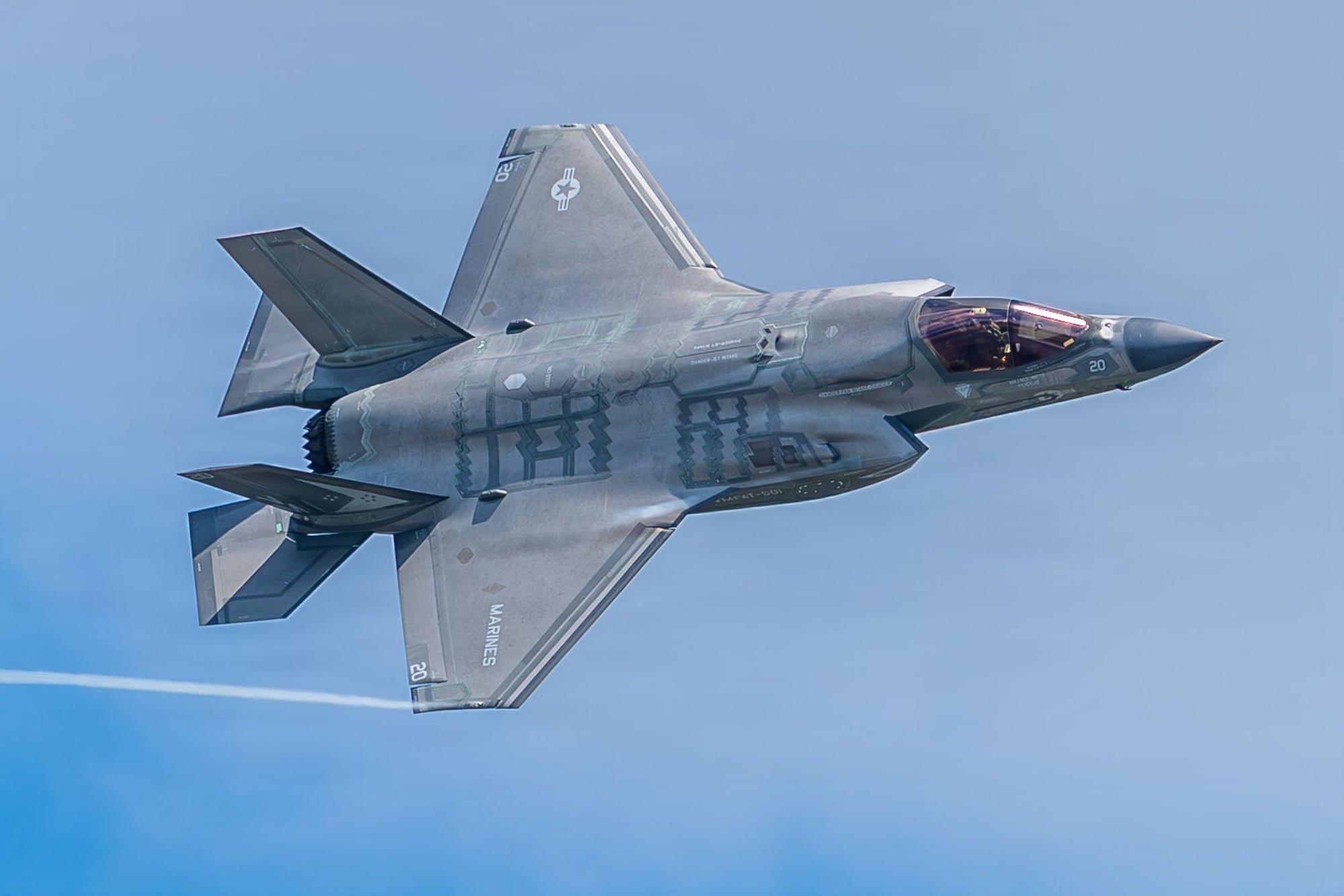
El F-35B Lightning II now does the job, and does it with stealth, a modern sensor suite and a far kinder safety margin. What it does not have is the Harrier’s peculiar claim on affection, which came from being the only thing in the inventory that could operate from a road, a clearing or a container ship when nothing else could get there.
The Harrier is not finished everywhere. The Italian and Spanish navies still fly theirs, reportedly into 2030. But American Marine Harrier operations, which began with the AV-8A in 1971, are over, and the last one built now sits in a hangar in Pensacola with its engine on a stand beside it.
Sources: DVIDS release by Megan Wasel for PMA-226, 9 September 2026; The Aviationist; US Marine Corps; Los Angeles Times, “The Vertical Vision”, December 2002.
0 Comments