
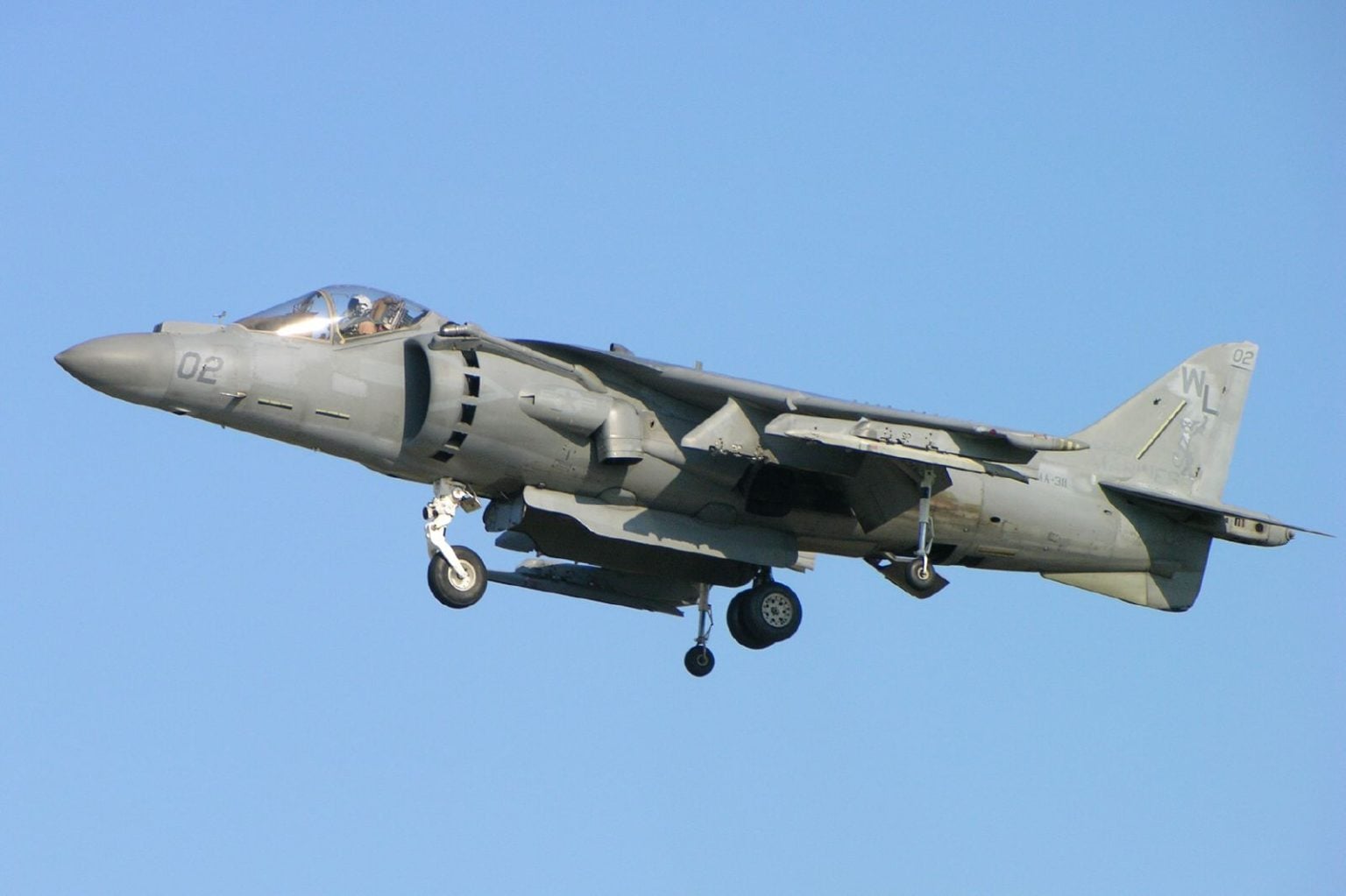
Hawker Siddeley Harrier
& Sea Harrier
The world’s first operationally successful “jump jet” — a vectored-thrust V/STOL fighter that took off vertically, hovered, and in 1982 wrote one of the most lopsided air-combat records of the jet age over the Falklands.
The jet that didn’t need a runway
The Harrier is the aircraft that made vertical take-off, hovering and rolling-vertical landing a battlefield reality. It grew from the Hawker P.1127, designed around the Bristol Siddeley Pegasus vectored-thrust turbofan — a single engine whose four nozzles swivel from aft to straight down. The prototype made its first tethered hover on 21 October 1960 and its first conventional flight in March 1961, and by later that year could transition fully between hover and wingborne flight.
After the supersonic P.1154 was cancelled, the RAF took a developed subsonic version: the Harrier GR.1 entered service on 1 April 1969 as the first fixed-wing combat aircraft able to operate independently of runways. The Royal Navy’s Sea Harrier FRS.1 followed in 1980, and the US Marine Corps bought the type as the AV-8A. Britain, America, India, Spain and Italy all flew Harriers of one generation or another.
Its legend was sealed in the 1982 Falklands War, where 28 subsonic Sea Harriers defended the British fleet 8,000 miles from home against faster Argentine jets — and destroyed roughly 20–23 aircraft for no air-to-air losses. The concept outlived the aircraft: every lesson of Harrier V/STOL fed directly into today’s F-35B.
01The Harrier’s origin: how the P.1127 hovered its way into history
The whole Harrier story rests on a single idea — Michel Wibault’s thrust-vectoring concept, turned into a practical engine by Rolls-Royce’s Stanley Hooker as the Pegasus. Nine evaluation aircraft, the Kestrel FGA.1, were flown by a tripartite squadron of British, American and West German pilots in 1965. When the supersonic P.1154 was axed the same year, the subsonic Harrier survived, first flying in 1966 and entering RAF service with No. 1 Squadron at Wittering in 1969.
No other Western vertical-take-off combat jet ever reached front-line squadrons. The Harrier did — and stayed there, in one form or another, for more than four decades.
What makes the Harrier special
The Pegasus vectored-thrust engine
A single Rolls-Royce Pegasus turbofan with four rotating nozzles — two cold fan, two hot exhaust — that swivel together from horizontal to vertical-down under one lever. It lifts, hovers and propels the Harrier with no separate lift engines: the elegant solution that made the entire jump-jet concept work.
Reaction controls for the hover
At zero airspeed, wings and tail do nothing. The Harrier bleeds high-pressure air to “puffer” reaction jets at the nose, tail and each wingtip, giving the pilot pitch, roll and yaw control while balanced on columns of thrust — one of the most demanding skills in aviation.
VIFFing — vectoring in forward flight
Deflecting the nozzles downward or forward during wingborne flight produces sudden deceleration and tighter turns. A Harrier could brake so violently that a pursuing fighter shot past into its sights — a combat trick no conventional jet could copy, and a decisive edge for a subsonic aircraft.
02The Harrier’s Pegasus: one engine, four nozzles, no lift jets
Rival V/STOL designs bolted separate lift engines into the fuselage — dead weight in cruise. The Pegasus instead split its whole thrust across four swivelling nozzles rotated in unison, so the same engine that flew the aircraft also lifted it. That single decision kept the Harrier light enough to be a useful combat jet rather than a hovering curiosity, and it is why the layout survived unchanged from the 1960s P.1127 to the F402-powered AV-8B.
03The Harrier’s VIFF trick: how a slow jet beat faster ones
The Sea Harrier was slower than the Mirages and Daggers it faced in 1982, and slower is usually fatal in a dogfight. VIFFing changed the maths: by swivelling the nozzles in forward flight the pilot could dump speed almost instantly, forcing a fast attacker to overshoot and become the target. Combined with the all-aspect AIM-9L Sidewinder and aggressive flying, it turned the Harrier’s biggest weakness — a lack of raw speed — into a close-combat advantage.
Full specifications
Baseline note: the figures below describe the AV-8B Harrier II Plus — the radar-nosed, second-generation Harrier built by McDonnell Douglas and Boeing, and the only mark still in front-line service. It is chosen because it is the best-documented Harrier and the one a reader can still go and look at. Deltas for the first-generation Harrier GR1/GR3, the Sea Harrier FRS1/FA2, the AV-8A and the RAF's Harrier GR7/GR9 are given in grey.
Dimensions & weights
- Crew
- 1 (2 in the TAV-8B, Harrier T.10/T.12 and Sea Harrier T.8 trainers)
- Length
- 14.55 m (47 ft 9 in) — 14.12 m (46 ft 4 in) on radarless AV-8Bs and the RAF GR7/GR9; 14.27 m (46 ft 10 in) on the Harrier GR3 with its laser nose
- Wingspan
- 9.25 m (30 ft 4 in) — 7.70 m (25 ft 3 in) on the first-generation Harrier and Sea Harrier
- Height
- 3.55 m (11 ft 8 in)
- Wing area
- 22.61 m² (243.4 sq ft) — 18.68 m² (201 sq ft) on the first-generation metal wing
- Wing
- Supercritical carbon-fibre composite, leading-edge root extensions, single-slotted flaps (the second generation's single biggest change)
- Empty weight
- 6,764 kg (14,912 lb) — 6,340 kg (13,970 lb) day-attack AV-8B; 6,140 kg (13,535 lb) Harrier GR3
- Max take-off, short take-off
- 14,061 kg (31,000 lb) — 11,430 kg (25,200 lb) Harrier GR3; 11,880 kg (26,200 lb) Sea Harrier FA2
- Max take-off, vertical
- 9,415 kg (20,755 lb) — falls steeply with air temperature, humidity and altitude
- Internal fuel
- ~3,520 kg (~7,760 lb)
- Max external fuel
- ~3,520 kg (~7,760 lb) in four drop tanks
- Max external stores
- ~4,200 kg (~9,200 lb) — a paper figure; no operational sortie combined it with useful fuel
- Hardpoints
- 6 underwing, 1 centreline, 2 ventral pod stations
- Wing loading, max short take-off
- 622 kg/m² (127 lb/sq ft)
Performance
- Max speed, sea level
- 1,083 km/h (673 mph, 585 kt)
- Limiting Mach number
- Mach 0.9 (Mach 0.94 is quoted for the Plus in a shallow dive; no Harrier of any mark was ever supersonic in level flight)
- Max speed, first generation
- 1,176 km/h (731 mph, 635 kt) at sea level — the small-winged GR3 and Sea Harrier were faster low down than the Harrier II
- Rate of climb, sea level
- 4,480 m/min (14,700 ft/min)
- Service ceiling
- 15,240 m (50,000 ft) — 15,600 m (51,200 ft) Harrier GR3
- Combat radius, hi-lo-hi
- ~556 km (~345 miles, ~300 nm) with seven 227 kg (500 lb) bombs
- Range, maximum internal fuel
- 2,200 km (1,370 miles)
- Ferry range, four drop tanks
- 3,300 km (2,050 miles)
- Short take-off run, max weight
- 435 m (1,430 ft) — a carrier ski-jump deck run is far shorter
- Landing
- Vertical, zero roll (the rolling vertical landing, adopted late, trades a short roll for a useful hot-and-high weight margin)
- Load factor limits
- +7 g / −3 g (cut sharply with external stores)
Propulsion & systems
- Engine
- 1 × Rolls-Royce Pegasus 11-61 / Mk 107, US designation F402-RR-408, vectored-thrust turbofan
- Thrust
- 105 kN (23,500 lbf) short-lift wet rating — Rolls-Royce quotes up to 106 kN (23,800 lbf) for the Mk 107. Pegasus Mk 105 in the RAF GR7/GR9 gives 96.7 kN (21,750 lbf); Mk 103 in the Harrier GR3 and Mk 106 in the Sea Harrier FA2, 95.6 kN (21,500 lbf); Mk 101 in the GR1, 84.5 kN (19,000 lbf)
- Thrust vectoring
- Four nozzles rotating together through 98.5°, from horizontal to just past vertical. The front pair blow cold fan air, the rear pair hot core exhaust, split roughly 60/40; the nozzles are driven by air motors through motorcycle chains. The engine sits at the aircraft's centre of gravity, so the wing must come off to change it — eight hours at best.
- Intake and spools
- Bifurcated side intakes with blow-in auxiliary doors for the hover; low- and high-pressure spools deliberately contra-rotate so their gyroscopic moments cancel, without which the aircraft would be uncontrollable at low speed
- Water injection
- 227 litres (50 imp gal) of demineralised water sprayed into the combustor at about 160 litres a minute for roughly 90 seconds, buying a few hundred kilograms of extra lift on a hot day. Run it dry and the engine reverts to its dry rating mid-manoeuvre.
- Reaction control system
- High-pressure bleed-air puffer jets at the nose, tail and both wingtips, opened by the normal stick and rudder pedals, giving attitude control below flying speed. It is the reason a Harrier can hover at all, and the reason it drinks thrust while doing so.
- Radar
- Raytheon AN/APG-65 multimode pulse-Doppler — none at all on the AV-8B day-attack and Night Attack aircraft or the RAF GR7/GR9; Ferranti Blue Fox on the Sea Harrier FRS1; Blue Vixen on the FA2, a far better set than either
- Sights and sensors
- Wide-angle HUD, HOTAS, twin head-down displays, digital moving map, GEC night-vision-compatible NAVFLIR, AN/AAQ-28 Litening targeting pod — AN/ASB-19 angle-rate bombing set on the AV-8B day attack; TIALD then Sniper ATP on RAF Harriers; Ferranti FE541 inertial nav-attack and a nose laser ranger on the GR3
- Self-protection
- AN/ALR-67 radar warning receiver, AN/ALE-39 and AN/ALE-47 chaff and flare dispensers, AN/ALQ-164 jamming pod when carried (Zeus integrated defensive aids on RAF GR7/GR9)
- Ejection seat
- Stencel/UPCo SJU-4/A zero-zero — Martin-Baker Mk 12 in RAF GR5/GR7/GR9, Mk 10 in the Sea Harrier, Mk 9 in the Harrier GR1/GR3
- First flight
- YAV-8B, 9 November 1978; production AV-8B, 5 November 1981; Harrier II Plus, 22 September 1992 — P.1127 first tethered hover 21 October 1960; Harrier GR1, 28 December 1967
- Service entry
- January 1985, US Marine Corps — RAF Harrier GR1, 1 April 1969; Sea Harrier FRS1, 1980; RAF Harrier GR5, 1987
- Number built
- ~340 AV-8B-family aircraft delivered 1981–2003 (~820 Harriers of all marks worldwide; ~122 first-generation RAF GR1/GR3, ~110 AV-8A/TAV-8A, ~143 RAF GR5/GR7, ~98 Sea Harriers)
- Unit cost
- ~US$30 m flyaway for a Harrier II Plus in mid-1990s money (the US General Accounting Office argued in 1996 that remanufacturing old airframes into Plus standard was the less cost-effective route)
- Operating cost
- ~US$23,000 per flight hour, US Marine Corps, 2016 (among the higher figures for a single-engined tactical aircraft)
04The Harrier’s numbers: what “over 800 built” really counts
Production totals depend on where you draw the line. The first-generation Harrier / Sea Harrier / AV-8A line is commonly cited at around 700 airframes (MilitaryFactory quotes 718 for the early line). Add the second-generation Harrier II / AV-8B and RAF GR5/7/9, and the whole family runs to over 800. Firm unit-cost figures are unreliable: they span multiple variants, decades and currencies, so treat any single dollar figure as approximate. What is certain is the aircraft’s value — it gave small carriers and forward strips a fast jet that nothing else could match.
Armament & payload
The Harrier's weapons were entirely ordinary; what was extraordinary was where it could carry them from
Nothing on a Harrier's pylons was unique to the type. The fit was standard Western tactical ordnance — Sidewinders, Mavericks, Paveways, iron bombs and rocket pods — hung on six wing stations and a centreline against a nominal ~4,200 kg (~9,200 lb) limit that no operational sortie ever combined with useful fuel. Every kilogram on a pylon competed directly with internal fuel and with the thrust margin needed to come back aboard vertically, which is why the honest description of a Harrier mission is a short one with a modest load, flown from a deck or a strip that no other fast jet could use. The gun is the strange part of the story: the Americans built theirs into the lift-improvement strakes so it cost nothing in lift, and the RAF finished the Harrier's career flying with no gun at all. Clearances varied enormously between marks and operators; very little in this list was carried by every Harrier, and several entries were cleared on paper but almost never flown.
Gun
- 2 × ADEN Mk 4 30 mm revolver cannon in detachable ventral pods, roughly 100–130 rounds a side, 1,200–1,500 rounds a minute — the standard fit on the Harrier GR1/GR3, AV-8A and Sea Harrier FRS1/FA2
- 1 × General Dynamics GAU-12/U Equalizer 25 mm five-barrel rotary cannon on the AV-8B, 3,600–4,200 rounds a minute, split across two pods: gun to port, 300 rounds to starboard, joined by a cross-fuselage feed and drive bridge
- The pods are shaped to replace the ventral lift-improvement strakes, so the gun costs no hover lift — a genuinely elegant piece of design, and the reason the choice was gun or nothing rather than gun or bomb
- The RAF GR7/GR9 normally flew with plain strakes and no gun whatever. Their intended 25 mm ADEN 25 was cancelled in 1999 after weight growth and intractable gun-to-pod and pod-to-aircraft integration problems; the aircraft was cleared for emergency use only and the fleet went gunless for its entire late career, including Afghanistan
- Italian and Spanish AV-8Bs retain the GAU-12 fit
Air-to-air
- AIM-9G/L/M Sidewinder — up to 4 on most marks, 6 on the RAF GR7/GR9 with outboard rails
- AIM-9L Sidewinder in the Falklands: the all-aspect L model, rushed to the fleet in 1982, was the single biggest reason Sea Harriers shot down 20 Argentine aircraft in air combat for no air-to-air losses
- AIM-120 AMRAAM — up to 4 on the AV-8B Harrier II Plus with its AN/APG-65, and on the Sea Harrier FA2, which in 1994 became the first British aircraft to carry the weapon
- AIM-7 Sparrow was cleared on the Harrier II Plus but was effectively never carried operationally
- The day-attack AV-8B and the RAF GR7/GR9 had no radar, so their air-to-air work was Sidewinder-only and strictly visual
Air-to-surface guided
- AGM-65E laser-guided and AGM-65F imaging-infrared Maverick — the AV-8B's standard stand-off precision round, also carried by RAF Harriers
- AGM-122 Sidearm anti-radiation missile, a Sidewinder airframe rebuilt around a passive radar seeker, for US Marine defence suppression
- BAe Sea Eagle sea-skimming anti-ship missile, 2 rounds, on the Sea Harrier FRS1 and FA2 — the Harrier family's only heavyweight anti-ship weapon
- AGM-84 Harpoon cleared on the Harrier II Plus for Spanish and Italian maritime work
- Martel and later Sea Skua were trialled or considered on Sea Harriers but not adopted in service
Bombs
- Mk 82 227 kg (500 lb) and Mk 83 454 kg (1,000 lb) low-drag general-purpose bombs, plus Snakeye and BSU-49 retarded tails for low-level release; British 1,000 lb bombs on RAF and Fleet Air Arm aircraft
- Paveway II laser-guided bombs (GBU-12, GBU-16) and Paveway III (GBU-24) — the workhorse precision fit from the 1990s onward
- Paveway IV, the 227 kg dual-mode GPS and laser weapon, on the RAF Harrier GR9 from 2008; it was the GR9's principal Afghan weapon
- GBU-32 and GBU-38 JDAM and GBU-54 Laser JDAM on late US Marine AV-8Bs
- Cluster weapons: Mk 20 Rockeye and CBU-99/CBU-100 on US aircraft; BL755 and improved RBL755 on RAF Harriers, withdrawn from British service by 2008–2010 under the Convention on Cluster Munitions
Rockets
- CRV7 70 mm high-velocity rockets in 19-round pods on the RAF Harrier GR7/GR9 — with no gun fitted, these became the RAF Harrier's default answer to a close-in target in Afghanistan and Iraq
- Hydra 70 (2.75 in) rockets in LAU-68 and LAU-61 pods on US Marine AV-8Bs
- 5 in Zuni rockets in LAU-10 pods, US Marine fit
- SNEB 68 mm rockets in Matra 155 pods on the first-generation Harrier GR1/GR3 and AV-8A
- 2 in and 68 mm practice and marking rockets, including white phosphorus marking rounds for forward air control work
Pods & other stores
- AN/AAQ-28 Litening II and Litening III targeting and reconnaissance pods on US Marine, Italian and Spanish AV-8Bs
- TIALD on the RAF Harrier GR7, replaced from 2007 by the Sniper Advanced Targeting Pod, whose much better resolution mattered a great deal for urban close air support over Helmand
- AN/ALQ-164 electronic countermeasures pod, US Marine fit; RAF aircraft carried Phimat chaff and AN/ALE-40 dispensers before the GR9's integrated Zeus system
- Drop tanks: 300 and 250 US gal on the AV-8B, 100, 190 and 330 imp gal on British Harriers — in practice at least two pylons were almost always fuel
- RAF Digital Joint Reconnaissance Pod on the GR7/GR9; the F95 camera nose on the GR3; and the Exint pod, a genuinely serious 1990s proposal to carry a person under the wing, trialled and never adopted
Three typical loadouts
- Falklands combat air patrol, Sea Harrier FRS1, 1982
- 2 × ADEN 30 mm ventral gun pods • 2 × AIM-9L Sidewinder • 2 × 190 imp gal drop tanks. Roughly 20 minutes on station at radius; the CAP was fought, and won, on Sidewinder and shipborne fighter control rather than on manoeuvre.
- Amphibious close air support, US Marine AV-8B(NA), 2003
- 2 × GAU-12 ventral pods with 300 rounds of 25 mm • 4 × GBU-12 Paveway II • 1 × AN/AAQ-28 Litening II • 2 × AIM-9M • 1 × 300 US gal tank. Short-take-off launch from a landing helicopter dock, one target area, straight back.
- Helmand close air support, RAF Harrier GR9, 2008
- No gun • 1 × Sniper ATP • 2 × Paveway IV • 1 × CRV7 rocket pod • 2 × 250 imp gal tanks. Land-based from Kandahar; the endurance came from the tanks and from tanker support, not from the aeroplane.
Loadouts are representative reconstructions from published operational accounts, not authorised weapons-clearance documents. Station limits, permitted store combinations and asymmetric-load rules differed by mark, by operator and by software standard, and a Harrier's realistic load was set far more often by the hover thrust available on the day — temperature, pressure altitude, humidity, remaining water — than by any published maximum.
Variants
The Harrier was rebuilt once, and the rebuild was so thorough that it counts as a different aeroplane
There are really two Harriers. The first generation — Hawker Siddeley's P.1127, Kestrel, Harrier GR1 and GR3, the American AV-8A and the navalised Sea Harrier — is a small, short-winged, metal aeroplane of the 1960s that could barely lift a worthwhile bomb load out of a field. It proved the concept and, in the South Atlantic in 1982, proved it in the only way that finally counts.
The second generation is a McDonnell Douglas design in all but name. The AV-8B's big supercritical carbon-composite wing, leading-edge root extensions, raised cockpit and lift-improvement devices roughly doubled the useful payload-radius product for the same engine. British Aerospace came in as junior partner on a programme it had originally led, which remained a sore point in the UK industry for years.
The two families then diverged again. The RAF took the American airframe and fitted British engines, seats, defensive aids and eventually British precision weapons, ending at the GR9. The Fleet Air Arm went the other way entirely, keeping the small first-generation airframe and putting an excellent radar and AMRAAM into it as the Sea Harrier FA2 — and then scrapping it in 2006, years before the aircraft was worn out.
- Hawker P.1127 and Kestrel FGA.1 (1960–1966, 6 + 9 built)
- The research aircraft and the tripartite UK/US/West German evaluation squadron that proved vectored thrust was flyable by ordinary squadron pilots; six Kestrels went to the United States as the XV-6A.
- Harrier GR.1 / GR.1A / GR.3, T.2 / T.4 (1967–1987, ~122 single-seat plus ~27 trainers)
- The world's first operational V/STOL combat aircraft. The GR3 added a Ferranti laser ranger and marked-target seeker in a longer nose, a radar warning receiver in a fin fairing, and the Pegasus Mk 103; twelve flew from HMS Hermes in the Falklands in the ground-attack role.
- AV-8A / TAV-8A, rebuilt as AV-8C (1971–1987, 102 + 8 built, 47 rebuilt)
- The US Marine Corps bought the first-generation Harrier essentially off the British shelf, fitted American radios and Sidewinder rails, and invented much of the tactical doctrine — including VIFF — that the type is remembered for. The AV-8C rebuild added lift-improvement devices and better countermeasures.
- AV-8S / TAV-8S Matador (1976–1996, 11 + 2 built)
- Spanish Navy first-generation aircraft, bought via the United States because of the political situation in Spain at the time, flown from Dédalo and Príncipe de Asturias, later sold on to Thailand.
- Sea Harrier FRS.1 and Indian FRS.51 (1978–2016, 57 + 27 built)
- Raised bubble cockpit, Ferranti Blue Fox radar and a corrosion-proofed airframe for carrier life. The Falklands record — 20 air-to-air kills, no air-to-air losses — is the type's reputation in a single line, though Blue Fox was mediocre even by 1982 standards. India flew the FRS.51 until March 2016.
- Sea Harrier F/A.2 (1993–2006, 18 new plus 33 converted)
- Blue Vixen pulse-Doppler radar, among the best fighter radars of its generation in any aircraft, plus AMRAAM. Retired in 2006 on cost and hot-and-high thrust grounds, leaving the Royal Navy with no organic fixed-wing air defence for well over a decade.
- AV-8B Harrier II and AV-8B(NA) Night Attack (1981–2003, part of ~340 delivered)
- The second-generation airframe: composite wing, LERX, LIDS strakes, angle-rate bombing set. The Night Attack variant added a nose FLIR, night-vision-compatible cockpit and a colour moving map, and was the version that flew most of the Marines' hard sorties.
- AV-8B Harrier II Plus, EAV-8B Matador II, Italian AV-8B Plus (1992–2003)
- AN/APG-65 radar in an extended nose and the F402-RR-408 engine, turning a light attack aircraft into a modest but genuine fighter with AMRAAM. Spain took eight new plus rebuilds; Italy took 16 plus two TAV-8B trainers.
- Harrier GR.5 / GR.5A / GR.7 / GR.7A and T.10 (1985–2006, 143 plus 13 trainers)
- The British-assembled second generation, with Pegasus Mk 105, Martin-Baker Mk 12 seats, Zeus defensive aids and provision for a gun that was never fielded. The GR.7 added night attack; the GR.7A took the more powerful Mk 107.
- Harrier GR.9 / GR.9A and T.12 (2006–2010, ~70 converted)
- The Joint Force Harrier end state: an open avionics architecture, Sniper pod, Successor IFF and Paveway IV. Scrapped whole in the 2010 Strategic Defence and Security Review, with the last flights on 15 December 2010 and the airframes sold to the United States as spares for the Marine Corps.
Production totals for the Harrier family are unusually slippery, because a large fraction of later aircraft were remanufactured from earlier airframes and are counted twice by some sources and once by others. Figures here follow Boeing for the ~340 AV-8B-family deliveries and standard published histories for the first generation; a total of roughly 820 Harriers of all marks is the commonly cited family figure and should be treated as approximate.
From tethered hover to the F-35B
The concept
Wibault’s thrust-vectoring idea and Hooker’s Pegasus engine give rise to the Hawker P.1127.
First hover
The P.1127 makes its first tethered hover — a jet rising straight up.
First flight
The P.1127 flies conventionally; full transitions between hover and wingborne flight follow later in 1961.
Kestrel evaluation
A tripartite squadron (UK, USA, West Germany) flies the Kestrel FGA.1; the supersonic P.1154 is cancelled.
Harrier GR.1 flies
The first pre-production Harrier GR.1 takes to the air.
Enters RAF service
No. 1 Squadron at RAF Wittering — the first runway-independent fixed-wing combat aircraft.
Marines get the AV-8A
The first AV-8A is delivered to the US Marine Corps.
Sea Harrier at sea
The Sea Harrier FRS.1 enters Royal Navy service aboard the ski-jump carriers.
The Falklands
Sea Harriers down ~20–23 Argentine aircraft for no air-to-air losses — the type’s defining campaign.
Britain bows out
The UK retires its entire Harrier fleet; India follows with the Sea Harrier in 2016. The AV-8B soldiers on toward the F-35B.
From the flight line: twelve Harrier stories
The world’s first jump jet
How the P.1127 hovered in 1960 and rewrote what a fighter could do.
Read the full story
Roughly 20 to 0
The Sea Harrier’s near-perfect air-combat record over the South Atlantic.
Read the full story
VIFFing the enemy
Braking in mid-air to make a pursuer overshoot.
Read the full story
The ski-jump revolution
How a curved ramp turned small decks into fighter carriers.
Read the full story
Marines get their own air power
The AV-8 gives the Corps organic close air support.
Read the full story
Britain grounds its jump jets
The controversial 2010 decision to axe the Harrier.
Read the full story
Fighting from the forest
Dispersed, runway-free operations.
Read the full story
One engine, four nozzles
Inside the Pegasus.
Read the full story
Puffer jets and the hover
How a jet balances at zero speed.
Read the full story
The bow and the hover
A crowd-favourite display act.
Read the full story
The Matador and the Sea Harrier abroad
The Harrier goes global.
Read the full story
From Pegasus to F-35B
The idea that outlived the aircraft.
Read the full story
The Harrier in pictures
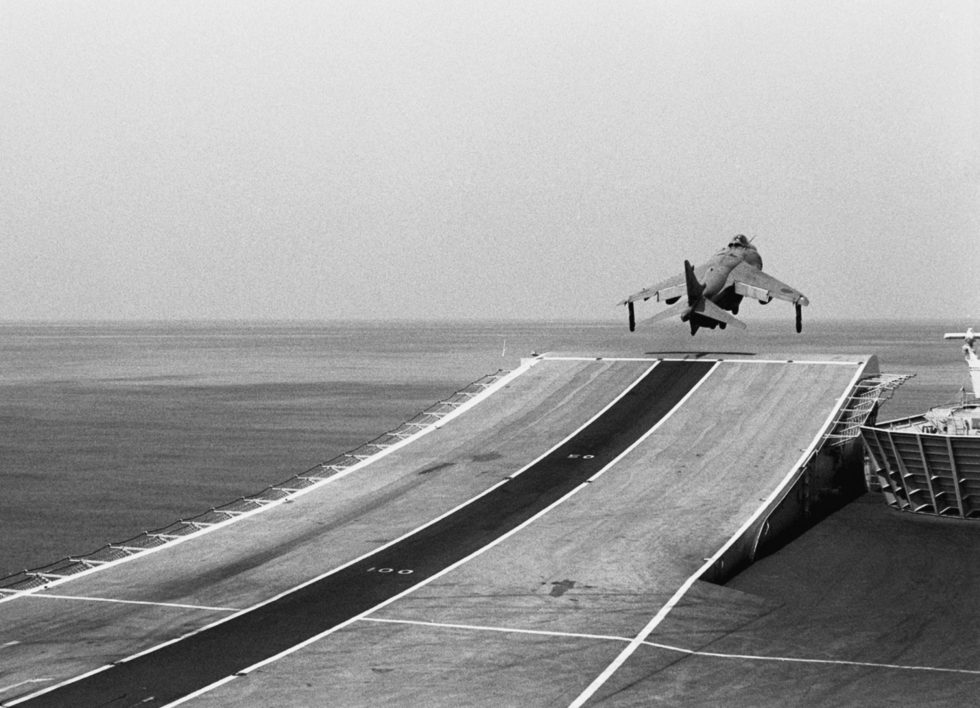
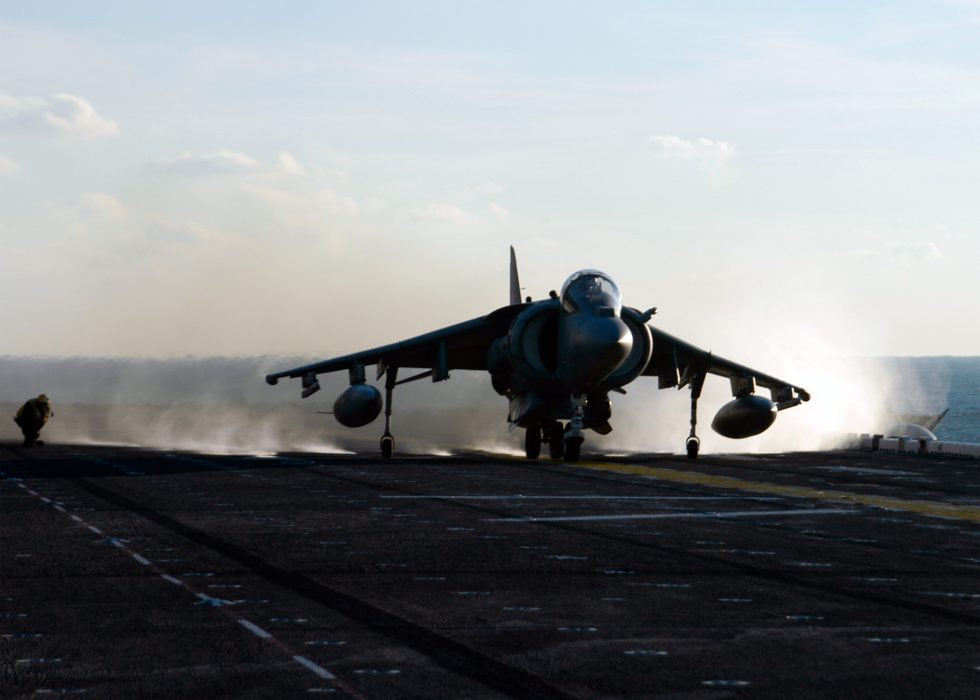
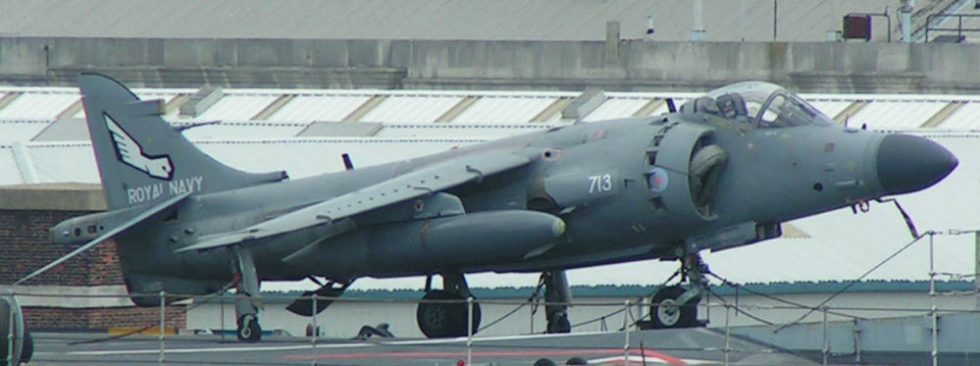
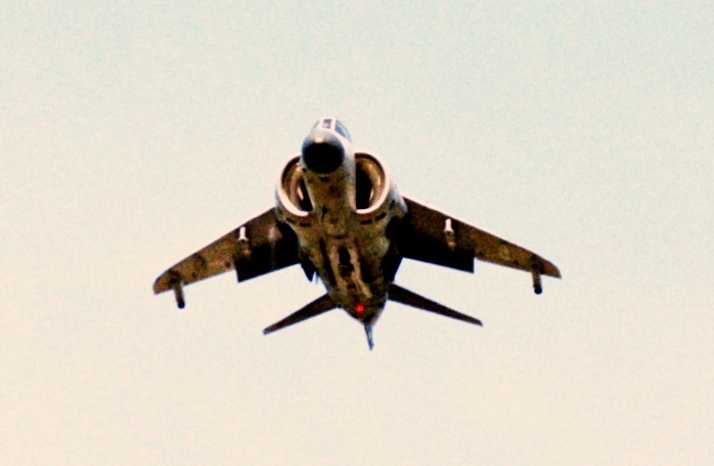
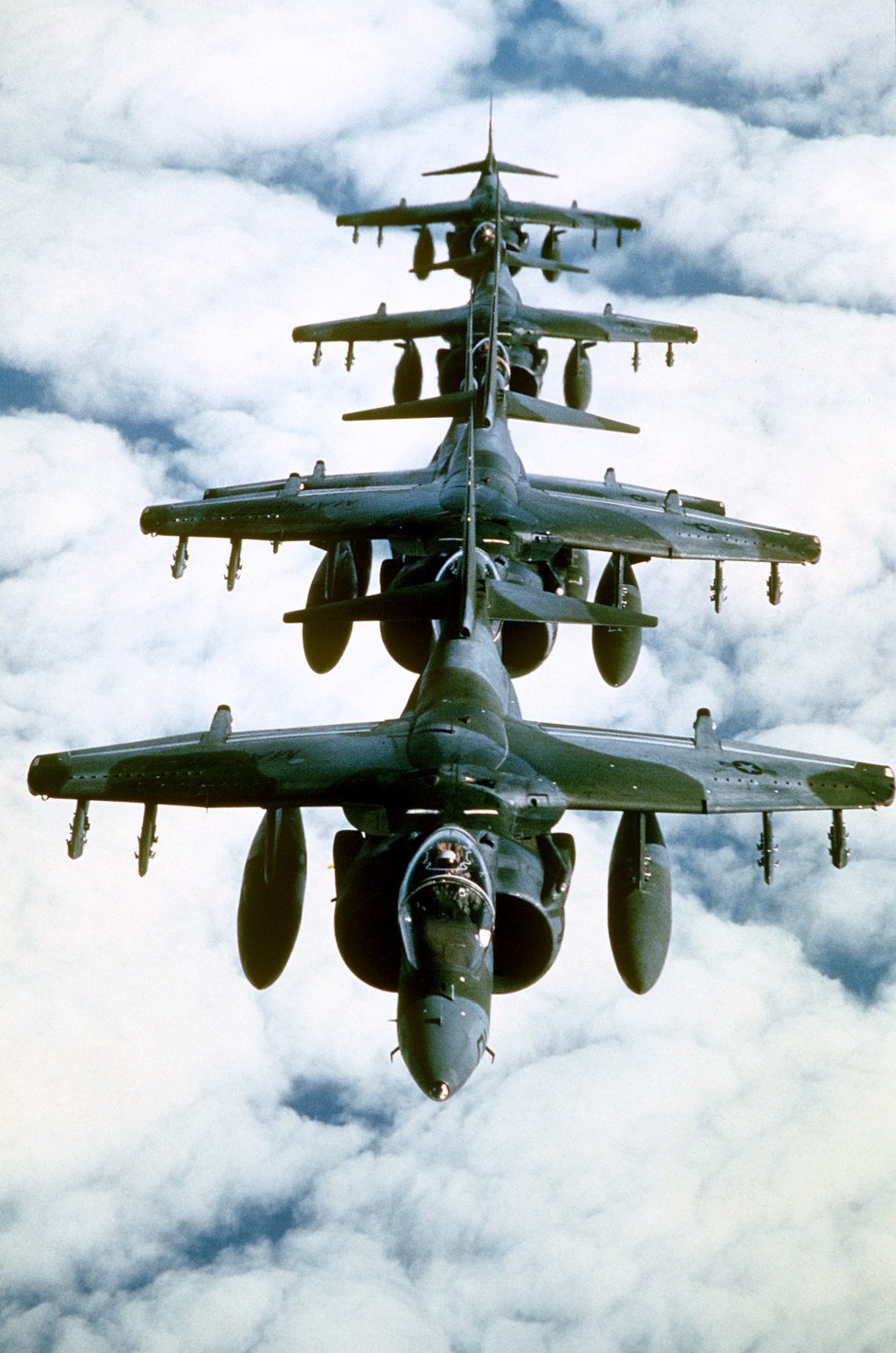
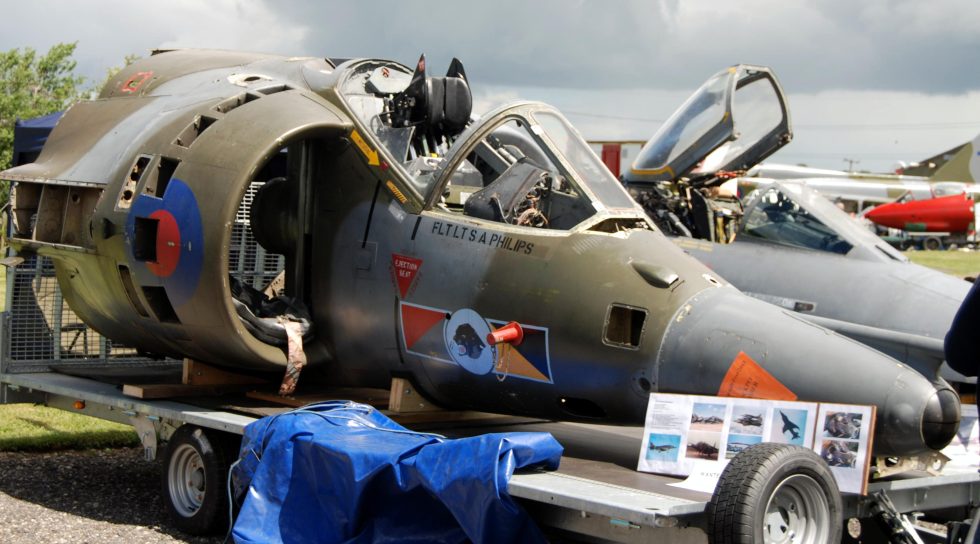
The Harrier in motion
A hand-picked Harrier video is on its way.
The Harrier in motion
Imperial War Museums — one of the most-watched Harrier films on YouTube.
Where the Harrier flew
Operators today
Two navies still fly the Harrier, and both are counting down
This is the shortest fleet chart on the site, and it is about to get shorter. The US Marine Corps — the operator that kept the Harrier alive for fifty years, bought more of them than anyone else, and took the casualties — flew its last AV-8B out of MCAS Cherry Point on 3 June 2026 and is shown here at zero. Only the Spanish and Italian navies still operate the type, and both are in run-out to the F-35B: Italy's Harriers are expected to go by about 2029, while Spain, having declined the F-35B, is buying up retired American airframes for spares in an attempt to keep a handful flying to roughly 2032 — which would make the Spanish Navy the last Harrier operator in the world, and would leave Spain with no embarked fixed-wing aviation at all when they finally stop.
These are estimates, and for fleets this small the error bars matter. Spanish and Italian totals are airframes on charge, not aircraft fit to fly on a given morning: the Spanish Navy's own figures cover eight new-build Harrier II Plus, five upgraded AV-8Bs and one TAV-8B, with several in upgrade or deep maintenance at any time, and Italian reporting in 2026 described only about half a dozen jets actually working from the carrier Cavour. Sources: Boeing and US Marine Corps retirement announcements, the Spanish Navy's published squadron establishment, IISS The Military Balance and FlightGlobal World Air Forces. Entries that could not be corroborated are omitted; no third-party aggregator dataset has been copied.
The jump jet that proved itself in battle
The Harrier’s combat career runs from the South Atlantic to the deserts of Iraq. Its most famous chapter is the 1982 Falklands War, where the Sea Harrier defended the British fleet against a numerically superior, faster air force — and won. Kill tallies from that campaign vary by source, so treat them as claims.
Compare the combat record of every military aircraft. Figures as of July 2026.
Everything people ask about the Harrier
Can I fly in a Harrier or Sea Harrier?
How fast is the Harrier?
Is the Harrier supersonic?
How does it hover?
What was its Falklands record?
Is the Harrier still in service?
How many Harriers were built?
What is VIFFing?
You can’t fly the Harrier.
These, you can.
Some legends only live in museums — others are fuelled and waiting. MiGFlug has put civilians in real military jet cockpits since 2004.
 Fly the L-39 AlbatrosThe world’s most-flown jet trainer — aerobatics included
 Fly the F-104 Starfighter“The missile with a man in it”
 Fly the MiG-21The Cold War’s most-produced jet
 Fly the T-33 Shooting StarAmerica’s first jet trainer
 Fly the DH VampireA piece of early jet history
 Fly the S.211Agile Italian jet trainer
 Fly the MB-326The classic Aermacchi jet
 Fly the MiG-15The Soviet legend of the Korean War
Continue the tour
Every fact, checked
- GlobalSecurity.org — Hawker Siddeley P.1127 KestrelDevelopment history of the P.1127 and Kestrel evaluation aircraft.
- MilitaryFactory.com — Hawker Siddeley Harrier / AV-8AProduction totals, variants and specification cross-check.
- Warfare History Network — The BAe Sea HarrierThe Sea Harrier and its Falklands combat record.
- The Aviationist — Sea Harrier, the forgotten hero of the FalklandsAnalysis of the 1982 air campaign and the AIM-9L.
- The Aviation Geek Club — A tense CAP over the FalklandsFirst-hand account of Sea Harrier combat air patrols.
- Flugzeuginfo.net — BAe Sea Harrier technical dataIndependent specification and performance figures.
- Purdue University Engineering — the Rolls-Royce PegasusHow the vectored-thrust Pegasus engine works.
- Dunsfold Airfield History Society — P.1127The airfield where the Harrier was born and tested.