
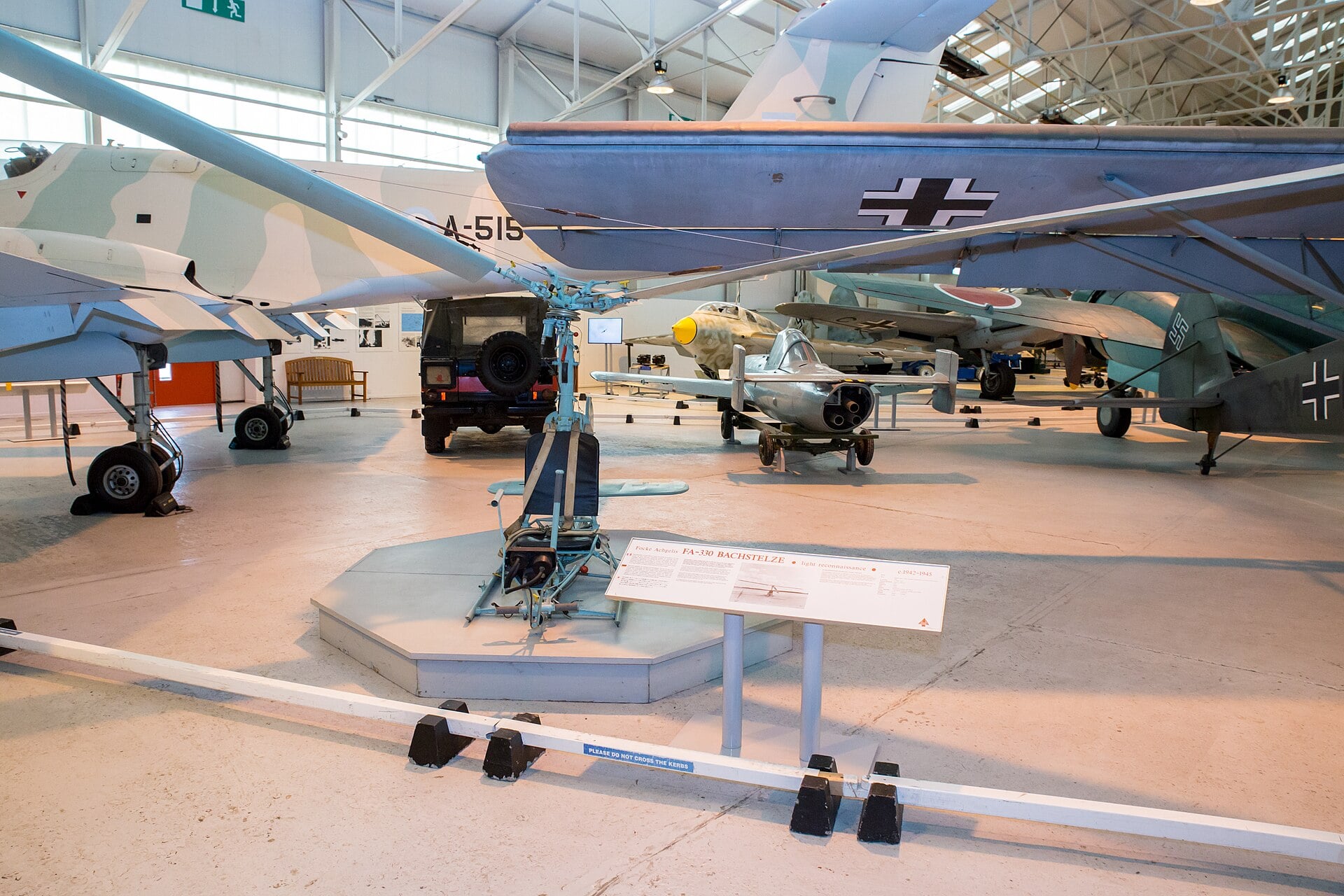
A submarine on the surface can see about five nautical miles. That is not a technology problem, it is a geometry problem: the lookout’s eyes are roughly five metres above the water and the earth curves away beneath him.
The German admiralty considered several solutions, including a folding seaplane. What it actually adopted was stranger and much simpler.
It put a man in a kite and flew him off the back of the boat on a steel cable.
Datos rápidos
| Aeronave | Focke-Achgelis Fa 330 Bachstelze (Wagtail), unpowered single-seat rotor kite |
| Diseñador | Henrich Focke, Focke-Achgelis GmbH; built by Weser Flugzeugbau |
| Primer vuelo | August 1942 |
| Número construido | About 200 |
| Rotor | Three blades, 7.32 m diameter |
| Weights | 68 kg empty, 148 kg maximum |
| Tow speeds | 40 km/h cruise, 80 km/h never-exceed, 27 km/h minimum control |
| Operating height | About 120 m |
| Confirmed sinkings | One: the Greek steamer Efthalia Mari, 6 August 1943 |
| Operators | Type IXD2 U-boats of the Monsun Gruppe |
Physics, not magic
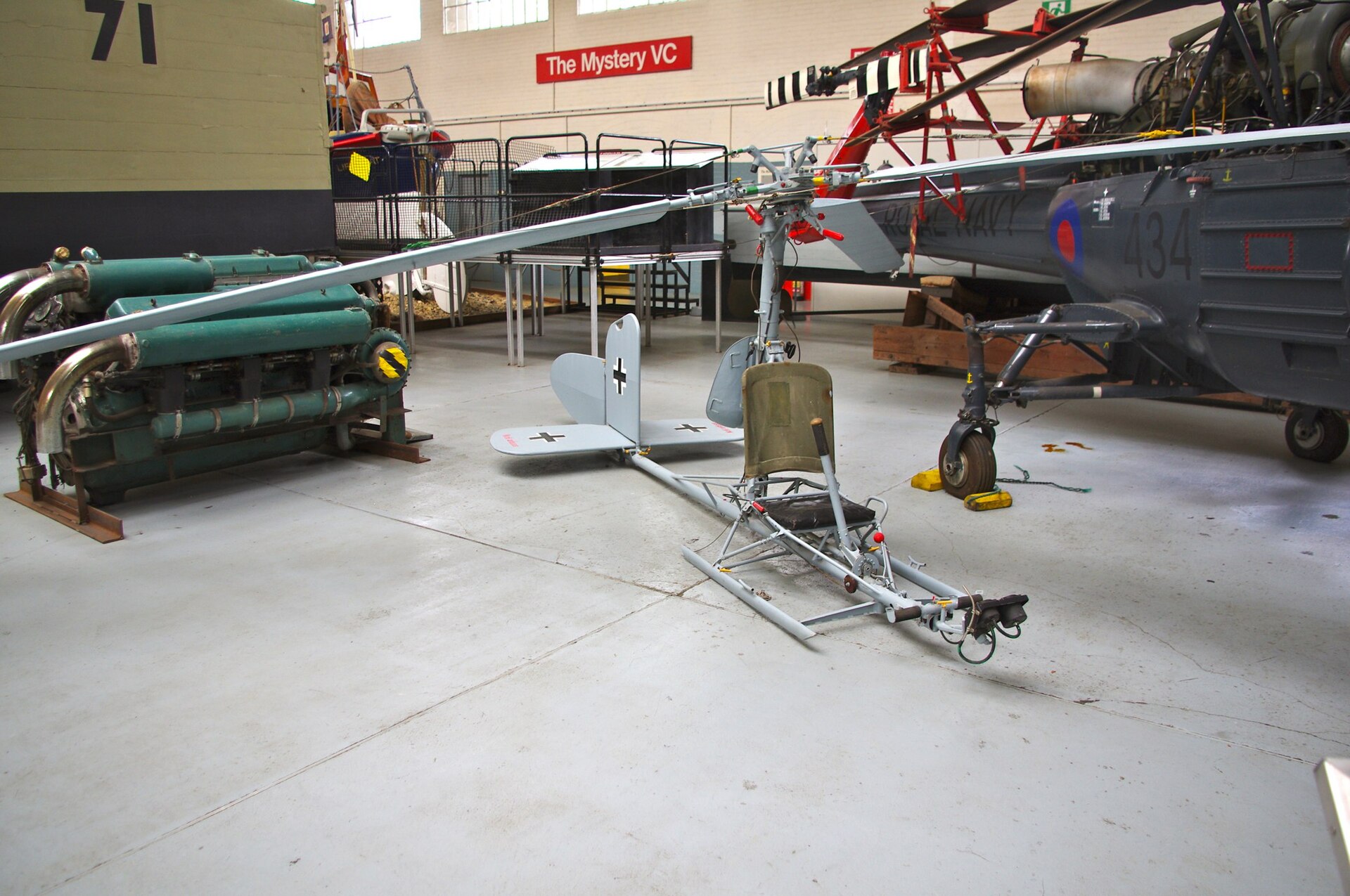
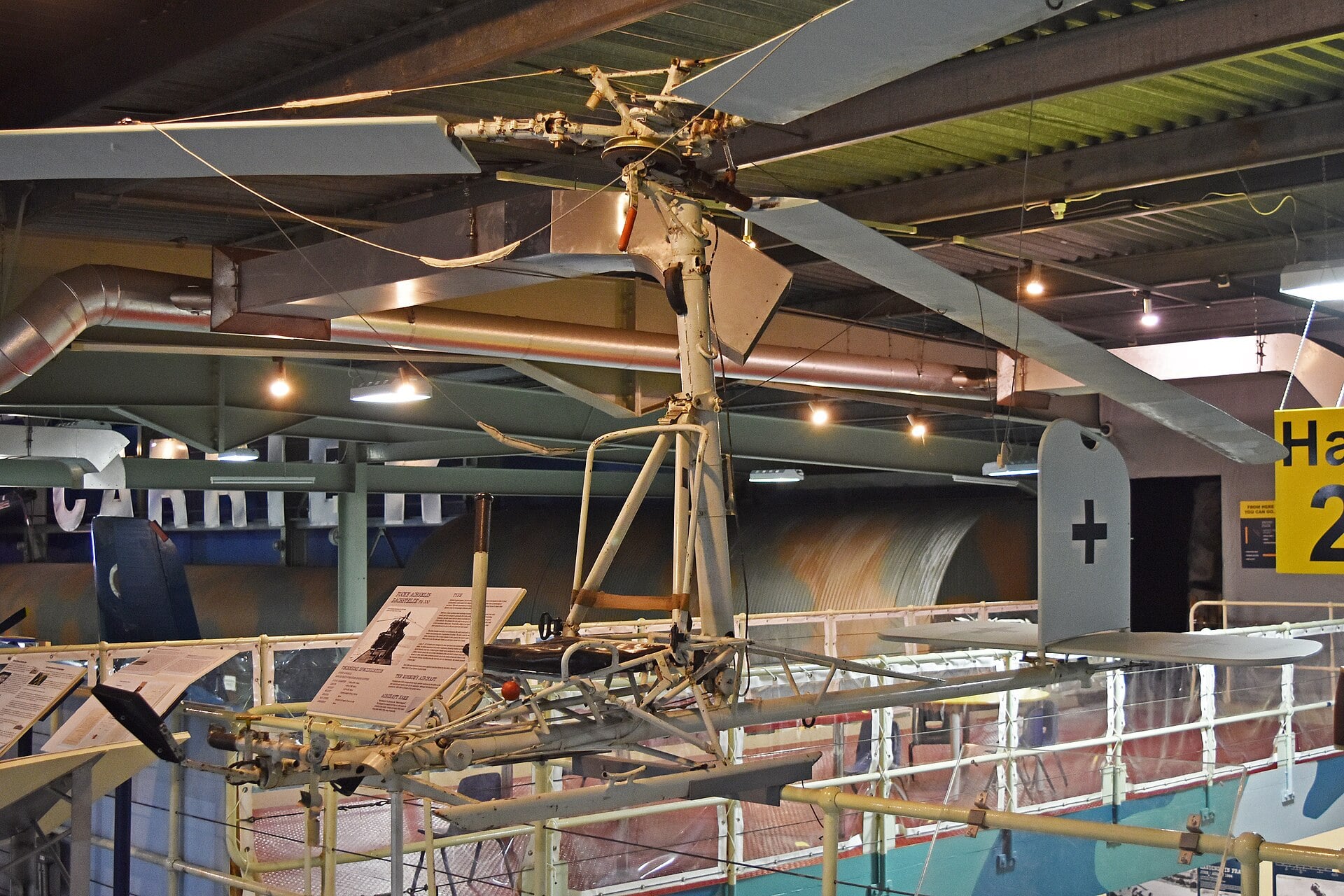
The Fa 330 had no engine and never needed one. A U-boat motoring on the surface drags air through the rotor disc, the blades autorotate, and the disc generates lift. Same principle as a modern autogyro, with the submarine playing the part of the engine.
Four men could assemble it on a small platform on the anti-aircraft gun deck behind the conning tower. In calm weather that took about four minutes. Stowage was two watertight canisters four metres long, one for the blades and tail, one for the fuselage, plus a small horizontal canister for the winch and cable.
The observer had a stick for pitch and roll, two pedals for yaw, three instruments, and an interphone whose wire was wound around the towing cable so he could report what he saw. At 120 metres his horizon opened from five nautical miles to about twenty-five.
What it was like to be on the end of the wire
Otto Giese served aboard a boat fitted with a Bachstelze and described it plainly in his memoir.
Note the cable length. Giese remembered 150 metres; the technical descriptions say 300. Both figures appear in the literature and nobody has reconciled them, which is a useful reminder that memoirs and manuals rarely agree.
The Allies took one apart and wrote it up
In May 1944 the Royal Navy captured U-852 intact, and with it a complete Fa 330. The resulting Allied intelligence report is fascinating precisely because of how carefully hedged it is.
“It is believed.” “It appears.” “Presumably.” The report describes the jettison lever, the parachute canister behind the seat, the rubber stop blocks limiting blade coning, even the rope pulley for spinning the rotor up by hand. What it could not tell the Admiralty was whether the thing actually worked.
One ship. That is the entire score.
Two hundred were built. The Fa 330 contributed to exactly one sinking: U-177 spotted, intercepted and sank the Greek steamer Efthalia Mari on 6 August 1943.
The reason is not that the aircraft failed. It is that using it required the U-boat to do the single most dangerous thing a U-boat can do: run on the surface at a predictable speed on a predictable heading, unable to dive quickly, with a man on a wire behind it and a large radar return above it.
By the time the Fa 330 was cleared for operations in early 1943, Allied air cover had made that lethal across most of the Atlantic. So it was restricted to the emptiest water available, flown by the long-range Type IXD2 boats of the Monsun Gruppe.
Even there the record is thin and occasionally comic. U-181’s kite broke and was lost on its first attempt to fly. U-861 spotted a ship off Madagascar in September 1944 and the ship escaped in the time it took to winch the observer back down. U-862 and U-196 reached Penang and traded their Bachstelzen to the Japanese for a floatplane.
The one that got away with it
The best Fa 330 story has nothing to do with sinking anything. In June 1944 U-862 ran into thick fog in the Denmark Strait. The boat put its Bachstelze up, the observer climbed above the fog layer, and from there he navigated the submarine out into the Atlantic.
That is an aeroplane doing exactly what an aeroplane is for: seeing something a man at sea level cannot.
After the war the British towed Fa 330s behind ships and jeeps and found they worked perfectly well. By then the helicopter had arrived and nobody needed a kite. But the idea did not die: it gave Igor Bensen the enthusiasm that produced the B-8 and the modern gyrocopter movement, and as recently as 2013 an American defence contractor was testing an unpowered tethered autogyro as a cheap alternative to a shipborne helicopter.
Eighty years on the geometry has not changed. The horizon is still five miles from the deck, and it is still cheaper to lift an observer than to build a carrier.
Preguntas frecuentes
What was the Focke-Achgelis Fa 330 Bachstelze?
How did the Fa 330 fly without an engine?
How high did the Fa 330 fly and how far could the observer see?
How many ships did the Fa 330 help sink?
Why was the Fa 330 barely used?
How did the pilot get down in an emergency?
Do any Fa 330s survive?
Did the Fa 330 influence later aircraft?
Sources: Wikipedia; Lawrence Paterson, Hitler’s Grey Wolves; Otto Giese, Shooting the War; Allied intelligence report via Lone Sentry; Smithsonian National Air and Space Museum; National Museum of the US Air Force.
0 Comments