F-47 and F/A-XX: The Industrial Base Problem Nobody Solved

by | Sep 17, 2026 | Aviación militar, Noticias | 0 comments

When the Pentagon shelved the Navy’s sixth-generation fighter last year, the official reason was that American industry could not develop and build two of them at once. A lot of people did not believe it.

The Air Force general who advises the Pentagon on buying major weapons has now said, on the record, that the worry is real — and also that it is not really about the two fighters at all.

Gen. Dale R. White, Director of Critical Major Weapon Systems and the senior acquisition adviser to the Secretary of the Air Force, spoke to reporters at the Air & Space Forces Association’s Air, Space & Cyber Conference on 15 September 2026. His verdict on the F-47: on track, flying within two years, no problems visible. His verdict on the industrial base that has to build it: less cheerful.

Datos rápidos

OMS: Gen. Dale R. White, Director, Critical Major Weapon Systems

Cuando: Media roundtable, AFA Air, Space & Cyber Conference, 15 September 2026

F-47: Boeing-built USAF sixth-generation fighter; first airframe in production about a year; first flight expected 2028

F/A-XX: The US Navy carrier-based sixth-generation fighter; Boeing and Northrop Grumman still competing

The snag: A prime-contractor decision was expected by August 2026 and has not come

White’s concern: Capacity of the industrial base overall, in people and in production rate

His caveat: The problem is “not unique” to F-47 or F/A-XX

The quiet part, said out loud

Asked about the Navy’s difficulties building its own sixth-generation fighter alongside the F-47, White did not reach for reassurance.

“Really, it’s just being able to manage the overall resourcing as it relates to number one, people resources. Number two, when you start getting into the production conversation, do we have enough capacity to be able to produce at that rate? And so, by and large, I have concerns. I have concerns about the capacity of our industrial base, but they are not unique to F-47 or to any program.”
Gen. Dale R. White — Director, Critical Major Weapon Systems, US Air Force, 15 September 2026

That last clause is the interesting one. The original justification for putting F/A-XX on ice was specific: two sixth-generation fighters at the same time is one too many. White’s framing is broader and, if anything, more worrying. The constraint is not the fighters. The constraint is everywhere.

“We’re seeing it in multiple platforms. And so what we’re having to do is, at some point, we’re having to make some trade space in between some of these.”
Gen. Dale R. White — Director, Critical Major Weapon Systems, US Air Force, 15 September 2026

“Trade space” is acquisition language for something losing. White did not say which programmes, and nobody in the room was going to get him to.
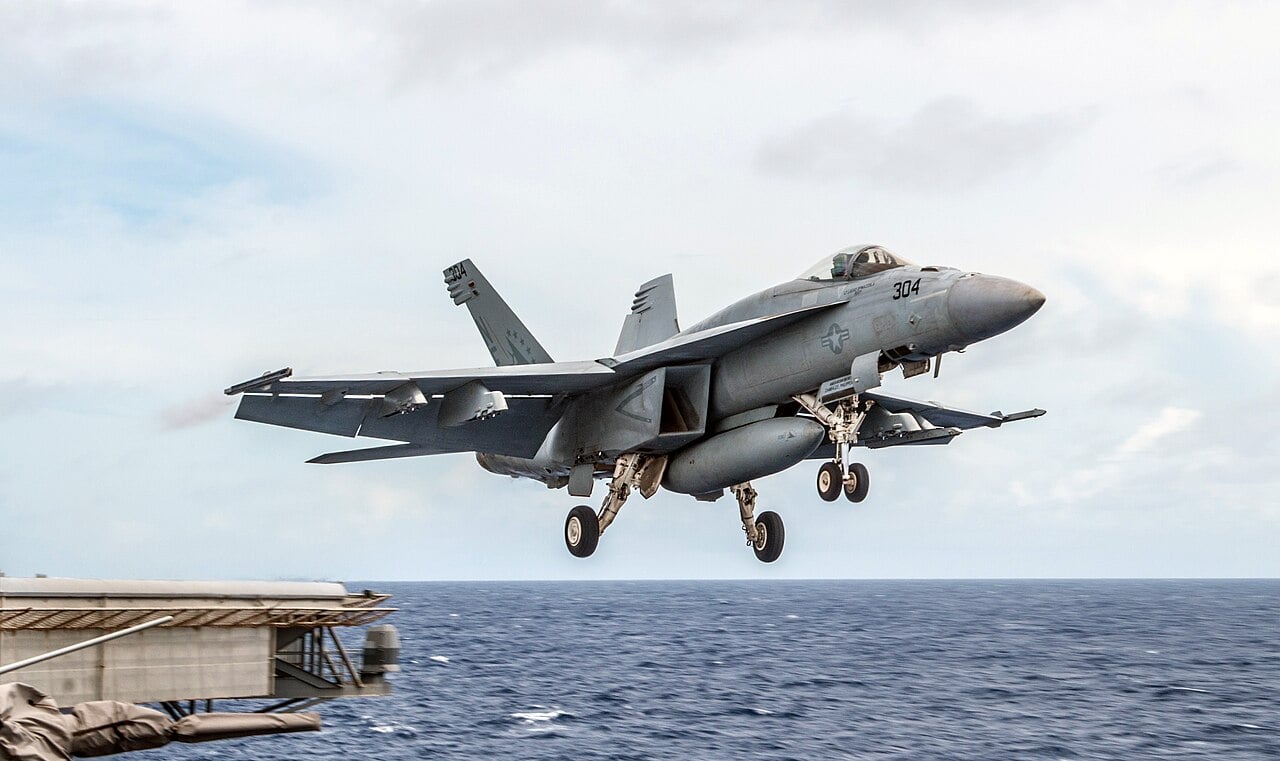
A US Navy F/A-18E Super Hornet launching from the flight deck of USS Ronald Reagan
The aircraft the F/A-XX is meant to succeed: an F/A-18E Super Hornet leaving USS Ronald Reagan. The Navy still has no prime contractor for its replacement. US Navy photo

The F-47 is, by his account, fine

On the Air Force side, White was unambiguous. The programme “continues to progress exceptionally well,” and the long run-up matters.

“As you know, many, many years in tech maturation and risk reduction gave us a tremendous head start on this program … We are still absolutely on path to be able to hit the mark of flying within this administration. So we see no issues in front of us right now.”
Gen. Dale R. White — on the F-47 programme, 15 September 2026

He also had a specific compliment for Boeing, which is not a sentence that has appeared often in defence reporting recently: the company is making “smart investments” and pouring in capital expenditure. The caution that followed was about sequence, not willingness — the design has to be closed out before flight test and software milestones arrive.

The first F-47 has been in production for roughly a year. First flight is expected in 2028.

The Navy is still waiting

The contrast is stark. The Air Force has an aeroplane being built. The Navy does not yet have a company to build one.

F/A-XX has been in and out of limbo for over a year: shelved in a budget proposal, rescued by Congress, then promised a decision by August 2026 that did not arrive. Boeing and Northrop Grumman remain the two competitors. Asked last week, a Navy official offered the most content-free sentence available: the programme remains on track, and there is no further information to provide.

The Chief of Naval Operations has been more candid about why the Navy wants it at all, and his argument is not the one people expect.

“One of the challenges we’re seeing is, not only are our peer competitors improving their capability for anti-air, either air-to-air or surface-to-air, but the lower cost of entry of very capable weapons is also making more players on the field in which that level of stealth and technology is required … This is just having an aircraft that can operate with a level of uncertainty and with the acceptable level of risk.”
Almirante Daryl Caudle — Chief of Naval Operations, speaking at Sea-Air-Space, April 2026

In other words: it is not about China alone. Capable air defences are getting cheap enough that second-tier opponents can field them, which is precisely the lesson the last year has been teaching in Yemen and Iran.

One jet, two services?

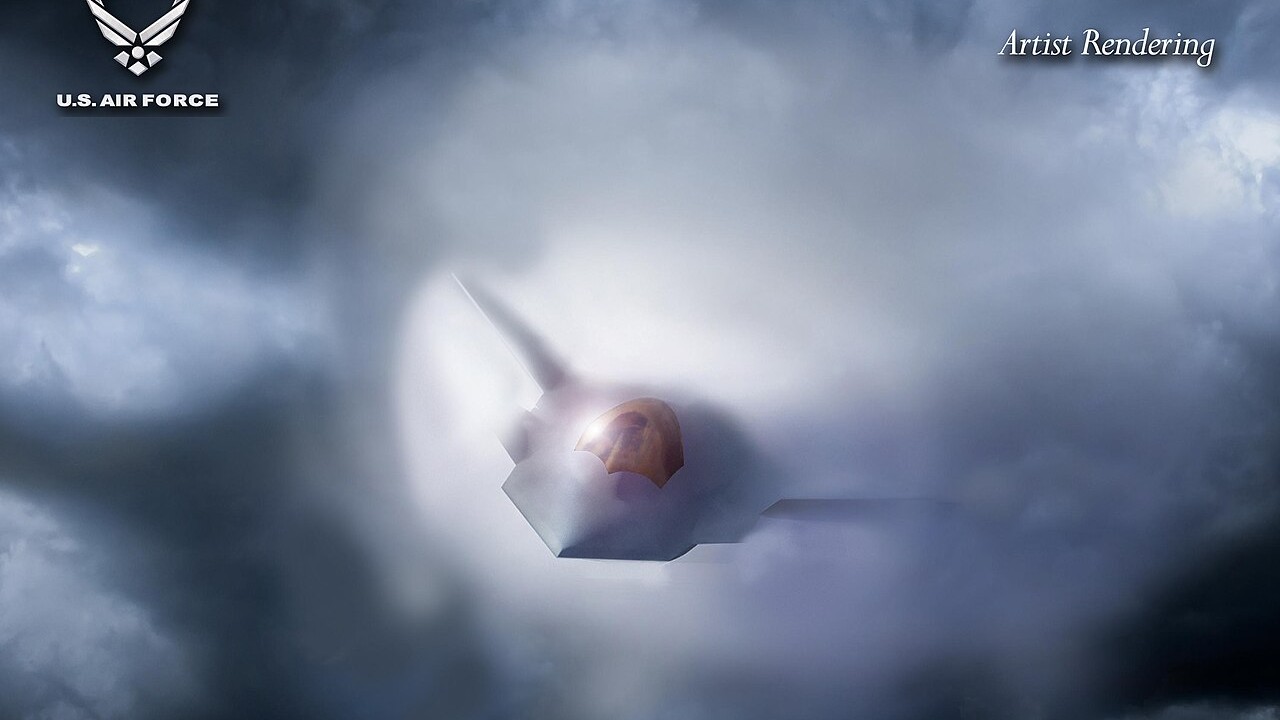
There is an obvious way to make the industrial-base problem smaller, and Boeing being a finalist for both programmes makes it hard to ignore. If the Navy picks Boeing, F/A-XX could end up as a navalised relative of the F-47 rather than an entirely separate aircraft.

Boeing’s own published F/A-XX concept art looks conspicuously like its F-47 artwork, a resemblance that has not gone unnoticed.

Commonality would cut risk and cost, and there is already meaningful sharing between the two services’ sixth-generation efforts. It would not be free. Turning a land-based design into a carrier aircraft is historically where optimism goes to die — the structure, the approach speed, the landing gear and the corrosion environment all impose their own tax. And building both at volume still needs the capacity White is worried about.

The decision on who builds F/A-XX is expected in the coming weeks. Until then, the honest position is the one the general took: the F-47 looks healthy, and the system that has to produce it does not entirely.

Sources: TWZ; Air & Space Forces Magazine; US Air Force; US Navy.
Preguntas frecuentes

What did Gen. Dale White say about the F-47 and F/A-XX?
At a media roundtable on 15 September 2026 he said the F-47 is progressing exceptionally well and remains on course to fly within this administration, but that he has concerns about the capacity of the US industrial base in both people and production rate. He stressed those concerns are not unique to either fighter programme.
Why was the Navy F/A-XX programme shelved?
The Pentagon justified sidelining it partly on the grounds that American industry could not simultaneously finish developing and then produce two extremely complex new fighters. The reasoning was contested at the time. Congress subsequently intervened and the programme is described as back on track.
When will the F-47 fly?
First flight is expected in 2028. The first airframe has been in production for about a year, and Gen. White said in September 2026 that the programme remains on path to fly within the current administration, with no issues currently visible to him.
¿Quién está construyendo el F/A-XX?
Nobody yet. Boeing and Northrop Grumman remain the two competitors for the US Navy sixth-generation carrier fighter. A prime contractor decision was expected by August 2026 but has not been announced, and a Navy official said in September only that the programme remains on track.
Could the F/A-XX be a navalised F-47?
It is possible if Boeing wins, and the company has published F/A-XX concept art that closely resembles its F-47 artwork. Commonality would reduce cost and risk, but adapting a land-based design for carrier operations brings significant structural and operational penalties.
¿Qué es el F-47?
The US Air Force sixth-generation fighter being built by Boeing, the winner of the Next Generation Air Dominance competition. It follows many years of technology maturation and risk-reduction work, including X-plane demonstrators, which officials credit with giving the programme an unusually fast start.
Why does the Navy still want a new carrier fighter?
The Chief of Naval Operations has argued the driver is not only peer competitors improving their air defences, but the falling cost of capable anti-air weapons putting more actors on the field. That makes stealth and advanced technology necessary against opponents well short of a peer adversary.
Can civilians fly in a fighter jet?
Not a sixth-generation one, but genuine fast-jet flights are available to civilians in types such as the MiG-29, L-39 Albatros and Hawker Hunter, including supersonic and edge-of-space sorties. MiGFlug arranges them; current types and prices are on the Página de vuelos y precios.

Publicaciones relacionadas

0 Comments

Submit a Comment

Your email address will not be published. Required fields are marked *