
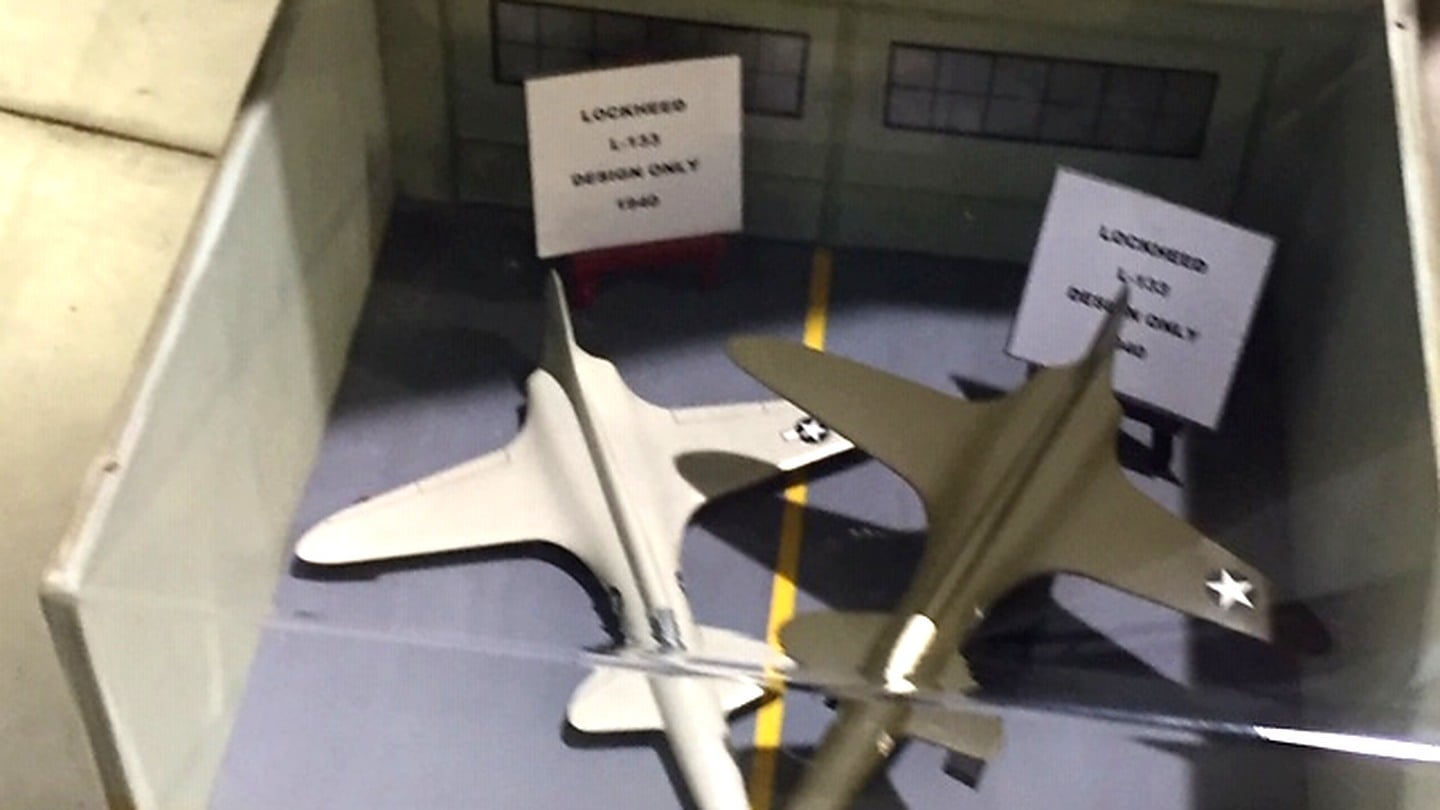
In March 1942, while the United States was still flying propeller fighters and would be for the rest of the war, Lockheed handed the Army Air Forces a proposal for a twin-engined jet with a canard foreplane, a blended wing and body, and a predicted top speed of 612 mph.
The Army looked at it and said no. Not because it was bad. Because it was too advanced.
Datos rápidos
| Designation | Lockheed L-133-02-01 |
| Diseñadores | Clarence “Kelly” Johnson, Willis Hawkins and Hall Hibbard |
| Work began | 1939, as company-funded paper projects |
| Submitted | 30 March 1942, to the US Army Air Forces |
| Motores | Two Lockheed L-1000 axial-flow turbojets, 5,100 lbf each |
| Disposición | Canard foreplane, blended wing-body, slotted flaps |
| Predicted speed | 612 mph (985 km/h) in level flight |
| Rango | Only 310 miles (500 km) |
| Armamento | Four 20 mm cannon in the nose |
| Construido | None. The design never left paper |
America’s first jet was a Lockheed, and it was a drawing
Lockheed was the first American company to start work on a jet aircraft. In 1939 Johnson, Hawkins and Hibbard began a series of paper projects; by 1940 the company was funding preliminary work on a jet fighter itself, without a contract.
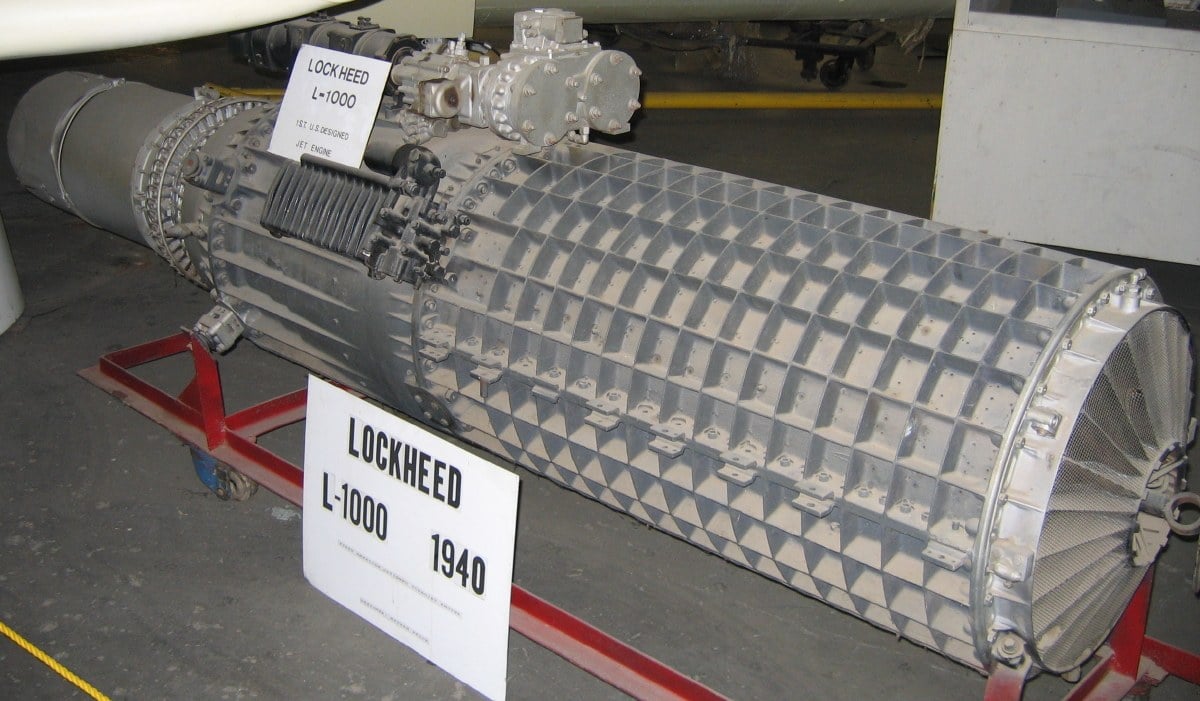
They were also building their own engine. The L-1000 was an axial-flow turbojet of Lockheed’s own design, which mattered enormously, because axial flow is the architecture every modern jet engine still uses. Britain’s Whittle engines and the American derivatives that followed were centrifugal: simpler, fatter, and a dead end for high performance.
The shape was sixty years early
Look at the configuration and count how many ideas arrived decades later. A canard foreplane, which the West would not put on a production fighter until the Viggen in the 1970s. A blended wing-body, which is how the F-16 and everything after it manages lift and volume. Two engines buried in a low-drag integral fuselage, which is the Me 262’s opposite and the F-22’s ancestor.
There was one very practical piece of conservatism in there. The main wing was essentially the outer wing panels of the P-38 Lightning, an aerofoil Lockheed already understood and had tooling for.
El Planes That Never Flew episode on the L-133, cited by Wikipedia as a source on the design.
Why the Army said no
The USAAF judged the L-133 too advanced to pursue, and from a 1942 standpoint that was not cowardice. Two unproven engines of a new architecture, a layout nobody had flown, and a fighter with a combat radius so short that 310 miles was the total range. In a war being fought across oceans, that last number is close to disqualifying on its own.
The consequences ran in two directions. Lockheed’s design experience fed straight into the P-80 Shooting Star, America’s first operational jet fighter. But because the L-133 was not approved, the L-1000 engine lost its reason to exist and its development stalled in long pauses.
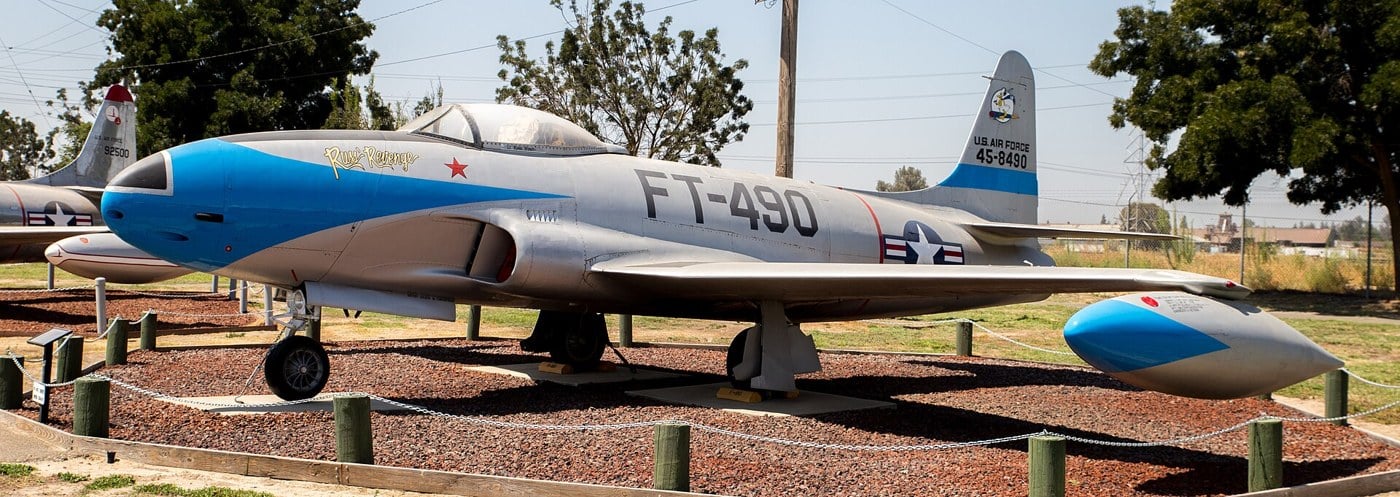
So when the P-80 needed a powerplant, the quickest answer was the Allison J33, derived from British centrifugal practice. America’s first operational jet fighter flew on an engine architecture its own industry had already moved beyond on paper four years earlier.
The cost of being right too early
It is easy to write the L-133 as a tragedy of official timidity. The more interesting reading is that both sides were correct. Lockheed was right about where jet aircraft were going. The Army was right that a wartime air force cannot bet on two unproven technologies at once and a fighter that runs out of fuel in 310 miles.
What the episode really cost was the engine. An American axial-flow turbojet programme, running from 1940 with a customer behind it, would have changed the shape of the early jet age. Instead the L-1000 drifted, and the United States spent the next decade catching up on an architecture it had thought of first.
The L-133 was never built, never flown, and never given a serial number. Two desktop models in a display case at Chino are most of what physically survives of the first American jet fighter.
Sources: René J. Francillon, Lockheed Aircraft since 1913 (Putnam, 1982); Bill Norton, U.S. Experimental & Prototype Aircraft Projects: Fighters 1939–1945 (Specialty Press, 2008); Planes of Fame Museum. Note: published figures for the predicted top speed vary between 612 and 625 mph; 612 mph is the figure consistent with the quoted 985 km/h.
0 Comments