
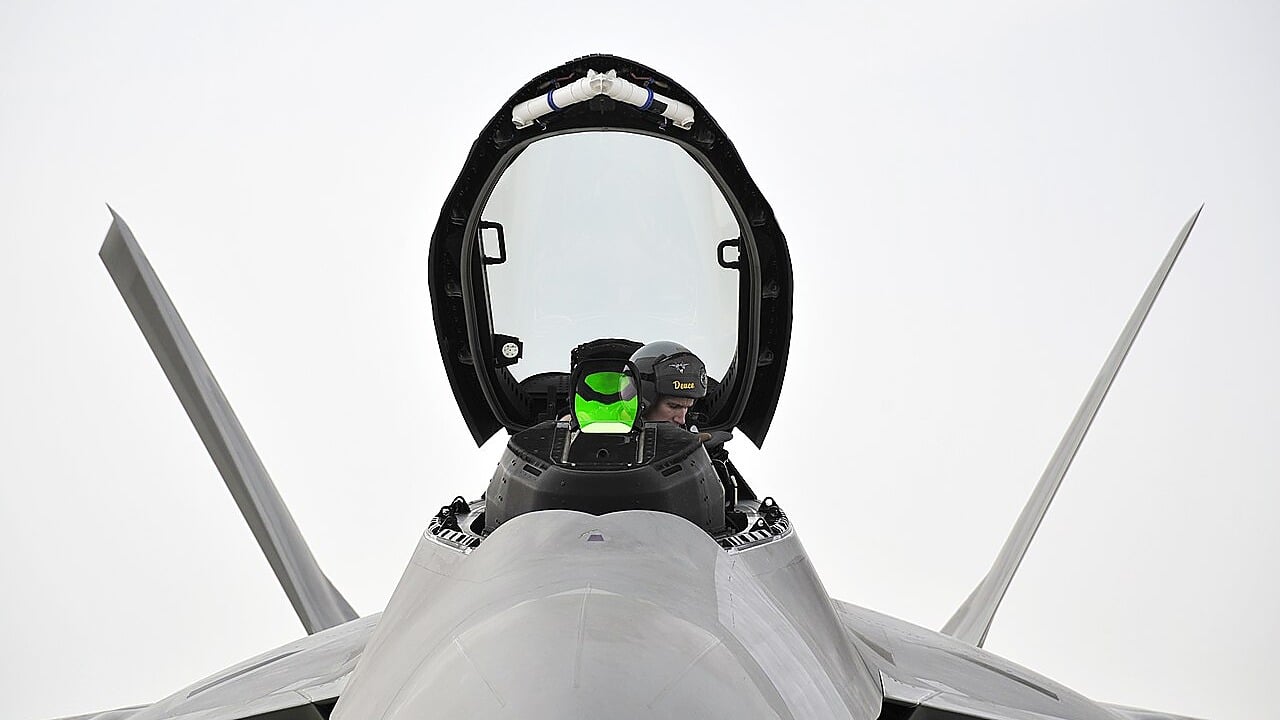
Ask most people what a fighter pilot breathes and the answer comes back instantly: pure oxygen. It is one of those facts everyone knows, it was broadly true for about forty years, and today it is wrong in two separate directions. Modern fighters cannot make pure oxygen. And at low altitude they are forbidden from delivering anything close to it.
The governing document says so in one sentence. MIL-STD-3050, the US military standard for aircraft crew breathing systems, states that in order to reduce the incidence of acceleration atelectasis and delayed otitic barotrauma, oxygen concentration in the inspired gas shall not exceed 60 percent at cabin altitudes between sea level and 15,000 feet. Not should not. Shall not.
That standard exists because of a decade-long mystery that grounded the most expensive fighter America has ever built, put two serving officers on national television, and ended without anyone being able to name a single root cause. This is the story of the box that makes the air, and why it turned out to be harder than anyone expected.
Datos rápidos
- What OBOGS is: On-Board Oxygen Generating System — pressure swing adsorption over zeolite beds
- Feed gas: Engine compressor bleed air (ninth stage on the F-22)
- Maximum purity: About 95 percent; the balance is mostly argon
- Low-altitude limit: 60 percent oxygen below 15,000 ft cabin altitude (MIL-STD-3050)
- Why the limit exists: Acceleration atelectasis and delayed otitic barotrauma
- Pressure breathing starts: Around 38,000 ft, against a theoretical 40,000 ft
- F-22 fleet stand-down: 3 May 2011 to 21 September 2011
- T-45 fleet pause: 5 April 2017, 197 aircraft; OBOGS flying resumed 18 July 2017
- Root cause: Never resolved to one factor — officially multifactorial
The box that makes the air
An on-board oxygen generating system does not store oxygen. It manufactures it, continuously, from air the engine has already compressed. Hot high-pressure bleed air is cooled through heat exchangers and pushed through beds of synthetic zeolite — a molecular sieve. Nitrogen molecules have slight polarity and stick to the sieve; oxygen and argon do not, and pass through. Drop the pressure and the nitrogen is released and vented overboard, and the bed is ready for the next cycle. Two or three beds alternate so the flow never stops. The waste stream is roughly 17 percent oxygen and 82 percent nitrogen, which is to say it is slightly worse than the air outside.
This is also why an OBOGS cannot make pure oxygen, ever. MIL-STD-3050 explains the ceiling plainly: oxygen and argon are both concentrated because the molecules are similar in size and non-polar, so only the nitrogen can be preferentially separated. The maximum concentration obtainable under ideal conditions is approximately 95 percent, with the balance mostly argon. Squeezing out that last few percent would take a second purification stage nobody has wanted to carry. The argon is inert and physiologically irrelevant, so it simply rides along.
Real aircraft sit a little under that ceiling. The US Air Force Scientific Advisory Board recorded concentrators producing 93 to 94 percent depending on temperature, pressure and cycle time. And the output is not a fixed number — it is scheduled. On the F-22 Raptor and the F-35 the system varies the charge and purge timing of the sieve canisters to hit the right partial pressure of oxygen for the altitude the cockpit is currently at. Older types such as the F-15E, F-16 and A-10 run their concentrator flat out and dilute the product downstream in the regulator instead. Across the whole envelope MIL-STD-3050 allows concentration to range anywhere from 40 to 95 percent.
A US Navy training film walking through the F/A-18E/F OBOGS hardware itself — rarely seen outside the fleet.
Why pure oxygen is the wrong answer low down
The obvious question is why anyone would cap the output at all. If the pilot is fine on 94 percent at 40,000 feet, why dilute it back to 60 percent on the runway?
Because the lungs are too good at absorbing oxygen. Fill an alveolus with nearly pure oxygen and the blood can take it up faster than breathing can replace it. Nitrogen, which the body does not absorb, is what normally holds the alveolus open. Remove it and small airways start to collapse. The clinical term is absorption atelectasis. Add G-loading and it becomes acceleration atelectasis, and it stops being a laboratory curiosity.
The research behind the 60 percent number is older than most of the aircraft flying it. In the 1980s Tacker and colleagues put twelve subjects through aerial combat manoeuvres between 4.5 and 9 G and found that above 5 G as much as half the pulmonary airways were distorted or closed, cutting vital capacity by up to 20 percent. Haswell and Tacker established that the effect became significant above roughly 70 percent inspired oxygen. A 2021 replication in Experimental Physiology found acceleration atelectasis after one minute at a steady 5 G, and evidence that as little as 30 seconds of exposure could trigger it.
There is a cruel twist buried in that work. The anti-G suit makes it worse, by pushing the diaphragm up and compressing the lungs from below. The pilot’s protective equipment and the pilot’s breathing gas are pulling against each other. What relieves it is a cough, a deep breath, an anti-G straining manoeuvre, or positive pressure breathing at around 30 mmHg. British aviation medicine of the 1950s had a nickname for the symptom, earned on an aircraft that supplied 100 percent oxygen: Hunter lung.
Which is how you end up with a standard that reads like a compromise, because it is one. Sixty percent below 15,000 feet, 75 percent at 20,000, rising to a flat 94 percent above 30,000. The logic is that crews are very unlikely to be pulling sustained G above 15,000 feet of cabin altitude, so the atelectasis risk and the hypoxia risk can be traded against each other by altitude band.
Getting rid of the LOX cart
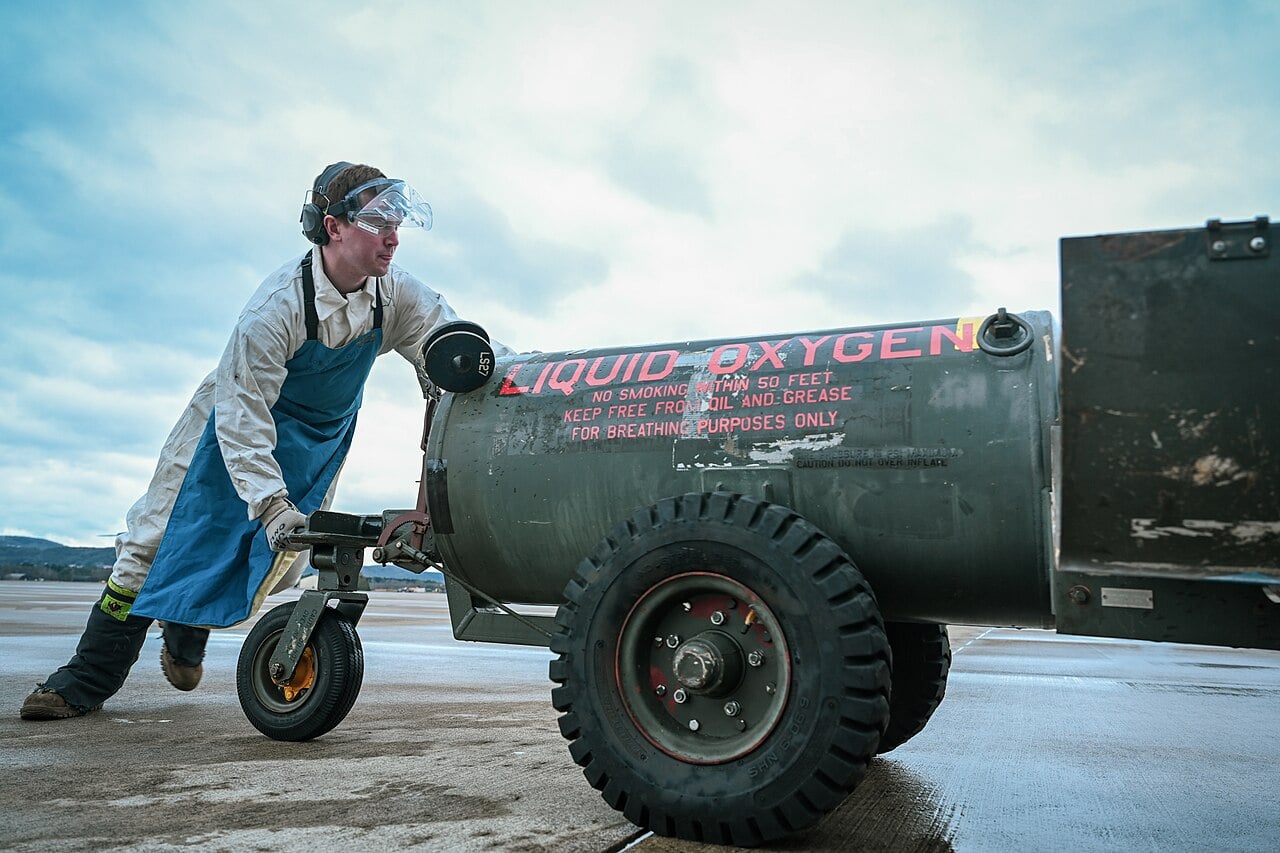
Before OBOGS there was liquid oxygen, and a ground crew wheeling a vacuum-insulated converter out to every aircraft before every sortie. It worked, and the reasons the military wanted rid of it are listed in MIL-STD-3050 with unusual candour: eliminating liquid oxygen storage and the support equipment, eliminating the vulnerability of a base LOX facility, no longer having to buy LOX at a deployed location, eliminating the safety issues of servicing aircraft with it, the long-term cost of using it, and removing the cases where the crew’s oxygen supply was what limited the aircraft’s range.
NATO’s own technical survey of the era was blunter still. LOX systems were wasteful of oxygen, needed complex dispensing equipment, required time to build pressure after charging, and demanded strict precautions against contamination at every stage. The contamination mechanism is nastier than it sounds: impurities have higher boiling points than liquid oxygen, so they accumulate in the converter until a slug of concentrated contaminant finally passes through the warming coil and into the pilot’s mask. The Scientific Advisory Board found the same thing in the safety record of the F-15A to D, which still uses LOX today — most incidents traced to mechanical failure, hose routing, or contaminated liquid oxygen.
The rollout took decades. The AV-8B Harrier II was the first US production combat aircraft to carry one, approved for production in November 1984 after trials at Patuxent River and Yuma. The B-1B was the first operational Air Force molecular sieve system. The F-16 is the surprise: it flew successful OBOGS tests at Hill AFB in 1982 and 1983, but jets delivered before 1997 still came with a LOX system, with OBOGS arriving on new Block 50 aircraft and retrofitted later. Fourteen years between a successful test and a production fit. On the F-14D and F/A-18C/D the Navy simply dropped the concentrator into the space the LOX converter had occupied.
Then the Raptor started making pilots sick
On 3 May 2011 Air Combat Command grounded the entire F-22 fleet. It stayed grounded until 21 September — four and a half months of the United States’ premier air superiority fighter sitting in its shelters because pilots were reporting hypoxia-like symptoms nobody could explain.
The numbers are worth getting right, because almost every account garbles them. Major General Charles Lyon, who led the Air Force’s F-22 Life Support Systems Task Force, told the House Armed Services Committee in September 2012 that the fleet had experienced six physiological incidents over its first five years, and that the number more than doubled in the next three. Separately, the Air Force Safety Center’s own tally records 2 events in FY2010, then 26 in FY2011 and 31 in FY2012 — higher because the definition and the reporting discipline both tightened as the crisis unfolded. The Congressional Research Service put the figure at at least 25. All three numbers are defensible and all three mean different things.
Lyon was candid about the threshold that triggered the grounding: the incidents represented less than 0.1 percent of all sorties flown to that point, which he said was not good enough and did not meet the service’s safety standards. The risk posed by uncertainty, in his words, exceeded their threshold.
Hanging over all of it was the loss of Captain Jeffrey Haney, killed on 16 November 2010 when his F-22 crashed in the Talkeetna Mountains in Alaska after the bleed air system shut down and cut his breathing air. The Accident Investigation Board attributed the crash to channelised attention, failure to monitor instruments, and unrecognised spatial disorientation. In February 2013 the Department of Defense Inspector General found that the board’s conclusions were not supported by the facts it presented and that it had not exhausted its investigative leads — a criticism of the investigation’s reasoning, not a finding about the cause. The Scientific Advisory Board, for its part, removed the crash from its own study after recovery of the data recorder showed the oxygen delivery system had not caused the loss of the aircraft.
What the Scientific Advisory Board actually concluded
The Air Force asked its Scientific Advisory Board to look at the whole problem. Report SAB-TR-11-04, Report on Aircraft Oxygen Generation, was published on 1 February 2012. Its headline finding was that there was no headline finding: the Air Force had not been able to determine a root cause, and the Class E Safety Investigation Board had investigated each incident of unknown cause without finding anything common between them.
It framed two hypotheses that organised everything afterwards. Either the life support system was delivering less oxygen than the pilot needed, or it was producing or failing to filter toxic compounds. On the second, the board was close to conclusive: contaminants were consistently measured in the breathing air, at levels far below those known to cause health risks or impaired performance.
The design findings were harsher. The F-22’s OBOGS, backup oxygen system and emergency oxygen system had not been classified as safety-critical items. The backup oxygen system had been deleted during development to save weight, leaving the Raptor the only OBOGS-equipped aircraft in the inventory with neither a backup supply nor a plenum. The OBOGS Fail warning light carried a twelve-second delay. The emergency oxygen handle was found to be difficult to locate and rapidly activate. And the board noted that engine-to-mask modelling and simulation was, in its word, non-existent.
The 60 Minutes segment of 6 May 2012 that turned an engineering problem into a national story.
Four days after the fleet had returned to flying under restrictions, two F-22 pilots from the Virginia Air National Guard went on CBS to say they would not fly it. Major Jeremy Gordon and Captain Josh Wilson had gone to Representative Adam Kinzinger, himself an Air Force pilot, to secure protection under the Military Whistleblower Protection Act before speaking. Gordon’s description of the problem is still the sharpest thing anyone has said about it.
Asked by the same programme why it was taking so long to find the fault, General Michael Hostage, then commander of Air Combat Command, gave an answer of disarming honesty: if he knew what the problem was, it would be gone. He had just not found it yet.
The answer, such as it was
The first official sign of a resolution is buried in a page added to the Scientific Advisory Board report as it went to press. Titled Note in Proof, it records that the task force had continued testing and believed it had found a root cause: that the operation and interaction of the Breathing Regulator Anti-G valve and the pilot’s life support equipment could, under certain conditions, restrict the pilot’s normal breathing.
The pilots were not being starved of oxygen. They were being squeezed. The Combat Edge upper pressure garment — the vest that inflates to help a pilot breathe under G — was inflating when it should not have been, and making breathing harder rather than easier. Lyon told Congress that the task force was confident hypothesis one, oxygen quantity, described the major contributors, and that hypothesis two, oxygen quality, was not the root cause. The fix was a modified upper pressure garment valve, fielded by the end of 2012, plus cockpit-selectable oxygen settings to reduce the effects of high concentration, and an automatic backup oxygen system retrofitted across the fleet by mid-2014.
There was one more indignity. The C2A1 charcoal filters fitted to protect the pilots were themselves shedding charcoal into the breathing hoses. Pilots had begun coughing up black sputum; Air Force doctors cut open the hoses and found black residue inside. The filters were removed in the spring of 2012.
NASA was asked for an independent view, and the Engineering and Safety Center’s principal engineer Clinton Cragg delivered the most complete summary anyone produced: the incidents were attributable to high oxygen concentrations at lower altitudes, to the acceleration that compounds the effect of high oxygen, to restricted breathing from inappropriate inflation of the upper pressure garment, and to uncharacterised vulnerabilities elsewhere in the life support system. Read that list against the physiology section above and the first two items are acceleration atelectasis, named in everything but the term. His other observation was not an engineering one at all.
Lyon’s own final word was that the incidents were the result of multifactorial combinations, and that there would be physiological incidents in the future because they occur in all high-performance aircraft. No single cause was ever named. That remains true today.
Then it happened to the Navy
In late March 2017, 94 training flights were cancelled across Naval Air Stations Kingsville, Meridian and Pensacola because T-45 Goshawk instructor pilots raised operational risk management concerns. On 5 April the Navy paused the entire 197-aircraft fleet. The pause ran twelve days, and the workaround that got the aircraft flying again on 15 April is the tell: Vice Admiral Mike Shoemaker authorised resumption by limiting maximum cabin altitude to below 10,000 feet so the aircraft could operate without using the OBOGS at all. Full OBOGS flying resumed on 18 July, with 143 aircraft modified by that November.
The cost was roughly eight months of zero new tactical aviation pilot production, with a backlog building at around 25 prospective pilots a month. The T-45 physiological episode rate tells the story cleanly: 11.86 per 100,000 flight hours in 2012, 46.97 in 2016, 110.65 in the first part of 2017, and 22.28 after the modifications.
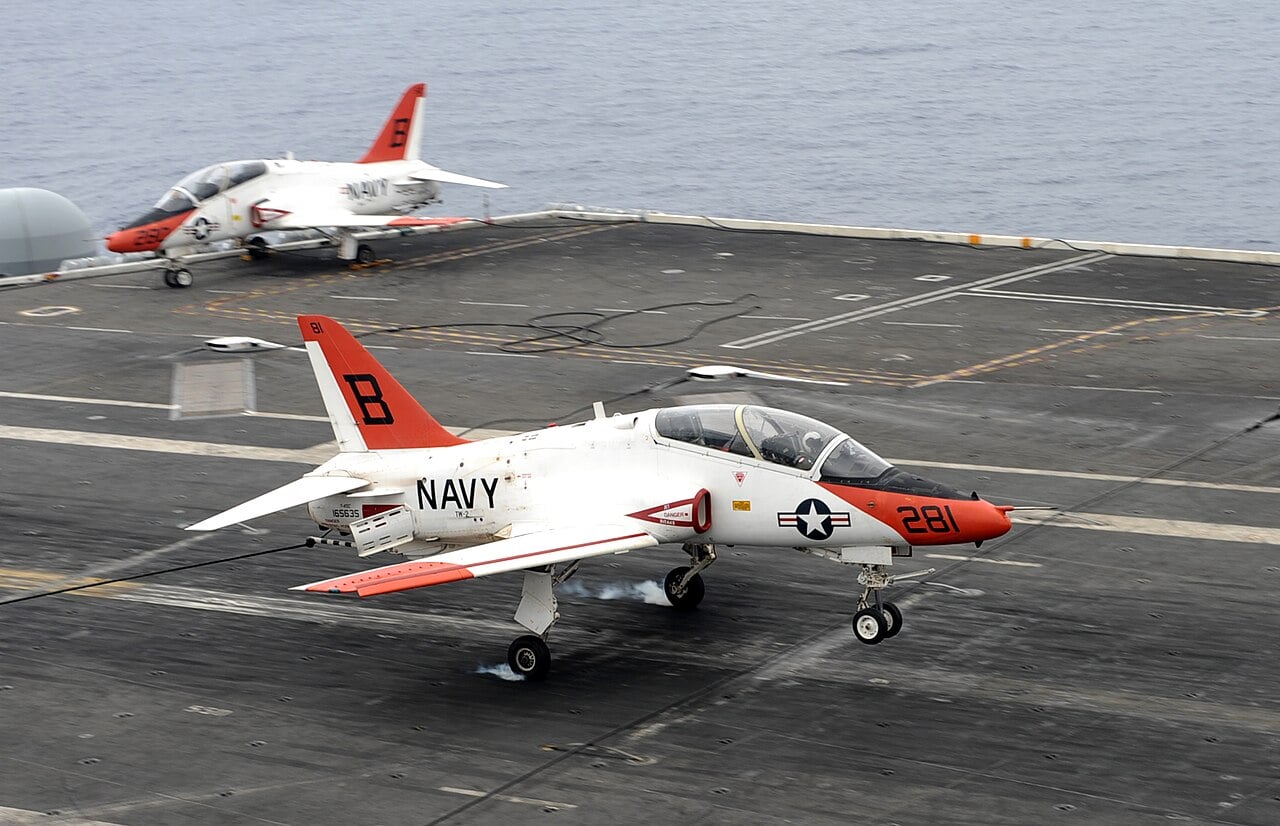
The Navy’s Comprehensive Review, ordered by the Vice Chief of Naval Operations and led by Admiral Scott Swift, reported in June 2017 with a finding that reframed the whole problem: the integration of OBOGS into the T-45 and F/A-18 was inadequate to consistently provide high quality breathing air, and to varying degrees neither aircraft was equipped to continuously supply the clean, dry air the device was designed to receive. The sieve was not broken. It was being fed badly.
The F-35 had its own smaller episode almost simultaneously. On 19 June 2017 the 56th Fighter Wing at Luke AFB announced it would resume F-35A flying after an eleven-day pause covering five physiological events between 2 May and 8 June, adding that no specific root cause had been identified despite visits from the Joint Program Office, Lockheed Martin and the Air Force Research Laboratory. The Air Force subsequently disclosed ten earlier F-35A events dating back to 2011.
CBS News on the Air Force’s announcement that it believed it had solved the Raptor’s oxygen problem.
Where it stands
By June 2020 the Navy had spent three years and roughly $50 million on two root-cause corrective action teams, producing over 8,000 pages and 567 recommendations. Rear Admiral Fredrick Luchtman, who led the Physiological Episode Action Team, opened the briefing with the same sentence the Air Force had reached eight years earlier: there is no single causal factor. What the Navy added was a different frame — that breathing highly concentrated air from a closed loop while encumbered by bulky gear in a cramped cockpit increases the work of breathing, and that fatigue and altered breathing patterns produce inefficient gas exchange that looks a great deal like hypoxia without being it.
Contamination was ruled out for good by volume: 21,000 air samples over 20 months, reviewed independently by Johns Hopkins, which agreed the air was and had been extremely clean. The results were a 96 percent reduction in the T-45 episode rate and 74 percent on the F/A-18 since 2017. Across the US Air Force, in-flight physiological episodes fell from 376 in 2018 to 142 in 2022, with no Class A or B mishaps attributed to one that year.
The two services still do not fully agree. The Navy’s position is that hypoxia is possible in specific circumstances but is not the main driver. The Air Force continues to view most incidents through the lens of hypoxia. And the research has not stopped: a 2026 paper from the Naval Medical Research Unit in Dayton concluded that obstructions in the inhalation valve of the flight mask are a plausible contributor to reported in-flight events.
The most durable legacy is the standard. MIL-STD-3050 did not exist before the Raptor crisis; it was written by a 36-month Air Force Research Laboratory effort begun in June 2012, with Honeywell, Cobham, Lockheed, Boeing, Airbus, Martin-Baker and UTAS in the room. The Director, Operational Test and Evaluation’s FY2025 report notes that the T-7A Red Hawk’s oxygen system will be evaluated against MIL-STD-3050A, a document that, in its own words, incorporates lessons learned from several fighter aircraft mishaps.
So: do fighter pilots breathe pure oxygen? No. They breathe a carefully scheduled mixture that their aircraft manufactures from the engine, capped at 60 percent for most of a low-level sortie, rising towards 94 percent only when altitude makes it necessary. The cap is there because the alternative collapses parts of their lungs. It took the loss of an aircraft, the grounding of two fleets, a decade of investigation and a new military standard to establish that the box making the air and the person breathing it have to be designed as one system. That lesson is now written into the document every new American fighter and trainer is tested against.
Sources: MIL-STD-3050, Aircraft Crew Breathing Systems Using On-Board Oxygen Generation Systems; USAF Scientific Advisory Board, Report on Aircraft Oxygen Generation, SAB-TR-11-04, 1 February 2012; House Armed Services Committee hearing on F-22 pilot physiological issues, 13 September 2012; AGARD-AG-286, Advanced Oxygen Systems for Aircraft; CBS 60 Minutes, 6 May 2012; US Navy Comprehensive Review on physiological episodes, June 2017; DODIG-2021-004 and DODIG-2021-120; DOT&E FY2025 Annual Report; Summerfield et al., IntechOpen 2018; USNI News; 56th Fighter Wing Public Affairs.

0 Comments