
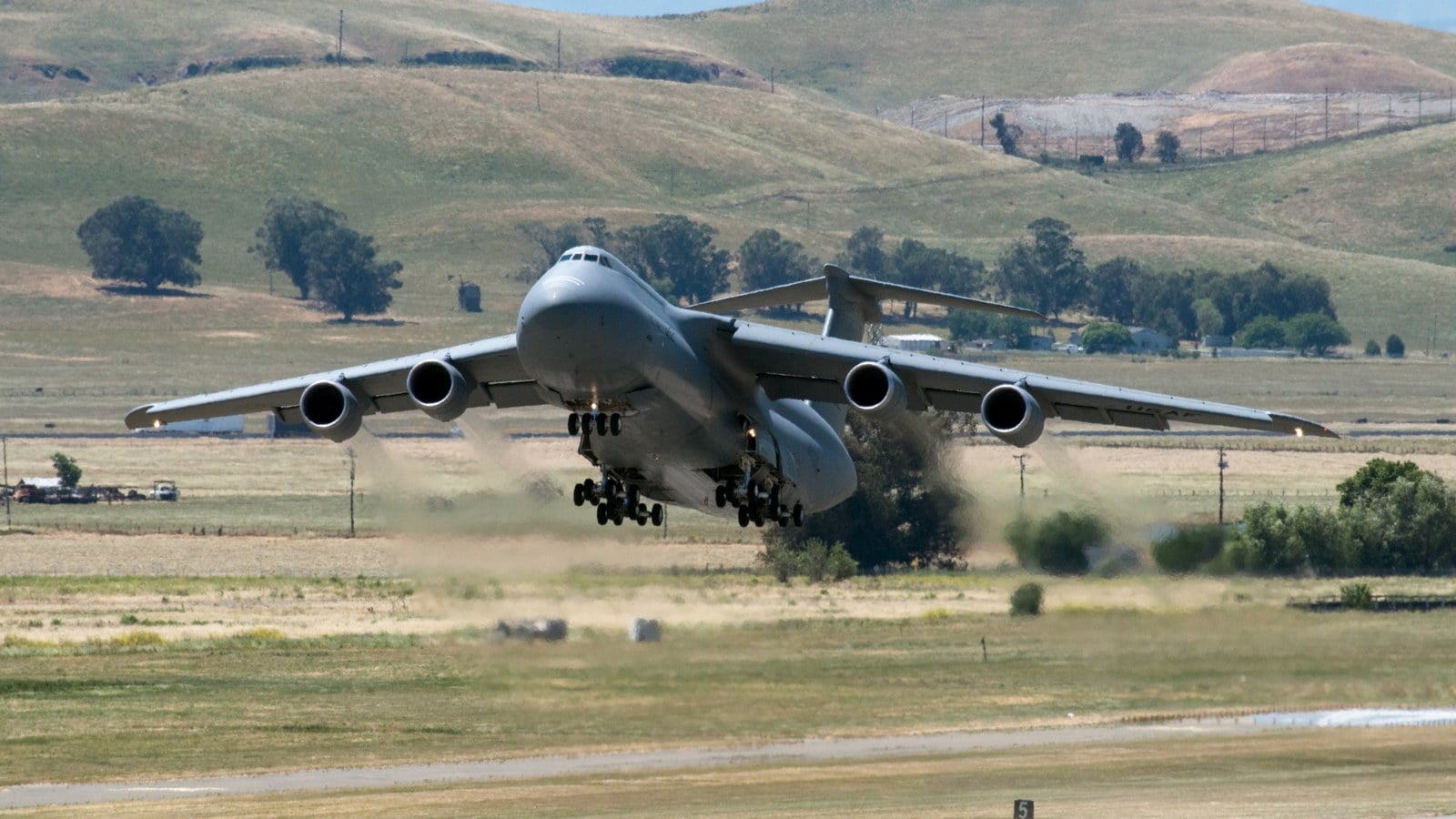
At 22,000 ft (about 6,700 m), landing gear is supposed to be folded away and forgotten. So when photographer Ján Kolárik pointed his lens at a US Air Force Galaxia C-5 crossing Slovakia, he caught something genuinely odd: one of the giant airlifter’s main landing gear bogies on the port side, hanging down in the airstream.
The Aviationist, which published Kolárik’s photos on 21 October 2026, identified the aircraft as 86-0011 and reported that it was flying from Burgas, Bulgaria, to Portsmouth International Airport at Pease, New Hampshire. Instead of pressing on across the Atlantic, the Galaxy descended and landed at Ramstein Air Base, Germany.
There has been no official explanation, and the exact date of the flight was not published. But the story ended well: according to The Aviationist, transponder data shows the jet spent about three and a half hours on the ground at Ramstein before departing again at a normal cruising altitude. To understand how a single bogie can end up dangling at 22,000 ft, you need to look at what may be the most intricate landing gear on any airlifter.
Datos rápidos
Aeronave: Lockheed C-5 Galaxy, serial 86-0011 (per The Aviationist)
Sighting: Over Slovakia, port main gear bogie extended at about 22,000 ft (6,700 m)
Reported route: Burgas, Bulgaria, to Pease, New Hampshire
Resultado: Landed at Ramstein Air Base, Germany; departed again after about 3.5 hours (transponder data)
Photographer: Ján Kolárik
C-5 landing gear: 28 wheels: 24 on four main gear legs, 4 on the nose gear
Maximum take-off weight: 840,000 lb (381,018 kg)
What the photos show
Kolárik’s images show the Galaxy in cruise with one port-side main bogie deployed while everything else is stowed. The Aviationist’s reading of the transponder track is that the crew noticed the problem early: after leaving Burgas, the aircraft stayed around 10,000 ft for some time, which suggests checklist work and calls to engineering support on the ground.
The serial tells its own story. 86-0011 falls in the C-5B production batch delivered between 1986 and 1989, and almost all of those B models were later rebuilt as C-5M Super Galaxies with new engines and avionics. The Aviationist did not name the unit the aircraft belongs to.
Whether Ramstein was a planned stop or a diversion has not been confirmed either. What is clear is that a gear leg left hanging adds drag, which costs fuel and range – not something any crew wants before an Atlantic crossing.
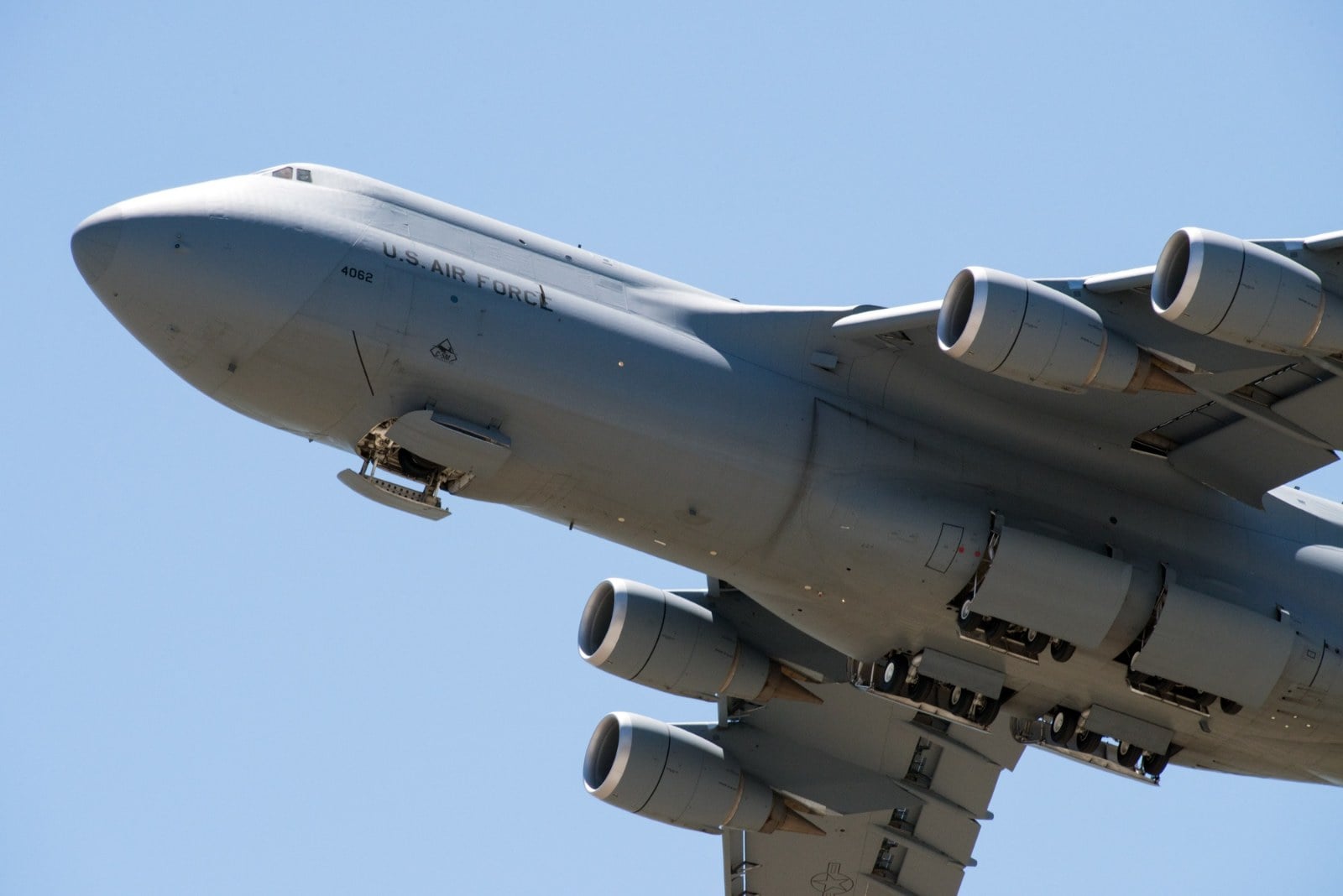
Twenty-eight wheels and a 90-degree twist
The Air Force describes the C-5 Galaxy landing gear as five sets of gear with 28 wheels between them. Four of those sets are main gear legs, each carrying a six-wheel bogie, for 24 main wheels; the nose gear adds four more. All that rubber spreads a maximum take-off weight of 840,000 lb (381,018 kg) giving the Galaxy high flotation on paved and unpaved surfaces alike.
Retracting it is a small ballet. The main gear rotates through 90 degrees after take-off so that the bogies line up with their bays along the lower fuselage before folding away. More rotation means more actuators, more locks and more sensors – and more places for a single leg to disagree with the other three.
On the ground the rear main gear can caster, swivelling like a shopping-trolley wheel to shrink the Galaxy’s turning radius. It is the kind of detail you only appreciate once you have watched a 247 ft (75.3 m) aircraft turn around on a runway.
C-5 Galaxy landing gear swing test (AIRBOYD)
The kneeling giant
The other famous trick of the C-5 Galaxy landing gear is that the aircraft can kneel. The official fact sheet is matter-of-fact about it.
Lowering the whole jet brings the cargo floor down towards truck-bed height, so vehicles can drive straight in through the nose or the rear ramp. According to Air & Space Forces Magazine, Air Mobility Command has limited kneeling to reduce wear on the gear – a reminder that this system works hard for a living.
It has had its bad days. In July 2017 Air Mobility Command briefly stood down the C-5s at Dover Air Force Base, Delaware, while maintainers investigated nose landing gear problems, and in 1983 a C-5A landed with its gear up during touch-and-go practice at Travis Air Force Base, California.
Against that background, a single bogie stuck down over Slovakia looks less like a crisis and more like a crew doing what crews are trained to do: slow down, troubleshoot, and land somewhere with the right people and parts. Without one photographer looking up at the right moment, nobody outside the Air Force would ever have known.
Sources: The Aviationist, U.S. Air Force, Air & Space Forces Magazine, Avgeekery, Defense News, WHYY, DVIDS, AIRBOYD

0 Comments