
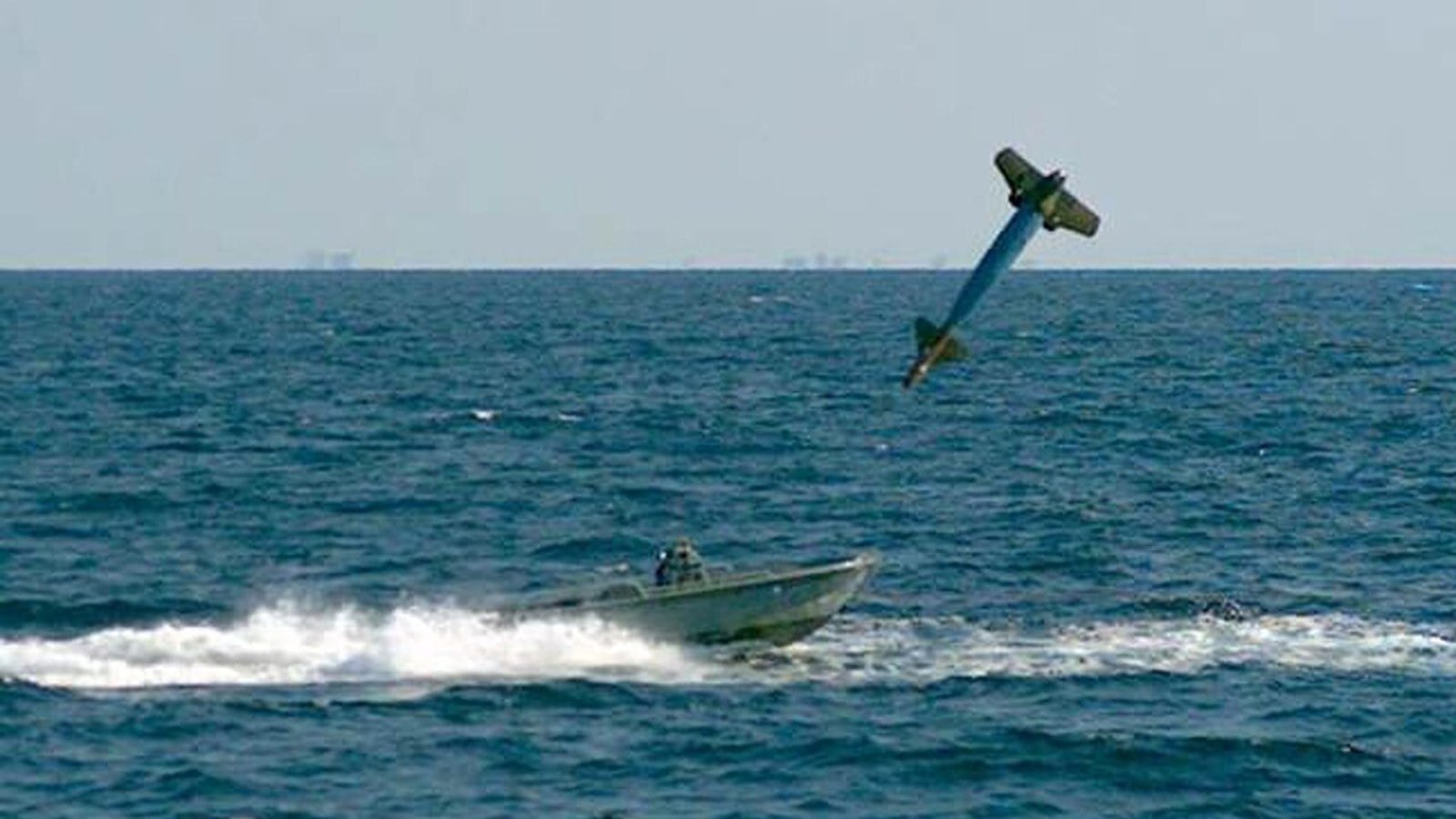
For seven years the Thanh Hoa Bridge simply refused to fall. American aircraft flew more than 870 sorties against the “Dragon’s Jaw” south of Hanoi and lost 11 aircraft doing it. Then, in the spring of 1972, a handful of Phantom crews from the 8th Tactical Fighter Wing did what hundreds of earlier missions could not – with bombs that steered themselves onto a spot of invisible light.
That is the whole trick of the laser-guided bomb: someone points a laser at the target, and a cheap kit bolted onto an ordinary “dumb” bomb follows the reflection down. Half a century later the same principle still flies on almost every Western strike jet. Here is how a laser-guided bomb actually works, from the seeker in its nose to the reasons GPS never replaced it.
Datos rápidos
Principle: Semi-active laser homing: the bomb follows laser energy reflected from the target
Inventor: Texas Instruments (Weldon Word) with the USAF at Eglin AFB, from 1964
First combat: Combat evaluation in Vietnam, May–August 1968
Laser: Pulsed near-infrared, typically 1,064 nm, with a matching pulse code
Typical weapon: GBU-12 Paveway II: 500 lb (227 kg) Mk 82 bomb plus guidance kit
Main limit: Clouds, smoke, dust and rain block the laser
Producción: Raytheon had delivered 250,000 Paveway kits by 2004
From a Texas Lab to the Dragon’s Jaw
The laser-guided bomb was born in 1964, when Texas Instruments engineer Weldon Word and Col. Joseph Davis Jr. of the Air Proving Ground at Eglin Air Force Base set out to adapt Army laser technology to bombs. Davis wanted a weapon accurate to within about 30 feet; Word promised working prototypes for less than $100,000. The first test drop, on a 750 lb M117 bomb, came in April 1965.
The Air Force called the programme Paveway. In combat trials with the 8th Tactical Fighter Wing at Ubon, Thailand, between May and August 1968, the 2,000 lb Mk 84 version averaged a miss distance of about 20 feet (6 m). The competing BOLT-117 managed roughly 75 feet. Texas Instruments won, and its kit was cheap – a few thousand dollars, against tens of thousands for TV-guided weapons.
The real proof came in 1972. On 27 April and again on 13 May, 8th TFW F-4 Phantom IIs attacked the Thanh Hoa Bridge with laser-guided bombs, some of them 3,000 lb monsters. On 13 May the western span was knocked off its massive concrete abutment. Between February 1972 and February 1973 the Air Force dropped more than 10,500 laser-guided bombs; about 5,100 were direct hits and roughly 4,000 more landed within 25 feet.
Archive footage on the development of the laser-guided bomb from 1960 to 1972.
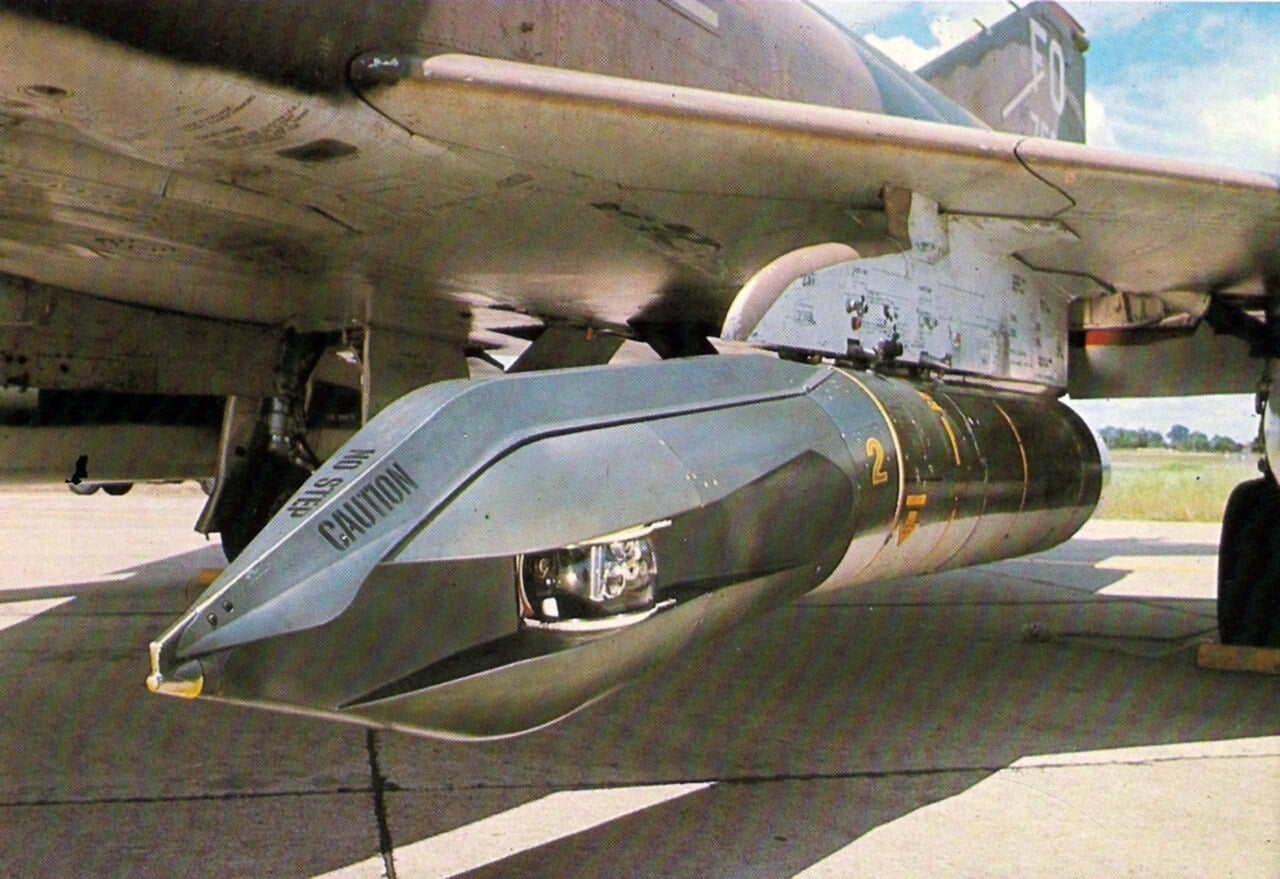
Those early missions used two aircraft. One Phantom carried the bombs; another carried the Pave Knife pod, a stabilised laser designator whose crew held the beam on the aim point until impact. That division of labour – one platform lights, another shoots – still defines how laser-guided bombs are used today.
The Laser: An Invisible, Coded Pointer
The designator fires short, powerful pulses of near-infrared light, typically at a wavelength of 1,064 nanometres – invisible to the eye. Each pulse lasts only around 10 to 20 nanoseconds, and pulses typically repeat 10 to 20 times per second. Where the beam hits the target, the energy scatters in all directions. Crews call this reflection the “sparkle”.
Each pulse train carries a code, set by its pulse repetition frequency (PRF). The designator and the bomb are set to the same code, and the seeker checks the timing between pulses before it accepts any signal. That way, several designators can work on one battlefield without bombs chasing the wrong spot, and a stray laser on another code is simply ignored.
This is why the system is called semi-active. The bomb carries no transmitter of its own; it is a passive receiver tuned to one specific signal. All the expensive, heavy hardware – the laser, the stabilised optics, the operator – stays on the aircraft or with the soldier on the ground.
The Seeker: Four Quadrants and a Simple Question
The heart of the bomb sits in its nose. Behind a glass dome, a lens focuses the reflected laser energy onto a detector split into four quadrants. If the target lies dead ahead, the spot lands in the centre and all four quadrants receive equal energy. If the target is up and to the right, most energy falls on the upper-right quadrant.
The guidance electronics compare the four signals continuously and generate up-down and left-right error commands. Those drive the canards on the front of the kit, which steer the bomb until the signal is balanced again. The question the seeker asks is brutally simple: where is the spot relative to where I am going?
On Paveway I and II the seeker sat in a free-swivelling housing with a ring-shaped tail, so it aligned itself with the airflow and looked along the direction the bomb was actually travelling. Weldon Word later said the probe resembled a badminton shuttlecock, and the name “birdie head” stuck. At the back, fixed or pop-out wings keep the weapon stable; they do not steer.
The Basket and the Bang-Bang
A laser-guided bomb cannot fly to just anywhere. It must be released inside an invisible cone above and in front of the target, its narrow end on the laser spot. Pilots call this the basket. Release outside it and the seeker either never sees the spot or lacks the energy to reach it.
Paveway I and II steered with bang-bang control: the canards were either fully deflected or neutral, never anything in between. The result is a bomb that weaves its way down in a visible sine-wave path, constantly over-correcting. It is accurate – the GBU-12 is credited with a circular error probable of about 1 metre in Raytheon tests – but each full-deflection flick costs energy and range.
To save energy, crews often release the bomb ballistically and switch the laser on only late in the fall, so the weapon does not start manoeuvring too early. Timing is critical: lase too late and the bomb cannot correct its error; lase too early and it may bleed off speed and fall short.
Paveway III: Smarter Steering
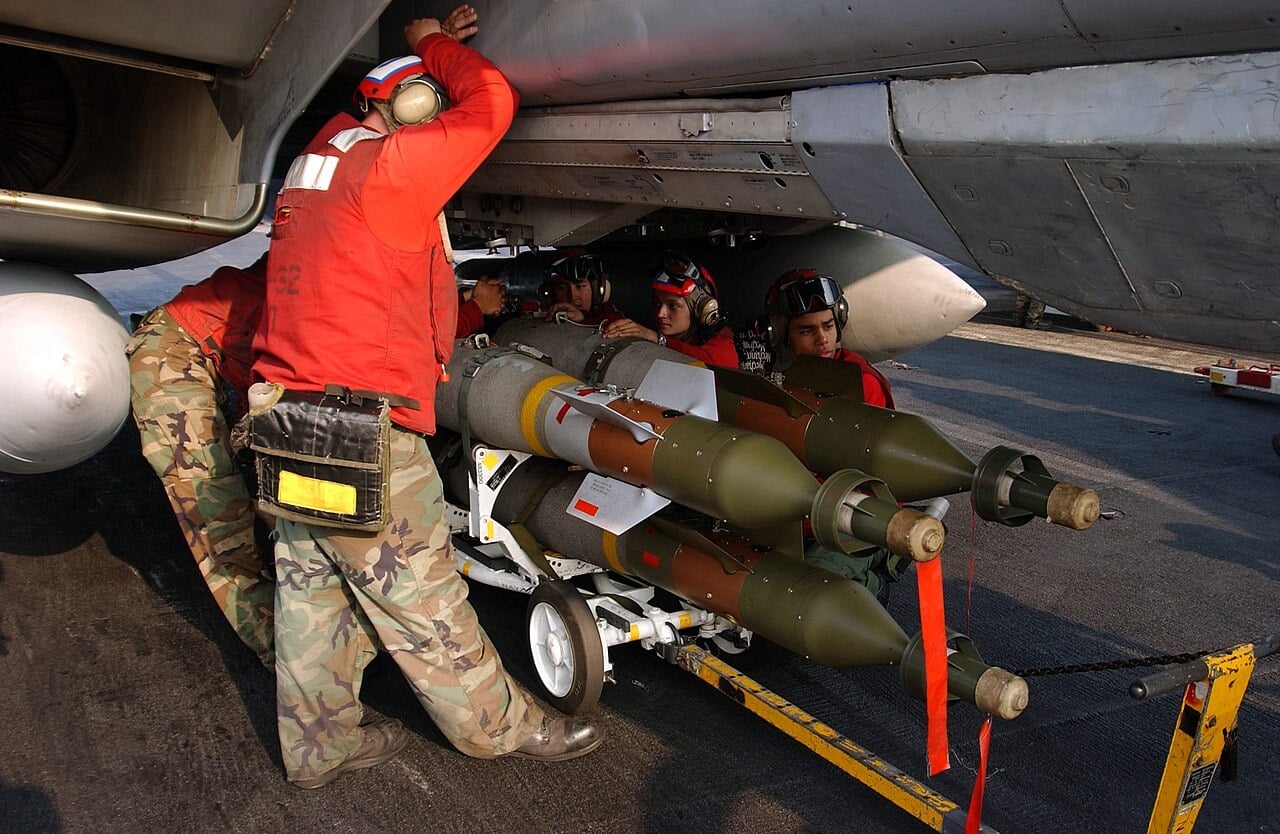
By the late 1970s the bang-bang bombs had a problem with low-level attacks. Released close to the ground, the seeker saw the spot too early and pitched the bomb down, cutting its range. Texas Instruments answered with Paveway III, which entered service in the mid-1980s on 2,000 lb class weapons such as the GBU-24.
Paveway III uses a microprocessor autopilot with proportional control: canard deflection matches the size of the error, giving a smooth, energy-efficient flight path. A wider field-of-view scanning seeker and larger wings let it be lobbed from low level and fly much farther. The F-117 carried a variant, the GBU-27, and the GBU-28 bunker buster was rushed into service in 1991 on a Paveway III guidance package.
Self-Lasing, Buddy-Lasing and the JTAC
Today there are three ways to light a target. In self-lasing, the bombing aircraft carries its own targeting pod, such as Sniper or LITENING, and designates its own bomb. A single F-15E Strike Eagle crew can find, lase and hit a target alone.
In buddy-lasing, one aircraft designates for another – the Pave Knife method of 1972. It lets a jet without a pod, or one whose pod is busy, drop on a target someone else is holding. The third method puts the designator on the ground. Joint terminal attack controllers (JTACs) and special forces use handheld or tripod-mounted designators to mark targets for aircraft overhead, often in close contact with the enemy.
What joint terminal attack controllers do: the New Zealand Army’s JTACs explain. Video: NZ Defence Force
Ground lasing is the most precise way to put a bomb exactly where friendly troops need it, because the controller can see what the pilot cannot. It also explains why laser codes matter so much: on a busy battlefield, several designators and several bombs can be in the air at once.
Weather: The Laser’s Achilles Heel
A laser needs a clear line of sight from designator to target, and from target to bomb. Low cloud, rain, fog, smoke and dust all scatter or absorb the beam. During the 1991 Gulf War, bad weather repeatedly hampered laser- and infrared-guided strikes – one of the lessons that pushed the Pentagon towards satellite guidance.
The designator also has to keep the spot steady on the aim point until impact. If it loses the target, or the laser stops, a pure laser-guided bomb loses guidance and falls ballistically. That vulnerability drove the next step.
Enhanced Paveway and Why JDAM Did Not Kill the Laser
GPS-guided bombs arrived in force in the late 1990s. The JDAM, in service from 1999, steers to satellite coordinates through cloud, rain and smoke with an accuracy of around 5 metres. Many predicted the end of the laser-guided bomb.
It did not happen. The answer was to combine both. Enhanced Paveway kits, which became operational in 2000, add a GPS-aided inertial unit to the laser seeker: GPS gets the bomb close in any weather, the laser provides the final precision. If the laser spot is lost, the bomb continues to the GPS coordinates.
Two things keep the laser in the game. First, GPS can only hit a fixed coordinate; a laser can follow a target that moves – a truck, a boat, a tank. Boeing itself added a laser seeker to its JDAM to create the Laser JDAM for exactly that reason. Second, a human designator can adjust the aim point to the last second, which matters enormously in close air support.
The numbers back it up. In the 2003 invasion of Iraq, laser-guided bombs made up 29.5 percent of the munitions dropped, against 22.4 percent for JDAM. The RAF’s current Paveway IV, in service since 2008, is a dual-mode GPS and laser weapon from the start.
The RAF’s Paveway IV, a dual-mode GPS and laser-guided bomb, explained in two minutes. Video: BFBS Forces News
Sixty Years of the Same Simple Idea
The laser-guided bomb has outlasted the Tomcat and the F-117 that once carried it, and most of the Phantoms too. Its genius lies in what it does not contain: no radar, no transmitter, no expensive sensor. It is a dumb bomb with a cheap eye and a pair of small canards, and a human somewhere holding a dot of light on the right spot.
More than half a century after the Dragon’s Jaw fell, that formula is still hard to beat. GPS made bombs independent of the weather. The laser keeps them honest at the last second.
Sources: Air & Space Forces Magazine, National Museum of the U.S. Air Force, Invention & Technology, Raytheon, Designation-Systems.net, Defence Science Journal (DRDO), Electronics For You, Wikipedia, U.S. Air Force, U.S. Navy



0 Comments