
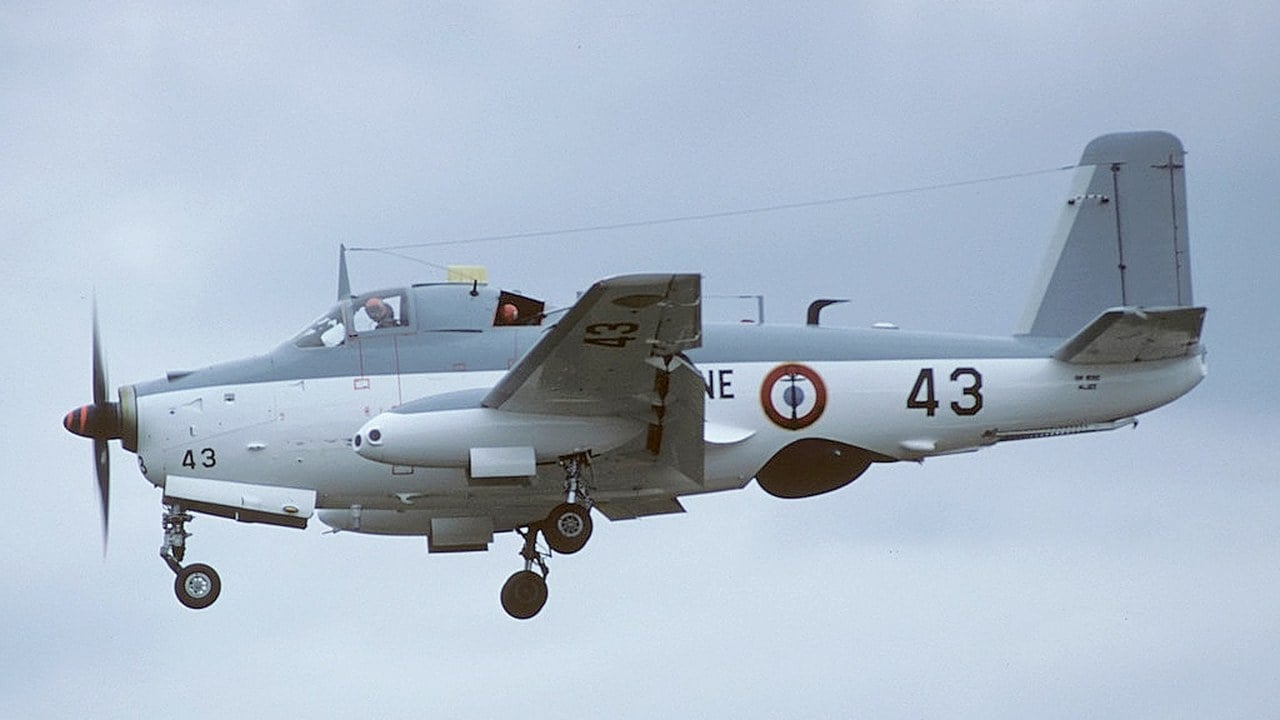
In late 1971, the Indian aircraft carrier INS Vikrant had a problem. One of her boilers was out of action, her speed was limited, and her catapult was not yet ready. At that speed, the only aircraft she could hope to operate was a stubby French turboprop with a crew of three, and nobody yet knew whether it could get off the deck without a catapult. It was the Bréguet Alizé.
A few weeks later, those same Alizés were flying night strikes against shipping off East Pakistan. It was the combat high point of an aircraft that rarely makes the history books, yet served two navies from 1959 to 2000 and hunted submarines from three French carriers and one Indian one.
Datos rápidos
- Tipo: Three-seat carrier-based anti-submarine aircraft
- Constructor: Bréguet, France (Br.1050)
- Primer vuelo: October 1956
- Motor: One Rolls-Royce Dart turboprop
- Construido: 89, between 1957 and 1962, including prototypes
- Operadores: French Aéronavale (1959 to 2000); Indian Navy (1961 to 1991)
- Carriers: Arromanches, Clemenceau, Foch and INS Vikrant
- Wartime service: Goa operation (1961) and the Indo-Pakistani wars of 1965 and 1971
From a jet-prop hybrid to a submarine hunter
The Alizé, French for “tradewind”, grew out of a failed experiment. The Bréguet Br.960 Vultur of the early 1950s combined a turboprop in the nose with a jet engine in the tail. Its second prototype was rebuilt as the Br.965 Épaulard anti-submarine aircraft, and that in turn led to the Br.1050 Alizé.
The jet engine was gone. The Alizé had a single Rolls-Royce Dart turboprop, a low wing that folded for carrier stowage, and a tricycle undercarriage whose main wheels retracted forwards into wing nacelles. The front of those nacelles held sonobuoys. It carried a pilot, a radar operator and a sensor operator, all crammed into one cockpit.
Britain tackled the same carrier anti-submarine problem with the Fairey Gannet, a larger aircraft driven by a double turboprop. The French solution was simpler and smaller: one engine, one propeller, and everything else packed around the crew and the radar.
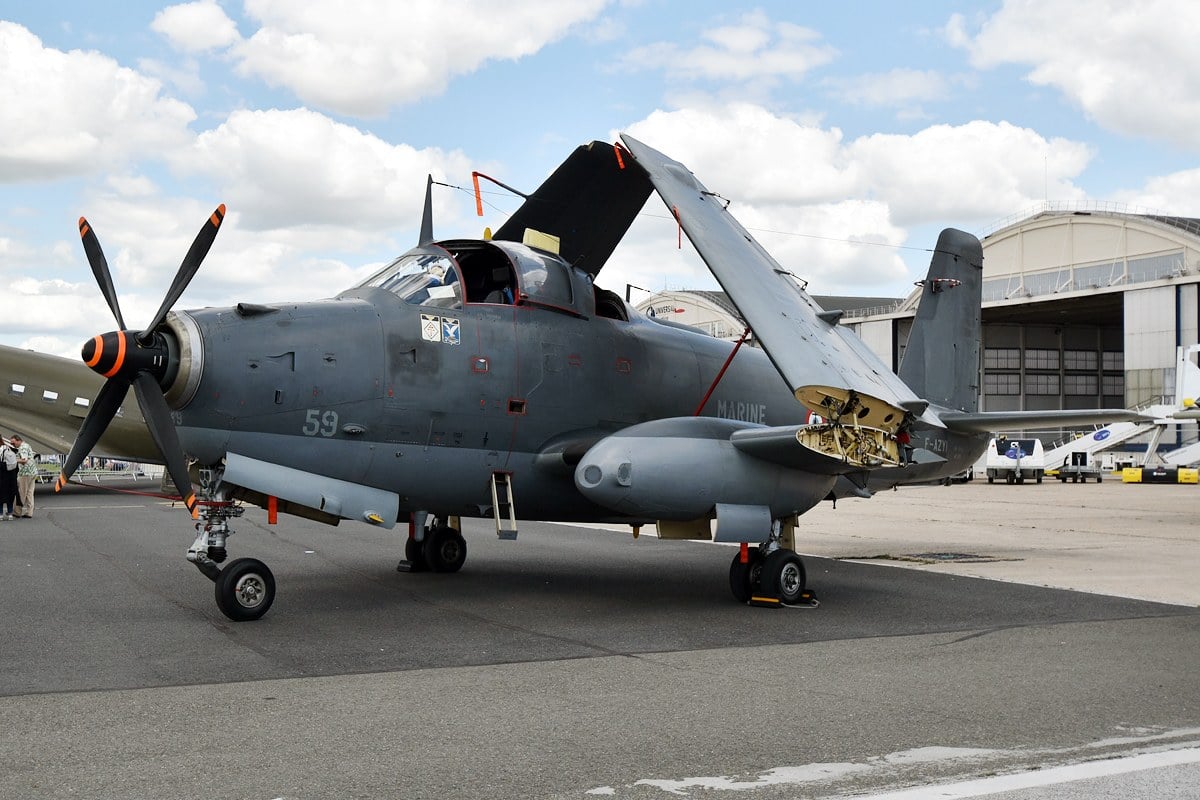
Its signature feature was the radar. A retractable radome in the belly could be lowered in flight to search the sea and raised for take-off and landing. An internal bay took a homing torpedo or depth charges, and underwing pylons could carry rockets, bombs or AS.12 wire-guided missiles.
Into French service
The prototype first flew in October 1956 and was shown at the Paris Air Show in May 1957. Development took time, and the first production aircraft did not reach the Aéronavale until March 1959. Final assembly took place at Biarritz, with parts from Toulouse and other factories. In all, 89 were built between 1957 and 1962, including prototypes.
French Alizés flew from the carriers Arromanches, Clemenceau y Foch and from shore bases. Their job was patient, unglamorous work: long patrols over the sea, searching for submarines with radar and sonobuoys while the jets on deck took the headlines. With a range of around 2,500 km, they could stay out for hours.
Archive footage of French Navy Alizés aboard the carrier Foch in 1968.
India’s night strikers
India was the only export customer. Its navy bought around a dozen Alizés and commissioned them into INAS 310, the “Cobras”, in 1961, the year Vikrant joined the fleet. They flew reconnaissance over Goa during its annexation that December, and maritime patrol and electronic intelligence missions in the 1965 war with Pakistan.
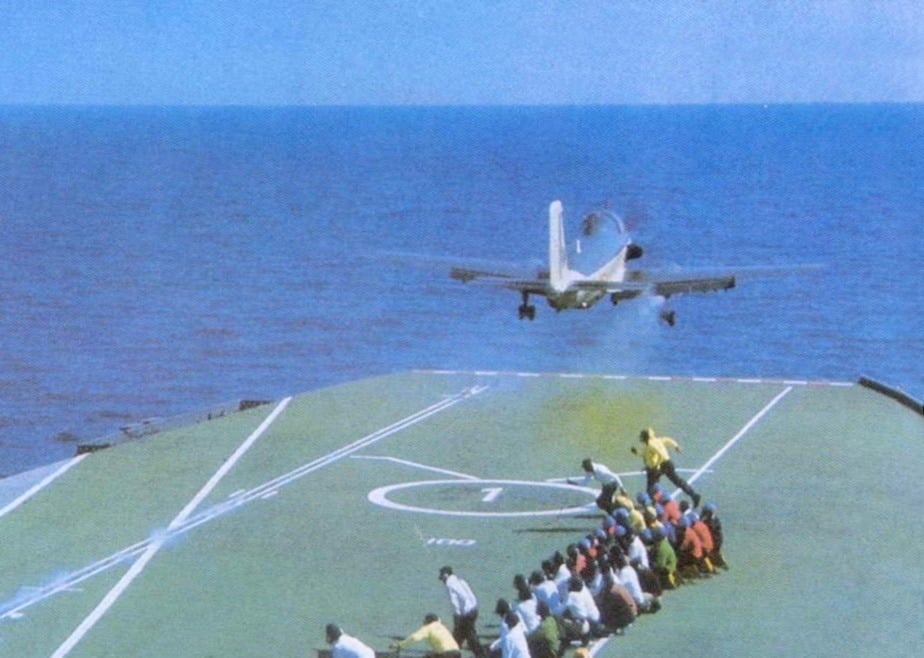
The 1971 war was their finest hour. Rear Admiral S. Ramsagar, then the Cobras’ senior pilot, later described how the squadron proved that the Alizé could take off from the damaged Vikrant without the catapult, first in a lightened state and then at full load.
Vikrant sailed for the Bay of Bengal. While her Sea Hawk jets struck by day, the Alizés flew anti-submarine and reconnaissance patrols around the clock and, as the only night-capable aircraft aboard, carried out the night strikes with bombs, as well as daytime rocket and depth-charge attacks.
Ramsagar described a night attack on merchant ships anchored in the river at Khulna, flown with his commanding officer, Commander Ravi Dhir, each Alizé carrying five 500 lb bombs through heavy anti-aircraft fire. Two days later he attacked a naval tug towing troop boats, finishing with a depth-charge run flown practically skimming the water.
His crippled Alizé, with no electrical power or hydraulics and a small fire in the radome, made it back to the carrier with its undercarriage and hook lowered by gravity. Not every crew was so lucky: on 10 December 1971, an Indian Navy Alizé was shot down by a Pakistani Caza estelar F-104.
Archive footage of Indian Navy Alizé operations aboard INS Vikrant.
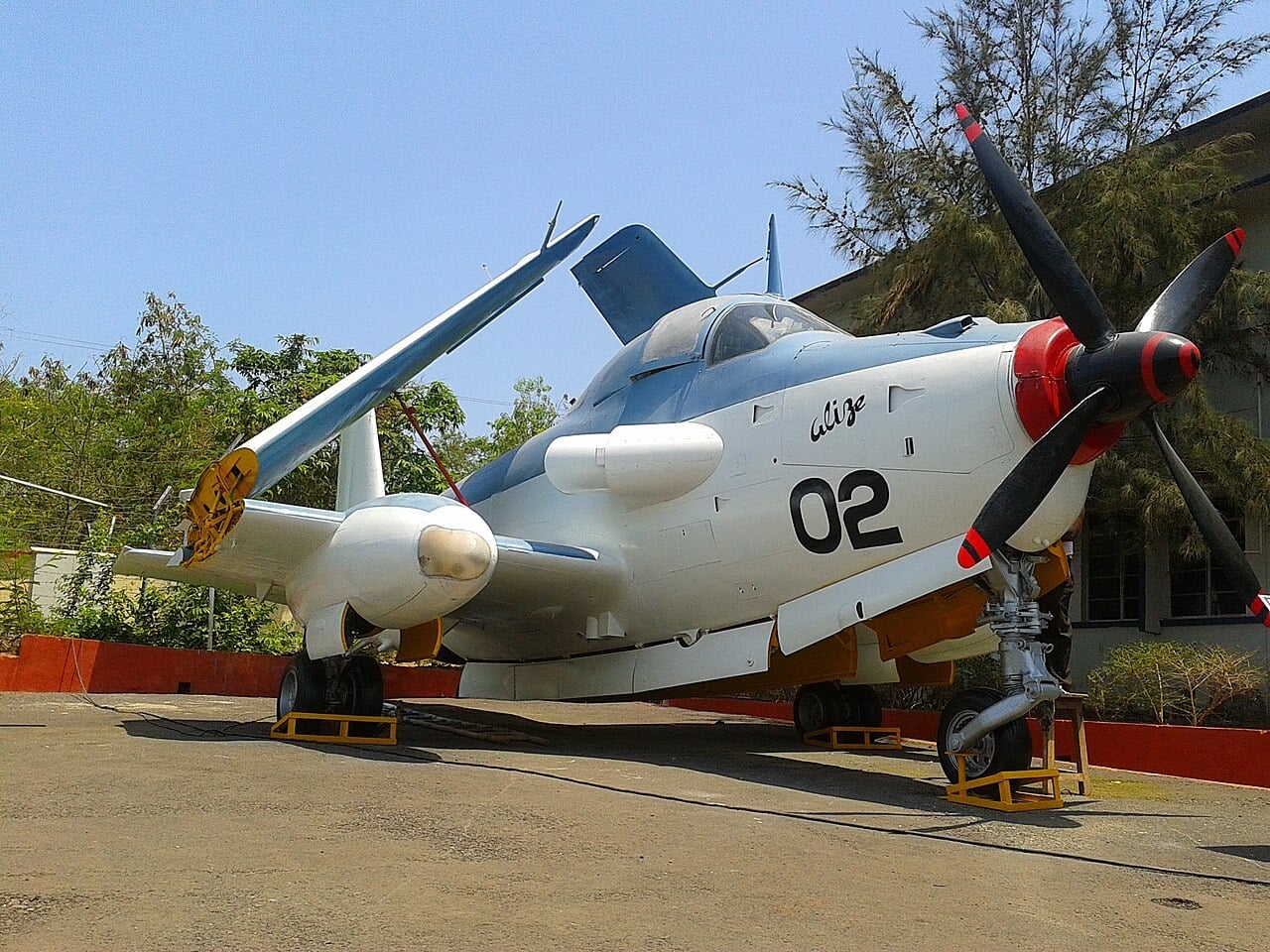
The Indian Alizés kept working long after. In 1987, flying from shore bases, they supported the Indian Peace Keeping Force in Sri Lanka, and during Operation Cactus, after the attempted coup in the Maldives in 1988, they helped force the surrender of rebels escaping in a hijacked ship. The Cobras retired the type in 1991 and moved on to the Dornier 228. One Alizé is preserved at the Naval Aviation Museum in Goa.
Forty-one years at sea
In France, the Alizé was updated again and again. In the 1980s and 1990s the Aéronavale gave it new radar, navigation, electronic-surveillance and data-link equipment, and later a forward-looking infrared sensor. Even so, by the 1990s it could no longer realistically hunt modern nuclear submarines, and its work shifted to surface surveillance.
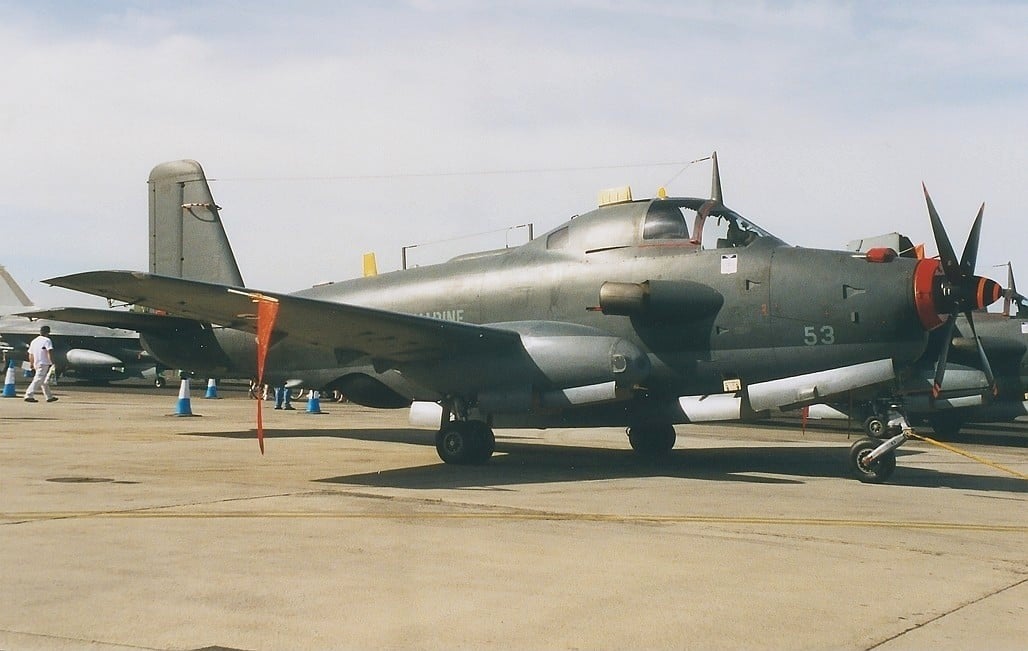
A French Senate report on naval aviation at the turn of the millennium listed the last Alizés for withdrawal in 2000, with the Grumman E-2C Hawkeye arriving as their successor on the carrier deck. The type left Aéronavale service in September 2000, 41 years after the first delivery.
A surviving airworthy Alizé displaying at Duxford, its Dart turboprop still turning decades after the type left service.
That is a long career for any carrier aircraft, let alone one designed in the early 1950s. The Alizé was never fast and never famous. But it was the aircraft that kept French carriers watching beneath the waves for four decades, and the one an Indian crew trusted to fly them home through anti-aircraft fire on a single engine and no hydraulics.
Sources: Ailes Anciennes Toulouse (Br.1050 Alizé history), Livefist (Rear Adm S. Ramsagar, “The Alize 1050 in 1971”), StratPost (INAS 310 Cobras 50th anniversary), Aviation Safety Network (IN203, 10 December 1971), French Senate report on the future of the carrier group (1999-2000 session)
Header photo: Mike Freer - Touchdown-aviation / Wikimedia Commons, GFDL 1.2
0 Comments