
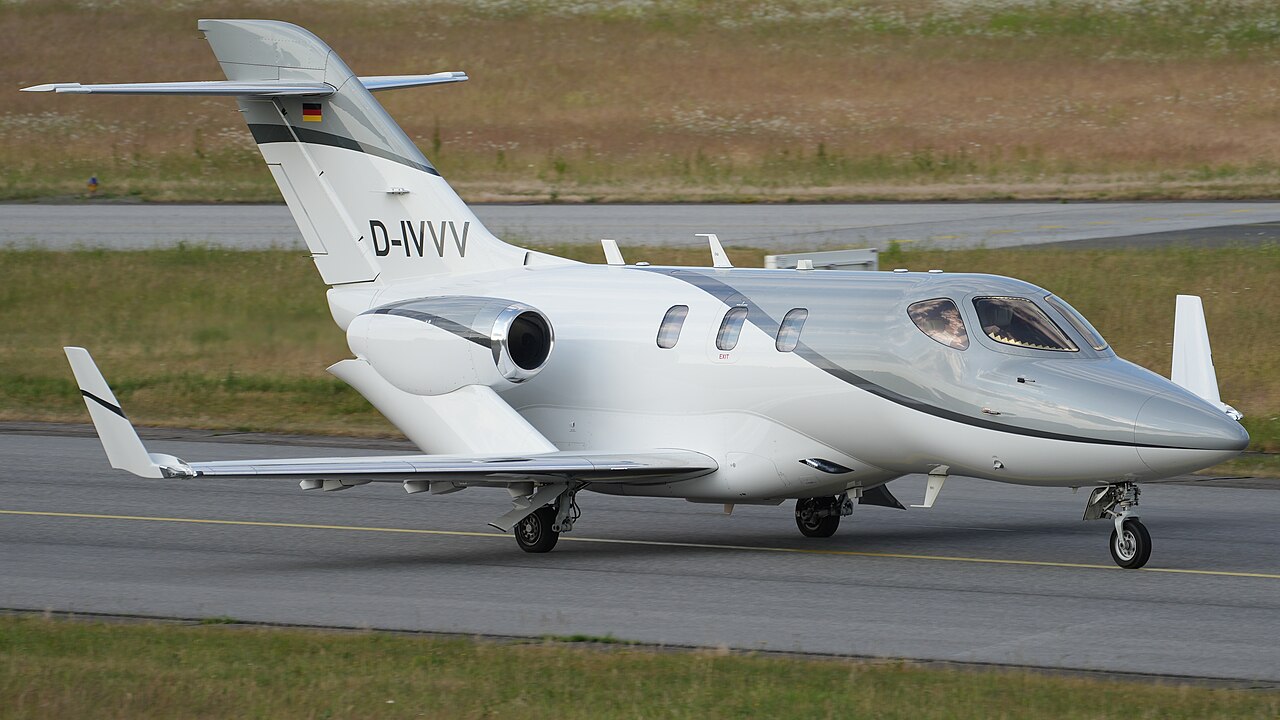
Walk around a HondaJet on the ramp and your eye snags on the same thing every time. The two engines are not hanging under the wings like an airliner’s, and they are not bolted to the tail like almost every other small business jet. They sit on short pylons encima of the wings, like a pair of jet-powered saddlebags.
It looks like a styling flourish. It is the opposite. Engine location, as the aircraft’s designer wrote in 2004, was the single biggest design decision of the whole programme, and for decades conventional wisdom said that putting nacelles over a wing was a reliable way to make a fast aeroplane slower.
Honda’s engineers spent years in computers and wind tunnels proving the opposite. Here is how a carmaker’s first jet turned a known aerodynamic penalty into a bonus, and why its nose owes something to a pair of Italian shoes.
Datos rápidos
- Aeronave: Honda HA-420 HondaJet, light business jet
- Diseñador: Michimasa Fujino, Honda; concept sketched 1997, settled 1999
- Primer vuelo: 3 December 2003, proof-of-concept aircraft, Greensboro, North Carolina
- Proceso de dar un título: FAA type certificate December 2015; EASA May 2016
- Motores: Two GE Honda HF120 turbofans on pylons above the wing (OTWEM)
- Key idea: Nacelle front face near the wing’s shock position, about 75 to 80 percent chord, weakens the shock
- Laminar flow: SHM-1 natural-laminar-flow wing; laminar nose cuts fuselage drag about 10 percent
- Elite II: 422 kn cruise, 1,547 nm range (FAA certified November 2022)
A car company goes flying
Honda’s interest in small jets goes back to the late 1980s. Its experimental MH02, built and flown with Mississippi State University’s Raspet Flight Research Laboratory, was the first all-composite light business jet to fly. Flight testing continued through 1996, and then the aircraft was shipped to Japan.
The engineer behind the next step was Michimasa Fujino. He began sketching the HondaJet in 1997 and had the concept settled by 1999, when tests in a Boeing wind tunnel showed it worked. In October 2000, Honda R&D Americas opened a research facility at Piedmont Triad International Airport in Greensboro, North Carolina, and on 3 December 2003 the proof-of-concept HondaJet made its first flight there.
Aviation International News looks back at the HondaJet prototype’s first flight, 20 years on.
Even then, Honda had not decided to sell it. Fujino put the aircraft on public display for the first time at EAA AirVenture Oshkosh on 28 July 2005 to test the waters. The reaction was strong enough that Honda announced commercialisation at the following year’s AirVenture.
The problem with engines on top
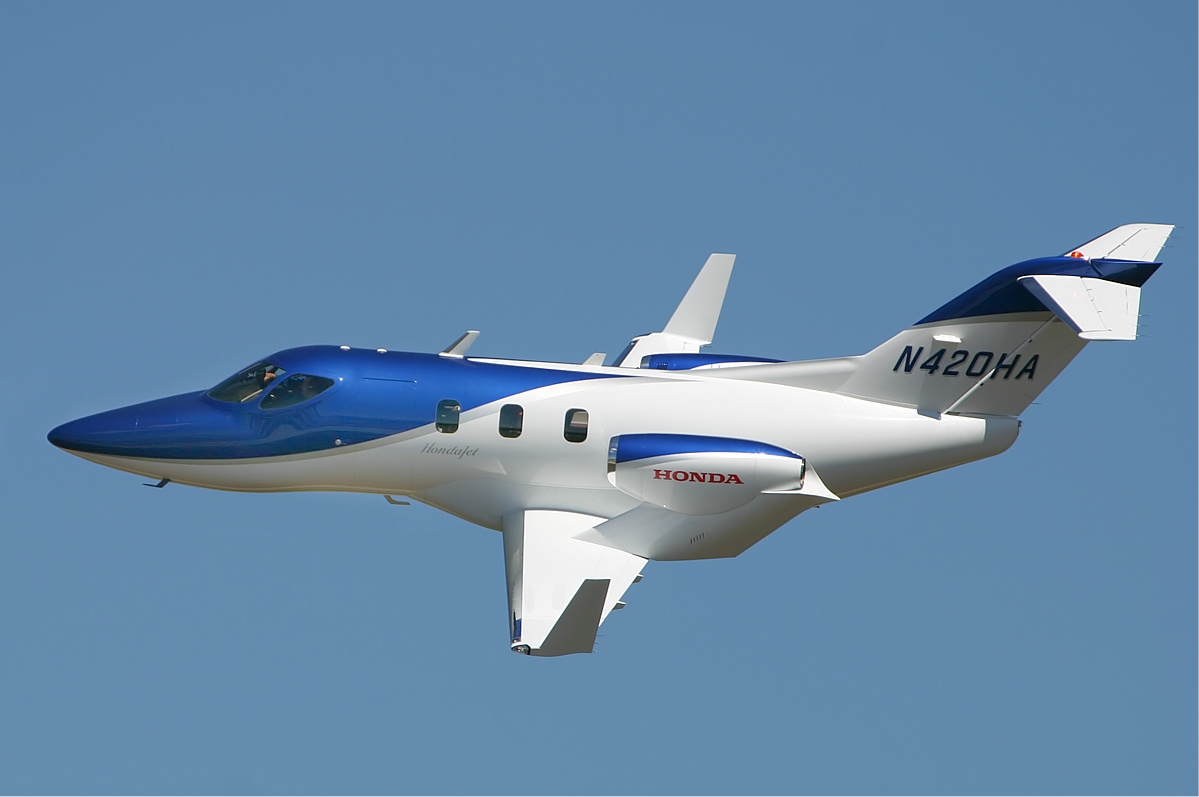
Most light jets mount their engines on the rear fuselage. That keeps the wing clean, but the engines need a heavy carry-through structure inside the fuselage to hold them, and that structure eats into the cabin. Fujino’s first motive for moving them was simple: mount the engines on the wing, delete the carry-through, and the cabin gets bigger.
The catch is aerodynamic. Air accelerates as it flows over the top of a wing, and on a jet cruising at high subsonic speed it can reach the speed of sound and form a shock wave. Put a nacelle in that already fast airflow and, as a rule, the interference makes the shock stronger and drag starts to climb sharply at a lower Mach number. The VFW-Fokker 614 tried over-wing engines in the 1970s, and the interference limited its speed.
Honda’s team attacked the problem with a three-dimensional Euler code, then validated the results in the Boeing Transonic Wind Tunnel with a scale model, sweeping the Mach number from 0.70 to 0.84. They moved the nacelle forward and back, up and down, in and out, and watched what happened to the shock.
The sweet spot at three-quarters chord
Here is the “aha”. On the clean wing, the shock sat at about 70 percent of the chord. When the front face of the nacelle was placed near that point, around 75 to 80 percent chord, the shock became weaker, not stronger. Drag divergence moved to a higher Mach number than the wing achieved with no nacelles at all. Place the nacelle at mid-chord instead, and a strong shock formed towards the trailing edge, exactly as the textbooks warned.
Fujino and his colleague Yuichi Kawamura called it favourable interference, and published it in the Journal of Aircraft in 2003. Their conclusion was that the optimum over-the-wing layout produced lower drag than a conventional rear-fuselage engine mount. Honda calls the result OTWEM, for over-the-wing engine mount, and patented it.
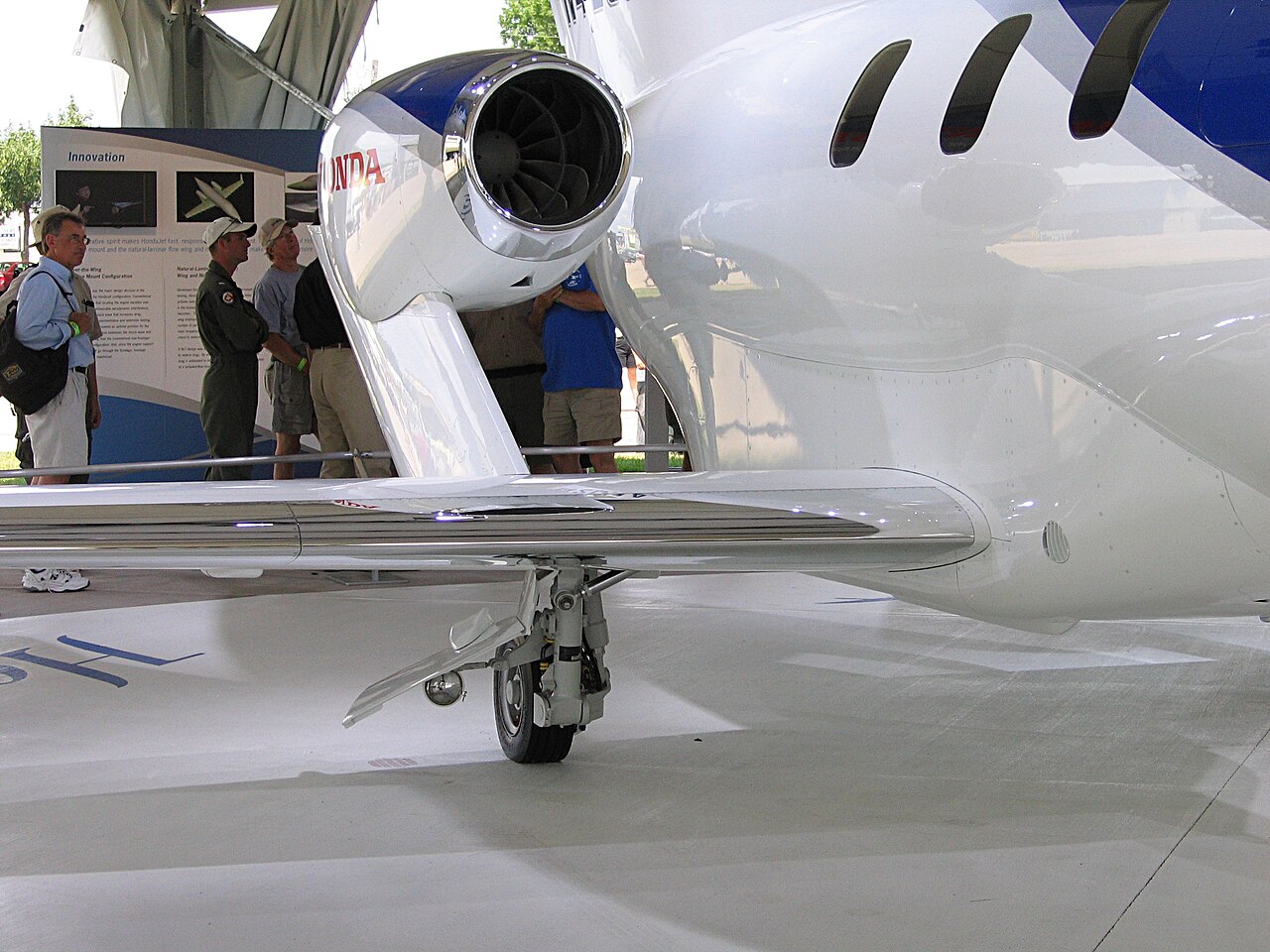
The team also checked the obvious worries. Low-speed tests on a one-sixth-scale model showed the wing first stalled at about 55 percent of the semi-span, with the root between fuselage and nacelle still flying, and maximum lift was slightly higher with the nacelles fitted. A powered model with electric engine simulators showed inlet distortion stayed within engine limits up to a post-stall angle of attack of 26 degrees.
Honda Aircraft’s own explanation of why the HondaJet’s engines are mounted over the wings.
Laminar flow, from the nose back
The HondaJet over-the-wing engine mount was only half of the drag story. The HondaJet also uses natural laminar flow, which means shaping surfaces so the thin layer of air next to the skin stays smooth and orderly for as long as possible, instead of tumbling into higher-drag turbulence. No suction pumps or slots, just geometry and very clean surfaces.
The wing uses a new airfoil, the SHM-1, with a favourable pressure gradient to about 42 percent chord on the upper surface and about 63 percent on the lower. To validate it at full-scale speeds and Reynolds numbers, Honda fitted a test glove to a Lockheed T-33 jet trainer and flew it. Laminar flow is ruthless about steps, gaps and waviness, so the metal wing’s upper skin is a single machine-milled integral panel.
The nose got the same treatment. Using a panel code and a one-third-scale model, Honda shaped the fuselage nose to keep the boundary layer laminar at climb and cruise angles of attack. According to Fujino’s 2004 paper, the laminar-flow nose cut fuselage drag by about 10 percent compared with a turbulent-flow nose.
The shape also had to look right. Fujino has confirmed the story that he was inspired by a pair of Salvatore Ferragamo high heels he noticed in an airport duty-free shop in Hawaii. Behind the composite fuselage skin, then, is a nose drawn by aerodynamics and approved by a designer’s eye.
Del prototipo a la línea de producción
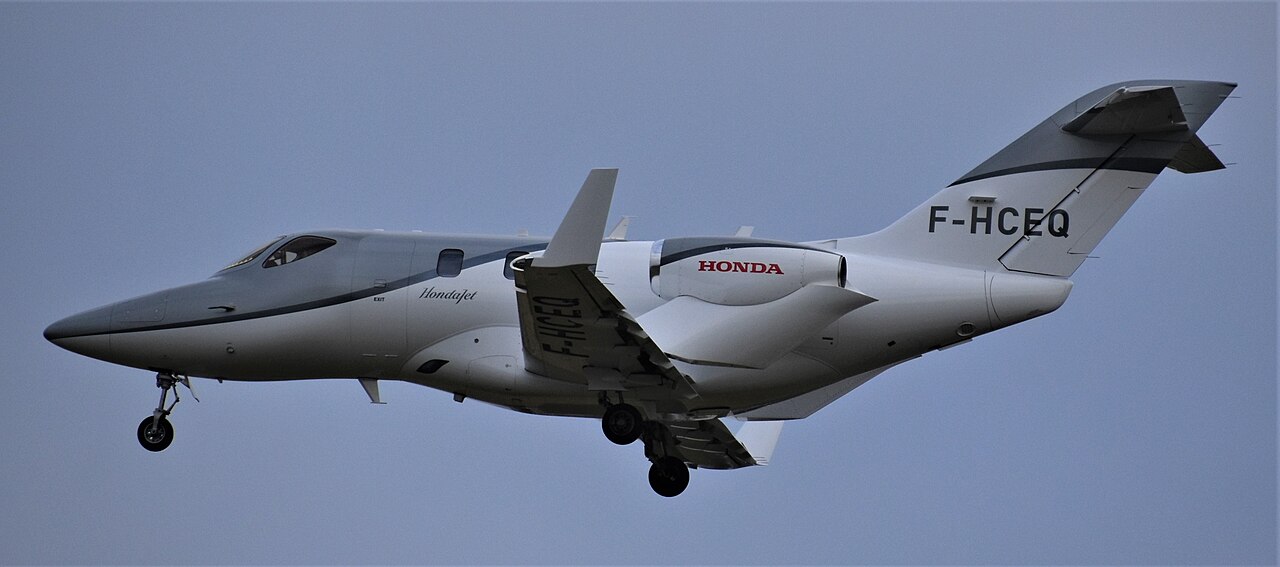
The prototype flew with two Honda HF118 turbofans of 1,670 lb thrust each. Production aircraft use the GE Honda HF120, developed under a GE and Honda partnership and certified by the FAA in December 2013. The first FAA-conforming HondaJet flew on 20 December 2010, and the first production aircraft on 27 June 2014.
The FAA issued the HA-420 type certificate in December 2015, and Honda delivered the first customer aircraft on 23 December 2015 in Greensboro. EASA certification followed in May 2016, and the FAA granted Honda a production certificate in July that year. In its press release, Honda Aircraft pointed straight at the feature that defines the aeroplane.
The family has grown since. The HondaJet Elite arrived in 2018, and the Elite II, certified by the FAA in November 2022, is credited with a cruise speed of 422 knots and a range of 1,547 nautical miles. Honda is now working on a larger stretched design, the HA-480 Echelon, that keeps the same engines-on-top layout.
AOPA flies the HondaJet and looks at what the unusual layout means from the cockpit.
That may be the real verdict on OTWEM. For three decades, designers looked at the VFW 614 and filed over-wing engines under “interesting failure”. A motorbike and car company found the exact spot on the wing where the idea stopped being a penalty, and built a jet family around it.
Sources: Michimasa Fujino, “Development of the HondaJet” (ICAS 2004); Fujino and Kawamura, “Wave-Drag Characteristics of an Over-the-Wing Nacelle Business-Jet Configuration” (Journal of Aircraft, 2003); AOPA; Business Insider; Wikipedia (Honda HA-420 HondaJet)

0 Comments