
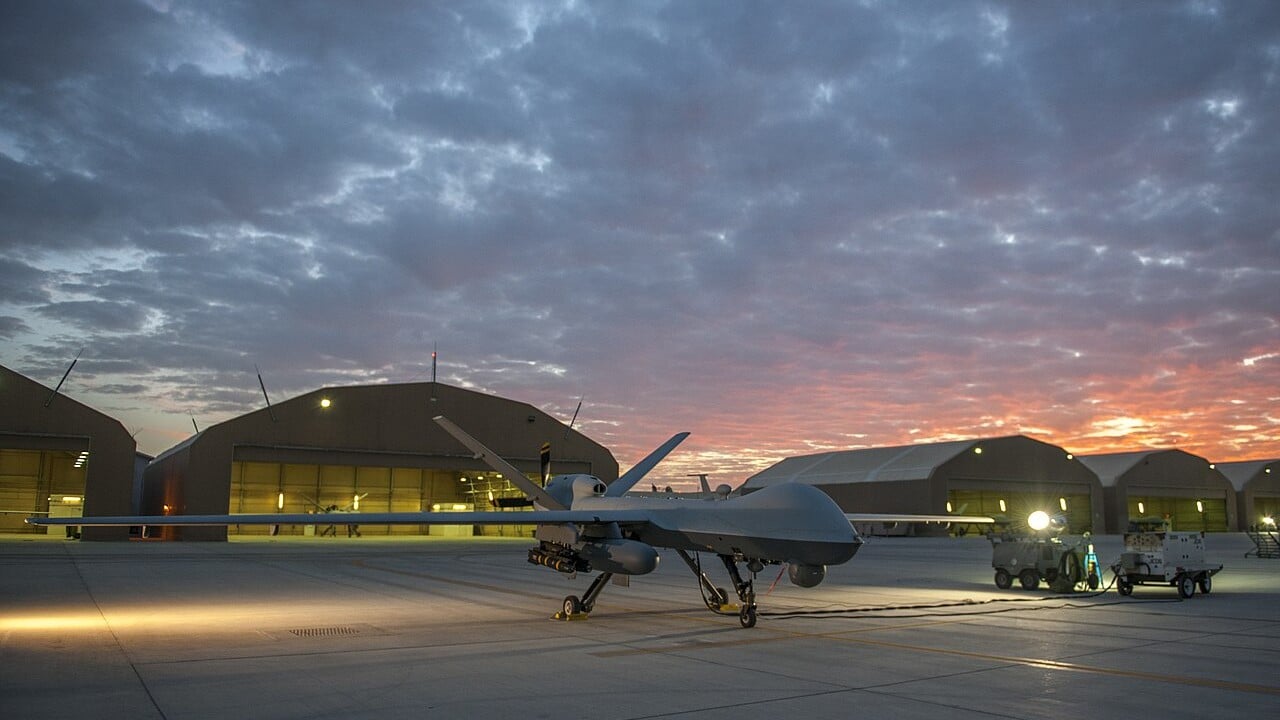
The pilot is sitting in an air-conditioned box in the Nevada desert. The aircraft is thousands of miles away, circling over a different continent at 20,000 feet. When the pilot moves the stick, the MQ-9 Reaper answers, but only after the command has made a trip into space and back.
This is remote split operations, the system that has let the US Air Force fly Reapers over Iraq, Afghanistan and beyond from bases in the United States. It splits every mission in two: one crew close to the runway to launch and land the aircraft, and another, often half a world away, to fly the mission itself.
Here is how that split works, why it was needed, and why the Air Force has spent the last few years tearing half of it down.
Datos rápidos
- Aeronave: General Atomics MQ-9 Reaper
- Multitud: Pilot and sensor operator, plus a mission intelligence coordinator when needed
- Launch and recovery element (LRE): Local crew at the forward airfield; takeoff and landing over a line-of-sight C-band link
- Mission control element (MCE): Remote crew, largely at Creech AFB, Nevada; flies the mission via satellite
- Reported command delay: About 1.2 seconds via satellite
- Satellite landings: ATLC proven July 2021 under satellite control
- Last C-band LRE sorties: 22 May 2025, 11th Attack Squadron, Creech AFB
- Next step: Low Earth orbit satellite links tested in December 2022 to cut latency
Two crews, one aircraft
According to the US Air Force fact sheet, a complete MQ-9 system is more than an aircraft. It includes several Reapers with their sensors and weapons, a ground control station, a satellite link, spare equipment and the crews to run round-the-clock missions. The basic crew is two people: a rated pilot who flies the aircraft and commands the mission, and an enlisted sensor operator who works the cameras and guides weapons, with a mission intelligence coordinator added when needed.
The ground control station is their cockpit: a stick and throttle, a bank of screens showing video, maps and aircraft data, and no windows. Under remote split operations there are two kinds of crew. The launch and recovery element, or LRE, sits at the forward airfield where the Reapers are based. The mission control element, or MCE, can be anywhere with the right satellite connection, which for many US Air Force crews has meant Creech Air Force Base in Nevada.
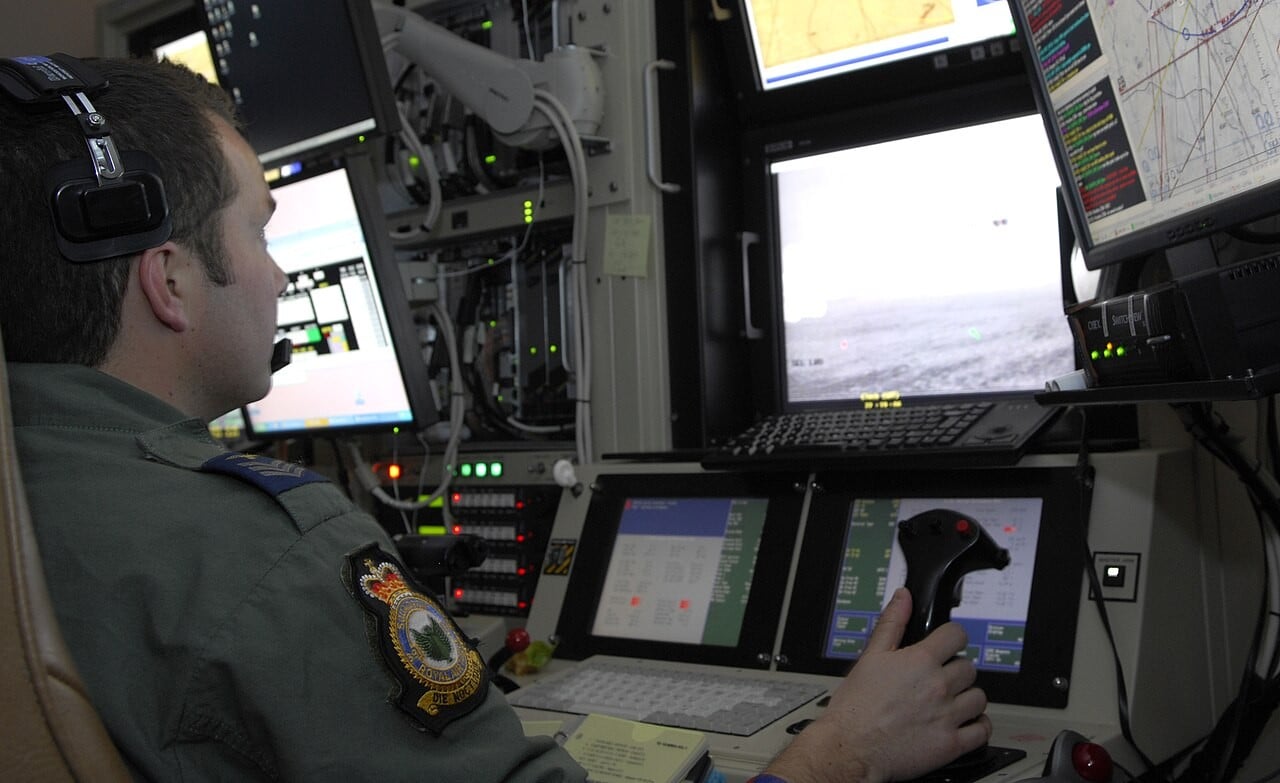
The LRE controls the aircraft on the ground and during takeoff and landing over a direct, line-of-sight radio link, the C-band link in Air Force parlance. Once the Reaper is safely airborne, control is handed over to the MCE, which takes it through the satellite link for the long hours of surveillance or strike work. At the end of the mission the process runs in reverse.
The 1.2-second problem
Why not simply fly the whole sortie by satellite? Because of distance. The Reaper’s long-range link runs through satellites in geostationary orbit, about 35,800 km above the equator. A signal travelling up to such a satellite and back down to the aircraft covers more than 70,000 km, and even at the speed of light that takes roughly a quarter of a second.
In practice the path is longer than a single hop: a command from a crew in the United States first has to reach a ground station that can see the right satellite, and every piece of equipment along the way adds its own delay. The figure widely reported for the Reaper is about 1.2 seconds for an operator’s command to reach the aircraft, and the video coming back is delayed as well. The pilot is always looking at the recent past.
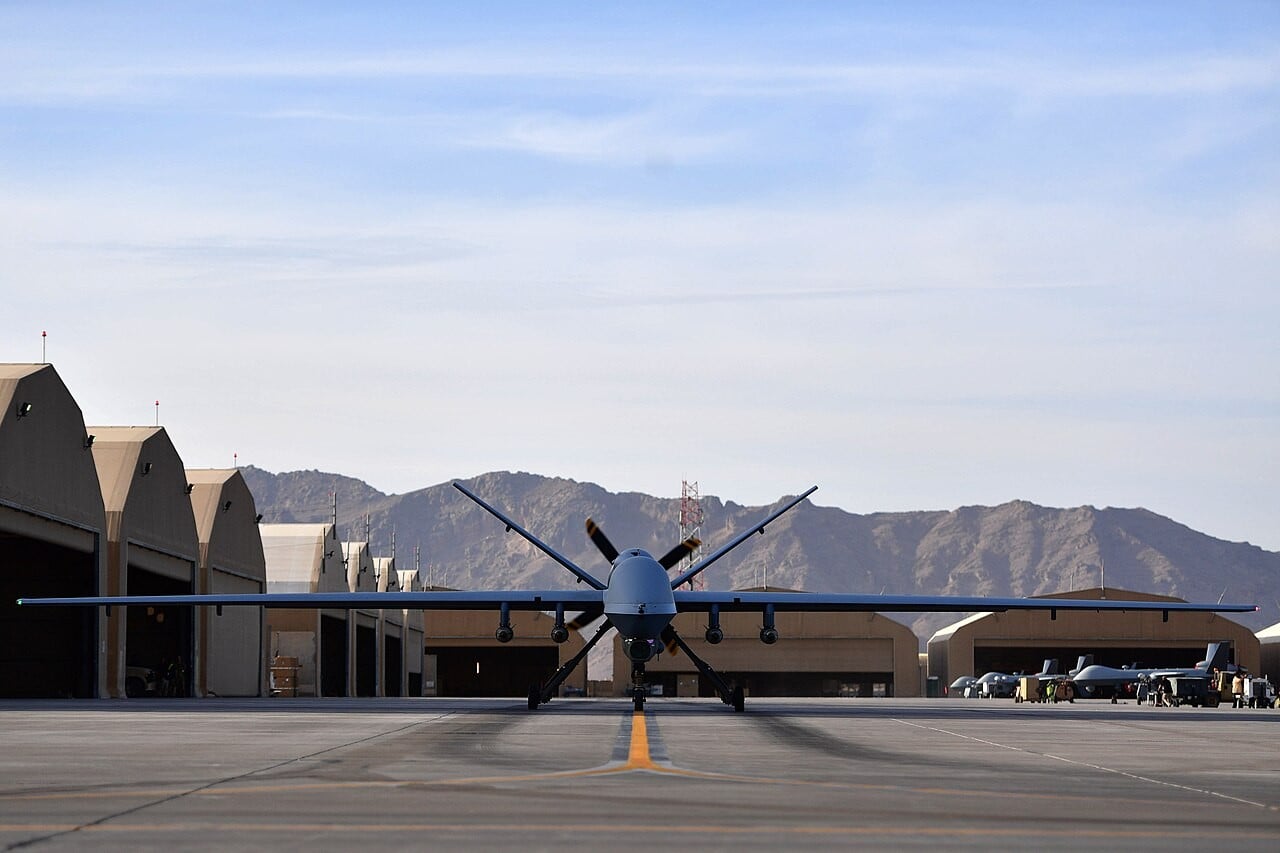
At 20,000 feet, a delay of more than a second is something crews learn to fly around. In the last seconds before touchdown, when a pilot is judging the flare and correcting for gusts, it is a much bigger problem. That is why, for most of the Reaper’s career, takeoffs and landings stayed with a local crew on a direct link, and the fact sheet still notes that the aircraft needs clear line of sight to a ground data terminal antenna for takeoff and landing.
The 174th Attack Wing’s own look at the job of an MQ-9 launch and recovery element.
Why split the mission at all?
The payoff is in people. Only the small launch and recovery team, plus maintainers, has to deploy. The bulk of the aircrew stays at home and flies combat missions in shifts, and a single stateside base can control aircraft operating from several forward airfields. The Air Force describes it as fewer people forward and simpler command and control and logistics.
The concept was proven early. In January 2009, airmen of the 432nd Wing flew a Reaper over the Fort Irwin training ranges in California with control split between Holloman Air Force Base in New Mexico and Creech. As one commander pointed out, crews were already doing the same thing for real over Iraq and Afghanistan.
Allies adopted the same model. The Royal Air Force first flew its Reapers over Afghanistan from Creech with No. 39 Squadron, before later moving operations to RAF Waddington in Lincolnshire.
Landing by satellite
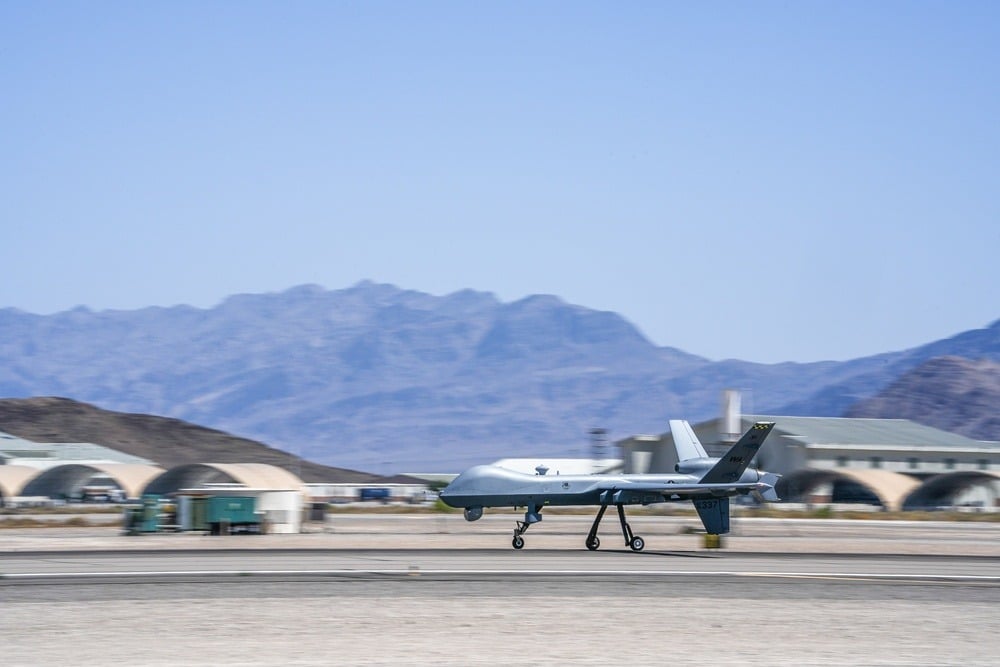
The weak point of the split was always the forward team. Every airfield where a Reaper might land needed its own LRE crew, ground control station and antennas. In July 2021, the 556th Test and Evaluation Squadron showed that the Reaper’s Automatic Takeoff and Landing Capability, ATLC, could remove that need. Under satellite control from crews at Base de la Fuerza Aérea Nellis, a Reaper took off from Creech, flew to Cannon AFB in New Mexico, landed, took off again and returned.
With ATLC the aircraft flies the takeoff and landing itself, while the remote crew monitors it for safety. In 2023, Air & Space Forces Magazine reported that a deployment that once needed about 55 maintainers, ground control stations and ground data terminals could be done with about 10 airmen and a pallet and a half of equipment.
The old way is now being retired. On 22 May 2025, crews of Creech’s 11th Attack Squadron flew the unit’s last C-band launch and recovery sorties, a day of touch-and-goes by pilots who had spent their careers learning to land the Reaper by hand. On 13 October 2025 the squadron, until then a launch and recovery training unit, flew in combat for the first time, handling every phase of the mission over satellite links.
Shrinking the delay
The next step is attacking the latency itself. In December 2022, General Atomics and the Air National Guard flight-tested an MQ-9A with a satellite command-and-control link through low Earth orbit, much closer to the ground than geostationary satellites. The company says early testing showed significantly lower latency and that the link could be used in all phases of flight.
The US Air Force’s recruiting profile of the remotely piloted aircraft pilot career.
Remote split operations turned the Reaper into a global aircraft flown from a handful of bases. Its own success, plus automation and faster satellites, is now making the split unnecessary. The pilot in the Nevada desert stays. The crew at the end of the runway is the part that is going away.
Sources: U.S. Air Force MQ-9 Reaper fact sheets, DVIDS (432nd Wing, 11th Attack Squadron), Air Force News Service, Air & Space Forces Magazine, Shephard Media, General Atomics Aeronautical Systems, Fox News
Header photo: Tech. Sgt. Robert Cloys, U.S. Air Force / Wikimedia Commons, public domain
0 Comments