
The document runs to 179 pages and almost all of it is dams, waterways and laboratory budgets. On page 143, in a column of numbers under the National Nuclear Security Administration, there is a line that reads: B94 … 77,108 … +77,108.
That is it. Seventy-seven million dollars, in thousands, recommended for fiscal 2027. The 2026 column beside it is blank, because there was no B94 in 2026. There is no paragraph anywhere else in the statement explaining what a B94 is, what it does, or who asked for it.
In the American nuclear designation system a “B” prefix means one thing: a bomb dropped from an aircraft. And a genuinely new one has not been named in a very long time.
Datos rápidos
The designation: B94 — in the American system, a “B” number is an air-dropped bomb, a “W” number a warhead
Where it appeared: One table line in the Senate Appropriations Committee’s Explanatory Statement for the Energy and Water Development Appropriations Bill, 2027
The money: $77.108 million recommended for fiscal 2027, every dollar of it new — the 2026 column is blank
Where in the budget: NNSA, Weapons Activities, Stockpile Management, Stockpile Modernization — the same block as W80-4, W87-1, W93 and B61-13
Narrative text explaining it: None. The 179-page statement never mentions B94 outside that table row
Last new US bomb designation: The B90 nuclear depth and strike bomb, cancelled in September 1991
One Line, Seventy-Seven Million Dollars, No Explanation
The Senate Appropriations Committee released five fiscal 2027 funding bills on 12 November 2026. One of them covers energy and water development, which is where the Department of Energy lives, and with it the National Nuclear Security Administration — the semi-autonomous agency that designs, builds and maintains America’s nuclear weapons. The Pentagon buys the aircraft and the missiles. The NNSA builds what goes on the end.
The explanatory statement that accompanies the bill is where a committee spells out, line by line, what it wants the money spent on. Under Atomic Energy Defense Activities, the Weapons Activities account breaks down into Stockpile Management, and under that, Stockpile Modernization. That sub-account is a short list of the programmes currently rebuilding or replacing individual weapons: the W80-4 life extension for the cruise missile warhead, the W87-1 for the new land-based missile, the W93 for the submarine force, and the B61-13, the newest member of the long-running B61 gravity bomb family.
Immediately below B61-13 sits B94, with no indentation and no explanation, carrying $77.108 million that did not exist a year ago. Directly beneath it is another new line simply called “Future Programs”, carrying $122.892 million. And at the top of the same block, the old B61 Life Extension Program line drops to zero.
Why a New “B” Number Is Unusual
American nuclear weapons carry a designation that tells you how they are delivered. A W number is a warhead: it sits on a missile, a torpedo or an artillery shell. A B number is a bomb: it falls out of an aeroplane. Every modification of an existing weapon keeps the parent number and adds a suffix, which is why the gravity bomb in the stockpile today has run from the B61-3 and B61-4 through the B61-12 to the B61-13 without ever becoming a B62.
A clean new number therefore signals something the government considers a new weapon rather than a modification. According to La zona de guerra, which first reported the B94 line on 16 November, the last entirely new American bomb designation was the B90, a nuclear depth and strike bomb whose programme was cancelled in September 1991. The last new designation of any kind was the W93 warhead now in development for the Trident II submarine missile.
The designation was spotted in the appropriations text by Eliana Johns of the Federation of American Scientists and flagged publicly by Jeffrey Lewis of Stanford’s Center for International Security and Cooperation. As of publication, no US government page uses the term B94 at all: a check of the NNSA newsroom, its stockpile page and its stewardship planning documents on 16 November returned nothing.
The Bunker-Buster Theory, and Why It Is Only a Theory
La zona de guerra’s own assessment is that the B94 is probably the Nuclear Deterrent System-Air-delivered, or NDS-A, a programme it describes as aimed at hard and deeply buried targets and traceable back to at least 2022. The outlet is careful to label this as unconfirmed, and so are we: there is no public NNSA document that connects the two, no stated yield, no named delivery aircraft, and no image, drawing or model of NDS-A in the public domain.
What is on the record is that the United States has been short of options against very deeply buried targets for two decades. The B61-11, the earth-penetrating variant, entered service in 1997. Its intended successor, the Robust Nuclear Earth Penetrator, was publicly abandoned in 2005. The B61-13 that is being built now is based on the B61-12 and, by the NNSA’s own description, carries “a yield oriented to defeat certain harder and large-area military targets” — which is not the same thing as digging.
The B61-13 programme itself is moving fast. The NNSA announced the first assembled unit in May 2025, almost a year early, and on 10 September 2026 said Y-12 had finished the canned subassembly production run roughly seven months ahead of schedule. The committee’s recommendation actually trims that line slightly, by $2.929 million, while creating the B94 line from nothing. Read together, those two numbers look less like a cut and more like a handover.
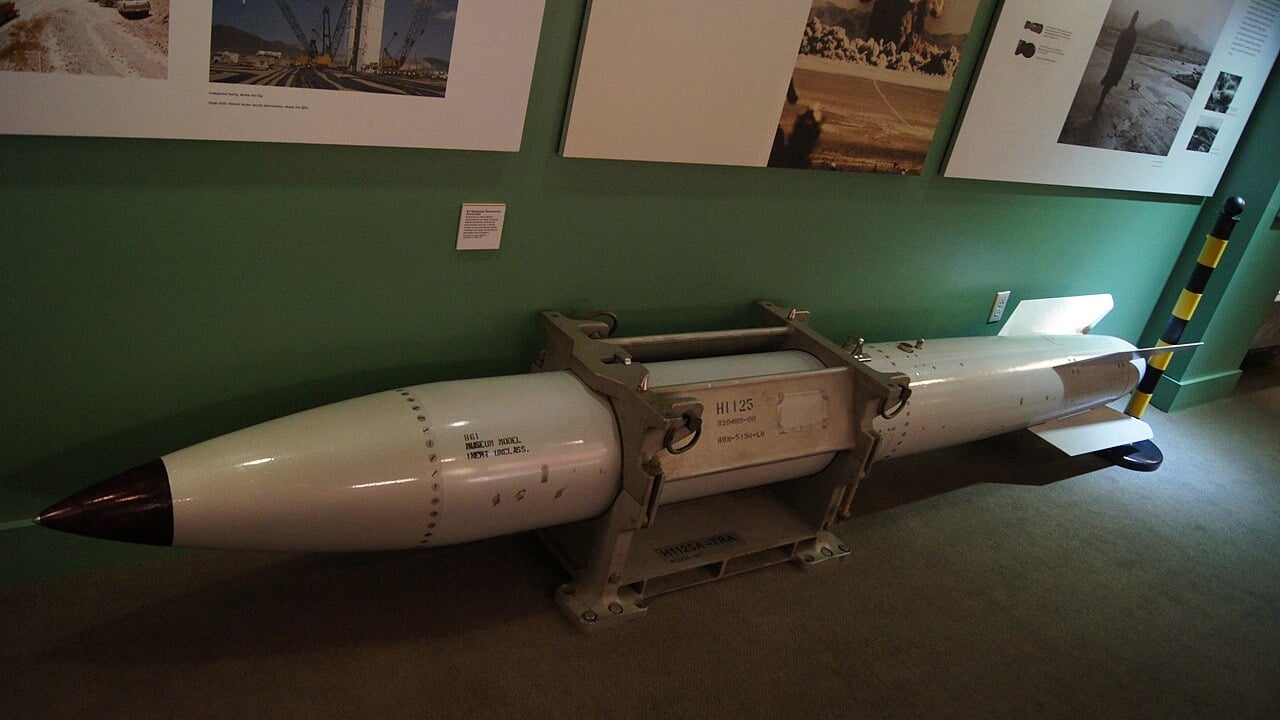
A B61-12 inert flight test at the Tonopah Test Range. Weapons in this family are dropped, filmed and scored for years before anything reaches the stockpile; none of that has been shown for the B94.
¿Qué sucede después?
A committee recommendation is not an appropriation. The explanatory statement accompanies a draft bill that still has to pass the Senate, be reconciled with the House, and be signed. Lines appear in these documents and vanish again. The “Future Programs” entry directly below B94 is a reminder of how much of this account is deliberately unlabelled.
But designations are not invented by appropriators. Somebody inside the weapons complex has already assigned this one, which means the programme behind it is real enough to have a number, a budget line and a place in the stockpile plan — even if, for now, the only thing the public knows about it is three characters and a figure in a table.
Sources: Explanatory Statement for the Energy and Water Development Appropriations Bill, 2027, Senate Committee on Appropriations, page 143 (B94 line item, read in full on 16 November 2026); Senate Appropriations Committee release of five FY2027 funding bills, 12 November 2026; National Nuclear Security Administration, “NNSA Completes B61-13 Canned Subassembly Production at Y-12 Seven Months Ahead of Schedule”, 10 September 2026; NNSA, “NNSA completes assembly of the first B61-13 nuclear gravity bomb ahead of schedule”, 19 May 2025; The War Zone, 16 November 2026.



0 Comments