
On 5 December 2022, inside a ten-metre target chamber at Lawrence Livermore National Laboratory in California, 192 laser beams fired at a tiny capsule of fusion fuel. They delivered 2.05 megajoules of energy. The fuel gave back 3.15 megajoules.
For the first time, a controlled nuclear fusion experiment had produced more energy than the energy put into the fuel to start it. Physicists had chased that moment for more than 60 years. And yet the lasers had drawn roughly 300 megajoules from the grid to make that pulse, so the lab still used roughly a hundred times more electricity than the fusion released.
That gap between a scientific triumph and a working power station is the whole story of fusion. Here is how nuclear fusion works, why stars do it effortlessly and we find it so hard, and how the same reaction already powered the biggest bombs ever built.
Datos rápidos
- Qué es: Light nuclei, usually hydrogen isotopes, joining into a heavier nucleus and releasing energy
- Main fuel on Earth: Deuterium (from seawater) and tritium (bred from lithium)
- Energy per D-T reaction: 17.6 MeV: a 14.1 MeV neutron and a 3.5 MeV helium nucleus
- Temperature needed: Around 100 million kelvin on Earth; the Sun’s core is about 15 million K
- Magnetic record: JET, 69 MJ over 5 seconds from 0.2 mg of fuel (announced February 2024)
- Ignition: NIF, 5 December 2022: 3.15 MJ out from 2.05 MJ of laser energy in
- Armas: Ivy Mike, 1 November 1952, 10.4 megatons, first full-scale H-bomb test
- ITER: D-T operations scheduled for 2039 under the July 2024 baseline
Fusion vs fission: joining, not splitting
Nuclear fusion is the opposite of nuclear fission. Fission splits a very heavy nucleus such as uranium or plutonium into lighter pieces. Fusion pushes two very light nuclei, usually isotopes of hydrogen, together until they merge into a heavier one, typically helium.
Both release energy for the same underlying reason. How tightly a nucleus is bound depends on its size, and the most tightly bound nuclei sit around iron and nickel. Split something much heavier, or join things much lighter, and you move towards that sweet spot. The products weigh slightly less than what went in, and the missing mass comes out as energy, as Einstein’s E = mc² says it must.
The amounts are startling. In the deuterium-tritium reaction that fusion machines use, about 0.7 percent of the fuel’s mass turns into energy. A single reaction releases 17.6 million electronvolts. Adding an electron to a hydrogen nucleus, a typical chemical event, releases 13.6 electronvolts: less than a millionth as much.
The problem: protons hate each other
If fusion releases so much energy, why does it not happen all the time? Because every nucleus carries positive charge, and like charges repel. Two hydrogen nuclei approaching each other are pushed apart by the electrostatic force, which physicists call the Coulomb barrier.
Only when they get extremely close does the strong nuclear force, which holds nuclei together but acts over a tiny distance, take over and pull them into one. To get there, the nuclei have to be moving very fast, which means very hot. On paper, deuterium and tritium would need temperatures above a billion kelvin to climb the barrier.
Two things lower the bar. In any hot gas, some particles move far faster than average, and those fast ones do most of the fusing. And quantum mechanics lets a nucleus that has almost enough energy “tunnel” through the rest of the barrier. Even so, practical fusion needs fuel in the range of a hundred million kelvin, hot enough that atoms are stripped of their electrons and become a plasma.
How the Sun does it
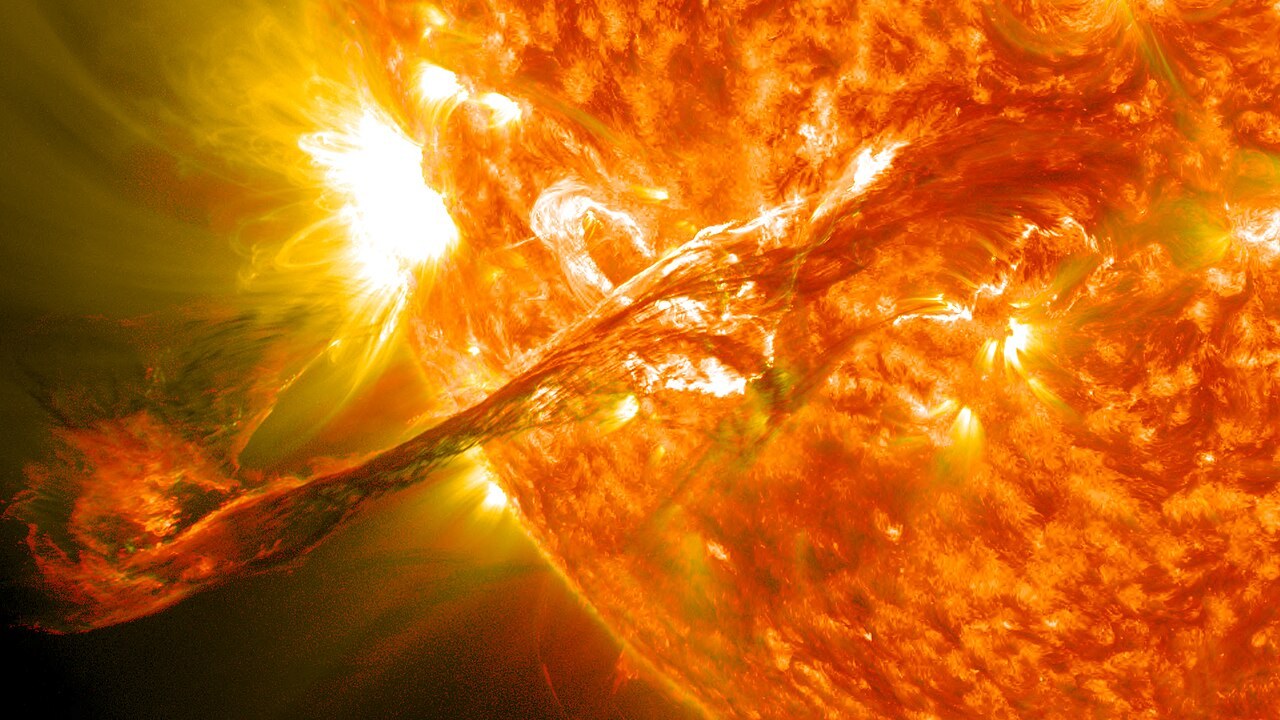
The Sun cheats with gravity. Its own enormous weight squeezes and holds the hydrogen in its core at about 15 million kelvin, far cooler than a fusion reactor needs, but at crushing density and for billions of years. Arthur Eddington suggested in 1920 that hydrogen fusing into helium powered the stars, and Hans Bethe worked out the details in 1938 and 1939.
In stars like ours, the main route is the proton-proton chain: a series of reactions whose net result is that four protons become one helium nucleus, two positrons, two neutrinos and energy. The first step is so improbable that the Sun’s fuel lasts a very long time; converting all the hydrogen in its core is calculated to take more than ten billion years.
Here is the aha. Despite the inferno at its centre, the Sun is a slow, gentle fusion reactor. It works because it is so vast. A machine on Earth has no gravity to help and a few cubic metres to work with, so it has to run far hotter than the Sun to get any useful amount of fusion.
The fuel: deuterium and tritium
That is why fusion machines do not burn ordinary hydrogen. They use two heavier hydrogen isotopes. Deuterium has one proton and one neutron and is found in seawater. Tritium has one proton and two neutrons, is radioactive and barely exists in nature.
Their reaction is by far the easiest to ignite. In 1946, physicist Egon Bretscher found that deuterium and tritium fuse about a hundred times more readily than had been assumed. Each reaction produces a helium nucleus carrying 3.5 MeV and a neutron carrying 14.1 MeV. The helium stays in the plasma and keeps it hot. The neutron, having no charge, flies straight out, and that is where a power plant would capture its energy as heat.
Because tritium is so scarce, future plants will have to make their own by letting those neutrons strike lithium in the walls around the plasma, a process called tritium breeding. Testing it is one of the jobs of ITER, the giant reactor under construction in France.
The recipe: hot enough, dense enough, long enough
Every fusion approach has to satisfy the same three-part test, known as the Lawson criterion or the triple product: temperature, density and confinement time. The plasma has to be hot enough to fuse, packed densely enough for collisions to be frequent, and held together long enough for the energy it releases to outrun the energy it loses.
There are two main ways to do that on Earth. Magnetic confinement holds a thin, very hot plasma for seconds or minutes using magnetic fields. Inertial confinement crushes a tiny pellet so hard and fast that it fuses in a fraction of a billionth of a second, before it can fly apart. Both have now produced headline results.
Magnetic confinement: the tokamak
Because a plasma is made of charged particles, magnetic fields can steer it. The most successful design is the tokamak, a Soviet invention, which twists powerful magnetic fields into a doughnut-shaped cage so the plasma circles endlessly without touching the walls.
Europe’s Joint European Torus, JET, at Culham near Oxford, was the workhorse. In its final deuterium-tritium experiments it held high fusion power for 5 seconds and produced a record 69 megajoules of energy from just 0.2 milligrams of fuel, the UK Atomic Energy Authority announced in February 2024. JET, operating since 1983, ended its scientific operations in December 2023.
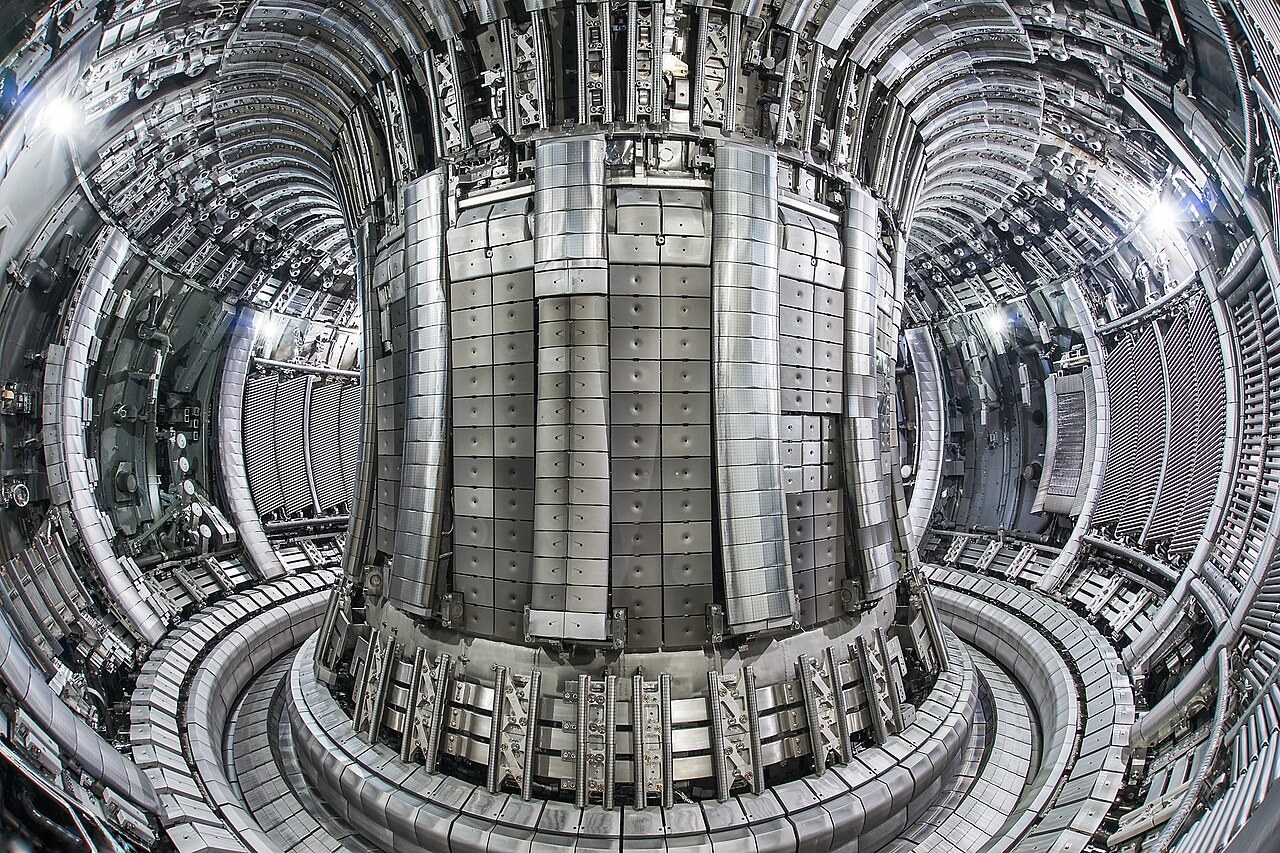
EUROfusion on JET’s final deuterium-tritium experiments and the 69 megajoule record.
Inertial confinement: lasers and a tiny capsule
The National Ignition Facility takes the opposite approach. Its 192 lasers do not hit the fuel directly. They heat the inside of a tiny gold cylinder, which glows with X-rays that blast the outer layer off a fuel capsule. The capsule implodes, and the deuterium-tritium at its centre is crushed and heated until it fuses.
When enough of the helium nuclei produced stay inside and heat the rest of the fuel, the reaction becomes self-sustaining across the pellet. That is ignition, and on 5 December 2022 NIF reached it, producing about 1.5 times the laser energy that drove it. The US Department of Energy announced the result on 13 December 2022.
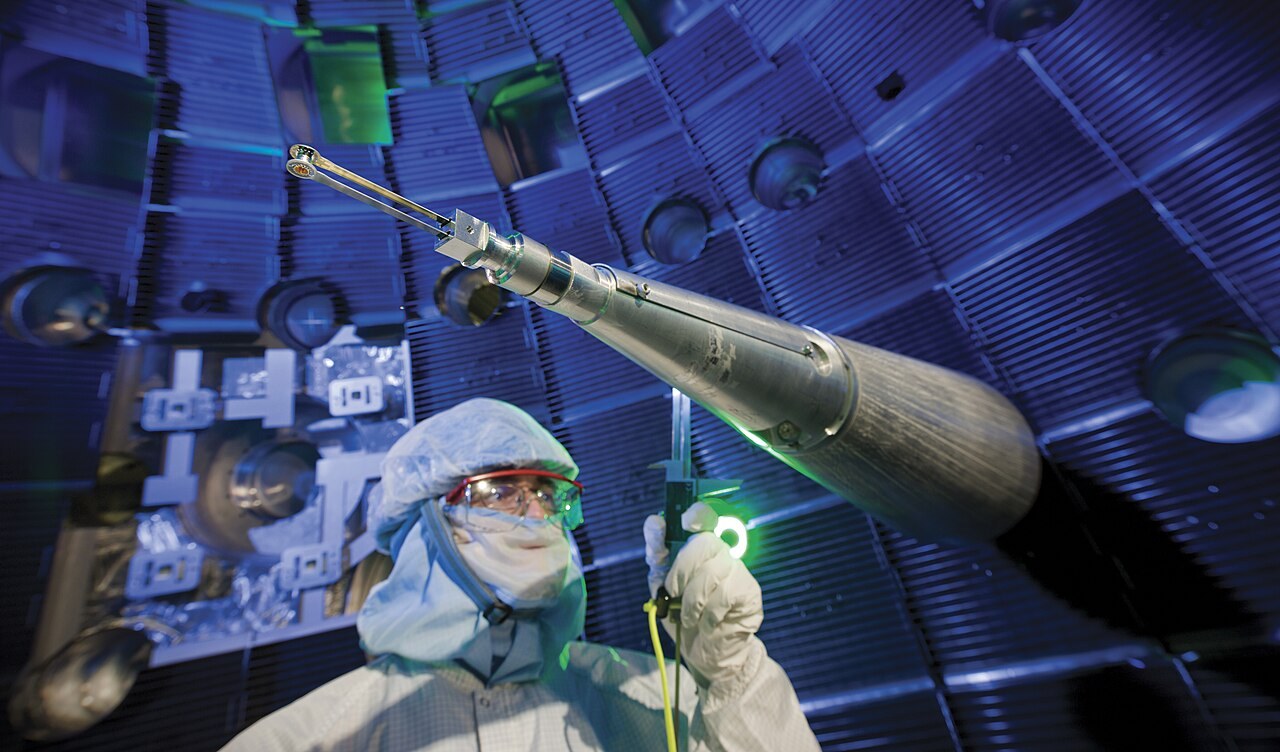
NIF has repeated ignition since, and in June 2025 a team led by Los Alamos National Laboratory used it to produce 2.4 megajoules and a self-sustaining burning plasma with a different target design. But NIF’s main mission is nuclear weapons stockpile science, not electricity, and its lasers are far too inefficient for a power plant.
60 Minutes goes inside the National Ignition Facility and the experiment that achieved fusion ignition.
The uncontrolled version: the hydrogen bomb
Humans first released fusion energy on a large scale not in a laboratory but in a weapon. The hydrogen bomb uses a fission bomb as a trigger: its X-rays compress and heat a separate stage of fusion fuel until it ignites, a scheme known as the Teller-Ulam design.
The first full-scale test, Ivy Mike, erased the island of Elugelab in the Pacific on 1 November 1952 with a yield of 10.4 megatons, and F-84 pilots flew through its cloud to collect samples. Even then, most of the yield came from fission: about 77 percent from the bomb’s uranium casing splitting under the flood of fusion neutrons. In 1961 a Soviet Tu-95 dropped Tsar Bomba, about 50 megatons, the largest explosion ever made.
A bomb solves the confinement problem by not bothering: it releases everything at once. A power plant has to do the opposite, burning a few grams of fuel steadily and safely, which is far harder.
ITER and the road to a power plant
The next giant step is ITER, a tokamak being built at Saint-Paul-lez-Durance in southern France by the European Union, China, India, Japan, Korea, Russia and the United States. It is designed to produce 500 megawatts of fusion heat from 50 megawatts of heating, a tenfold gain, for several minutes at a time, though it will not generate electricity.
It is also badly late. Under the schedule ITER published in July 2024, research operations are due to start in 2034, deuterium-deuterium plasmas in 2035 and deuterium-tritium operations in 2039. Its first plasma had once been planned for 2020.
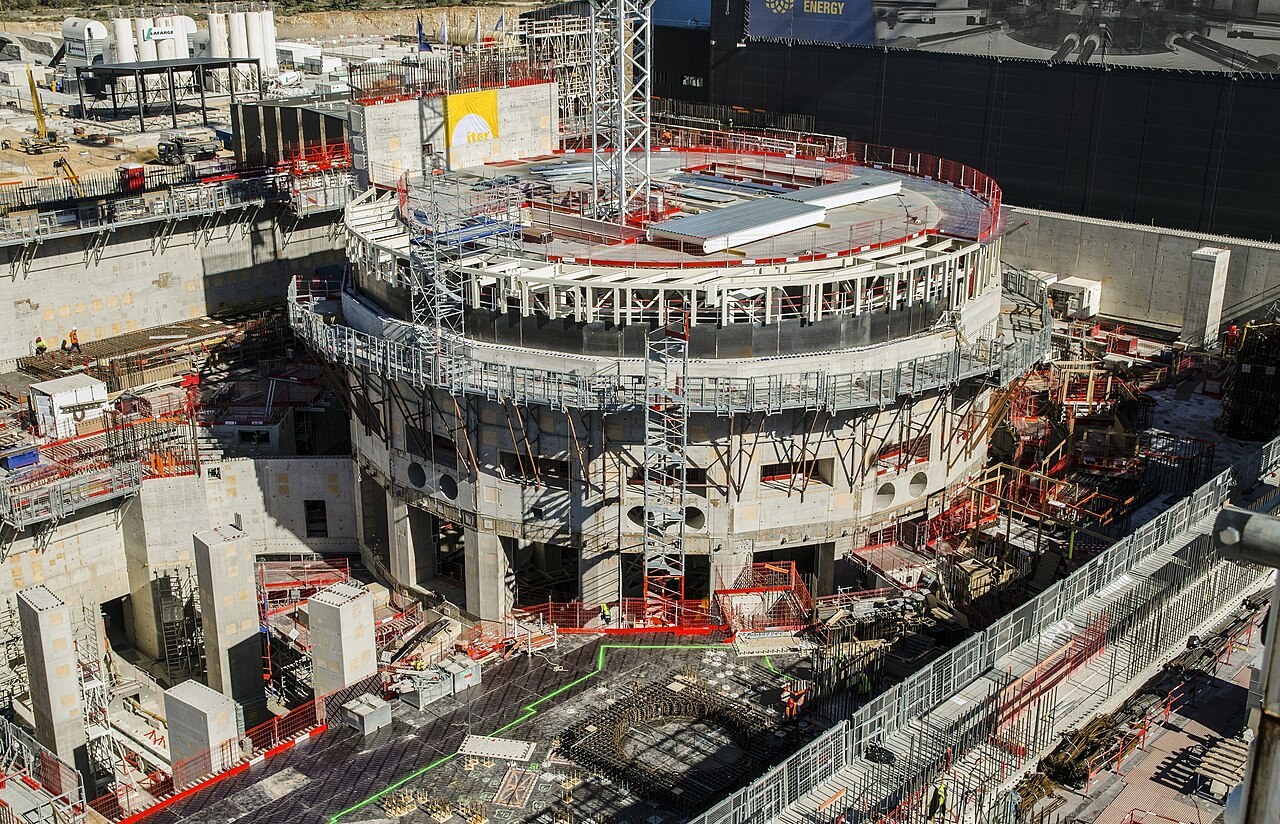
Even ITER leaves hard problems for the plants that follow: materials that survive years of bombardment by 14 MeV neutrons, breeding enough tritium, and making the whole machine produce far more electricity than it consumes, not just more heat than the plasma absorbs.
The ITER Organization tells the story of the international tokamak project in southern France.
Why it is worth the trouble
Fusion’s appeal is easy to state. The fuel is abundant, the reaction emits no carbon dioxide, and unlike a fission reactor a fusion plasma cannot run away: disturb it and it simply goes out. The neutrons do make the machine’s structure radioactive, but there is no long-lived high-level waste of the kind fission leaves behind.
Every star you can see is proof that fusion works. Lasers in California and magnets in Oxfordshire have now proved we can do it too. The question that remains is not whether fusion is possible, but whether we can build a machine that does it cheaply, reliably and for decades. That is an engineering problem, and it may take decades more to answer.
Sources: US Department of Energy (fusion ignition announcement, 13 December 2022), Lawrence Livermore National Laboratory, Los Alamos National Laboratory, UK Atomic Energy Authority and EUROfusion (JET DTE3 record, February 2024), ITER Organization
Header photo: NASA Goddard Space Flight Center / Wikimedia Commons, CC BY 2.0


0 Comments