

The Airbus at the holding point weighs 66 tonnes. The runway ahead is long, there is a 20-knot headwind straight down the centreline, and the air is a mild 24 degrees Celsius. The crew will now push the thrust levers forward, and stop them well short of the stop.
Almost every airliner you have ever flown on did exactly the same thing. It took off on less than the power its engines could produce, deliberately, with the manufacturer’s blessing and the regulator’s written approval. On that particular departure the flight computer was told the outside air temperature was 68 degrees Celsius, roughly 44 degrees hotter than the air actually was. The number is false and everybody involved knows it is false. That is the point of it.
This is the reduced thrust takeoff: the most routine thing in commercial aviation that still sounds, to a passenger, like a corner being cut. It is not. It is one of the few procedures in the industry that makes an aeroplane both cheaper and statistically safer at the same time, and the rules that govern it are unusually precise about where the line sits.
Datos rápidos
Qué es: taking off at a thrust setting below the maximum the engines could deliver in the conditions of the day
Two methods: reduced thrust, which Airbus calls a flexible takeoff, and derated thrust, a fixed lower rating
The legal floor: a reduced setting must be “at least 75 percent of the takeoff thrust” for the existing ambient conditions (FAA AC 25-13, para 5a(4))
The input: a fictitious outside air temperature, called the flexible temperature or the assumed temperature
Never allowed on: contaminated runways; wet runways without specific performance accountability; with the antiskid system inoperative
Always: at the discretion of the pilot, in the words of the regulation itself
Why bother: engine reliability, maintenance and operating costs — and, less obviously, a lower chance of the engine failing at the worst possible moment
The paperwork that makes it legal
The governing document in the United States is an FAA advisory circular written in 1988 and still doing its job: AC 25-13, Reduced and Derated Takeoff Thrust (Power) Procedures, dated 4 May 1988 and signed by Darrell M. Pedersen, then Acting Manager of the Aircraft Certification Division. It consolidates the agency’s guidance under three airworthiness rules, FAR 25.101, 25.1521 and 25.1581, and it opens by stating the commercial case in one sentence.
Takeoffs at settings below the maximum available, the circular says, “may provide substantial benefits in terms of engine reliability, maintenance, and operating costs.” Then it splits the subject in two, and the distinction it draws is the one most explanations skip.
Derated takeoff thrust is a lower rating with its own paperwork: a level below maximum takeoff thrust for which the Airplane Flight Manual carries “a set of separate and independent, or clearly distinguishable, takeoff limitations and performance data.” Select it and the thrust setting becomes “a normal takeoff operating limit” — a ceiling you are not supposed to exceed.
Reduced takeoff thrust is something looser: “a takeoff thrust less than the takeoff (or derated takeoff) thrust,” arrived at by approved simple methods. Here the circular is explicit that the setting “is not considered a takeoff operating limit.” Nothing stops the crew from pushing the levers up. That single legal difference drives everything that follows.
How far down can it go? Paragraph 5a(4) draws the line from below rather than above: the reduced setting must be “at least 75 percent of the takeoff thrust, or derated takeoff thrust if such is the performance basis, for the existing ambient conditions.” A quarter of the available thrust is the most anyone may give away, and the circular adds that the reduction must not cost the aeroplane any system that is normally working for takeoff — automatic spoilers, engine failure warning, configuration warning, anything running on bleed air.
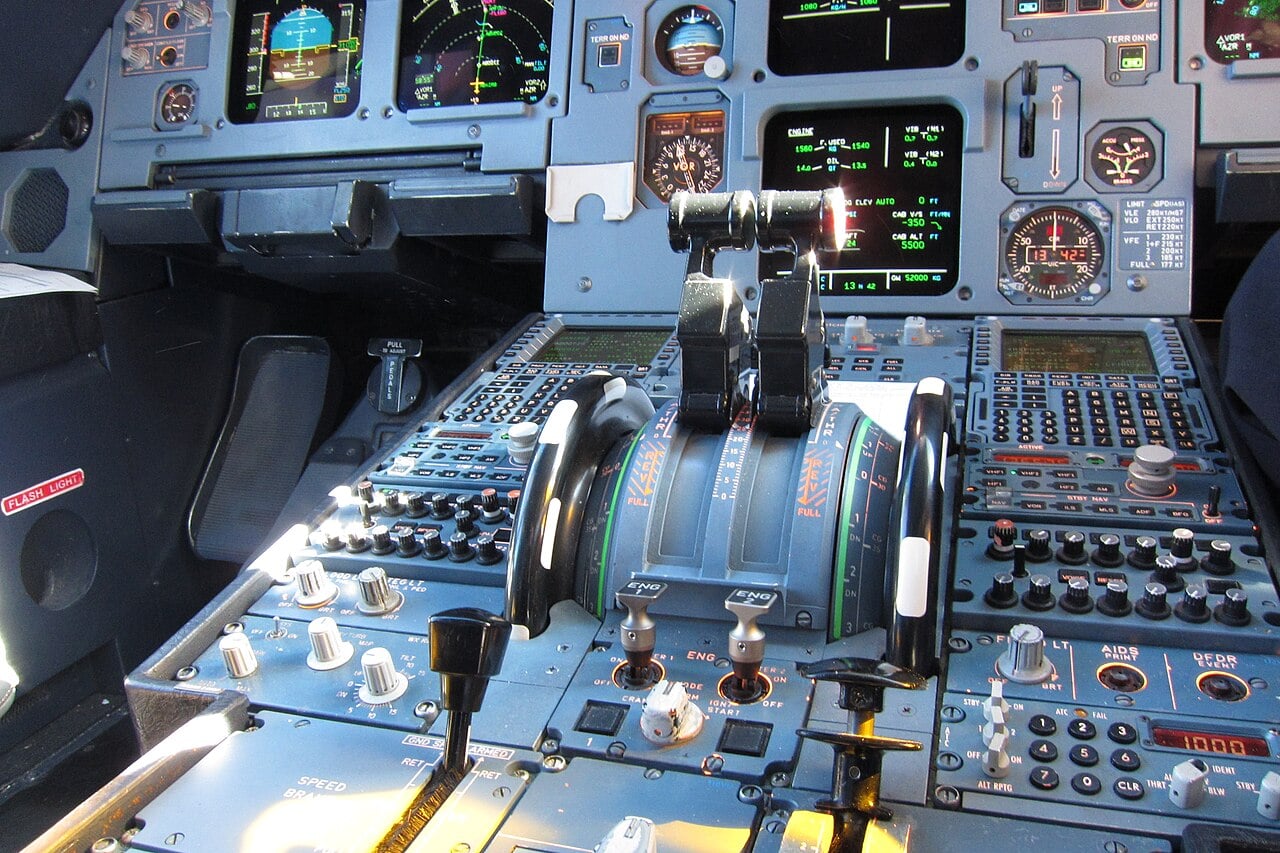
Flex: telling the aeroplane a lie it can check
Airbus set out the mechanics in Getting to Grips with Aircraft Performance, the Flight Operations Support brochure its customer services department published in January 2002. The logic begins with an observation so obvious it is easy to miss: “The aircraft actual takeoff weight is often lower than the maximum regulatory takeoff weight.”
Because it is lower, there is slack. The crew consults a runway takeoff weight chart, finds the temperature at which the thrust the aeroplane actually needs would be the maximum available, and enters that temperature instead of the real one. Airbus calls it the “flexible temperature” or “assumed temperature”, and describes it as “the input parameter through which the engine monitoring computer adapts the thrust to the actual takeoff weight.”
The reason a lie about the weather produces a correct thrust setting is that turbine engines are flat rated. They are guaranteed to deliver their full rated thrust at and below a particular ambient temperature — 30 degrees Celsius for the CFM International CFM56-7B series, to take one common example — and above that temperature the thrust available falls away as the air thins. Feed the computer a hotter day and it rolls the engines back along a curve the manufacturer has already certified.
Three conditions have to hold, and Airbus states them as a set: the flex temperature must be higher than the chart reference temperature, higher than the real outside air temperature, and no higher than the maximum flex temperature, which is simply the point at which the 25 per cent floor is reached. The worked example in the brochure is a departure from Paris-Orly runway 08, slats and flaps at 1+F, 66 tonnes, 24 degrees outside, 20 knots of headwind, dry runway, air conditioning off. The answer: flex temperature 68 degrees, V1 145 knots, VR 145 knots, V2 150 knots.
The margins do not shrink. They quietly grow.
The instinct that something is being taken away is almost universal, and Chiles addressed it directly in that article. There is, he wrote, “absolutely no loss of any necessary performance margins involving field length, screen height, climb or obstacle clearance.” If the aeroplane satisfied the certification standards at the hotter assumed temperature, it satisfies them at the cooler real one.
In practice it does better than satisfy them. Takeoff speeds are flown as indicated airspeeds, but what the aeroplane actually does is governed by true airspeed, which depends on air density. On the real, cooler day the air is denser, so the true airspeed at any given indicated speed is lower. The aircraft therefore uses less runway and climbs on a steeper gradient than the certified figures for the assumed temperature promise. Chiles put the effect “on the order of several hundred feet in field length,” and noted that it grows as the gap between the real and assumed temperatures widens.
Those margins are not abstractions. The screen height an aeroplane must clear at the end of the certified takeoff distance is 35 feet on a dry runway and 15 feet on a wet one. A reduced-thrust departure clears them with room the paperwork never claims.
Flex temperature explained from the flight deck, by airline pilot and YouTube instructor Captain Joe.
Derate is a different animal entirely
Where flex is a temperature the crew invents, a derate is a rating the manufacturer certified in advance. In the January 2002 state of the Airbus fleet, six derate levels existed, running from four per cent below maximum takeoff thrust to twenty-four per cent below it in four-point steps, with the A340-500 and -600 carrying two further levels at 32 and 40 per cent.
Because the maximum thrust available at any point in the takeoff is genuinely lower, a derate changes the aerodynamics of an engine failure. Less asymmetric thrust means a lower minimum control speed on the ground and in the air, re-established under JAR/FAR 25.149. And a lower minimum control speed can let V1 come down, which shortens the accelerate-stop distance, which on a short runway can let the aeroplane take off heavier than it could at full power. Airbus illustrates the point with an A340 whose best takeoff weight comes at a 20 per cent derate.
There is a sting in it. Because the performance was calculated against those lower control speeds, the brochure sets a hard rule: when a derated takeoff is carried out, full thrust “must never be selected until the aircraft is airborne and above the minimum flap retraction speed.” A flexible takeoff carries no such restriction. The circular says plainly that during a reduced-thrust takeoff, takeoff thrust “may be selected at any time during the takeoff operation”, and Airbus confirms that full thrust “remains available at any moment during the takeoff phase.”
The runway surface splits them too. Reduced thrust is forbidden on a contaminated runway outright. A derate is not, because each derate level comes with its own certified performance data for dry, wet and contaminated surfaces. On a snow-covered runway, the fixed derate is the only one of the two still on the table.
The same ground covered to airline transport pilot licence standard: derate and assumed temperature reduction, side by side.
What the airlines are actually buying
The economics are not subtle. A General Electric study of failure modes in the CF6-80, cited by Chiles and credited to Jack Stopkotte of GE Aircraft Engines in September 2003, found that regular use of the maximum 25 per cent fixed derate produced close to an order-of-magnitude improvement in cycles to failure: from one to two thousand cycles, to five to ten thousand. The same study identified thrust derate as the “most important factor in reducing turbine blade failures and deterioration.”
A separate study by the China Civil Aviation Flight College, presented by Yan Chenghong to the International Council of the Aeronautical Sciences congress in 2002, approached it from the temperature side. Running a hot section at 870 degrees Celsius for 3,500 hours cost 51 per cent of blade life; running it at 705 degrees cost 35 per cent. The difference worked out to roughly a doubling of hot-section life overall.
Exhaust gas temperature is the currency here, and it leaks into the fuel bill as well: the GE work found that every 10 degrees Celsius of EGT deterioration translates into about one per cent of fuel-flow deterioration. Because the takeoff is the most punishing phase of the cycle, the operator who gains most is the short-haul carrier flying several sectors a day, not the long-haul one flying a single stage.

The conditions attached
AC 25-13 requires the Airplane Flight Manual to state, as a limitation, that reduced-thrust takeoffs “are not authorized on runways contaminated with standing water, snow, slush, or ice, and are not authorized on wet runways unless suitable performance accountability is made for the increased stopping distance on the wet surface.” They are also barred when the antiskid system, if fitted, is unserviceable.
The circular even defines what counts as contaminated: more than a quarter of the required field length, across the width being used, covered by standing water or slush deeper than 0.125 inch (3.2 mm), or with an accumulation of snow or ice. It then adds a note of judgement that is rare in airworthiness guidance, pointing out that water sitting where rotation and liftoff occur is far more dangerous than the same water early in the roll, and that such a runway “might better be considered ‘contaminated’ rather than ‘wet.’”
One further condition catches people out. An operator cannot simply reduce thrust forever and assume the engines will still make full power when the day comes. The circular requires a periodic takeoff demonstration at the aeroplane’s full takeoff thrust setting, logged in the aircraft’s permanent records, so that engine deterioration does not creep past authorised limits. An approved engine condition-monitoring programme can stretch the interval, but it cannot abolish the check.
Nor is it a clean win for the neighbours. Chiles noted the awkward truth that while sideline noise may improve, the longer takeoff run and shallower climb path can put the aircraft closer to monitors further out and raise the readings there.
The failure mode is not the thrust. It is the number.
If reduced thrust has a dark side, it is not the reduction. It is the arithmetic that produces it. On the night of 20 March 2009 an Airbus A340-541 registered A6-ERG, operating as Emirates flight EK407 with 18 crew and 257 passengers aboard, struck its tail on the runway at Melbourne and ran off the end of it on departure for Dubai. Nobody was hurt. The aircraft was substantially damaged.
The Australian Transport Safety Bureau published its final report on 16 December 2011. The accident, it found, “resulted from the use of erroneous take-off performance parameters” — parameters that were themselves the product of “an incorrect take-off weight being inadvertently entered into the electronic flight bag during the pre-departure preparation.” The wrong number then passed through every subsequent check without anyone catching it.
What makes the finding unsettling is how ordinary it turned out to be. As part of the investigation the ATSB ran a separate research study, Take-off performance calculation and entry errors: A global perspective, covering occurrences in the twenty years to 2009. Melbourne, it concluded, was “just one of many occurrences involving the use of erroneous take-off performance parameters across a range of aircraft types, operators, locations and types of operation.”
The deeper point the bureau made goes to the design of the procedure rather than the crew. Degraded takeoff performance, it found, was “generally not detected by the flight crew until well into the take-off run, if at all”, because the takeoff performance philosophy used in civil transport aircraft “did not require the flight crew to monitor the acceleration of the aircraft or provide a reference acceleration that must be achieved.” A jet accelerating too slowly looks, from the flight deck, very much like a jet accelerating normally. The ATSB issued a safety recommendation to the FAA and a safety advisory notice to IATA and the Flight Safety Foundation.
None of which is an argument against reduced thrust. It is an argument about where the risk actually lives. The engines will do precisely what the number tells them to do, and they will do it with great reliability for a very long time. The number is the fragile part.
Boeing’s certification rejected-takeoff test on the 747-8: maximum weight, worn brakes, no thrust reversers, and a two-minute wait before the fire trucks are allowed to move. The margins a reduced-thrust takeoff preserves are the ones demonstrated here.
Why it still looks like cheating, and is not
Strip away the vocabulary and the procedure is a trade: the aeroplane gives up thrust it does not need in exchange for an engine that is less likely to break. The regulation permits it only down to three-quarters of full power, only on a surface that can stop the aircraft, only with the anti-skid working, and only with a standing arrangement to prove periodically that full thrust is still there. Every one of those clauses exists because somebody thought about what happens when it is not.
And the last clause of all is the one the circular puts in the Airplane Flight Manual in plain language: application of reduced takeoff thrust in service “is always at the discretion of the pilot.” A captain who looks at the wet runway, the short field and the hills at the far end and wants everything the engines have can simply have it. Most days, on most runways, they do not need to ask.
Sources: FAA Advisory Circular 25-13, Reduced and Derated Takeoff Thrust (Power) Procedures, 4 May 1988; Airbus Flight Operations Support & Line Assistance, Getting to Grips with Aircraft Performance, January 2002; Patrick Chiles, “When Less Is More”, Flight Safety Foundation AeroSafety World, March 2011, citing Jack Stopkotte (GE Aircraft Engines, 2003) and Yan Chenghong (ICAS, 2002); Australian Transport Safety Bureau investigation AO-2009-012, final report 16 December 2011.



0 Comments