
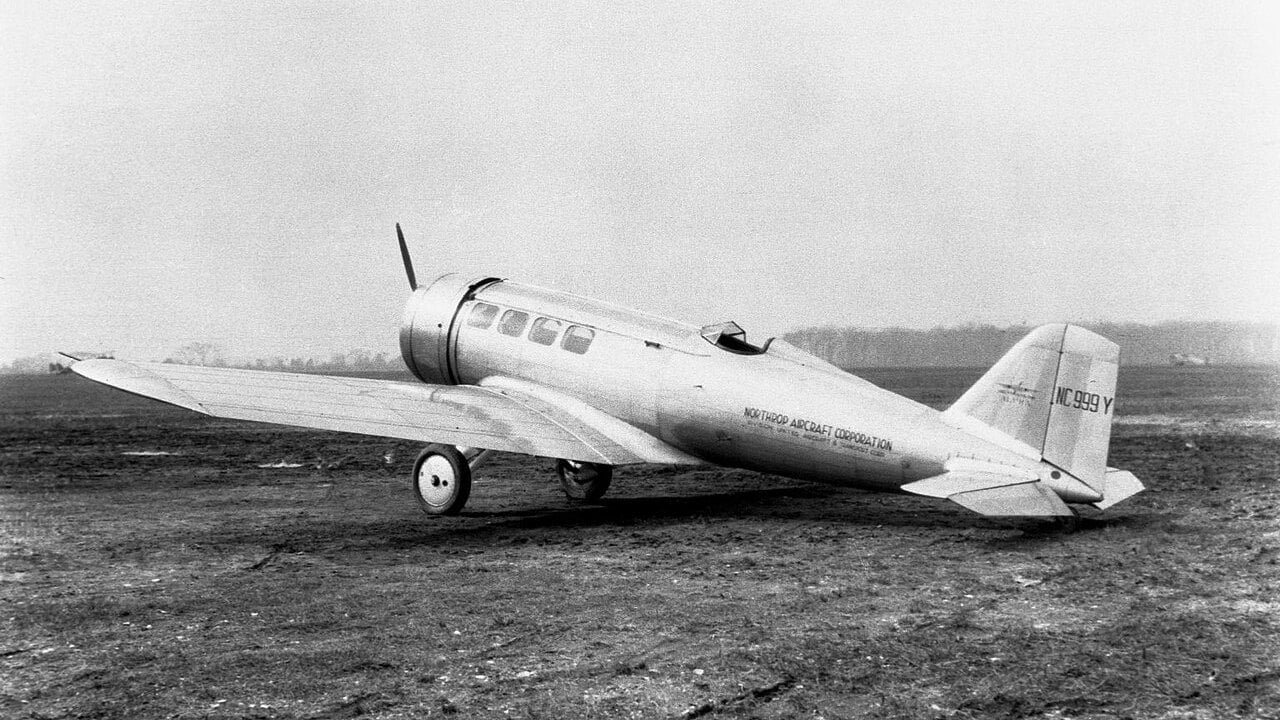
At the 1931 National Aircraft Show in Detroit, the American aviation industry was in a sombre mood, with the Depression biting hard into orders. Then a reporter from Scientific American walked up to a gleaming silver monoplane from California and called it “a beautiful ship, streamlined to the last degree.”
That ship was the Northrop Alpha. It carried six passengers in a closed cabin, a load of mail in the hold, and its pilot in an open cockpit behind them, exposed to wind, rain and engine oil. It looked half like the future and half like the past. That is exactly what it was.
The Alpha never became famous. It was built only in small numbers, and it was obsolete as a passenger plane within a few years. But hidden inside its wing was an idea that would shape the airliners every traveller of the next three decades flew in.
Datos rápidos
- Aeronave: Northrop Alpha, single-engine all-metal mail and passenger monoplane
- Diseñador: John K. “Jack” Northrop
- Introduced: 1930
- Capacidad: Six passengers in a closed cabin; pilot in an open cockpit
- Motor: One 420 hp Pratt & Whitney Wasp radial
- Velocidad máxima: 177 mph (later models)
- Operadores: Transcontinental & Western Air (TWA); US Army Air Corps as YC-19 / Y1C-19
- Legado: Multicellular stressed-skin wing later used on the Douglas DC-2 and DC-3
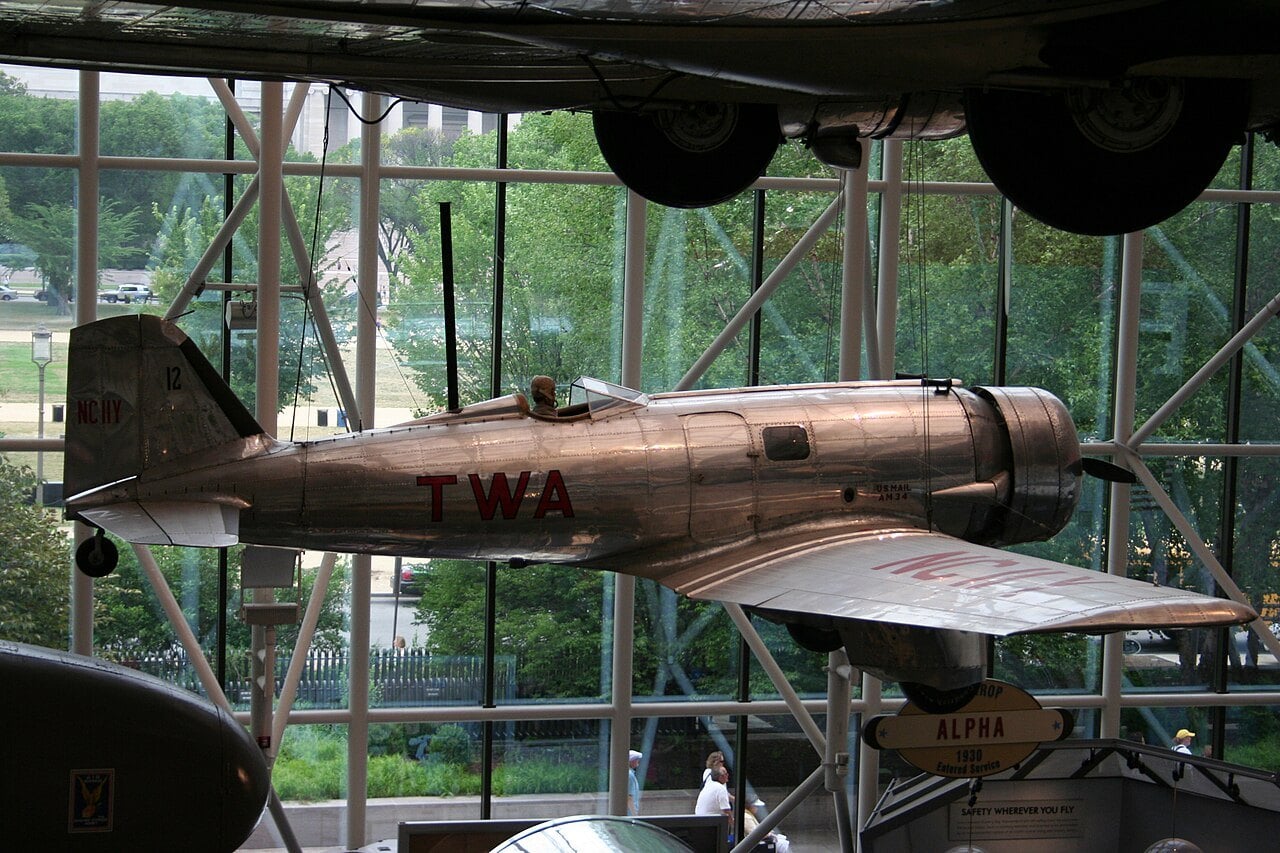
- Sobreviviente: NC11Y, National Air and Space Museum, Washington, D.C.
Jack Northrop’s all-metal bet
John K. “Jack” Northrop was a self-taught engineer who had already worked for the Loughead brothers, for Douglas and for Lockheed. At Lockheed he designed the Vega, the wooden record-breaker flown by Amelia Earhart and Wiley Post. By the end of the 1920s he wanted to do something different: build an aeroplane entirely out of metal.
According to the Smithsonian’s National Air and Space Museum, Northrop conceived the Alpha as a way to prove his ideas for the quantity production of an all-metal aeroplane, using nothing more than the machine tools that existing factories already had. Built by the Northrop Aircraft Corporation in Burbank, California, the Alpha was introduced in 1930.
The fuselage was a semi-monocoque shell, meaning the aluminium skin itself carried much of the load rather than merely covering a frame. The wing was a cantilever design with no external struts or bracing wires. Power came from a single 420 hp Pratt & Whitney Wasp radial, an engine already trusted for its reliability, and later versions could reach 177 mph.
The wing that mattered
The real breakthrough was inside the wing. Instead of one or two big spars carrying all the bending loads, Northrop built a multicellular structure: a series of spanwise cells formed by several thin webs, with the metal skin stressed so that it shared the work. If one part of the structure was damaged, the loads had other paths to follow.
The result, as Air & Space magazine put it in its history of the aircraft, was a wing that was light, inexpensive and rugged. Wind-tunnel work at Caltech also refined the details of the airframe, and the lessons were carried into Northrop’s later designs.
Northrop had close ties to Douglas, and the multicellular wing and stressed-skin construction did not stay at Burbank. The National Air and Space Museum is blunt about where they ended up.
The Douglas DC-2 and DC-3 were the airliners that made flying pay, and the DC-3’s military twin, the C-47 Skytrain, went on to carry troops and cargo across every theatre of the Second World War. A design principle first proven on a single-engine mail plane ended up in thousands of airframes.
Period film of the Northrop Alpha, the all-metal mail plane that carried TWA’s airmail across the United States in the early 1930s.
Mail, passengers and an open cockpit
The Alpha was built for one job: to carry mail and passengers quickly out of small airfields. Transcontinental & Western Air, the future TWA, put it on its coast-to-coast routes, where the aircraft could cross the United States in about 23 hours with stops at Winslow, Albuquerque, Amarillo, Wichita, Kansas City, St. Louis, Terre Haute, Indianapolis, Columbus, Pittsburgh and Philadelphia before New York.
Why leave the pilot outside? The answer says a lot about flying in 1930. The museum’s curator F. Robert van der Linden explained that the open cockpit was not an oversight.
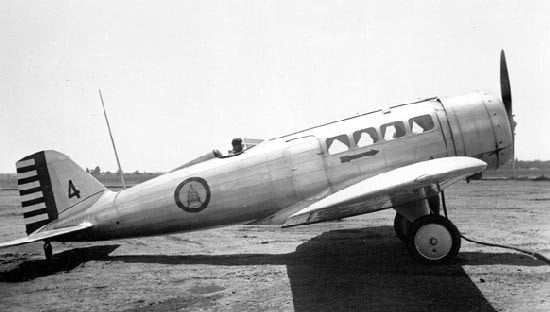
The US Army Air Corps liked the design too. It ordered three Alphas as VIP transports, one designated YC-19 and the others Y1C-19, with the first delivered in May 1931.
From passengers to gardenias
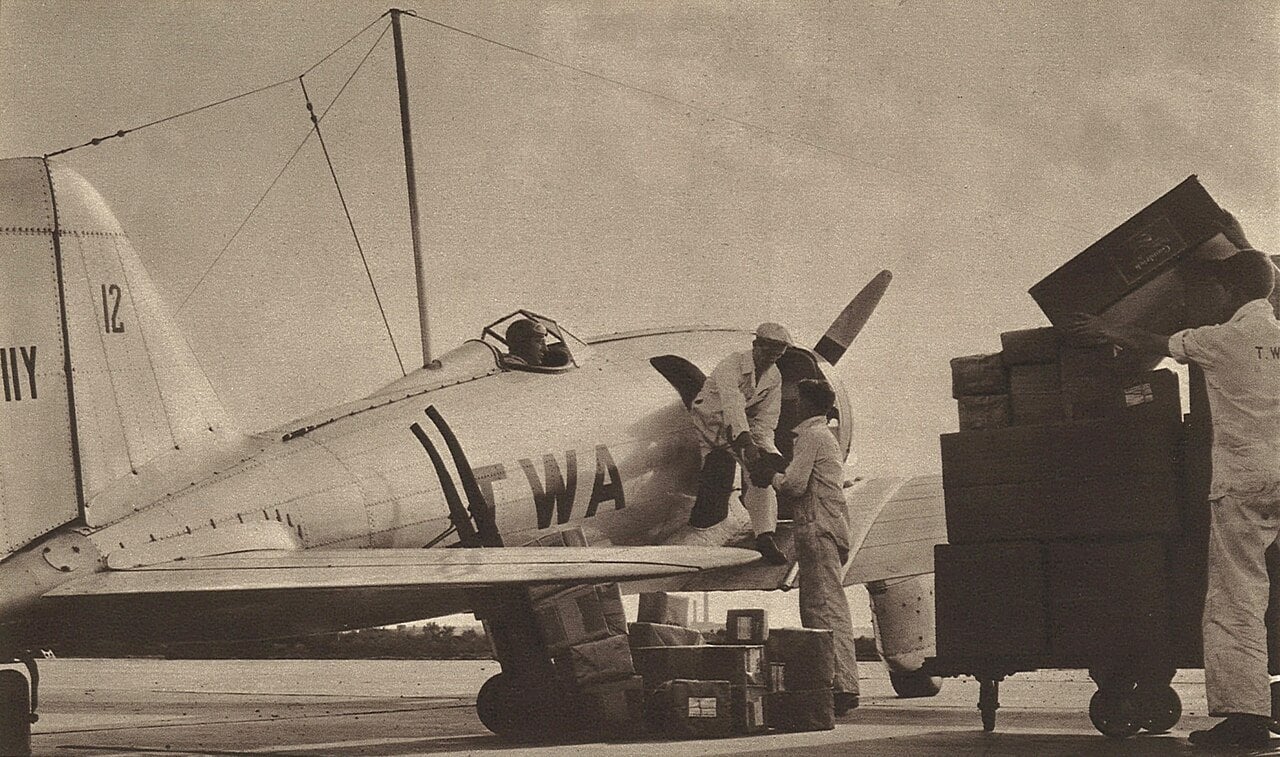
The Alpha’s passenger career was short. Larger twin-engine transports from Boeing and Douglas, enclosed cockpits and all, made a single-engine six-seater obsolete almost as soon as it entered service. The Alphas were not scrapped, though. They were converted to carry freight, and they were good at it.
TWA’s cargo Alphas flew some unusual loads across the country. The museum’s records list freshly cut gardenias, silk worms, medical serums and auto parts. Their original landing gear was eventually replaced too, after wind-tunnel tests at Caltech had shown the value of streamlined wheel fairings.
NC11Y: the survivor
One Alpha survives, and it has had a remarkable life. NC11Y was the third Alpha built and rolled out in November 1930. It first became the personal aircraft of Col. C. M. Young, the assistant secretary of commerce for aeronautics, then passed to the Ford Motor Company and National Air Transport before Transcontinental & Western Air bought it in November 1931. On 21 February 1933, Charles Lindbergh flew it on TWA business.
Retired after 1934, it was sold to Frederick B. Lee, who fitted floats for a planned round-the-world flight that never happened. It then passed through a long line of owners until Foster Hannaford Jr. of Winnetka, Illinois, bought it after the war. He hoped to make it fly again but died in 1971 before he could, and left it to the Experimental Aircraft Association.
A look at the surviving Northrop 4A Alpha, NC11Y, on display at the National Air and Space Museum.
The National Air and Space Museum negotiated with the EAA and TWA, and in 1975 a team of TWA volunteers led by Dan McGrogan rebuilt the aircraft at the airline’s technical centre in Kansas City. In 1976 it went on display in Washington, D.C., where it now hangs in the America by Air gallery in TWA colours, pilot’s cockpit still open to the sky.
Look past the fixed undercarriage and the single engine, and the Alpha’s silver skin tells the real story. Every DC-3 that ever carried a passenger flew on a wing built on principles this small, half-open mail plane had already proven.
Sources: Smithsonian National Air and Space Museum (Northrop 4A Alpha, A19761144000), Air & Space / Smithsonian Magazine (“Jack Northrop’s Beautiful Ship”), FineScale Modeler (Northrop Alpha review, 2015), Davis-Monthan Aviation Field Register (NC11Y)
0 Comments