
For six years, China's reusable spaceplane has been one of spaceflight's best-kept secrets. It launches on a rocket, stays in orbit for months, releases small objects, lands on a runway in the desert, and Beijing says almost nothing about any of it.
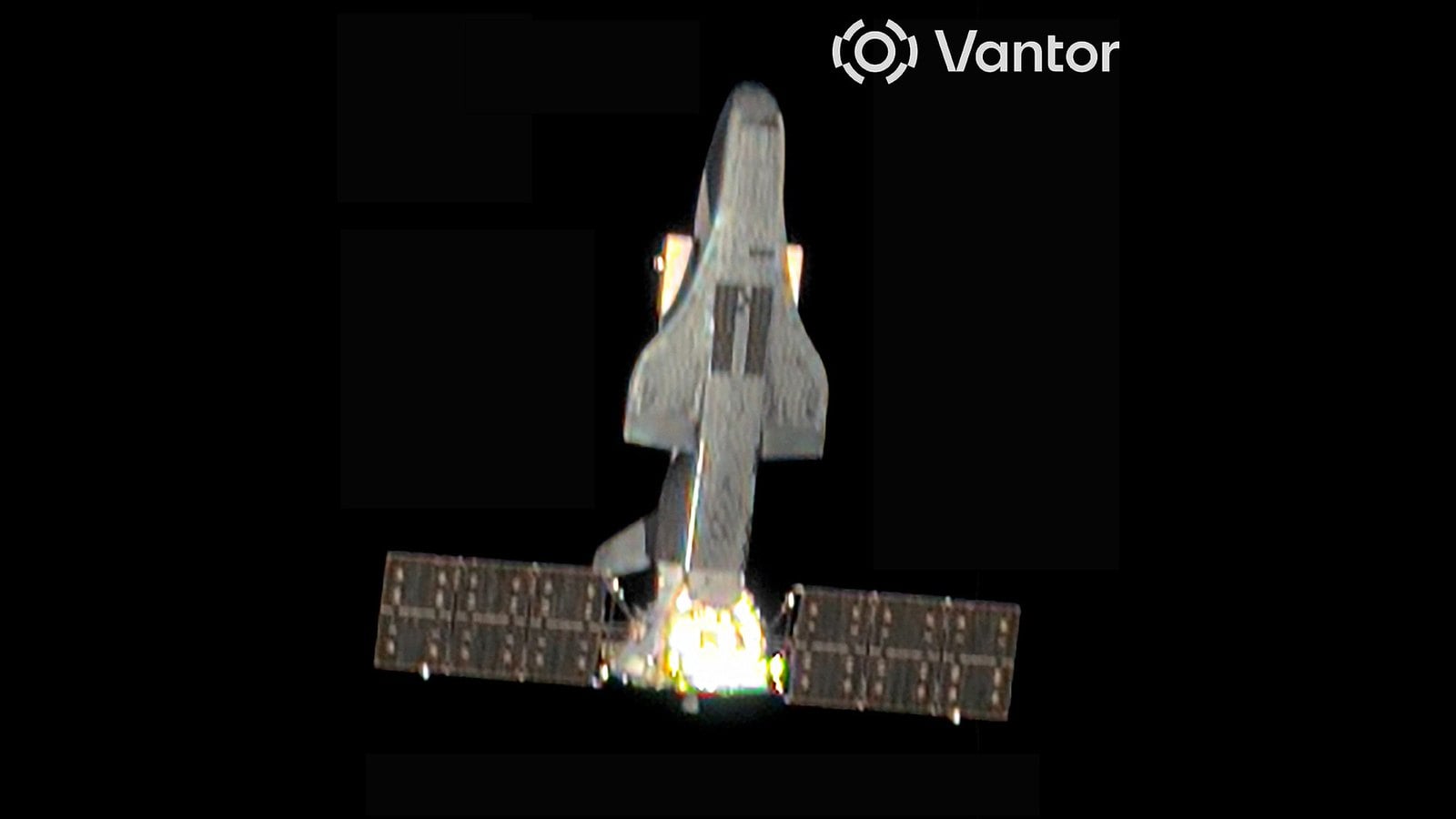
Now the US Defense Intelligence Agency has published the best picture of the Chinese spaceplane to date. The image sits inside the agency's unclassified report Challenges to Security in Space, released on 26 October 2026, with a short caption crediting Maxar.
It shows a small winged vehicle in orbit, payload bay doors open, with a cylindrical section at the tail and solar arrays spread out on either side. For a programme Beijing has kept almost entirely out of sight, that counts as a full reveal.
Datos rápidos
- Vehículo: Chinese reusable experimental spacecraft, an uncrewed spaceplane
- New image: Taken by a Maxar satellite in 2024, published by the DIA on 26 October 2026
- Mission 1: Launched 4 September 2020, about 2 days in orbit
- Mission 2: Launched 4 August 2022, 276 days in orbit
- Mission 3: Launched 14 December 2023, landed 6 September 2024 after about 268 days
- Mission 4: Launched 7 February 2026, still in orbit
- Launcher: Long March 2F from Jiuquan Satellite Launch Center
- Names: DIA lists two Chinese spaceplane models, Shenlong and Tengyun
What the picture shows
The image was taken by a Maxar (now Vantor) satellite in 2024. In an update to its report, The War Zone said Vantor gave the date as 28 May 2024 and the camera as WorldView-3, shooting from just under 90 km away. That date falls in the middle of the third mission.
The vehicle has a compact, shuttle-like body, short wings and twin tails. The most interesting part is at the back: a section attached to the tail carrying deployed solar arrays. Analysts read it either as a service module or as a separate satellite docked to the aft end, and some details in the image appear to have been redacted.
A blurrier version of the same picture first surfaced in 2024, when US Space Force Colonel John Patrick showed it at a conference in South Korea, according to The War Zone. At the time nobody would confirm whether it showed China's spaceplane or America's own X-37B. The DIA has now settled that question.
Four missions, one very quiet programme
The first flight began on 4 September 2020, when a Long March 2F lifted off from Jiuquan in north-west China. The vehicle came back two days later, landing on a runway that open-source analysts link to the Lop Nur area. Xinhua called the flight an important breakthrough and said the technology could offer a more convenient and cheap way to and from space for peaceful purposes.
The second mission, launched on 4 August 2022, lasted 276 days. The third began on 14 December 2023 and ended on 6 September 2024, after about 268 days in orbit by China's count. The fourth launched on 7 February 2026 and, as far as public tracking shows, the vehicle has not come home yet.
Scott Manley walks through the newly released image of China's spaceplane and what it reveals.
China has never said what the spaceplane carries. Chinese state media describe each flight only as a test of reusable spacecraft technology, and the brief launch announcements come without pictures of the vehicle itself.
The companion objects
What the spaceplane does in orbit is where it gets interesting. On the second mission, the tracking company LeoLabs observed repeated deployments, formation flying and docking of a sub-satellite catalogued as Object J. The DIA report describes the spaceplane manoeuvring with a companion satellite and station-keeping at around 1 km separation.
On the third mission, the DIA says, the spacecraft again released and interacted with an object, and trackers logged several objects released during the flight. The current mission has continued the pattern. Astronomer and satellite tracker Jonathan McDowell reported that the spaceplane re-rendezvoused with its sub-satellite on 10 September 2026 and recaptured it on 13 September, based on US Space Force tracking data.
Releasing, chasing and recovering a small satellite is exactly the kind of skill that matters for inspecting or servicing other spacecraft. It is also why Western defence agencies watch these flights closely. There is no public evidence that the vehicle carries weapons, and the DIA does not claim it does.

Shenlong, Tengyun and the X-37B
The DIA names two Chinese spaceplane models, Shenlong (“Divine Dragon”) and Tengyun, but does not say which one is in the picture. Shenlong is the name most often attached to the orbital vehicle, but China has never confirmed it. Tengyun is a different concept, a two-stage system that would launch from a carrier aircraft.
The obvious comparison is the US Space Force's X-37B, which has flown since 2010 and has its own add-on service module at the tail. The two vehicles look similar at a glance, but The War Zone notes that the Chinese design has wings with a much longer chord. Both are uncrewed, both land on runways, and both have owners who would rather talk about anything else.

The X-37B's eighth mission has been in orbit since August 2025. China's spaceplane has been up since February. For the first time, the public can at least see what one of them looks like up there.
Sources: US Defense Intelligence Agency (Challenges to Security in Space, 2026), The War Zone, The Aviationist, Popular Science, Xinhua, The Standard, CNBC, LeoLabs, Jonathan McDowell


0 Comments