
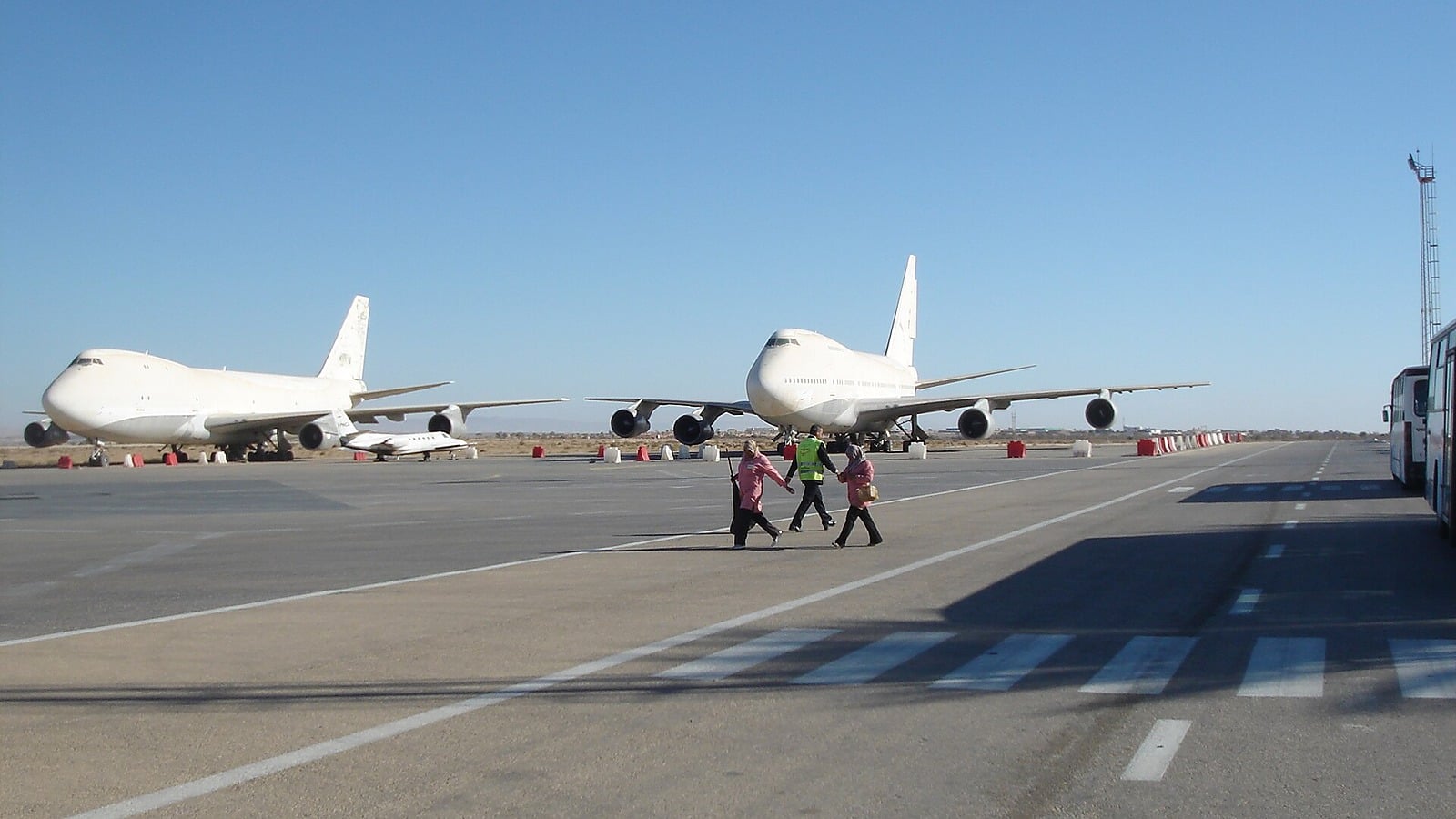
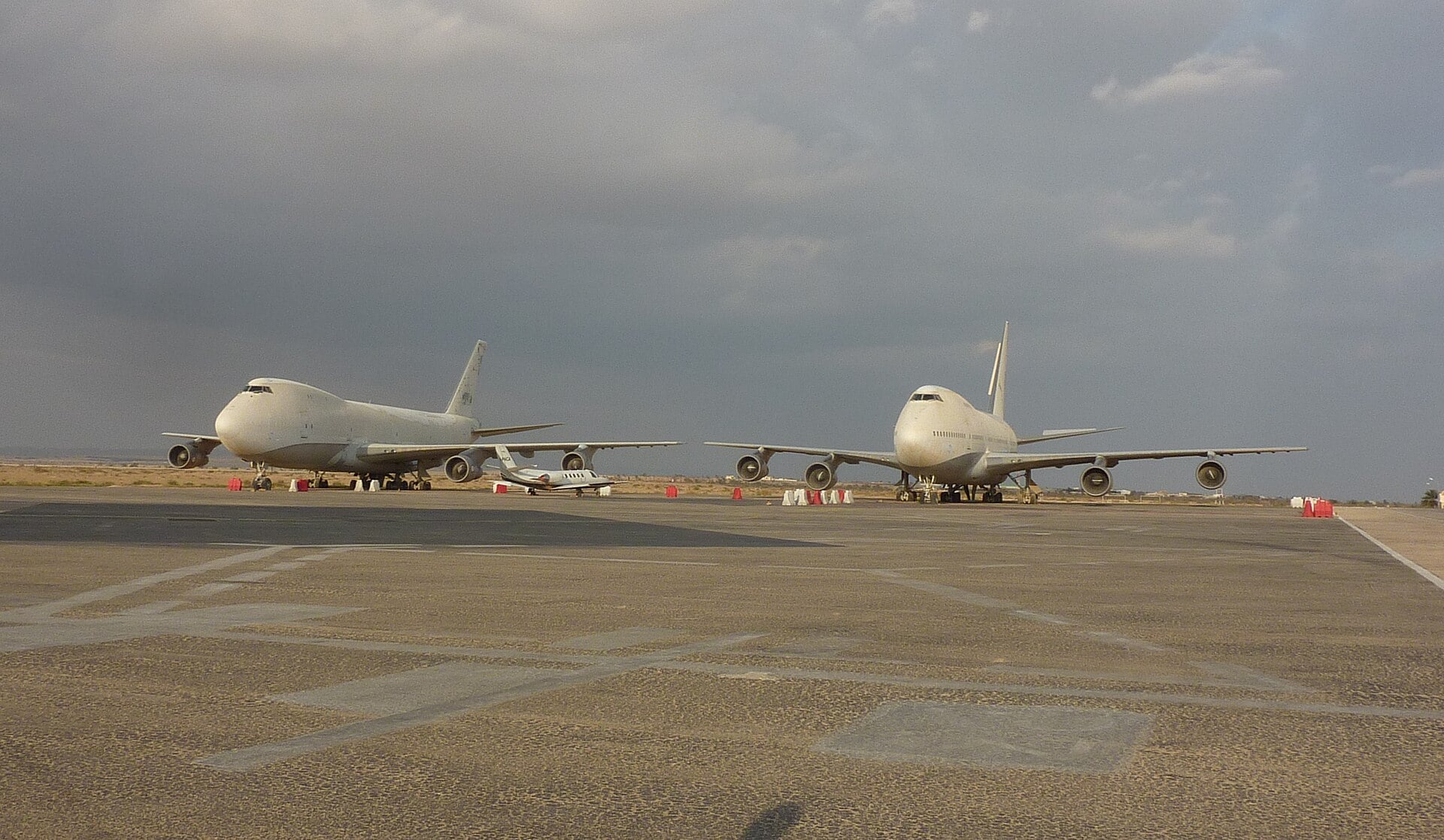
There is an airport on the edge of the Sahara where two Boeing 747s have stood still for so long that they have become part of the landscape. They sit on the apron at Tozeur-Nefta, in southwestern Tunisia, bleached white from nose to tail, chocked, flat-tyred, facing a runway they will almost certainly never use again. Neither has flown a commercial sector since January 1991.
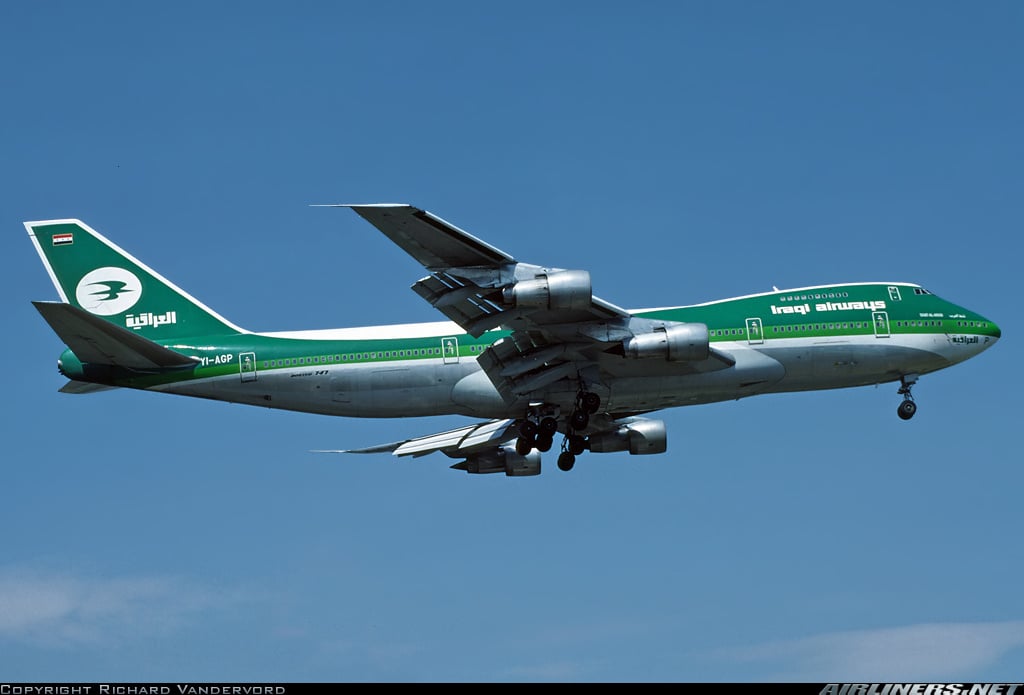
On 18 November their owner put them up for sale. Iraqi Airways, which is state-owned and reports to Iraq’s Ministry of Transport, published a direct-sale notice valuing each aircraft at $900,000. One is a Boeing 747-270C freighter-convertible registered YI-AGP. The other is a 747SP, YI-ALM, and it used to carry Saddam Hussein.
The price is not the remarkable part. The remarkable part is the thirty-five years.
Datos rápidos
- La aeronave: Boeing 747-270C YI-AGP (msn 22366) and Boeing 747SP-70 YI-ALM (msn 22858)
- Construido: both 1982, with Pratt & Whitney JT9D-7F engines
- Dónde: Tozeur-Nefta International Airport, southwestern Tunisia
- Parked since: January 1991, on the eve of Operation Desert Storm
- Dueño: Iraqi Airways, under Iraq’s Ministry of Transport
- Sale notice published: 18 November 2026, under an authorisation from the Iraqi Prime Minister’s office dated 27 February 2025
- Estimated value: $900,000 each, $1.8 million for the pair; bids accepted for one or both
- Deposit: 20 per cent, or $180,000 per aircraft, plus a 2 per cent service fee
- Committee sits: at the Iraqi embassy in Tunisia, 21 December 2026 to 5 January 2027
- Términos: sold as they stand, where they stand, with no technical warranty of any kind
The week Iraq scattered its airliners
In the first half of January 1991, with a coalition deadline running down and the first cruise missiles days away, Baghdad began moving aircraft out of the country. Military types went east, to Iran, in one of the stranger episodes of the war. Civil aircraft went wherever a friendly government would take them.
Two of Iraqi Airways’ jumbos were flown to Tunisia. Tozeur-Nefta was an odd choice and a logical one at the same time: a modern international airport built to feed Saharan tourism, with a long runway, plenty of empty concrete and almost no traffic to get in the way of two parked widebodies. The idea was shelter. The aircraft would wait out the bombing and come home.
They were repainted white before or shortly after they arrived, stripped of the green Iraqi Airways cheatline and the hawk on the fin. A Tunisian account from 2012 noted that by then the white was fading and the original green was beginning to show through again. Thirty-five years later the disguise has outlasted the thing it was hiding from.
Why they never went home
The bombing stopped in February 1991. The aircraft stayed. What kept them on the apron was not damage or mechanical failure but three things that had nothing to do with flying: an international embargo on Iraq, a mountain of unpaid parking charges, and a lawsuit in London.
The lawsuit was the big one. In early 1991 Kuwait Airways Corporation sued the Republic of Iraq and Iraqi Airways Company in the English courts over ten airliners that Iraqi Airways crews had flown out of Kuwait in the days after the August 1990 invasion, seeking around $1.8 billion for the aircraft and the spares inventory that went with them. Six of those ten were flown on to Iran for safekeeping and eventually returned to Kuwait Airways under United Nations auspices. Four were destroyed in coalition air raids on Mosul.
What followed was, by the reckoning of Iraq’s own counsel, the longest-running action in the history of the English Commercial Court. It reached the House of Lords several times, spawned five related English actions and satellite litigation in eight other countries, and produced rulings that are still taught as leading authorities. At one point a worldwide freezing order was made against Iraqi Airways and its director general’s passport was confiscated, which prompted the airline to shut down rather than keep flying into jurisdictions where it could be seized.
Any Iraqi Airways aircraft parked abroad in those years was therefore a potential target for enforcement. Two jumbos sitting on a Tunisian apron were safer where they were. It took until the end of 2012 for Iraq and Kuwait to settle, with Iraqi Airways agreeing to pay Kuwait Airways $500 million, roughly a third of what had been claimed.
One footnote worth keeping straight: the aviation analysis house CAPA reported the same $500 million as $300 million in reparations plus $200 million towards a joint Iraqi-Kuwaiti airline venture, while Iraq’s own lawyers described it simply as the settlement of the claim. The two accounts do not reconcile, and we are not going to pretend they do.
What is actually on offer
The notice Iraqi Airways published on 18 November is a direct sale rather than an open auction, authorised by the Iraqi Prime Minister’s office in February 2025. Companies and private individuals may bid, for one aircraft or for both, and the airline says the $900,000 figure per airframe was set against the references of an international valuation bulletin.
There is a thirty-day window for preliminary applications, with no deposit required at that stage. Serious candidates are then called to the decision phase, where they must post 20 per cent of the estimated value, $180,000 per aircraft, as a certified cheque, bank guarantee or transfer, and commit on paper that they do not appear on any blacklist. A 2 per cent service fee and the cost of publishing the notice sit on top.
The committee itself sits at the Iraqi embassy in Tunisia from 21 December to 5 January. The first ten days are for receiving bids and answering questions, between 10am and 1pm Tunisian time on working days; the last five are for review and decision. A winning bidder has at most five days to pay in full, and loses the deposit if they do not. Nothing is final until Iraq’s Minister of Transport signs off the committee’s minutes.
And then the sentence that governs everything else: the aircraft are sold in their current condition, in the place where they are parked, with no technical warranty. Ownership transfer, customs, transport, taxes and — from the moment of full payment and the signing of the acceptance report on site — the parking bill all become the buyer’s problem. From that point Iraqi Airways disclaims any responsibility toward the Tunisian authorities or the airport.
The small one carried the president
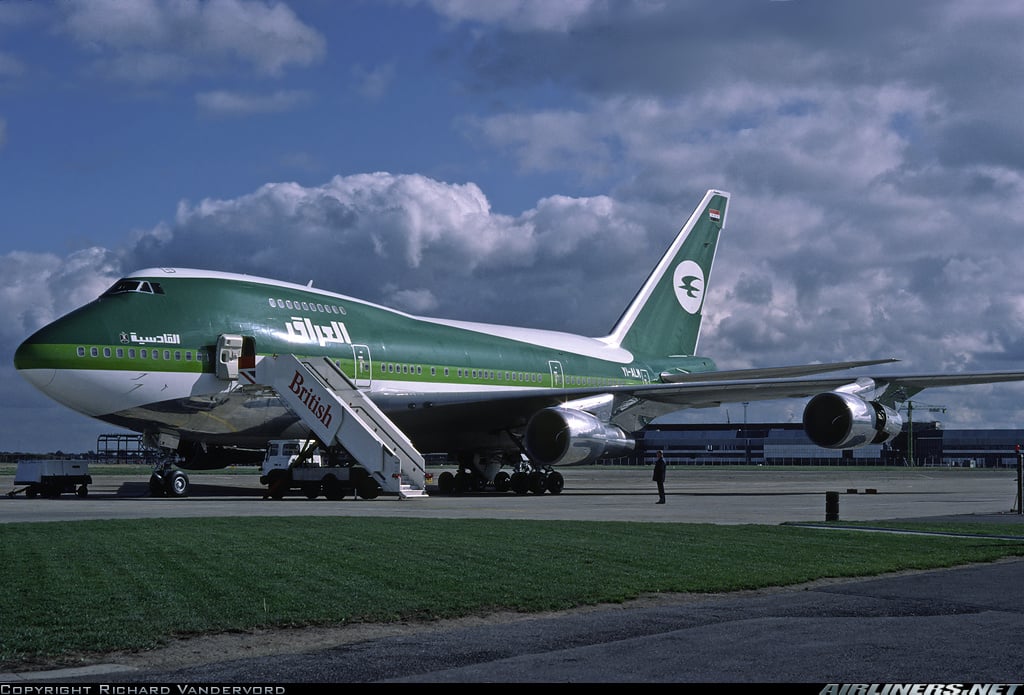
Of the two, YI-ALM is the aircraft people will want. It is a 747SP-70, construction number 22858, line number 567, and it served as the Iraqi government’s aircraft. Period photographs show it in the green Iraqi Airways scheme with the Iraqi flag on the fin and Arabic titles on the nose; a Tunisian account from 2012 names the pair Chott el Arab y Kadisiya, and the script carried on the SP’s nose is consistent with the second.
The SP was always a rare aeroplane. Boeing built 45 of them in total, chopping roughly 47 feet out of a standard 747 so the aircraft could carry a useful payload over distances nothing else could manage. SP stands for “special performance”; inside Boeing the early name was 747SB, for short body, and employees called it Sutter’s balloon after the 747’s chief engineer. It was the longest-range airliner in the world until the 747-400 arrived in 1989, and Afterburner has told the full story of the stubby jumbo separately.
Forty-five airframes is a small enough number that the loss of any one of them matters to people who care about this sort of thing. That is the argument for a museum buying YI-ALM rather than a scrapper. It is also, probably, an argument that loses.
Will they ever fly again?
Here is the honest answer: nobody has published an airworthiness assessment of either aircraft, and the seller is going out of its way not to offer one. What exists is a set of judgements.
The Tunisian outlet Aero-News states flatly that after thirty-five years in the Djerid desert climate both are permanently unfit to fly, but offers no source and no inspection to back it. Aviacionline describes them as being in non-flyable condition, again in its own voice. Against that, the Tunis business title Managers notes that the aircraft have remained on the apron through maintenance work and several inspections over the years, which is not nothing.
What can be said without guessing is this. Both airframes are 1982-build, so they are forty-four years old. Both are powered by Pratt & Whitney JT9D-7F engines, a model whose support network has been winding down for decades. Thirty-five years of Saharan heat, sand and ultraviolet is hard on seals, elastomers, wiring insulation and paint, and a return to service would require continuous maintenance records that have almost certainly not been kept to any authority’s satisfaction since the Berlin Wall came down.
Which is why the realistic buyers are not airlines. They are parts traders, metal recyclers, and — just possibly — a museum or a tourism project willing to pay to move something very large a very long way.
The bill for standing still
An airliner parked on someone else’s apron is not free. It accrues charges every day, and across thirty-five years those charges become the dominant fact about the aircraft. How much Iraq actually paid Tunisia is genuinely unclear, and the published figures do not line up.
The Tunisian site Tunisie.co reported in 2012 that, following an agreement reached in 2008, the Iraqi government had paid the Tunisian side 4 million Tunisian dinars in parking costs. aeroTELEGRAPH, writing this week, puts a settlement in 2020 and says that Iraq then paid around $5.4 million in parking fees and other claims, attributing the figure to media reports rather than to either government. Aviacionline and Aero-News both place an official settlement in 2020 but give no number at all. Somewhere in there is the truth; none of these outlets is in a position to prove it, and neither are we.
What is clear is the lesson Baghdad drew from it. Read the 2026 notice again and the parking clause is doing real work: the buyer picks up the charges from the moment of payment, and Iraqi Airways walks away from any further obligation to the Tunisian authorities or the airport. Whatever these aircraft are worth, the airline is finished paying rent on them.
This is also not the first attempt. The aircraft were offered in 2010, after negotiations involving Iraq, Tunisia, Kuwait and the United Nations. They were offered again in July 2023, at $494,000 each, with an auction set for 16 August that year that was postponed. At one stage dismantling them on site was openly discussed. Why the valuation has since risen to $900,000 has not been explained by anyone; aeroTELEGRAPH suggests the thinning supply of parts for forty-year-old 747s may simply have made the airframes worth more dead than they were three years ago.
A monument nobody meant to build
The men who flew these aircraft to Tozeur in January 1991 were doing something sensible and temporary. Get the jumbos out, wait for the war to end, bring them back. It is the kind of decision that looks obvious at the time and absurd only in retrospect, once the war has been followed by an embargo, the embargo by a twenty-two-year lawsuit, and the lawsuit by a slow realisation that nobody in Baghdad was coming for them.
Somewhere on the fuselage of one of them, under paint that was meant to last a few months, there is still a green cheatline and a hawk. If a buyer turns up before 5 January, the odds are that the next thing to happen to it involves a cutting torch. If no buyer turns up, the two aircraft will do what they have done since the year the Soviet Union ended, which is nothing at all.
Sources: Iraqi Airways direct-sale notice of 18 November 2026 as reported by Managers (Tunis) and Tunisie Numérique; Aviacionline; aeroTELEGRAPH; Aero-News Tunisia; Tunisie.co; Locke Lord LLP press release of 20 December 2012; CAPA; Wikimedia Commons.


0 Comments