
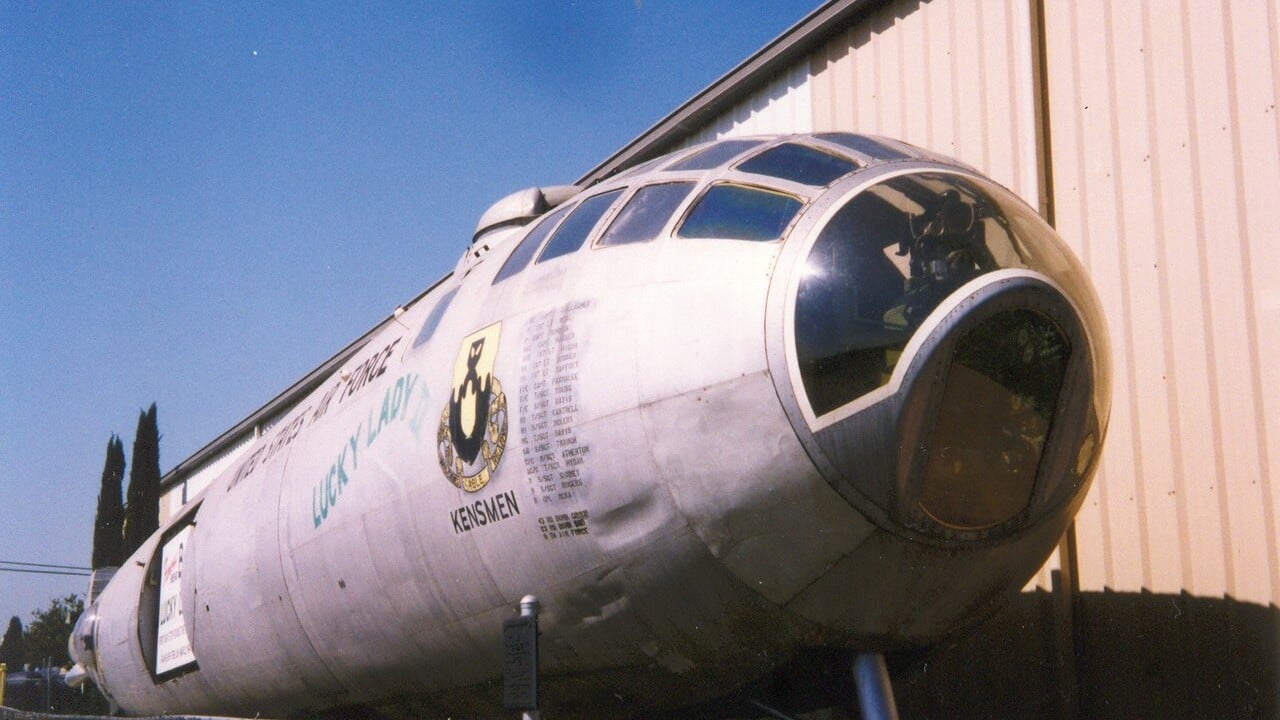
On 26 February 1949, a silver four-engined bomber lifted off from Carswell Air Force Base in Fort Worth, Texas, into a low overcast and turned east. Nobody outside a small circle in Strategic Air Command knew where it was going. Four days later it came back to the same runway, having never once touched the ground.
The aircraft was a Boeing B-50A Superfortress named Lucky Lady II, and it had just become the first aeroplane to fly around the world nonstop: 23,452 miles in 94 hours and 1 minute, kept aloft by four mid-air refuellings. It was not even supposed to be the aircraft that did it.
Datos rápidos
- Aeronave: Boeing B-50A Superfortress Lucky Lady II, serial 46-010, 43rd Bombardment Group
- Vuelo: 26 February to 2 March 1949, Carswell AFB, Texas, to Carswell, eastbound
- Registro: First nonstop flight around the world
- Distancia: 23,452 miles (37,742 km)
- Time: 94 hours, 1 minute
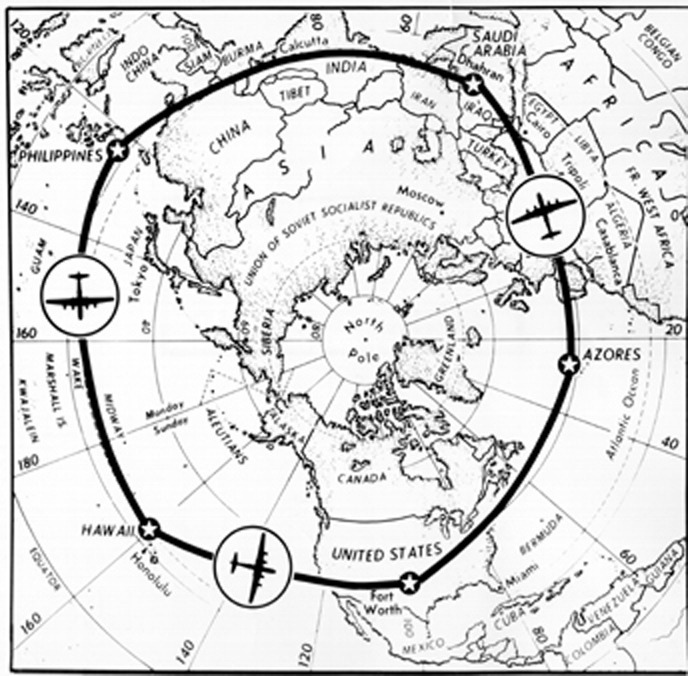
- Refuelling: Four times, by KB-29M tankers near the Azores, Saudi Arabia, the Philippines and Hawaii
- Multitud: 14, including three pilots, under Captain James G. Gallagher
- Awards: Distinguished Flying Cross for each crew member; Mackay Trophy
- Hoy: Fuselage at Planes of Fame Air Museum, Chino, California
A message for Moscow
The timing was everything. In early 1949 the Berlin Airlift was in full swing, the Cold War was hardening, and the United States still held a monopoly on the atomic bomb. What it lacked was a way to deliver it anywhere in the world from home. Most of the globe was beyond the unrefuelled range of any American bomber then in quantity production.
General Curtis LeMay had taken over Strategic Air Command in October 1948 and wanted to show, to the Soviet Union and to a sceptical American public, that SAC could reach any target on Earth. A round-the-world flight with B-29s the previous summer had made the point only weakly. One bomber crashed, and the two survivors, Lucky Lady y Gas Gobbler, needed 15 days and eight stops.
The answer was aerial refuelling. If a bomber could take on fuel in the air, its range was limited only by the endurance of its crew and engines.
The understudy takes the stage
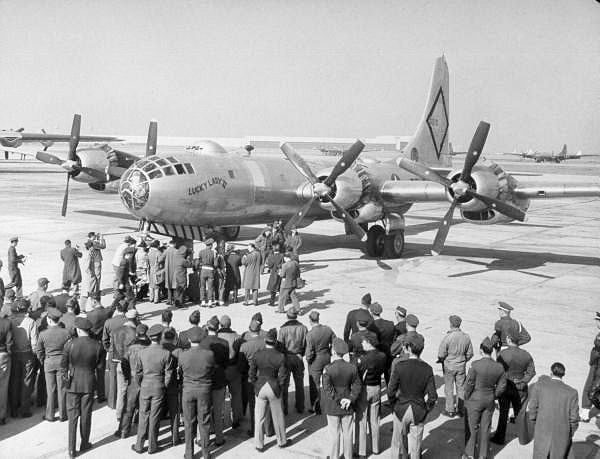
The B-50 was a post-war revision of the B-29 Superfortress, with far more powerful Pratt & Whitney R-4360 Wasp Major radial engines, a stronger structure and a taller fin. LeMay had five B-50As lined up for the attempt, in the expectation that at least one would succeed. Lucky Lady II, serial 46-010 of the 43rd Bombardment Group, was a standard production bomber, guns and all, apart from an extra fuel tank in the bomb bay.
She was the backup. The primary aircraft, Global Queen, took off from Carswell on 25 February, crossed most of the Atlantic, and then had to land in the Azores after engine trouble. The next day, 26 February, the understudy went instead.
Captain James G. Gallagher commanded. Because nobody could stay alert for four days, the B-50 carried a double crew of 14, three of them pilots: Gallagher, second pilot 1st Lt Arthur M. Neal, who had commanded the original B-29 Lucky Lady the year before, and copilot Captain James H. Morris. Crew members relieved each other every four to six hours, an early version of the augmented crews that fly long-haul airliners today.
Refuelling by grapple and hose
In-flight refuelling in 1949 was not the slick boom-and-receptacle operation of a modern tanker. The B-50 used the looped-hose method. The KB-29M tanker flew above and let down a cable; equipment on the bomber caught it and reeled it in, dragging a fuel hose behind it. Once the hose was connected, fuel simply ran downhill from tanker to bomber by gravity.
It was slow and it needed daylight, because radar was still unreliable. So SAC placed pairs of KB-29M tankers from the 43rd Air Refueling Squadron along the route at Lajes in the Azores, Dhahran in Saudi Arabia, Clark Field in the Philippines and in Hawaii, and timed the flight so the bomber would reach each rendezvous in the morning. According to Air & Space Forces Magazine, the first transfer, near the Azores, kept the two aircraft locked together in tight formation for two hours.
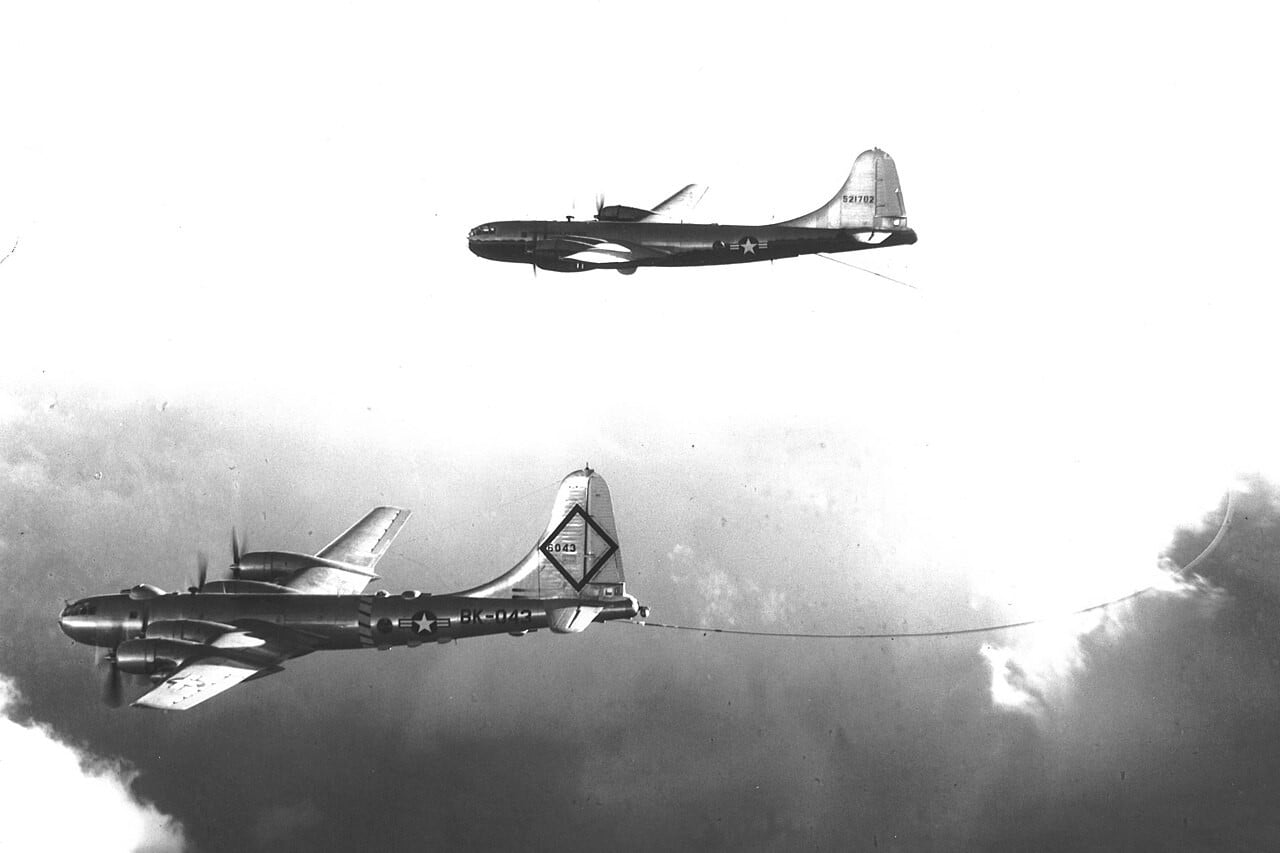
The secrecy was elaborate. Ground crews were not told what the modifications were for, the press was not told about the flight, and, according to the magazine, the Air Force filed dummy flight plans and had the bomber swap tail numbers with tankers at the refuelling points so that nobody could see one aircraft heading around the world.
Reuters archive footage of the first nonstop flight around the world in 1949.
Thunderstorms, a broken chain and a lost tanker
The route took Lucky Lady II past Gibraltar and across the Sahara, then to a second refuelling over Saudi Arabia that had to be flown through turbulence in a line of thunderstorms. The bomber’s log, as quoted by the magazine, recorded the crew starting to show signs of fatigue.
Over the Philippines the weather was worse, and a chain on the hose reel broke. Gallagher’s son later recalled on the aviation history site This Day in Aviation that his father turned west to chase the daylight while the crew fixed it, so the refuelling could still be completed. On its way back to Clark in bad weather, one of the KB-29M tankers, 45-21705, crashed, killing all nine men aboard. The accident report, Wikipedia notes, was altered to describe it as a routine training mission so as not to cast a shadow on the flight.
Bad weather followed the bomber to the fourth refuelling near Hawaii, which had its own mechanical problems. Then it was the long final leg back across the Pacific to Texas, flying at between 10,000 and 20,000 feet at an average ground speed of about 249 mph.
Home to Carswell
Lucky Lady II landed back at Carswell on the morning of 2 March 1949 after 94 hours and 1 minute in the air. Waiting on the ramp were LeMay, Secretary of the Air Force Stuart Symington, Chief of Staff General Hoyt S. Vandenberg and Eighth Air Force commander Major General Roger Ramey. By now the press had been tipped off, and the photographers were there too.
LeMay said the flight showed the Air Force could send bombers from the United States to any place in the world that required the atomic bomb. Symington drew the strategic lesson in a single phrase.
Each crew member received the Distinguished Flying Cross, and the crew won the Mackay Trophy for the most meritorious flight of the year and the Air Force Association’s Air Age Trophy.
The newspapers drew the same conclusion as the generals. The Associated Press, as quoted by Air & Space Forces Magazine, warned that potential enemies of the United States:
Lucky Lady III and the end of the line
The looped-hose method had proved that refuelling worked, and also that something faster was needed; the magazine credits the flight with spurring development of the flying boom. Eight years later, in January 1957, three B-52 Stratofortresses flew around the world nonstop in Operation Power Flite in 45 hours and 19 minutes, less than half Lucky Lady II’s time. One of them was named Lucky Lady III. Her commander was Lieutenant Colonel James H. Morris, the same man who had been copilot on the B-50.
A guided tour of a surviving Boeing B-50 Superfortress, the type that flew Lucky Lady II’s record.
Lucky Lady II herself had a short life after her fame. On 13 August 1950, on a maintenance test flight near Davis-Monthan AFB in Arizona, all four engines failed and the bomber was put down in the desert. The 11-man crew survived, but the aircraft was written off. Her fuselage toured as a recruiting exhibit and is now at the Planes of Fame Air Museum in Chino, California.
The first nonstop flight around the world without refuelling would not come until 1986, when Dick Rutan and Jeana Yeager flew Voyager for nine days. But in 1949 the point was not elegance. It was reach, and a B-50 crew and their tanker crews had just proved the Air Force had it.
Sources: Air Force Historical Research Agency (Lucky Ladies I, II and III fact sheet), Air & Space Forces Magazine (Bruce D. Callander, “Lucky Lady II”), This Day in Aviation, Wikipedia (Lucky Lady II; Boeing B-50 Superfortress; Operation Power Flite; Mackay Trophy)
Header photo: Stefan Semerdjiev / Wikimedia Commons, public domain
0 Comments