
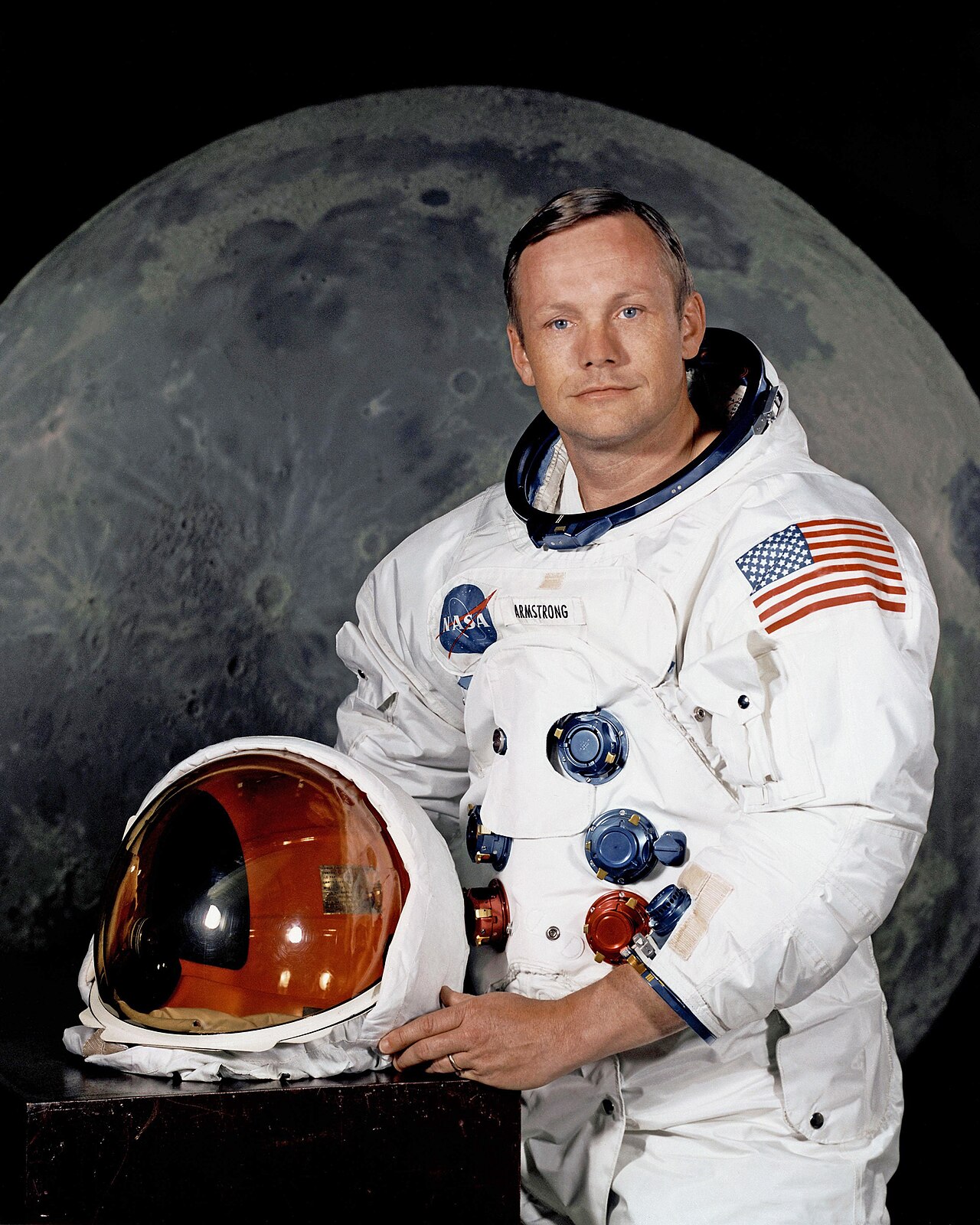
When Neil Armstrong stepped onto the Moon on 20 July 1969, he was 38 years old and had already survived more close calls than most pilots see in a career. Two ejections, a spacecraft tumbling out of control in orbit, and a landing that ended with the fuel warnings lit. Each time he was described in almost the same way: calm, methodical, and back at work almost immediately.
Datos rápidos
- Nacido: 5 August 1930, Wapakoneta, Ohio
- Korea: 78 combat missions with VF-51 from USS Essex, 1951 to 1952
- First ejection: 3 September 1951, F9F-2 Panther, aged 21
- Gemini 8: 16 March 1966: first docking in space, then a spin of about one revolution per second
- Second ejection: 6 May 1968, Lunar Landing Research Vehicle, Ellington Air Force Base, Texas
- Apollo 11: Landed 20 July 1969 after computer alarms and a boulder field
- Fallecido: 25 August 2012, aged 82
1951: A Cable Over Korea
Armstrong went to war as a 21-year-old Navy ensign, flying the Grumman F9F-2 Panther with Fighter Squadron 51 from the carrier USS Essex. On 3 September 1951, on his seventh combat mission, his group attacked targets in a valley in North Korea. As he pulled out of a low pass at about 350 knots, roughly 500 feet above the ground, something sliced off the outer part of his right wing. According to his biographer Jay Barbree, it was a cable strung across the valley, and it took six to eight feet off the wing and much of the aileron.

Armstrong held the damaged jet level with heavy control input, climbed out, and headed for the Marine airfield at Pohang. Unable to land a jet with that much wing missing, he ejected for the first time in his life and came down in a rice paddy near the field. The Marine who found him in a jeep turned out to be one of his roommates from flight school. Armstrong went on to fly 78 combat missions in Korea. Our post on the F9F Panther tells the story of the jet he flew.
1966: Gemini 8 Spins Out of Control
On 16 March 1966, Armstrong and David Scott launched on Gemini 8 and achieved the first docking of two spacecraft in orbit, with an unmanned Agena target. Shortly afterwards, the docked combination began to roll. Thinking the Agena was at fault, the crew undocked, and the Gemini spun faster. Post-flight analysis found that an electrical short had stuck thruster number 8 open. The spacecraft reached a roll rate of about one rotation per second, close to the point where the crew could lose consciousness.
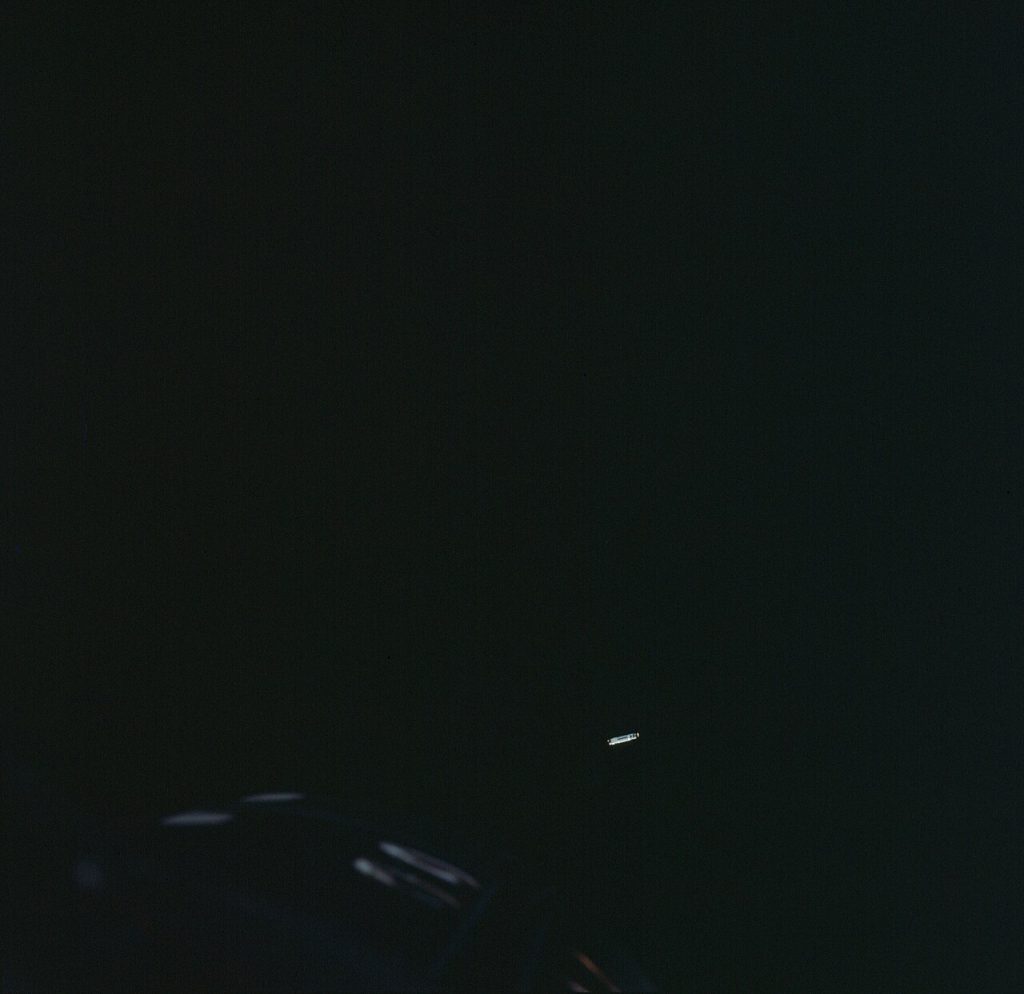
Armstrong shut down the main manoeuvring thrusters and switched to the separate re-entry control system, which stopped the spin. Using that system meant mission rules required a landing at the next opportunity. The planned three-day mission, including Scott’s spacewalk, ended after 10 hours and 41 minutes with a splashdown in the western Pacific, about 500 miles east of Okinawa.
1968: Ejecting From the Flying Bedstead
To practise the final descent to the Moon, NASA built the Lunar Landing Research Vehicle, a jet-supported frame that cancelled five-sixths of its weight to mimic lunar gravity. On 6 May 1968, flying LLRV-1 at Ellington Air Force Base near Houston, Armstrong lost control when a loss of helium pressure starved the attitude thrusters. He ejected at about 200 feet, seconds before the vehicle hit the ground and burned, and parachuted down unhurt. He was reportedly back at his desk the same day. We tell this story in detail in La cama voladora que casi mata a Armstrong.
1969: Alarms and Boulders
On 20 July 1969, as Armstrong and Buzz Aldrin descended towards the Sea of Tranquillity in the lunar module Eagle, the guidance computer flashed a series of 1202 and 1201 program alarms. Mission Control judged it safe to continue. Then, as the automatic system steered towards a landing area strewn with boulders around a crater, Armstrong took over semi-manual control, flew on beyond it and looked for a clear spot.
The descent ran long. Mission Control called out 60 seconds and then 30 seconds to the point where the crew would have had to land or abort, and Eagle touched down shortly after the 30-second call. That is the origin of the famous claim that Apollo 11 landed with only about 20 to 25 seconds of fuel left. Later analysis, including a NASA study of propellant slosh in the descent stage tanks, found that sloshing had triggered the low-fuel warning early, so the real margin was larger, though nobody could know that at the time.
A few hours later Armstrong became the first person to walk on the Moon. He was 38.
What the Popular Version Gets Right
The story as it is usually told is accurate in its outline: the seventh mission in Korea, the cable, the 350 knots, the rice paddy and the flight school roommate, the 78 missions, Gemini 8’s stuck thruster and once-a-second spin, the LLRV ejection at about 200 feet and his return to work the same day, the computer alarms and boulder field on Apollo 11. Two details need care. The claim that half a second more would have killed him in the LLRV is a common retelling; NASA says only that he ejected seconds before the crash. And the often-repeated 25 seconds of fuel at touchdown reflects the warnings at the time, not the real margin, which later analysis showed was larger.
Sources: Jay Barbree, Neil Armstrong: A Life of Flight (2014), excerpted by HistoryNet; NASA History Office, “55 Years Ago: Gemini VIII, the First Docking in Space” and “Astronaut Armstrong Survives LLRV Crash”; Smithsonian National Air and Space Museum, “Neil Armstrong’s Apollo 11 Close Call” (2019); NASA TM X-2362, Investigation of Slosh Anomaly in Apollo Lunar Module Propellant Gage; Paul Fjeld, AIAA Houston Horizons (2013).


0 Comments