
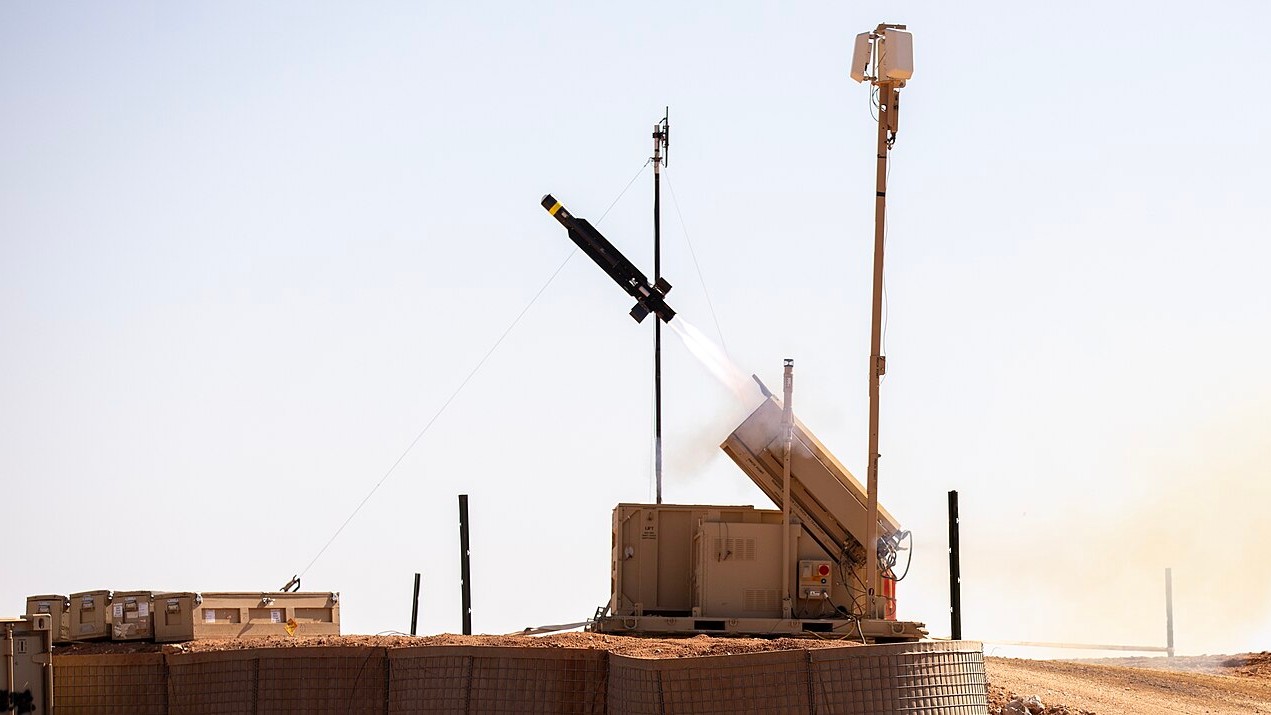
The Coyote is the US Army's go-to drone killer, and according to Raytheon it has more than 600 combat kills to show for it. On Monday the company revealed what comes next, and it has no jet engine.
The new Coyote Block 2C+RM, unveiled on 12 October at the start of the Association of the US Army's annual meeting in Washington, swaps the interceptor's small turbojet for a solid rocket motor and adds a new seeker and warhead. Raytheon says it has already flown three times, with Army officials watching each test.
The pitch is simple. Drones are getting faster, so the thing that shoots them down has to get faster too.
Quick Facts: Coyote Block 2C+RM
Fabricante: Raytheon, an RTX business
Unveiled: 12 October 2026, Washington (AUSA)
Propulsión: Solid rocket motor, replacing the Block 2's booster plus turbojet
Also new: Upgraded seeker and warhead (details not disclosed)
Tests so far: Three live launches, all observed by Army officials
Development time: About 15 months from concept to testing
Next tests: Planned through the first half of 2027
Estado: Company-funded; no production contract yet
From Propeller to Jet to Rocket
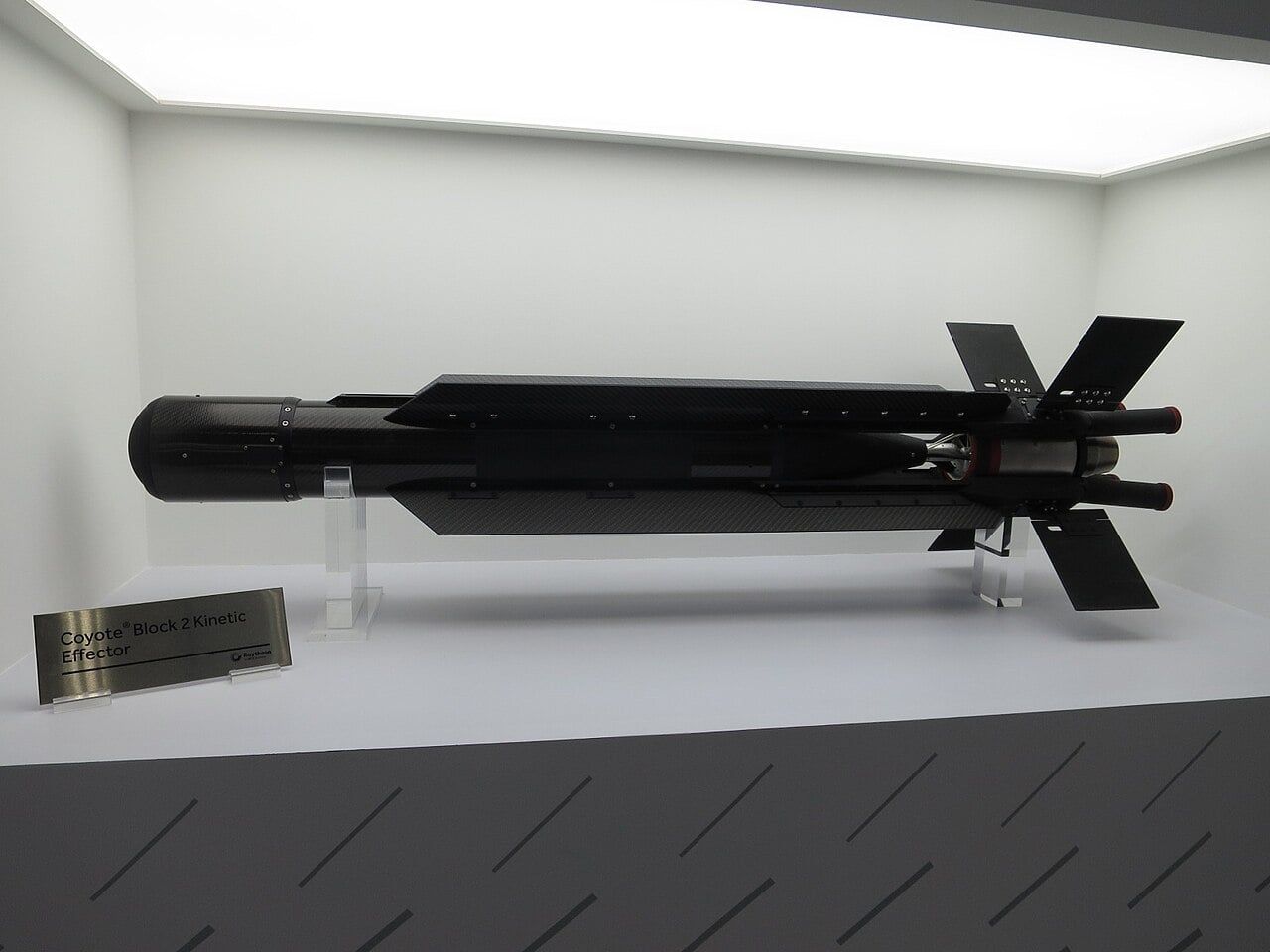
The Coyote started life in the 2000s as a small, tube-launched drone from Advanced Ceramic Research of Tucson, a company Raytheon eventually bought in 2015 under its later name, Sensintel. The early Block 1 used a propeller and folding wings. The Block 2, which turned it into a dedicated interceptor, added a rocket booster for launch and a small turbojet to sustain flight, letting it chase down drones at several hundred kilometres per hour and loiter for a re-attack if it missed.
The Block 2C+RM drops that booster-and-turbojet combination for a single solid rocket motor. Tom Laliberty, president of Land & Air Defense Systems at Raytheon, told reporters the change gives "upgraded propulsion for faster launch and higher velocity flight." He would not give numbers. Asked about range, he said only that the difference was "significant."
The trade-off is endurance. A turbojet can keep an interceptor airborne for minutes and let it circle back; a rocket burns out fast. Raytheon is clear that the rocket version is an addition to the family, not a replacement, and says it has no plans to stop building jet-powered Block 2s.
Why Class 3 Matters
The Pentagon sorts drones into groups by size, weight and speed. The cheap quadcopters seen over Ukrainian trenches sit at the bottom. Class 3 covers the larger, faster end of the threat, where one-way attack drones start to overlap with cruise missiles. Laliberty declined to say whether the new interceptor was designed with jet-powered attack drones from Iran or Russia in mind, but the timing speaks for itself: jet-propelled Shahed variants have already appeared over Ukraine.
Against a propeller-driven Shahed cruising at under 200 km/h, a jet-powered Coyote has speed to spare. Against a jet drone flying several times faster, every second between detection and intercept counts. A rocket gets the interceptor up to speed sooner, which shrinks the window an attacker has.
Of the upgraded seeker and warhead, Laliberty said the package "really gets after the more cutting-edge drone capabilities" that adversaries are fielding. Raytheon would not describe either, and declined to name the company that builds the rocket motor, saying its partner had asked it not to.
The Business Behind the Interceptor
Coyote is already big business. In September 2025 the Army awarded RTX an eight-year contract worth up to about $5 billion for Coyote interceptors, launchers and radars under its LIDS counter-drone programme, and Defense Daily reports that Block 2C production has roughly quadrupled over 18 months. Individual interceptors have previously been reported to cost around $100,000.
The rocket variant is not part of that yet. Raytheon says it has paid for development itself and needs government sponsorship to turn it into a programme of record. "We essentially need some government sponsorship," Laliberty told Defense Daily. More test launches are planned through the first half of 2027.
The direction of travel is clear. With Lockheed's PAC-3 production under pressure and Anduril pitching cheaper interceptors at the same show, the race is on to kill drones at a price the defender can afford. Coyote's answer is to keep the price low and the speed high.
RTX video of Coyote interceptors engaging target drones in testing.
Sources: The War Zone; Defense Daily; Aviation Week; Janes; Raytheon / RTX; Wikipedia (Raytheon Coyote).

0 Comments