
Ask anyone in American aviation how you get hired by an airline and you will be given a number. Fifteen hundred hours. It is the single best-known figure in the industry, it is quoted as though it were a law of physics, and almost every part of it is conditional.
There are four legal ways to reach a US airline right seat with fewer than 1,500 hours. The number itself was not derived from a training study; it was written into statute by Congress. And the accident that produced it was flown by two pilots who each had well over 1,500 hours.
None of that makes the rule wrong. It makes it a far more interesting rule than the number suggests, and it changes what a prospective airline pilot should actually be planning for.
Quick Facts: the US airline pilot hour requirements
| Statute | Airline Safety and FAA Extension Act of 2010, signed 1 August 2010 |
| FAA rule | Pilot Certification and Qualification Requirements for Air Carrier Operations, 15 July 2013 |
| Unrestricted ATP | 1,500 hours, minimum age 23 (14 CFR 61.159) |
| R-ATP, military | 750 hours (14 CFR 61.160(a)) |
| R-ATP, bachelor’s degree | 1,000 hours |
| R-ATP, associate’s or partial bachelor’s | 1,250 hours |
| R-ATP minimum age | 21 |
| Commercial pilot certificate | 250 hours (14 CFR 61.129) |
| Part 121 first officer before 2013 | Commercial certificate only |
| Colgan Air 3407 | 12 February 2009, 50 killed |
What the rule actually is
Strictly, there is no regulation called the 1,500-hour rule. What exists is a chain of three things.
The first is the Airline Safety and Federal Aviation Administration Extension Act of 2010, signed on 1 August 2010. Section 217 of that Act told the FAA that the minimum total flight hours to qualify for an airline transport pilot certificate shall be at least 1,500 flight hours. Congress wrote the number. The FAA was given discretion to credit specific academic training toward it, and that discretion is where everything interesting happens.
The second is the FAA's final rule, Pilot Certification and Qualification Requirements for Air Carrier Operations, published on 15 July 2013 with compliance required from 1 August 2013. Its key move was not to raise the ATP minimum, which was already 1,500 hours. It was to require that the second in command at a Part 121 airline hold an ATP certificate, or an ATP with restricted privileges, plus a type rating for the aircraft. Before that rule, a first officer needed only a commercial pilot certificate.
The third is 14 CFR 61.159, which sets out what 1,500 hours has to contain: 500 hours of cross-country time, 100 hours of night flight, 75 hours of instrument time in actual or simulated conditions, and 250 hours of pilot-in-command time in an airplane, of which 100 must be cross-country and 25 at night. The headline number is a total. The sub-totals are what make it hard.
The four ways in under 1,500
The restricted-privileges ATP, created by the same 2013 rule under 14 CFR 61.160, is the part of the system most people have never heard of. It is a real ATP certificate with a real limitation: the holder may serve only as second in command, and only in operations requiring no more than two pilots. The minimum age is 21 rather than 23, and every route needs 200 hours of cross-country rather than 500.
A US military or former military pilot, not removed from flying status for lack of proficiency or for a disciplinary matter involving aircraft operations, qualifies at 750 hours. A graduate with a bachelor's degree with an aviation major from an institution holding an FAA letter of authorisation, who has completed 60 semester credit hours of recognised aviation coursework, qualifies at 1,000. An associate's degree on the same terms with 30 credit hours gives 1,250, as does a bachelor's graduate who completed between 30 and 59 of those credits. Everyone else arrives at the unrestricted certificate at 1,500 hours.
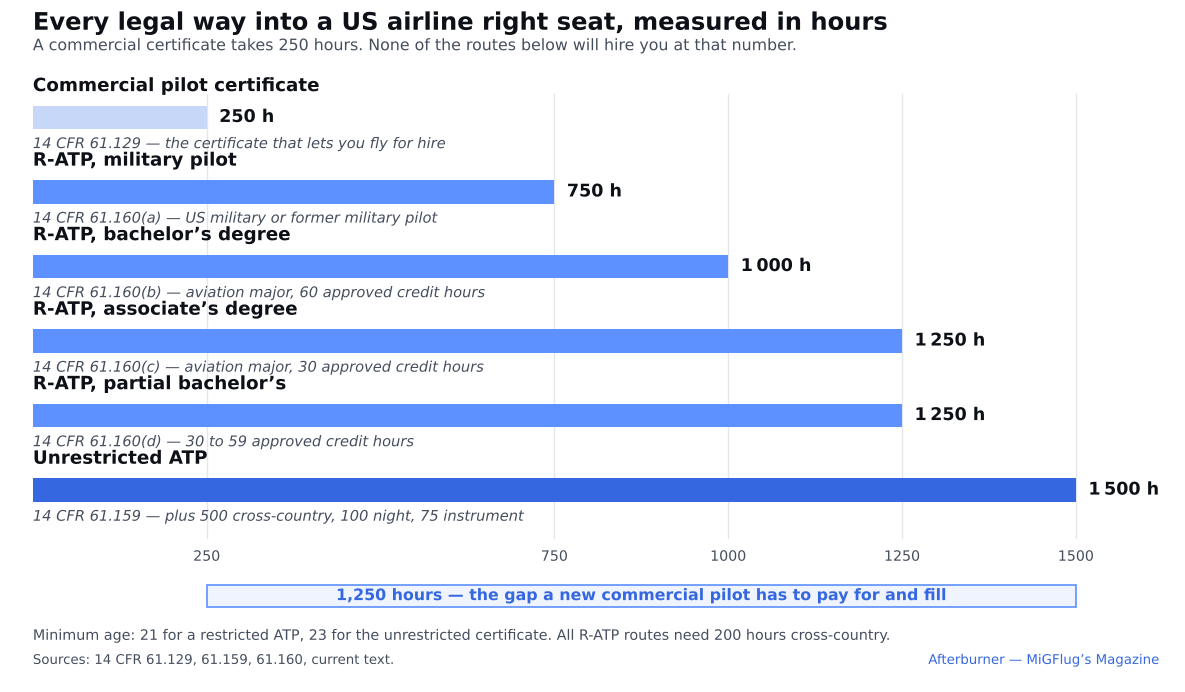
Put next to the certificate that actually permits flying for hire, the shape of the problem becomes obvious. A commercial pilot certificate under 14 CFR 61.129 requires 250 hours. That is the certificate that makes a pilot legally employable. It is also, for a pilot taking the non-degree route, 1,250 hours short of the one the airlines are required to hire.
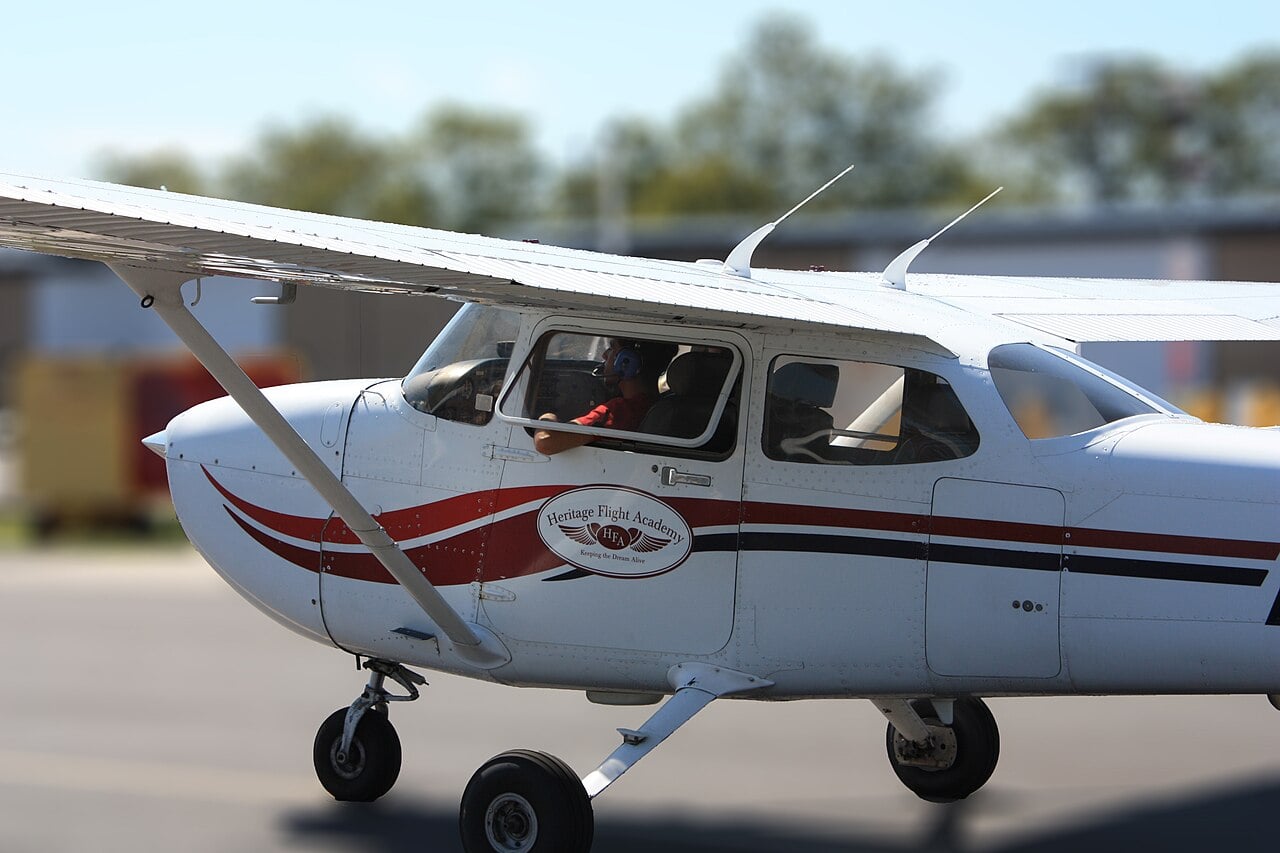
That gap is the real subject. It is not the training that is expensive, in the sense of instruction received. It is the time afterwards, spent accumulating hours in aircraft that teach a future airline pilot very little about airline flying, in jobs that exist mainly because the hours have to come from somewhere. Flight instructing, banner towing, pipeline patrol, skydive dropping, traffic watch and night freight in light twins are not career choices so much as the available ways to run a logbook from 250 to 1,500.
There is one more hurdle the number hides. Since 2013, an applicant for an ATP with a multiengine class rating must complete an FAA-approved ATP Certification Training Program before even sitting the written exam: 30 hours of academic instruction and 10 hours in a flight simulation training device, plus 50 hours of aeronautical experience in the class of airplane, up to 25 of which may be qualifying full-flight-simulator time. The ATP CTP is where a pilot first meets high-altitude aerodynamics, swept-wing handling and air-carrier operations in any structured way, and it did not exist before the rule everyone argues about.
Colgan 3407, and the uncomfortable arithmetic
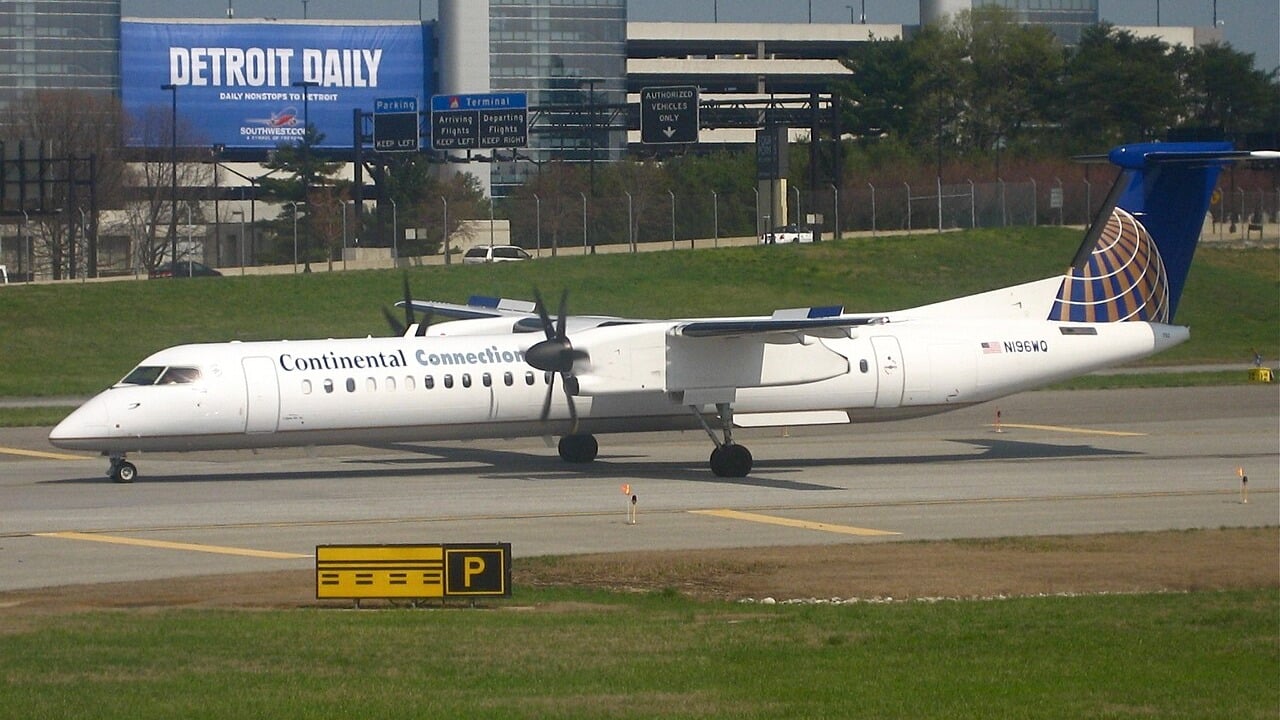
On the evening of 12 February 2009, a Bombardier Q400 operating as Continental Connection flight 3407 from Newark to Buffalo stalled on approach and struck a house in Clarence Center, New York. All 45 passengers and four crew were killed, along with one person on the ground. Fifty deaths. It remains the last fatal crash of a US scheduled passenger airliner for well over a decade.
The National Transportation Safety Board found the probable cause to be the captain's inappropriate response to the stick shaker, which led to an aerodynamic stall the aircraft did not recover from. The contributing factors it listed were the crew's failure to monitor airspeed, their failure to adhere to sterile cockpit procedures, the captain's ineffective management of the flight, and the operator's inadequate procedures for airspeed selection and management in icing conditions.
Here is the arithmetic that the 1,500-hour debate has never fully resolved. Captain Marvin Renslow had 3,379 total flight hours. First Officer Rebecca Shaw had 2,244. Both were comfortably above the threshold the accident went on to produce. A rule requiring 1,500 hours would not have kept either of them out of that cockpit.
What the record does show is a different kind of thinness. The Flight Safety Foundation, citing the FAA's own rulemaking documents, reported that when Colgan hired Shaw she had fewer than 1,500 hours, and that her instrument experience consisted of six hours in actual conditions and 86 in simulated. Total time and relevant time are not the same measurement, which was precisely the objection raised at the time.
FAA Administrator Randy Babbitt said during the rulemaking that he did not believe raising total hours without regard to the quality and nature of that time and experience was an appropriate way to improve proficiency. JetBlue argued in its submission that the correlation between a pilot's knowledge and their total flight time was unjustified, and that the right measure was the quality of experience rather than the quantity. Boeing made a similar case for focused training over accumulated hours.
The case for the number
The counter-argument is not a technicality, and it has won every fight so far. The Air Line Pilots Association, which represents more than 80,000 airline pilots, points out that before the rule a regional carrier could hire a first officer with as few as 250 hours, and that the 2013 package did a great deal more than set a number: it brought the ATP CTP, the type-rating requirement, improved training rules and the separate flight-duty and rest regulations that arrived alongside it.
ALPA credits the post-2010 regime with a 99.8 per cent reduction in the US airline fatality rate between 2010 and 2024, a figure worth treating as advocacy rather than as a controlled finding, because so many changes landed in the same window that isolating any one of them is not possible. What is harder to argue with is the operational record: the United States has not had a fatal scheduled airline accident of the Colgan type since.
The rule has also proved durable under pressure. Republic Airways applied in 2022 for an exemption that would have let its own academy graduates fly as first officers at 750 hours. The FAA rejected it. The current FAA Administrator, Bryan Bedford, has stated publicly that he supports the 1,500-hour requirement, contrary to what some of the press might say.
What this means if you want the job
Plan for the structure, not the headline. If you are going to study anyway, an aviation degree from an institution with an FAA letter of authorisation is worth between 250 and 500 hours of your life, which at typical rental rates is a larger saving than most people realise. If military service is on the table, it is worth 750. If neither applies, the honest planning number is 1,500 hours and the honest question is what kind of flying those hours will be.
Because the one thing every side of this argument agrees on is that the hours should be the right hours. The rule counts total time because total time is the only quantity that can be audited from a logbook. Nobody has ever claimed it is the quantity that matters most. A pilot who spends 1,250 hours flying circuits in the same aeroplane in the same airspace in good weather arrives at the airline with a legal logbook and very little else; a pilot who spends them instructing instrument students, flying night freight into real weather, and doing some of it single-pilot arrives with something the number cannot see.
Sources: 14 CFR 61.129, 61.159 and 61.160, current text; Airline Safety and Federal Aviation Administration Extension Act of 2010 (Pub. L. 111-216); FAA final rule, Pilot Certification and Qualification Requirements for Air Carrier Operations, 15 July 2013; National Transportation Safety Board; Flight Safety Foundation; Air Line Pilots Association; Wikipedia.



0 Comments