
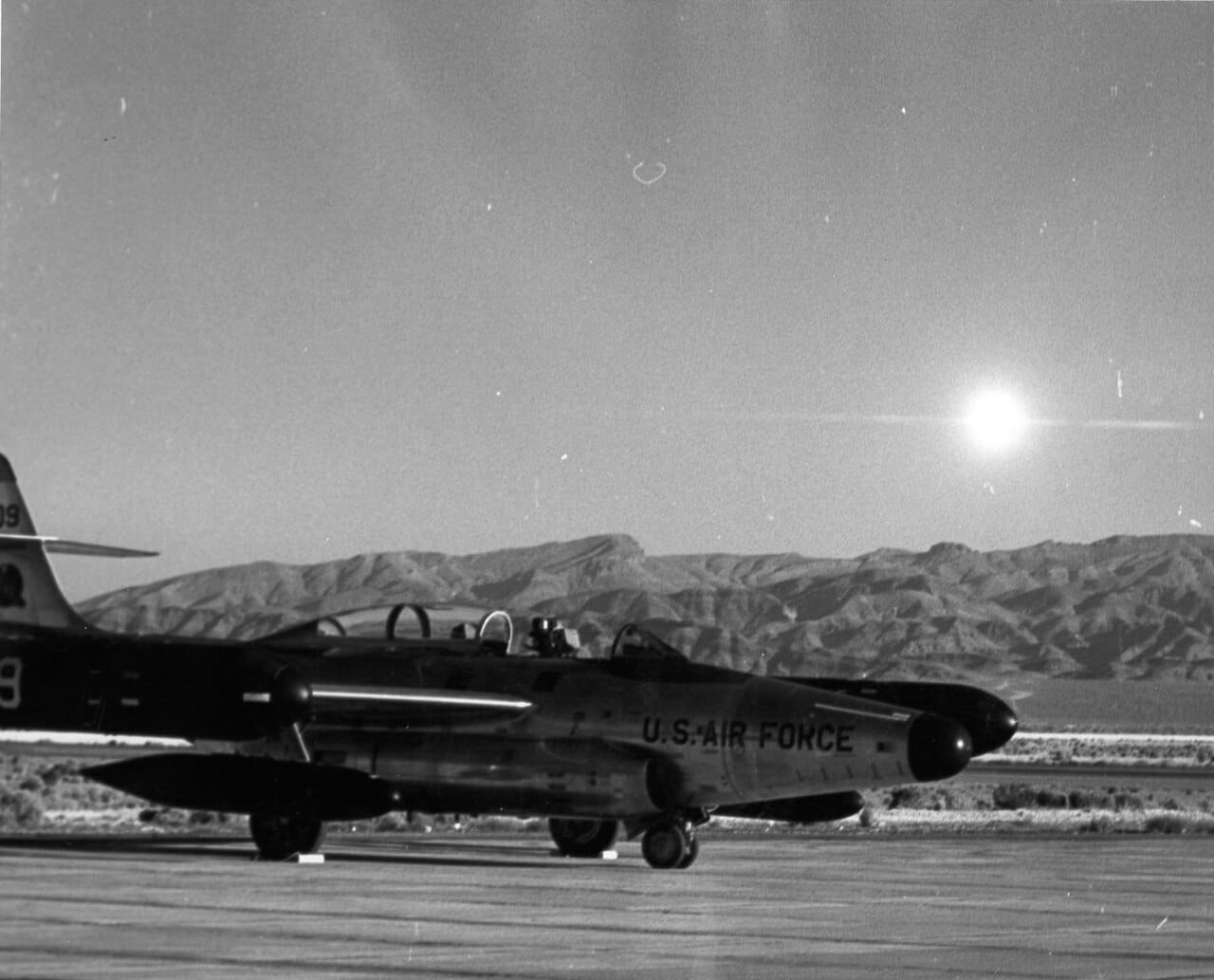
Somewhere over the Nevada desert on a July morning in 1957, five American officers stood in the open, looked straight up, and waited for a nuclear weapon to go off directly above their heads. There was no bunker. There was no lead shielding. There was a hand-lettered sign hammered into the dirt beside them that read, “Ground Zero. Population 5.”
This was not an accident or a punishment. It was a demonstration — and one of the strangest things the U.S. Air Force ever filmed on purpose.
Informations clés
- Événement: the “John” shot, Operation Plumbbob
- Date: 19 July 1957, Nevada Test Site
- Arme: AIR-2 Genie, an unguided nuclear air-to-air rocket (W25, ~1.5-1.7 kt)
- Fired by: a Northrop F-89J Scorpion interceptor
- Par terre: five officers volunteered to stand at ground zero, hatless
- Also there: cameraman George Yoshitake, with no protective gear
A nuclear rocket for shooting down bombers
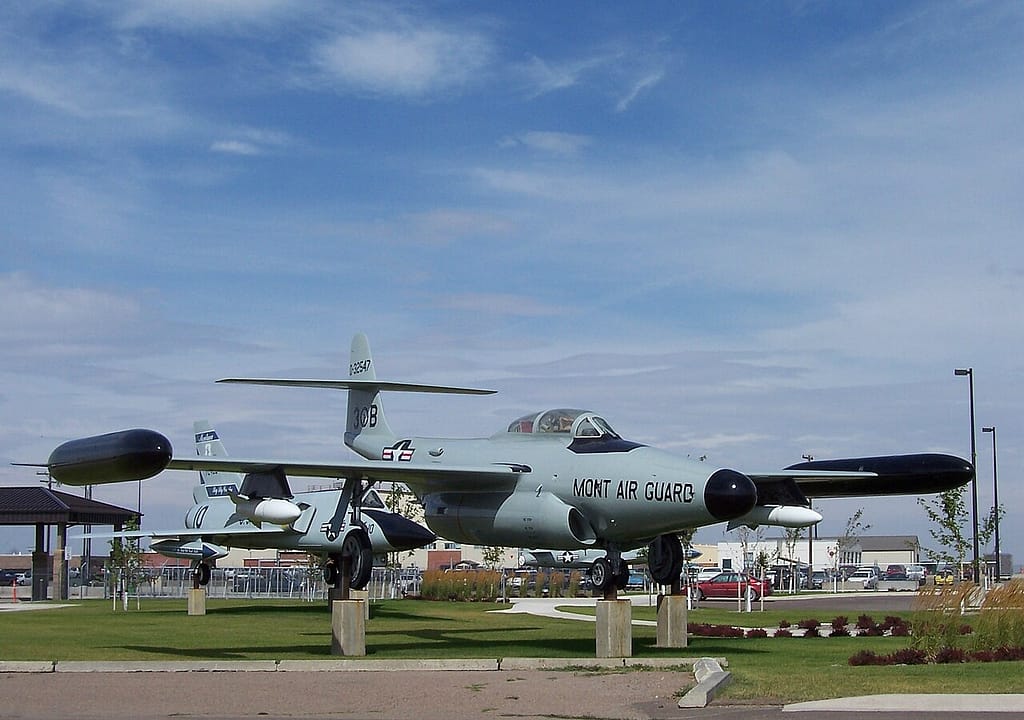
The weapon overhead was the AIR-2 Genie: an unguided air-to-air rocket tipped with a 1.5-kiloton nuclear warhead. Its logic was brutally simple. A single fighter could never reliably hit a tight formation of incoming Soviet bombers with conventional rockets, so the Air Force decided not to bother aiming precisely. Fire a small nuclear warhead into the middle of the formation and the blast would do the aiming for you.
The Genie made the Northrop F-89 Scorpion the first combat aircraft ever armed with a nuclear air-to-air weapon. On 19 July 1957, during Operation Plumbbob, an F-89J fired the only live nuclear Genie ever tested. The rocket accelerated to around Mach 3 and detonated roughly 18,000 to 20,000 feet up, a few miles downrange.
Population 5
To prove the Genie could be used safely over American towns, the Air Force needed to show that a nuclear burst high overhead would not harm people below. So five officers — Colonel Sidney Bruce, Lieutenant Colonel Frank Ball, Major Norman “Bodie” Bodinger, Major John Hughes and Don Luttrell — volunteered to be the people below.
They stood in shirtsleeves. When the warhead detonated, the film shows them flinching at the flash, then grinning and pointing as the shockwave rolled over them. A sixth man was there too: cameraman George Yoshitake, who had not volunteered at all but was ordered to film it, and who asked the night before what protective gear he would get. The answer was none.
Le règlement de comptes
In 1957, the reassurance seemed to work. The men were unhurt, the footage was triumphant, and the Genie went on to serve in U.S. and Canadian air defense into the 1980s. The long-term bill came due much later.
Several of the men who stood beneath the John shot — and the cameraman who filmed them — later developed cancer. Yoshitake, who lived long enough to talk about it, was blunt about what he came to believe.
The Genie was never fired with a live warhead again. What survives is the film: five calm men and a camera, standing under a nuclear explosion to prove it was nothing to worry about.
For anyone who wants the technical side of the weapon itself — the rocket, the warhead, and how an interceptor was meant to use it — this short explainer covers it well.
Sources: CTBTO; NPR; NBC News; military.com; The Week; Wikipedia (Operation Plumbbob; AIR-2 Genie; Northrop F-89 Scorpion). This piece touches on radiation exposure and cancer; it is presented as history.

0 commentaire