
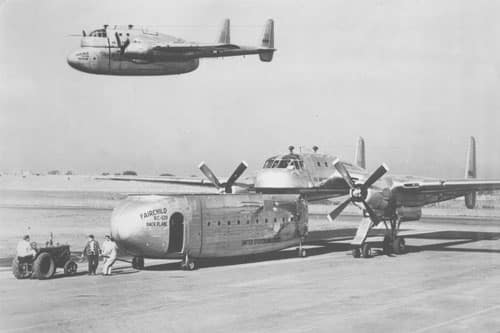
Imagine a cargo plane that works like a truck and trailer. It lands, drops off a fully loaded box, clips on an empty one, and is airborne again in minutes — while ground crews unload the box it left behind. In 1950, Fairchild actually built that airplane. It was called the XC-120 Pack Plane, and it was decades ahead of its time.
It was also deeply, memorably strange.
Informations clés
- Aéronef: Fairchild XC-120 “Pack Plane,” an experimental modular transport
- Big idea: a detachable cargo pod that clipped on under the fuselage
- Basé sur: the C-119 Flying Boxcar
- Premier vol : 11 August 1950; only one built
- Moteurs : two 3,250-hp Pratt & Whitney R-4360 radials; 258 mph
- Défaut fatal : stable with a pod attached, unstable without one
A cargo hold you could leave behind
Fairchild’s engineers started with their successful C-119 Flying Boxcar and asked a clever question: why make one fuselage do every job? A transport rigged for paratroopers carries dead weight when hauling freight, and vice versa. So they stripped the C-119 down to its flying essentials — wings, twin booms, tail, engines and a slim central fuselage — and made the entire cargo hold a separate, detachable pod that hung underneath.
Different pods could be pre-loaded for different jobs: freight, passengers, paratroops, even a portable hospital, radar station or command post. Electric winches in the four corners of the fuselage lifted a pod into place, ball-and-socket joints locked it, and an inflatable gasket sealed the seam. The pod rode on its own little wheels so it could be rolled around on the ground.

Ahead of the container ship
The logic was exactly the one that would later transform global trade. Load standardized boxes in advance, swap them fast, and keep the expensive vehicle moving. The XC-120 flew for the first time on 11 August 1950 — nearly six years before the world’s first true container ship set sail in 1956. Fairchild had stumbled onto intermodal shipping, in the air, before it existed at sea.

Le piège
There was one serious problem. The Pack Plane flew beautifully with a pod attached — and became alarmingly unstable without one. A flight engineer who flew the tests at Eglin Air Force Base summed up the experience with memorable brevity.
Only one XC-120 was ever built. It was tested through 1950 and splashed across the popular press, but the U.S. Air Force never adopted it. The stability issue might have been solved with time, but the Korean War created an urgent demand for ordinary C-119s, and Fairchild’s attention went there instead.
The Pack Plane was a dead end — but a prophetic one. Today’s militaries palletize and modularize everything, and the whole planet runs on swappable containers. Fairchild’s odd little plane simply had the right idea about 70 years early.
Sources: Robert Guttman, “Flying Container Ship: The XC-120,” Aviation History magazine (HistoryNet); GlobalSecurity; Wikipedia (Fairchild XC-120 Packplane).


0 commentaire