
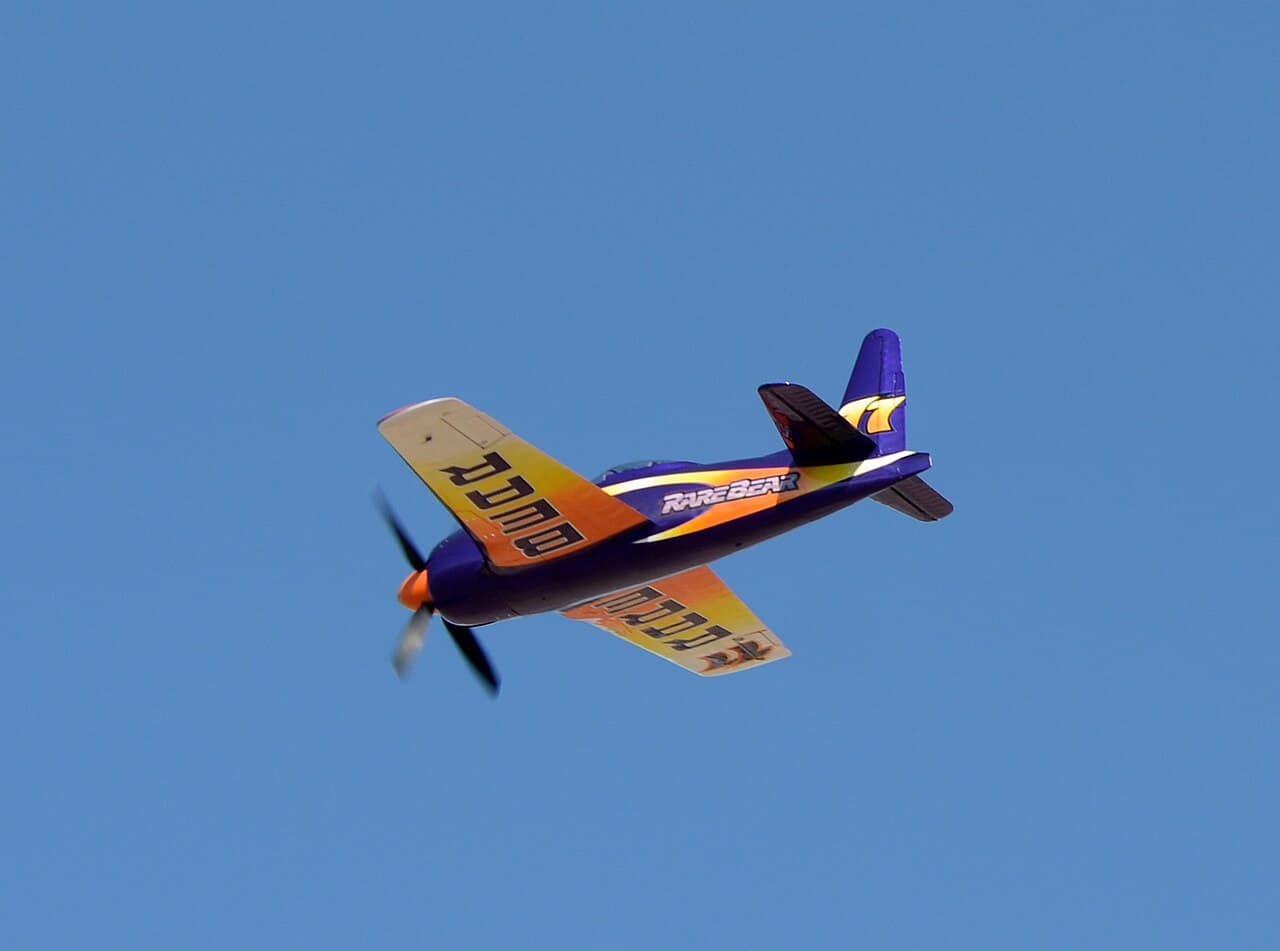
For fifty-nine years, one place on earth let you watch Second World War fighters flown at full power, fifty feet off the desert, at more than five hundred miles an hour, around pylons, against each other.
Reno ended in 2023. The races themselves did not — they moved to New Mexico, and this September the Unlimiteds finally follow. But the aeroplanes that made Reno famous spent an entire season not racing at all, and the reasons say a lot about why this sport was always living on borrowed time.
Informations clés
- Fondé: 1964 by Bill Stead; at Stead Field, Reno from 1966
- Format: Multi-lap closed pylon course, up to 8½ miles per lap
- Classes: Unlimited, Jet, Sport, Formula One, Biplane, T-6, STOL Drag
- Unlimited machinery: Heavily modified P-51s, Sea Furies, F8F Bearcats
- Course record: 507.105 mph — Skip Holm, “Dago Red”, 2003
- Piston world record: 528.33 mph — Rare Bear, 21 August 1989, still standing
- Last Reno event: 13–17 September 2023
- Now held at: Roswell Air Center, New Mexico
A rancher, a dirt strip and a closed air base
Bill Stead was a Nevada rancher and Second World War veteran who organised an air race near Reno in 1964. The first two years ran off a two-thousand-foot dirt strip. In 1966 the event moved to Stead Field, a recently closed Air Force base named after Bill’s brother Croston, a first lieutenant killed there in 1949.
The format never fundamentally changed: two and a half days of qualifying, four and a half days of heats, and the Unlimited Gold on Sunday afternoon. Aircraft fly a closed ovoid course marked by pylons, wingtip to wingtip, low.
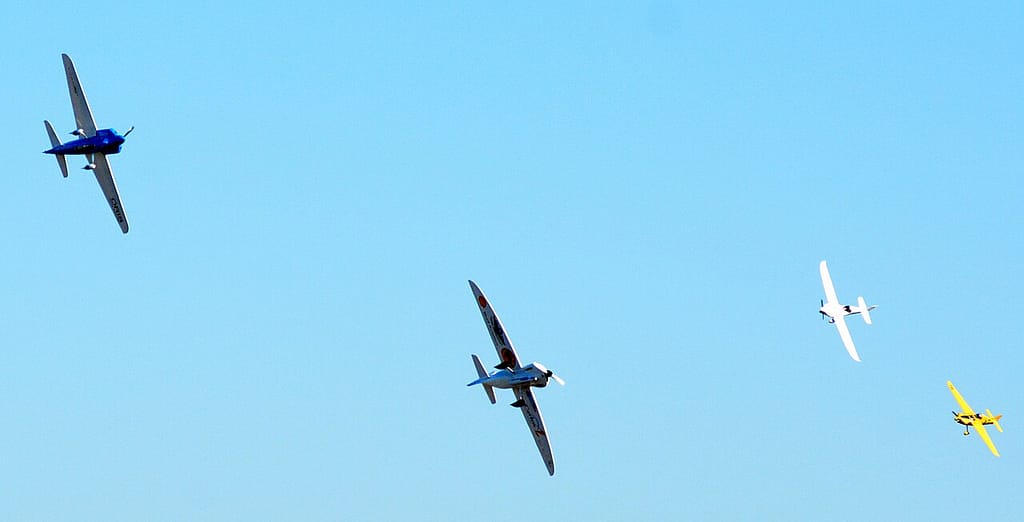
The fastest piston-engined aircraft in the world
The Unlimited class is where the legend lives. The rules are close to what the name implies: a piston-engined aircraft, heavily modified, typically over three thousand horsepower, routinely past four hundred miles an hour at low level.
Rare Bear is the emblem of the whole thing. Lyle Shelton found the wrecked Grumman F8F Bearcat in Indiana in 1962 and rebuilt it around a Wright R-3350 with a Skyraider propeller. On 21 August 1989 it set the three-kilometre world speed record for piston aircraft at 528.33 mph.
That record still stands, which is worth saying clearly because most coverage gets the next part wrong. In September 2017 Steven Hinton Jr flew the P-51 Voodoo at Challis, Idaho, with a fastest run of 554.69 mph and an average of 531.53. Headlines said he had beaten Rare Bear. He had not — FAI rules require an absolute record to be beaten by one percent, which meant 533.6 mph. Voodoo took a sub-class record. The Bearcat kept the big one.
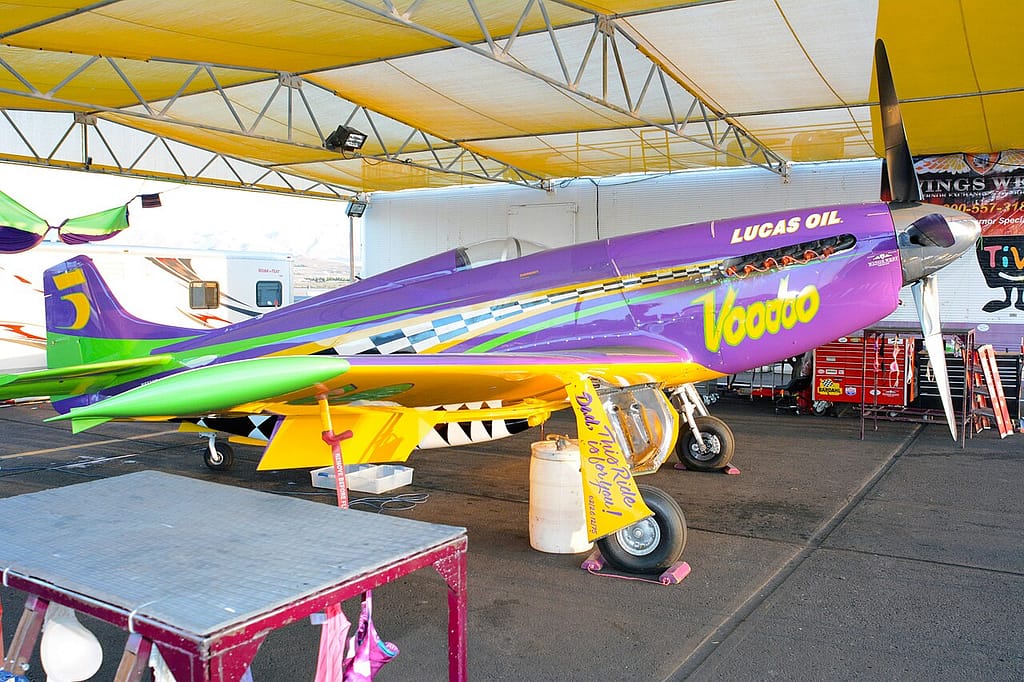
Unlimited Gold from pylon four — the view that explains the appeal better than any description.
16 September 2011
The accident that defines the modern history of the sport happened in the Unlimited Gold heat in 2011. Jimmy Leeward, flying a heavily modified P-51D called The Galloping Ghost, had just rounded pylon eight when the aircraft pitched violently up, rolled inverted and dived into the box seating in front of the grandstands at over four hundred miles an hour.
Eleven people died: Leeward and ten spectators. Sixty-nine were injured. It is the third-deadliest airshow disaster in American history.
The NTSB traced it to reused single-use locknuts in the left elevator trim tab system. They loosened, a fatigue crack formed in an attachment screw, and the trim tab began to flutter until the link assembly failed. Leeward was subjected to something like seventeen g, which incapacitated him. He was flying roughly five hundred and thirty miles an hour, about forty faster than he ever had before.
One contributing finding is particularly hard to read: the aircraft’s right trim tab had been fixed in place as an undocumented modification. Had both tabs been working, losing one might not have been fatal.
The Board issued seven safety recommendations covering course layout, spectator distance, pre-race inspection and the airworthiness of modifications. Racing resumed the following year, further from the crowd.
Onboard with Rare Bear in Unlimited Gold.
Why Reno ended
Not because of the crashes. Because of houses.
In March 2023 the Reno Air Racing Association announced that year’s event would be the last at Stead. The decision was not theirs.
Development had crept steadily toward the airfield. An event that needs a large empty area under the flight path had run out of empty area.
The final meeting had its own tragedy. On 17 September 2023, after completing the T-6 Gold race, two T-6s collided while manoeuvring in the traffic pattern for runway 8. Both pilots — Nick Macy and Chris Rushing, aged 65 and 67 — were killed. No spectators were hurt. The remaining races were cancelled and Reno ended two hours early, after fifty-nine years.
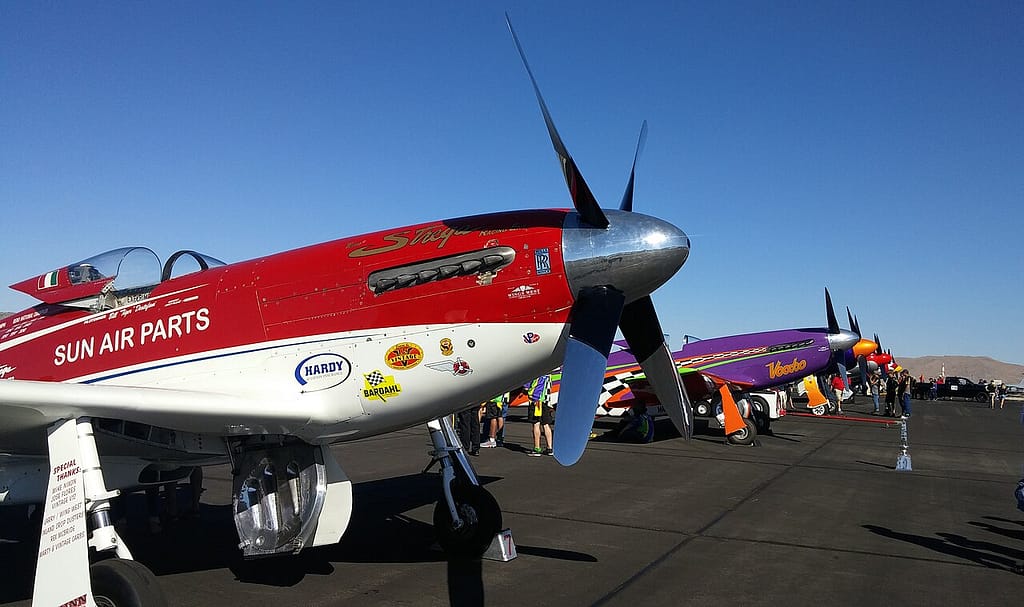
Roswell, and a season without Mustangs
The races moved to Roswell Air Center in New Mexico, and the first meeting ran there from 10 to 14 September 2025. Saturday was rained out. Five classes raced.
The Unlimiteds were not among them. The class withdrew in August 2025, a month before the event, having watched the Sport class pull out in July, citing safety, operational and sustainability concerns.
They are coming back. RARA’s July 2026 announcement lists fifteen Unlimited entries for the September meeting, including Steve Hinton in a P-51D, Brent Hisey in Miss America, Dennis Sanders in a Sea Fury and Tom Nightingale in a P-63. The 2026 event runs 16 to 20 September, with the Thunderbirds headlining.
So the Mustangs will race again, in a different desert, having missed a year.
What is actually at stake
The tension in air racing was never resolved. It was relocated.
Pushing eighty-year-old airframes past speeds their designers never imagined, at heights that leave no margin, is simultaneously the entire point and the entire problem. You cannot make it safe without making it something else. Nineteen aviators died at Reno between 1964 and 2010, before the 2011 disaster and the six deaths that followed it.
And yet there is nowhere else. Museums preserve these aircraft by not flying them hard. Airshows fly them gently. Reno was the last place on earth where a Merlin was run at full military power in anger, and where you could hear what these machines actually sounded like when men were using them for the purpose they were built for.
That is worth something. Whether it is worth what it has cost is a question the sport has been asking itself, honestly, for sixty years.
The final flag at Reno, September 2023.
Sources: Reno Air Racing Association, NTSB Accident Report AAB-12/01, AVweb, FAI record files, Aero-News Network

0 commentaire