
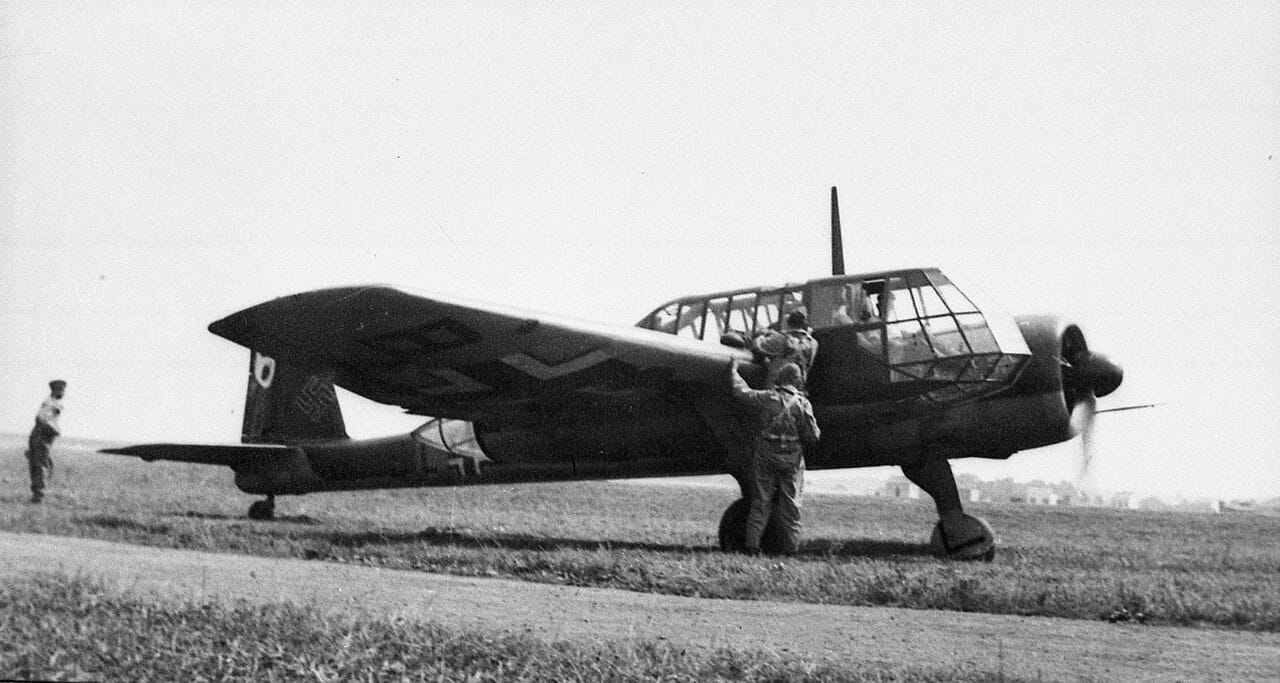
Look at a Blohm & Voss BV 141 head-on and your brain files a complaint. The engine and the tail are on the left. The crew sit in a glass pod on the right. There is no fuselage in the middle, because there is no middle. It looks like two different aircraft were assembled by someone working from the wrong drawings.
It was entirely deliberate, it was aerodynamically sound, and by most accounts it flew rather well.
Informations clés
Designer: Dr.-Ing. Richard Vogt, chief designer at Hamburger Flugzeugbau (Blohm & Voss)
Rôle: three-seat short-range tactical reconnaissance, to replace the Henschel Hs 126
Premier vol : 25 February 1938, as the Ha 141
Équipage: pilot, observer and rear gunner, all in the starboard gondola
Moteurs : BMW 132N radial on the early aircraft; BMW 801A on the BV 141B, the same engine as the Fw 190
Construit: fewer than 30 — published figures range from 13 to about 28
Won the contract instead: the twin-engined Focke-Wulf Fw 189 Uhu
Survivants : none
The problem the asymmetry solved
The 1937 RLM specification asked for a single-engined observation aircraft with better all-round visibility than the Hs 126. Those two requirements fight each other. A single engine goes on the nose, and a nose full of engine is precisely where a reconnaissance crew most wants to look.
Vogt’s answer was to stop insisting the aeroplane be symmetrical. Put the engine, and the tail boom behind it, out on the port side. Put the crew in a fully glazed pod on the starboard side. Join the two with the wing. The crew then have an almost uninterrupted view forward, down, sideways and back — blocked only to the left, where the engine sits. On the later B-series the starboard tailplane was cut away almost entirely so the rear gunner could see and shoot aft.

The obvious objection is torque and yaw. In practice the offset masses were each supported by the lift of the wing directly above them, so roll was not the problem it looks like. The yawing forces from thrust on one side and drag on the other were real but small, and could be trimmed out. As one aviation writer has put it, an aeroplane is already asymmetric about the horizontal plane and nobody thinks twice about trimming for that.
Nobody had asked for it
Blohm & Voss were not invited to tender. They were a shipbuilder with an aircraft subsidiary and a reputation for flying boats, and the company financed the first prototype itself. Ernst Udet, then running the Technical Department, was one of the few senior figures who took it seriously; he looped and rolled the aircraft on his first flight in April 1938.
Official evaluation at Rechlin in January 1940 came back favourable. Production plans were cancelled anyway, on 4 April 1940, on the grounds that the A-series was underpowered.

The B-series answered that with the 1,560 hp BMW 801A — and immediately ran into a different wall. The BMW 801 was the Focke-Wulf Fw 190’s engine, and the Fw 190 had priority. Development dragged on: the first B flew in January 1941, needed structural strengthening, and official evaluation of one airframe slipped as late as May 1943. By then the twin-engined Fw 189 had won the requirement and was in production, and there was no reason for a second reconnaissance type.
A planned Eastern Front deployment was cancelled in 1942. The BV 141 never became operational.
The one man who flew it and wrote it down
After the war Captain Eric “Winkle” Brown, the Royal Aircraft Establishment’s chief naval test pilot, flew an enormous number of captured German aircraft, and a BV 141B was among them. He was sceptical of the design’s central claim — that under attack the aircraft could be rolled onto its wingtip and held there in straight flight, giving the gunner a huge field of fire.
His overall verdict was warmer than the aircraft’s reputation deserves. He found it had good, effective controls, though poor lateral stability that would have made low-level flying in turbulence unpleasant — and he suggested that, combined with how good the Fw 189 was, this was the real reason it never went anywhere.
Not one BV 141 survives. What does survive is period film of the thing flying, which is worth watching purely to confirm that it is not a hoax.
A fuller account of the design and why Vogt built it this way:
And the aerodynamics of deliberate asymmetry, explained:
Foire aux questions
Why was the Blohm & Voss BV 141 asymmetric?
Le BV 141 volait-il réellement bien ?
How did it cope with propeller torque and yaw?
Combien de BV 141 ont été construits ?
Pourquoi le BV 141 n'a-t-il jamais été produit en série ?
Could the BV 141 really fly on its wingtip?
Do any BV 141s survive?
Sources: Peter Garrison, Aviation History, May 2017; Capt. Eric Brown, on flying the captured BV 141B; Plane-Encyclopedia; Bundesarchiv.

0 commentaire