

At Gatineau on Thursday morning a single turboprop pulled up over the airport in a ceremonial flypast, and a sixty-year era began its long goodbye. The aircraft was a Pilatus PC-21, built at Stans in central Switzerland. In Canadian service it is the CT-157 Siskin II.
Two of them are now in the country. Seventeen more will follow, all of them bound for 15 Wing Moose Jaw, and between them they will train the next generation of Canadian military pilots. They will also, eventually, be painted red and white and flown by the Snowbirds.
That last part is the one Canadians are arguing about, because the Snowbirds have flown jets since 1971 and the Siskin has a propeller on the front.
Informations clés
- Arrived: 17 September 2026, Gatineau, Quebec — the first two of 19
- Taper: Pilatus PC-21, designated CT-157 Siskin II in RCAF service
- Base: 15 Wing Moose Jaw, Saskatchewan
- Moteur: Pratt & Whitney Canada PT6A-68B, around 1,600 shaft horsepower
- Vitesse maximale : roughly 685 km/h — fast for a turboprop, slower than the jet it replaces
- Programme: Future Aircrew Training (FAcT), 71 aircraft across five fleets, run by SkyAlyne on a 25-year, C$11-billion contract
A Swiss Aircraft Canada Has Been Flying All Along
The Royal Canadian Air Force has never operated an aircraft built by Pilatus. That sounds like a first, and officially it is one. In practice Canada has been flying Pilatus designs for a quarter of a century: the trainers it has used until now were, in essence, developed from the PC-9 and built in the United States.
So this is less a new relationship than a formalised one. What changes is the standard. The PC-21 is not a refined PC-9; it is a clean-sheet aircraft designed to take a student much further before the cost of a real fast jet has to be paid. Switzerland has trained its own pilots on it since around 2008. Australia’s Roulettes display team flies it. So do Qatar, Saudi Arabia, Spain, France, Jordan and Singapore.
Pilatus’s deputy chief executive, Ioannis Papachristofilou, points at the part you cannot see from the ramp.
That is the whole commercial argument for the type. A student in a Siskin can be given a synthetic radar picture, synthetic threats and a synthetic wingman, and can learn to manage all of it at 300 knots in a machine that costs far less per hour to fly than an M-346 or a Hawk. By the time they reach the real fighter, the expensive hours are spent on flying rather than on learning what the symbology means.
The engine, pleasingly for Ottawa, is Canadian: a Pratt & Whitney Canada PT6A-68B of about 1,600 horsepower. A Swiss airframe with a Canadian heart is an easier sell in Parliament than an entirely foreign one.

The Tutor Problem
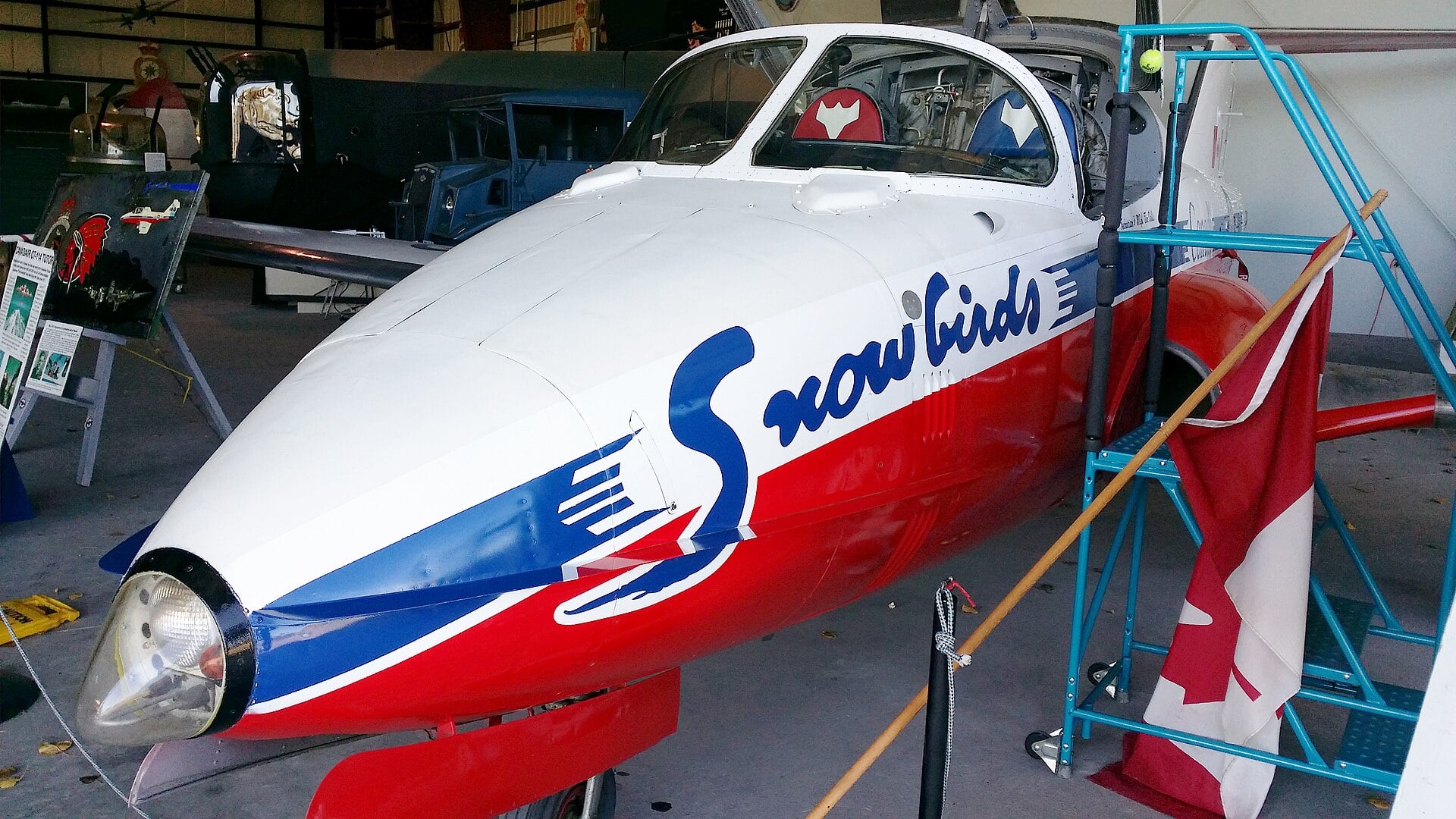
The CT-114 Tutor is roughly sixty years old. Canada tried to keep it flying to 2030 with an upgrade programme, and the plan came apart on the three things that always break old-aircraft plans: cost, schedule, and the slow disappearance of spare parts. This spring the federal government accepted the inevitable and announced a replacement.
The Snowbirds will fly their last show in the National Capital Region at Gatineau this weekend, with the first two Siskins parked nearby at AERO Gatineau-Ottawa — the outgoing and the incoming on the same field. The team’s final flight comes at the Grey Cup in Calgary in November. After that they stop, possibly until 2030, while Ottawa procures additional Siskins specifically for the display role.
Three or four seasons without the Snowbirds is a long time in a country that treats them as national furniture.
Can a Propeller Replace a Jet?
This is the objection, and it is not a silly one. The Tutor is a jet. It is loud, it leaves a clean smoke trail, and nine of them in tight formation make a particular noise that Canadians have grown up with. The Siskin has a five-blade propeller.
The RCAF’s commander, Lieutenant-General Jamie Speiser-Blanchet, has heard the complaint and does not accept it.
She concedes the Siskin is slower than the Tutor and quieter than a jet, but insists “it’s not a quiet aircraft” and that it will “really wow Canadians” once the shows resume. Anyone who has stood under a PC-21 at Axalp will know she has a point: a 1,600-horsepower turboprop turning a five-blade scimitar propeller does not whisper.
There is a second, quieter benefit she raised. Because almost every Canadian military pilot will now train on the Siskin, the pool of pilots already current on the display aircraft becomes enormous. Selecting a Snowbird stops being a conversion exercise. And basing the whole fleet at Moose Jaw keeps the maintenance and support in one place.
The Italian Question
Three months ago Canada opened talks with Leonardo about the M-346 for the advanced jet phase of its training pipeline. That contrast is worth holding in view: a Swiss turboprop for the bulk of the syllabus and the display team, an Italian jet for the pointy end.
It is a pattern Europe has been quietly exporting for a decade. The heavy lifting of pilot training migrates down to a turboprop that costs far less per hour and simulates much of what a jet used to teach; the jet is reserved for the handful of skills that genuinely need one. The Netherlands went the same way this month with the first flight of the PC-7 MKX.
The FAcT contract is the largest of its kind Canada has signed: 25 years, C$11 billion, 71 aircraft in five fleets, run by SkyAlyne, the partnership between CAE and KF Aerospace that won it in 2024. Two red-and-white turboprops at a Quebec airfield is what that looks like when it finally arrives.
Sources: The Canadian Press, SkyAlyne, Pilatus Aircraft, aeroTELEGRAPH, FlightGlobal, Royal Canadian Air Force.

0 Comments