
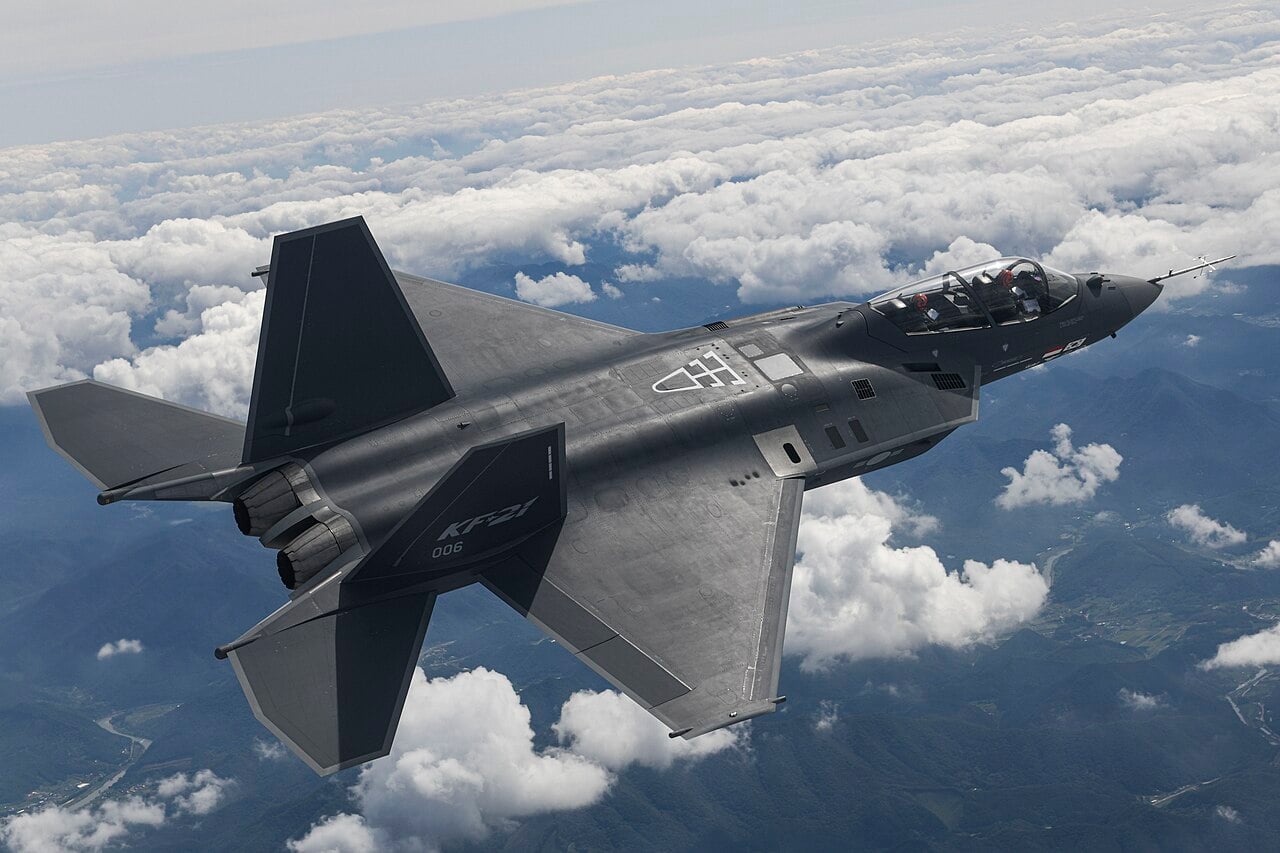
On Tuesday a Korean fighter took off from a Korean factory, flown by a Korean air force major who had just signed for it, and landed at a Korean air base. Twenty-five and a half years after a president promised it, South Korea has handed its air force a fighter it designed and built itself.
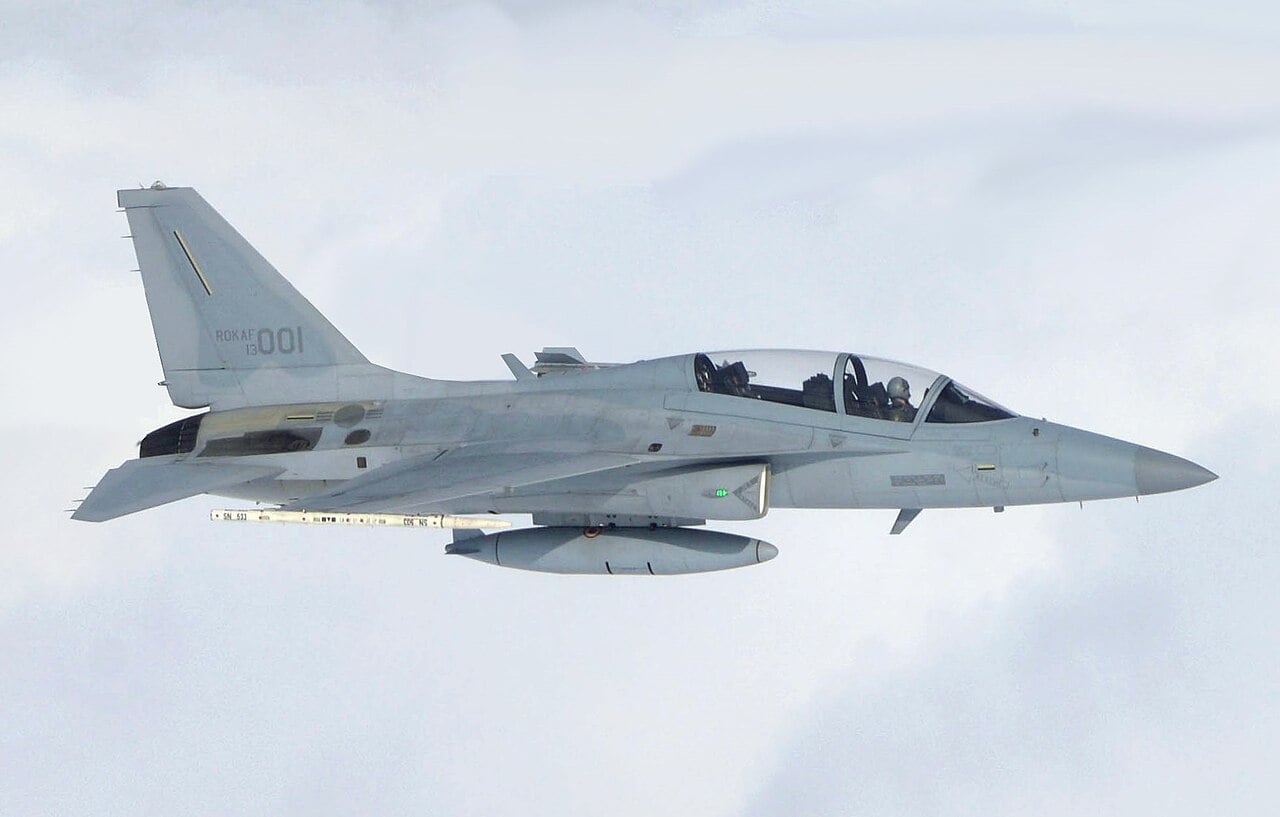
The first serial-production KF-21 Boramae flew from Korea Aerospace Industries’ plant at Sacheon to Yecheon Air Base in North Gyeongsang Province on 22 September, escorted by an FA-50, a TA-50 and a T-50 — three generations of Korean-built jets flying alongside the fourth.
Maj. Han Jae-seok, one of the air force’s first KF-21 pilots, signed the acceptance documents and then flew the aeroplane home.
Informations clés
| Aéronef | First serial-production KAI KF-21 Boramae, a two-seat Block I airframe |
| Livré | Tuesday 22 September 2026 |
| Itinéraire | KAI Sacheon plant to Yecheon Air Base, North Gyeongsang Province |
| Pilote | Maj. Han Jae-seok, Republic of Korea Air Force |
| Escorte | One FA-50, one TA-50 and one T-50 |
| Unité | 156th Fighter Squadron, 16th Fighter Wing, reactivated 1 June 2026 |
| Rolled out | 25 March 2026 |
| Programme announced | March 2001, by President Kim Dae-jung |
| System development began | December 2015 |
| flotte prévue | 40 Block I aircraft by 2028, then 80 Block II through 2032, around 120 in total |
Twenty-Five Years and Six Months
President Kim Dae-jung announced a domestic fighter programme in March 2001. System development did not formally begin until December 2015. The aircraft delivered on Tuesday therefore arrived roughly twenty-five and a half years after the political commitment and ten years and nine months after engineering work started in earnest.
Those are not embarrassing numbers for a clean-sheet fighter. They are close to normal. What is unusual is that a country with no prior experience of designing a supersonic combat aircraft finished one at all, complete with an indigenous AESA radar, an electronic warfare suite and beyond-visual-range missile integration.
The airframe that arrived at Yecheon is a two-seat Block I aircraft. It went to the 156th Fighter Squadron, a unit with its own history: a former F-4E Phantom II squadron under the 16th Fighter Wing, disbanded in 2012 and reactivated on 1 June this year specifically to operate the KF-21.
A Delivery Is Not a Capability
The Air Force Chief of Staff, Gen. Son Sug-rag, framed the handover as a transfer of responsibility rather than a finish line.
He is right to draw the line there. A delivered fighter is not a deployable squadron. Pilots have to be converted, maintainers trained, spare engines bought, ground equipment fielded, weapons procedures written and sortie generation rates proved. Every one of those matures on its own schedule, and a programme can produce excellent aircraft and still fail to produce a usable squadron for years.
What 120 Aircraft Are Meant to Do
South Korea plans to take 40 Block I aircraft by 2028 and 80 Block II aircraft with expanded strike capability through 2032, for a fleet of roughly 120. Block I is deliberately weighted towards air-to-air work, which narrows what the type can do in the short term and makes the 2032 figure the one that matters.
They are replacing retired F-4 Phantoms and ageing KF-5s, and will fly alongside F-15K Slam Eagles, KF-16s and F-35A. That is a layered force rather than a single-type air arm, and the KF-21 is the layer Seoul controls entirely: no export licence, no foreign government approval, no waiting list behind somebody else’s air force.
That is the actual point of the programme, and it is the reason a two-seat fighter landing at a provincial Korean air base on a Tuesday is a bigger story than the aircraft’s specification sheet suggests.
Sources: The Aviationist; FlightGlobal; Janes; Defence Security Asia; Republic of Korea Air Force.
0 Comments