
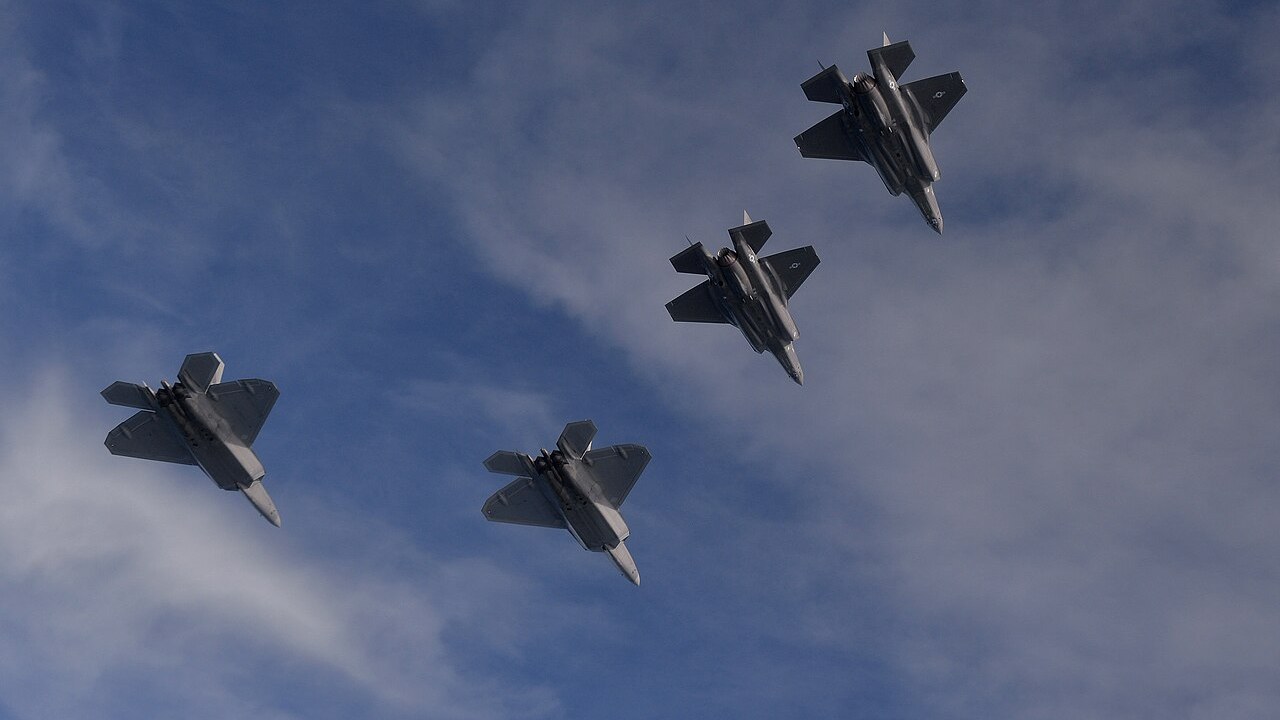
Look at the tactical display of a modern F-16 and you will see aircraft its own radar has never touched. A contact a hundred miles away, already labelled hostile. A friendly four-ship on the far side of a mountain range. A tanker orbit, a ship, a surface-to-air missile battery. All of it arrives silently, in bursts lasting a few thousandths of a second, over a radio network called Link 16.
Link 16 is the tactical data link that NATO and many allied air forces use to share one picture of the battle between aircraft, ships and ground stations. The US military once called it TADIL J. Pilots simply call it “the link”, and for many of them it has changed what flying a fighter feels like more than any new missile or engine.
How does a jet hold a reliable conversation with dozens of other jets, all at once, while the enemy tries to jam it? The answer is a clever piece of time management, a lot of frequency hopping and a vocabulary of standard messages.
Informations clés
- Système: Link 16, formerly TADIL J; NATO STANAG 5516, US MIL-STD-6016
- Origine: US JTIDS programme, mid-1970s; full development from 1981
- Band: 960 to 1,215 MHz, 51 hopping frequencies between 969 and 1,206 MHz
- Access: TDMA: 128 time slots per second, 7.8125 ms each; 12-second frames of 1,536 slots
- Messages: J-series binary messages, including PPLI position and identity reports
- Data rate: Typically 31.6, 57.6 or 115.2 kbit/s
- Terminals: JTIDS, MIDS-LVT and MIDS-JTRS
- Gamme: Line of sight, roughly 300 miles; extended by relays and satellite
From voice calls to a shared picture
Before data links, everything a fighter pilot knew about the wider fight came by voice. A controller on the ground or in an airborne radar aircraft read out bearings, ranges and altitudes, and the pilot built a mental picture from them. It worked, but it was slow, it was easy to mishear, and it clogged the radio.
Link 16 grew out of the US Joint Tactical Information Distribution System, or JTIDS, whose development dates back to the mid-1970s. A US Air Force diagram from 1975 already shows the idea: one “broadcast net” joining fighters, reconnaissance aircraft, AWACS, ground control centres and missile batteries. Full-scale development began in 1981 with a contract to Singer-Kearfott.
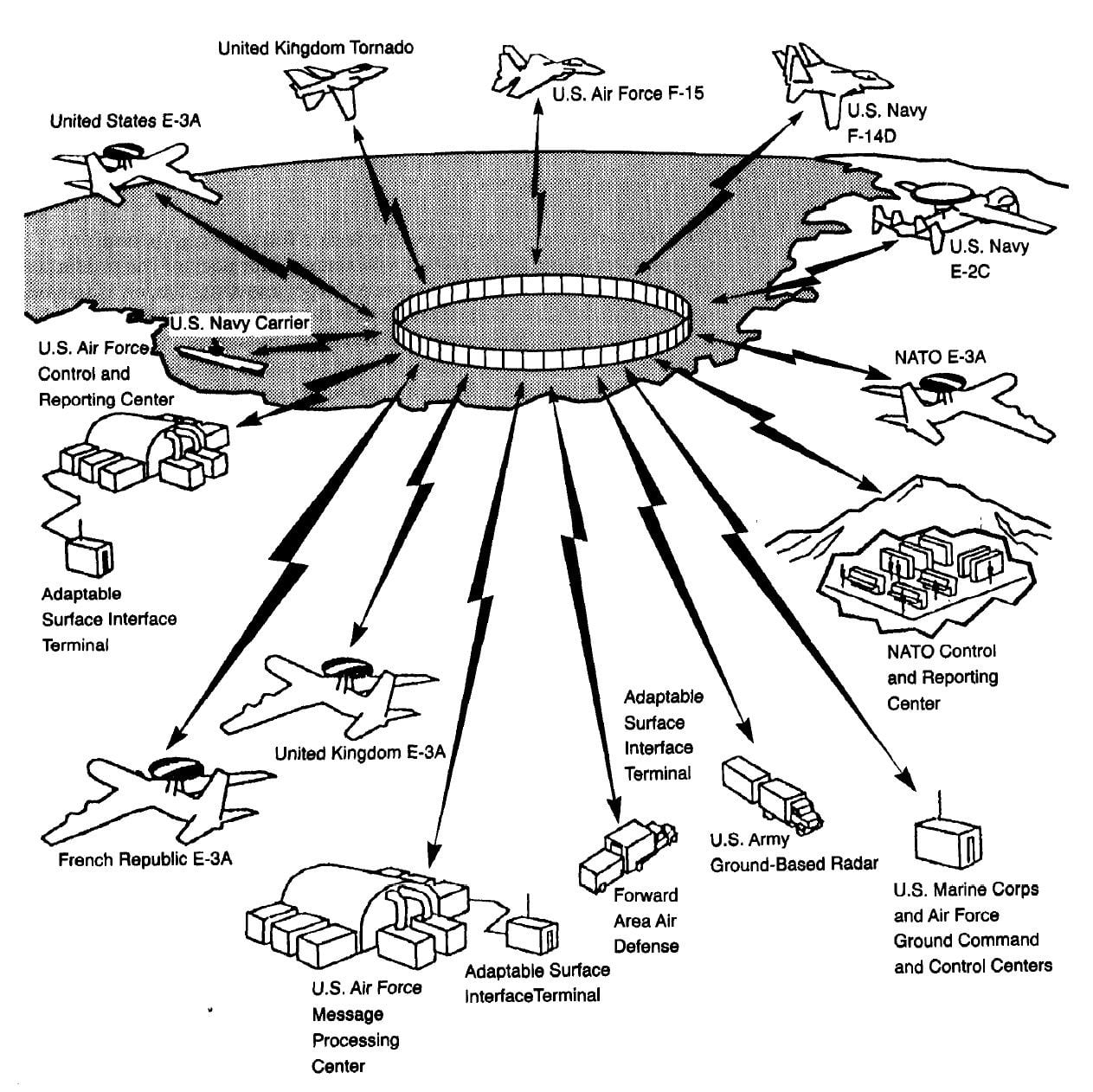
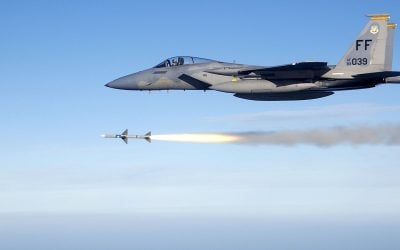
The first big users were the airborne radar aircraft and the air-defence fighters. The E-3 Sentry AWACS fleet carried JTIDS terminals, and later Block 30/35 upgrades added Class 2H terminals that made it fully Link 16 capable. The US Navy’s F-14D Tomcat et le F-15C Eagle carried JTIDS Class 2 terminals, and the Royal Air Force’s Tornado F3 could share its radar picture with other aircraft over JTIDS. Fielding was slow through the late 1980s and early 1990s, then expanded quickly after 11 September 2001, ahead of the wars in Afghanistan and Iraq.
The aha: everyone takes turns
The heart of Link 16 is time division multiple access, or TDMA. Instead of a radio channel where whoever keys the microphone first gets to talk, time itself is sliced up and shared out. Every second is divided into 128 time slots of 7.8125 milliseconds each. In any one slot, a single terminal transmits and everyone else on that network listens.
Those slots are organised into 12-second frames of 1,536 slots, and frames into 12.8-minute epochs of 98,304 slots, after which the pattern repeats. Before a mission, each aircraft, ship or ground station is loaded with a network plan telling it which slots belong to it. That is why there is no central switchboard relaying every message: each participant simply speaks in its own slots and listens in everyone else’s.
Eagle Dynamics producer Matt Wagner introduces the Link 16 data link on the DCS World F-16C simulator, showing how shared tracks appear on the cockpit display.
Because every terminal must know exactly when its slots begin, Link 16 needs extremely precise shared timing. That timing has a useful side effect. Terminals can work out their distance from one another, which is why Link 16 also offers relative navigation.
Hopping 76,923 times a second
A radio that always talks on one frequency is easy to jam. Link 16 avoids that by spreading its signal across the 960 to 1,215 MHz band, using 51 frequencies between 969 and 1,206 MHz. Each pulse lasts 6.4 microseconds, followed by a 6.6-microsecond pause, and each pulse goes out on a different, pseudo-randomly chosen frequency. Do the arithmetic and that is about 76,923 hops per second.
Each pulse carries five bits of data, and the hopping pattern, the slot assignments and the messages themselves are all encrypted. A jammer cannot simply sit on one channel and wait. Transmissions are also kept clear of 1,030 and 1,090 MHz, the frequencies used by IFF and air traffic control transponders, because Link 16 shares its band with civil aviation systems such as DME and TACAN.
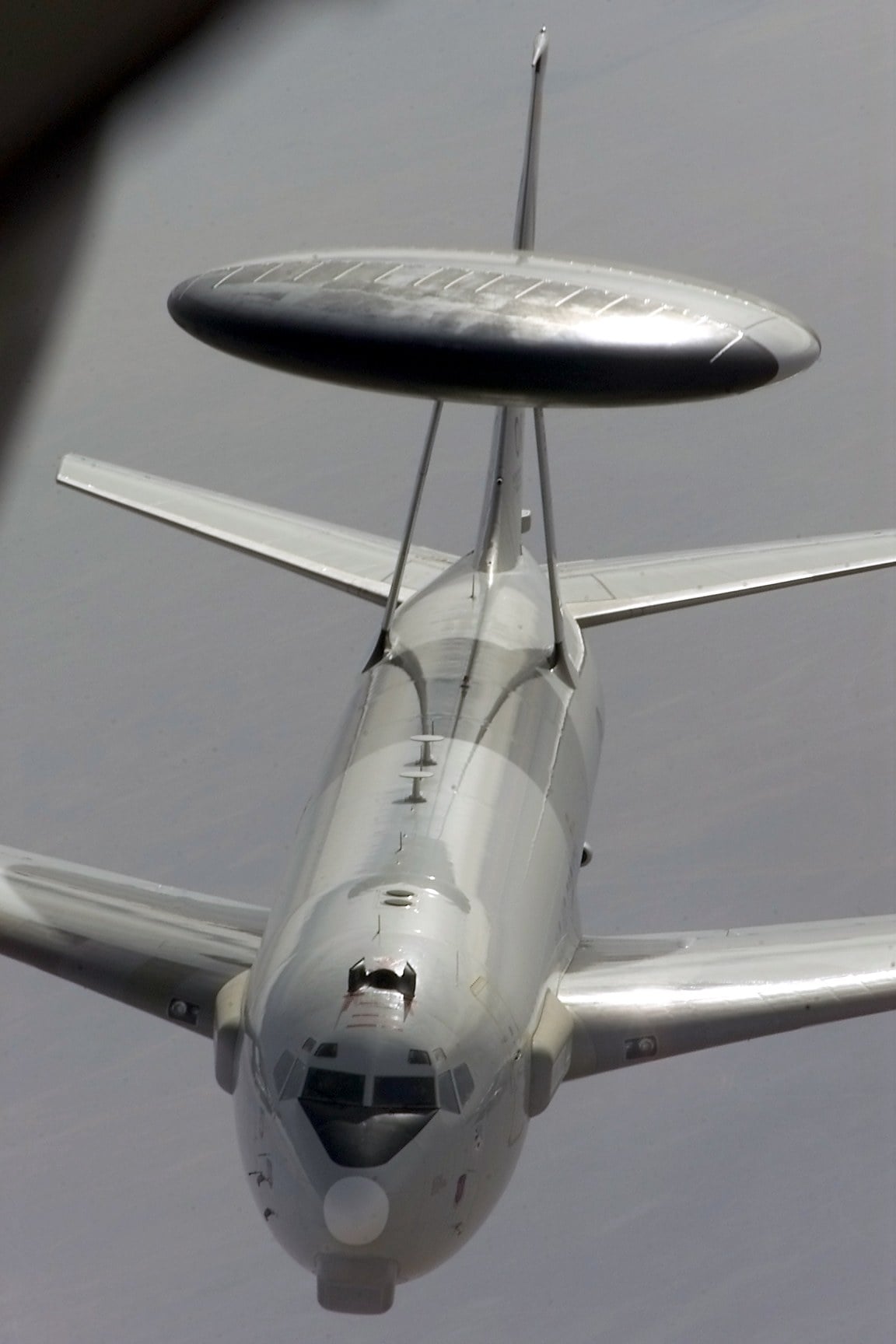
The price of using that band is range. Signals at these frequencies travel only in line of sight, so a standard terminal reaches roughly 300 miles. Beyond that, other terminals can relay the traffic, and protocols such as JREAP can carry Link 16 messages over satellite or other long-haul networks.
J-series messages: a shared vocabulary
Link 16 does not send pictures of a radar screen. It sends short, standardised binary messages known as the J-series, defined in the US standard MIL-STD-6016 and NATO’s STANAG 5516. Every terminal knows exactly what each message means, whatever the nationality of the aircraft that sent it.
The most important is PPLI, or Precise Participant Location and Identification. Each terminal sends it automatically, telling the network where it is and who it is. J2.2 is the air version. Surveillance tracks travel as J3 messages, mission assignments as J12, platform status as J13, and electronic warfare data as J14. Messages are grouped into network participation groups, so a fighter can belong to the weapons coordination group while a tanker does not.
That vocabulary is what produces the famous “God’s-eye view”. An AWACS sees a contact on radar and sends it as a track. A fighter that sees the same contact adds its own data. A ship far away sees both. All of them now share one picture, and none had to say a word on the radio.
A US Air Force air battle manager of the 962nd Airborne Air Control Squadron at JBER explains his job aboard the E-3 AWACS.
The hardware: MIDS terminals
In the cockpit, Link 16 lives in a terminal. The original JTIDS boxes were large and expensive, so the US, France, Germany, Italy and Spain funded a smaller common terminal under the Multifunctional Information Distribution System programme, or MIDS. The MIDS Low Volume Terminal spread across fighters, ships and ground systems, with one version, the Fighter Data Link Terminal, built for the F-15. The newer MIDS-JTRS is a software-defined radio that keeps Link 16 and adds enhanced throughput and programmable encryption.
Three production lines have built MIDS terminals: ViaSat, Data Link Solutions, a joint venture of BAE Systems and Collins, and the European consortium EuroMIDS. In January 2023 L3Harris closed its purchase of ViaSat’s Link 16 business for about $1.96 billion, a measure of how central the system has become.
Why stealth fighters were left out
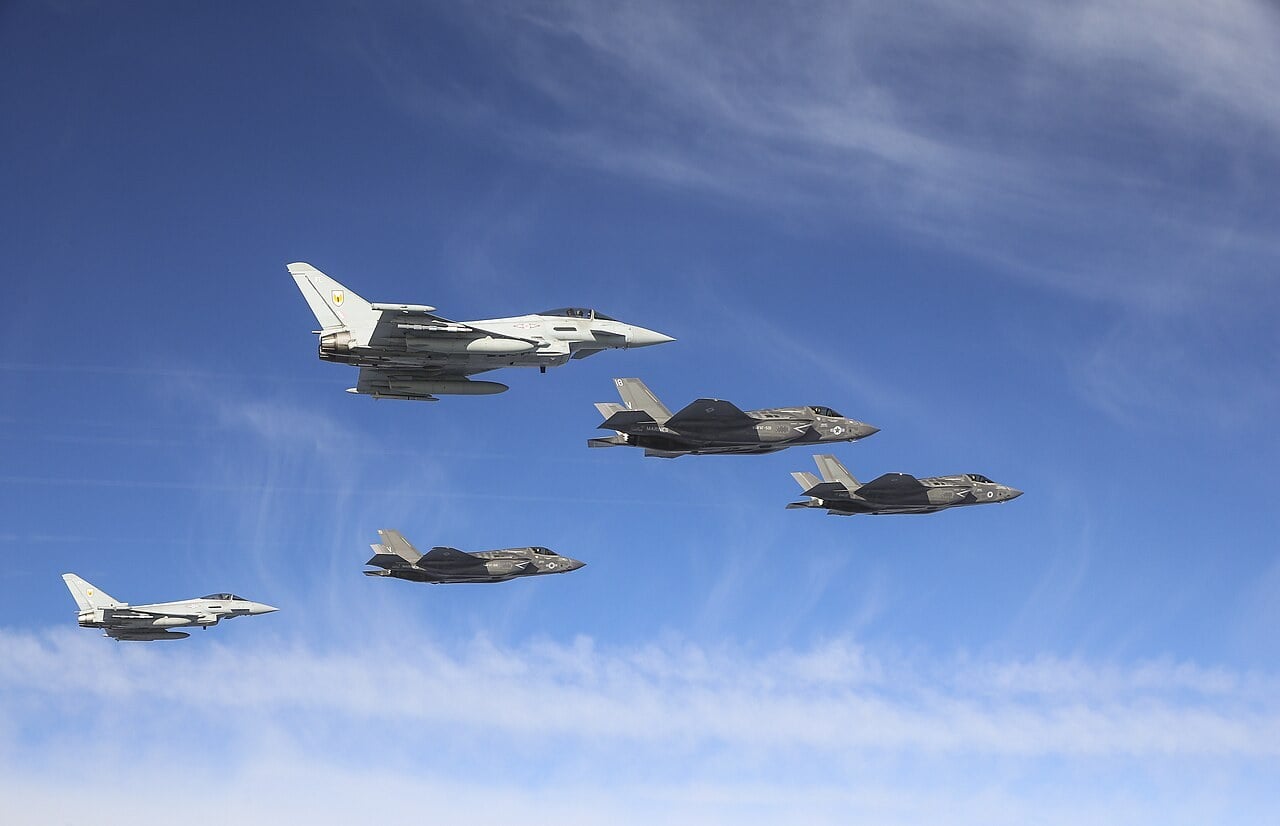
Link 16 has one big drawback for a stealth fighter: it broadcasts in every direction. An enemy may not be able to read it, but it can hear it. For that reason the F-22 Raptor was given its own directional Intra-Flight Data Link, IFDL, which only talks to other Raptors. For years the F-22 could receive Link 16 data but not transmit it. A MIDS-JTRS terminal with Link 16 transmit capability began going into the fleet in 2021.
Le F-35 Lightning II took a different approach. It carries Link 16 to talk to older aircraft, and the Multifunction Advanced Data Link, MADL, a narrow, directional Ku-band link for talking to other F-35s. MADL and IFDL use different waveforms, so for years the two American stealth fighters could talk to each other only by voice.
The fix has been translators. In the UK’s Babel Fish III trial in 2017, a Northrop Grumman airborne gateway converted MADL messages from an F-35B into Link 16 for a Eurofighter Typhoon. In Project Hydra in 2021, a U-2 carrying a gateway payload linked an F-22 and five F-35s in flight, and passed data to Link 16 users at the same time.
Millennium 7 HistoryTech on the F-35’s stealthy MADL data link and how it differs from Link 16.
Link 16 goes to space
The newest twist removes the line-of-sight limit altogether. In November 2023 the US Space Development Agency used three Tranche 0 satellites built by York Space Systems to broadcast Link 16 from low Earth orbit to radios on the ground in a Five Eyes partner nation. It was the first time Link 16 had been sent from space.
Half a century after the first JTIDS diagrams, the principle has not changed. Slice time into slots, hop the frequency, speak in a shared language, and every aircraft in the fight sees what the others see. The missiles and the radars get the headlines, but the link is what turns a collection of fighters into a team.
Sources: Wikipedia (Link 16; Joint Tactical Information Distribution System; Multifunctional Information Distribution System; Multifunction Advanced Data Link; Lockheed Martin F-22 Raptor; Boeing E-3 Sentry), ViaSat MIDS-LVT technical briefing (IDLS 2006), BAE Systems, Armada International, Air & Space Forces Magazine, DOT&E FY2019 F-22 report, US Air Force / DVIDS, UK Defence Journal, Lockheed Martin, DefenseScoop, L3Harris

0 Comments