
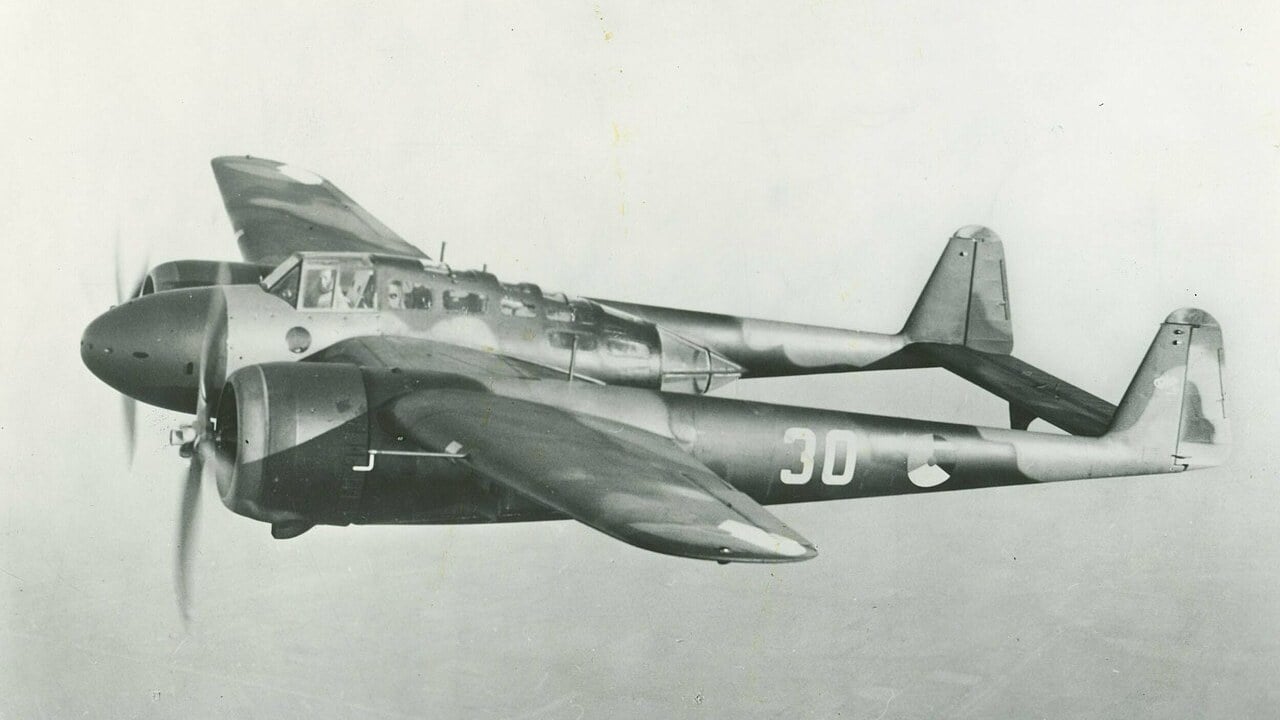
At half past two in the morning on 10 May 1940, eleven twin-boom fighters stood on Waalhaven airfield outside Rotterdam with their engines already running. They were Fokker G.1s, the heaviest fighters the Netherlands had. Ninety minutes later, Heinkel bombers appeared over the field and the order came to attack.
Eight got airborne. By the end of the morning, the Dutch heritage site fokker-history.com records, only one of them would ultimately survive and land at Bergen. In between, the G.1 crews fought one of the sharpest air battles of the German invasion of the Low Countries, in an aircraft that had been the sensation of the Paris Salon less than four years earlier.
Informations clés
- Aéronef: Fokker G.1 (G.I) jachtkruiser, twin-boom heavy fighter
- Surnom: Le Faucheur (the reaper, or mower)
- Première apparition publique : Paris aviation salon, November 1936, before its first flight
- Premier vol : 16 March 1937, Welschap airfield near Eindhoven
- Équipage: Two or three
- Moteurs : Two Bristol Mercury radials (G.1 Mercury); Pratt & Whitney Twin Wasp Junior on the export G.1 Wasp
- Dutch service: 36 Mercury aircraft ordered; 62 G.1s in all delivered to the Dutch military air arm by the eve of war
- Combat: May 1940, from Waalhaven and Bergen
- Survivants : None; a full-size replica has been displayed at Soesterberg
The sensation of Paris
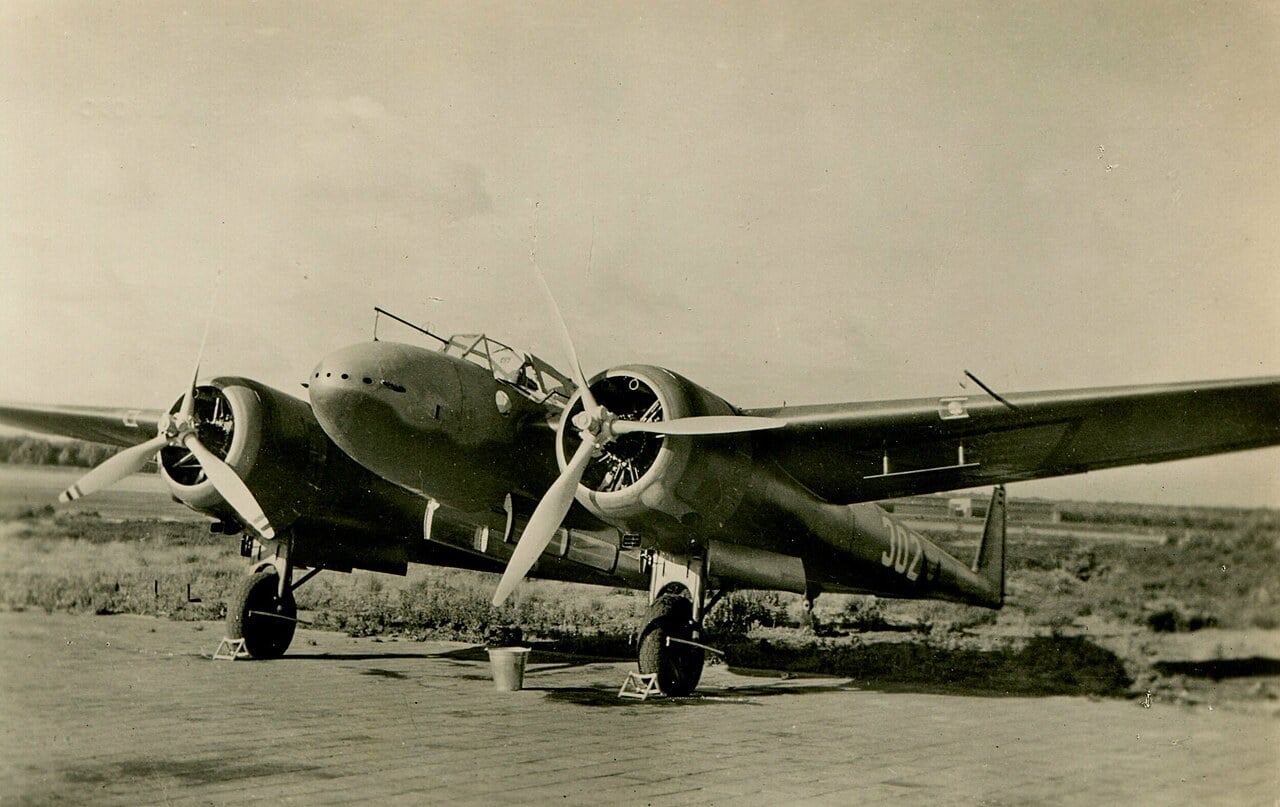
Fokker built the G.1 as a jachtkruiser, a “fighter cruiser”: a big, long-legged twin-engined fighter that could win air superiority over the battlefield, hunt bombers, scout and drop light bombs. Its layout was striking. Two engines sat at the front of two slim tail booms, with a central nacelle between them for a crew of two or three, a battery of guns in the nose and a gunner looking aft.
The prototype went on show at the Paris aviation salon in November 1936, before it had even flown, and caused a stir. French observers gave it the name that stuck, le Faucheur, the reaper or mower. It made its first flight from Welschap airfield near Eindhoven on 16 March 1937.
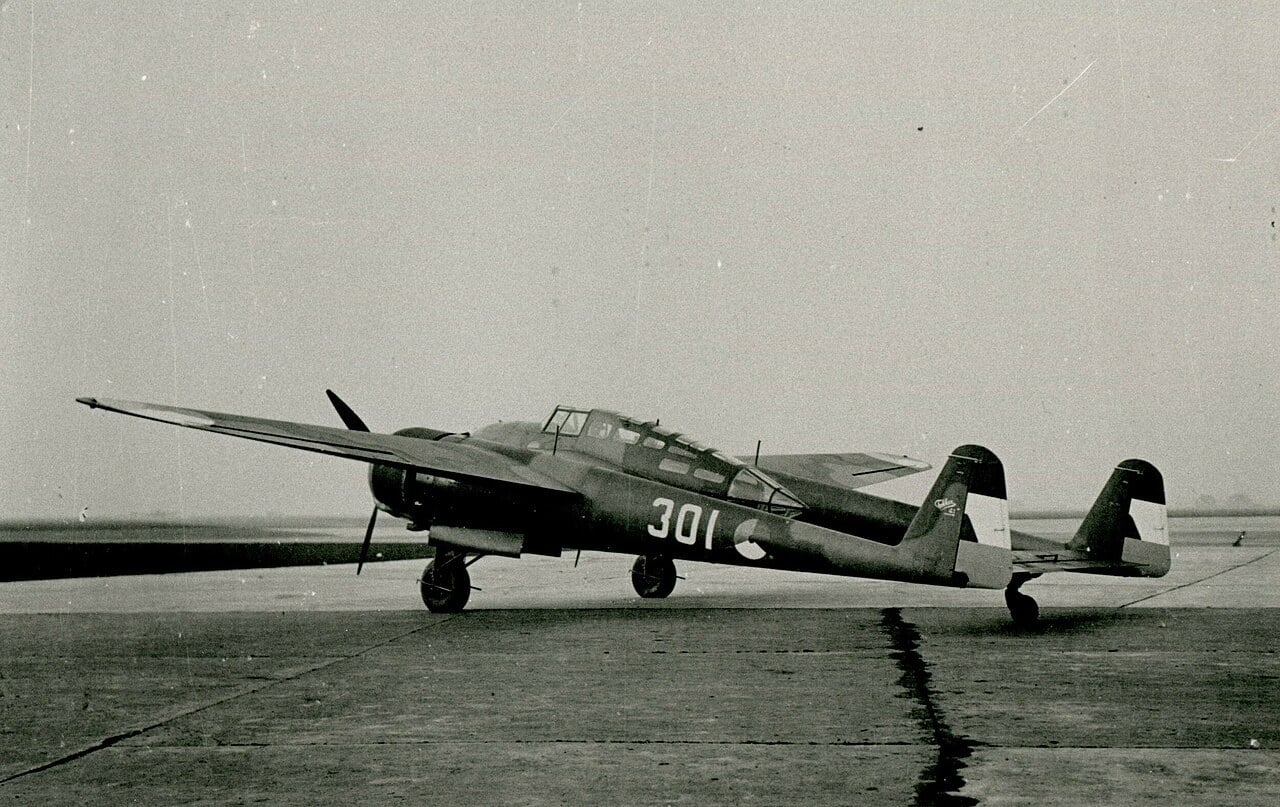
Like other Fokkers of the era it mixed metal and wood. The Dutch army air arm, the Luchtvaartafdeeling, ordered 36 with Bristol Mercury radial engines, the same engine as its single-seat Fokker D.XXI. The fokker-history.com account stresses one requirement above the rest: an uninterrupted stay in the air of four hours.
Orders from abroad, aircraft at home
Foreign air forces were interested too. A lighter export version, the G.1 Wasp with Pratt & Whitney engines, was ordered by the Spanish Republicans, 26 in all. The Dutch government would not permit the delivery, Finland looked at taking over the order, and the aircraft stayed at Fokker. On 30 March 1940 Sweden ordered 18 more, versions with Swedish armament for dive bombing and reconnaissance. None of them would ever be delivered.
Archive film of a Dutch Fokker G.1 flying display.
At home the pressure rose with the general mobilisation at the end of August 1939. The fokker-history.com account describes the inevitable teething problems of a complex new aircraft rushed into service: minor and major accidents, worries over armament and engines, and Fokker mechanics and specialists called in to help the air arm keep its fighter cruisers serviceable. A brand-new airfield was built for them at Bergen.
When the war came, the half-finished export aircraft were still in the Netherlands. According to the National Military Museum’s magazine Spinner, 62 G.1s in all were delivered to the Dutch military air arm on the eve of the Second World War. The front-line Mercury aircraft equipped two fighter groups: the 3rd JaVA at Waalhaven near Rotterdam and the 4th JaVA at Bergen, near Alkmaar.
Waalhaven, 10 May 1940
The German attack opened with strikes on the Dutch airfields. At Bergen the 4th JaVA was caught on the ground and lost all but one of its aircraft. At Waalhaven, warned and fuelled, the 3rd JaVA did better.
The crew of G.1 309, First Lieutenant J. Kuijpers with gunner Sergeant J. Venema, shot down two Heinkels and damaged a third, according to fokker-history.com. Fokker pilot Gerben Sonderman and his gunner Sergeant H. Holwerda brought down two German fighters and a Ju 52 transport. The 330, with Sergeant-Major J. Buwalda and gunner J. Wagner, shot down two bombers before Bf 109 damaged it so badly that it made an emergency landing near Zevenbergen.
It was not one-sided. The 319 crashed at Vlaardingen and its pilot, Second Lieutenant J. van der Jagt, was killed; his gunner had already died in the bombing of the airfield. Several G.1s, out of fuel and ammunition, put down on the beach at Oostvoorne, where crews threw camouflage over them and waited for supplies. The Germans found and bombed them on 13 May.
Over the following days the surviving G.1s, kept flying partly by cannibalising parts, were used mainly to strafe German infantry and attack Junkers transports landing troops around Rotterdam and The Hague. Records are fragmentary and contradictory: the type is credited with up to 14 confirmed aerial victories, and Sonderman is usually named its highest-scoring pilot with four.
A short film of the Fokker G.1 jachtkruiser in Dutch service.
Under new owners, and one escape
Le Spinner review of the standard two-volume history estimates that some 35 G.1s survived the fighting more or less intact, and many of them went on to fly in German markings. The Luftwaffe completed the Wasp aircraft left at Fokker and, according to most accounts, used them to train crews for its own heavy fighter, the Messerschmitt Bf 110.
One got away. In May 1941 Fokker test pilot Hidde Leegstra and engineer Piet Vos took a G.1 Wasp, originally numbered 362, on what was supposed to be a test flight from Schiphol and flew it to England, where it passed into British hands. It is a chapter of its own in the standard history of the type.
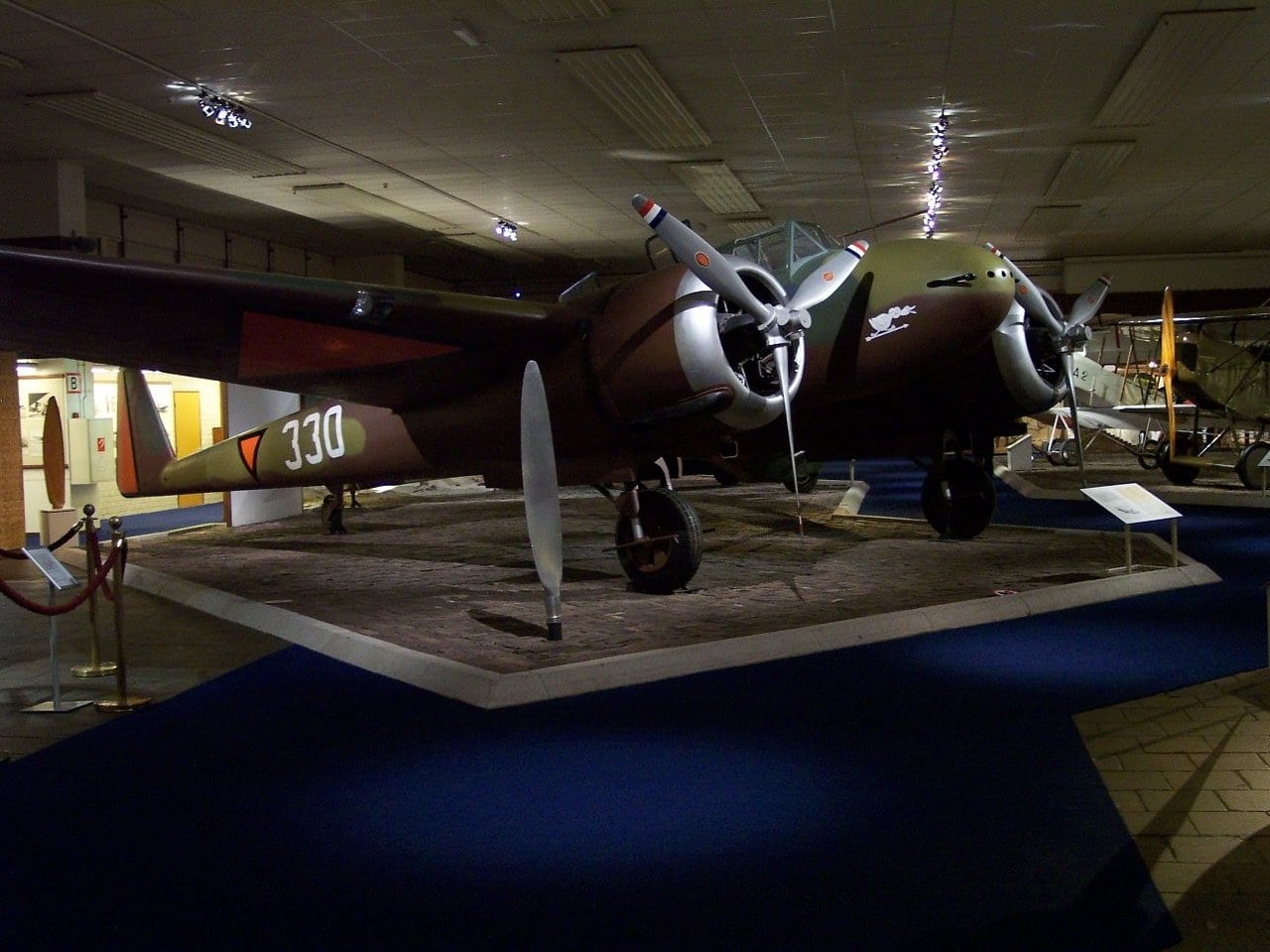
No original G.1 survives. A full-size replica, painted as 330, the aircraft Buwalda and Wagner fought in over Rotterdam, has been displayed at Soesterberg, home of the Dutch National Military Museum. The Fokker G-1 Foundation set out to build a reproduction, preferably a flying one; the museum magazine described that goal in April 2013 as ambitious and not yet achieved.
The G.1 belonged to a generation of twin-engined heavy fighters, from the Bf 110 to the P-38 Lightning, that tried to combine range, firepower and speed in one airframe. Most were outclassed by single-seat fighters in daylight. The G.1 never had the chance to find out what else it could become. Its war lasted less than a week, and on the first morning its crews made the Luftwaffe pay for every hour of it.
Sources: fokker-history.com (The Fokker G.1A; The Fokker G.1B), Nationaal Militair Museum Spinner magazine no. 48, dutch-aviation.nl, Gerdessen, Kalkman, Oostveen and Vredeling, Fokker G-1 jachtkruiser (Lanasta)
Header photo: Vliegbasis Soesterberg / Wikimedia Commons, CC BY-SA 4.0
0 Comments