
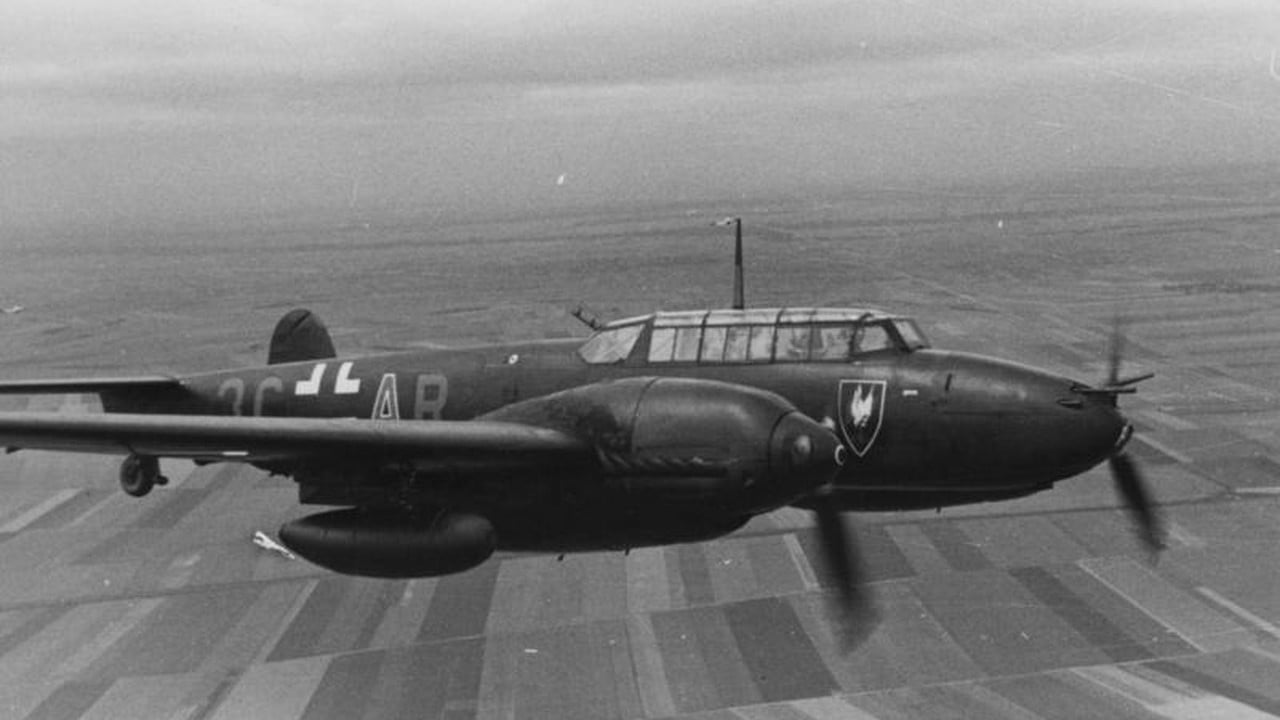
On 18 December 1939, 22 Vickers Wellington bombers flew in broad daylight towards the German naval base at Wilhelmshaven. RAF Bomber Command believed a tight formation of well-armed bombers could defend itself. Over the Heligoland Bight, German fighters proved otherwise, and the aircraft that excelled that day was a twin-engined heavy fighter that would spend the rest of the war being both underrated and overrated: the Messerschmitt Bf 110.
The Bf 110 was Hermann Göring’s pet project, a Zerstörer, or “destroyer”, meant to sweep the sky ahead of the bombers. Within a year, the Battle of Britain had exposed it as a poor match for single-engined fighters. Then it found a second life in the dark, and became the backbone of Germany’s night defences.
About 6,150 were built. Few aircraft of the war had a more uneven reputation, or a more interesting career.
Informations clés
- Taper: Messerschmitt Bf 110, twin-engined heavy fighter (Zerstörer), fighter-bomber and night fighter
- Premier vol : 12 May 1936, Augsburg, flown by Rudolf Opitz
- Construit: About 6,150
- Équipage: Two or three
- Bf 110 C-1: Two DB 601A engines; two 20 mm cannon and four 7.92 mm guns forward; about 540 km/h (336 mph) at 6,000 m
- Worst day: 15 August 1940: nearly 30 shot down over Britain
- Night role: Luftwaffe’s principal night fighter until 1944; Heinz-Wolfgang Schnaufer scored 121 victories in it
- Survivants : Two intact: RAF Museum London and Deutsches Technikmuseum Berlin
The destroyer concept
In the mid-1930s, single-engined fighters lacked the range to escort bombers deep into enemy territory. The German air ministry, encouraged by Göring, wanted a twin-engined, multi-seat fighter with long range and heavy cannon armament. Bayerische Flugzeugwerke, soon renamed Messerschmitt, dropped the requested bomb bay and concentrated on speed and firepower. Its design beat entries from Focke-Wulf and Henschel.
Rudolf Opitz flew the first Bf 110 from Augsburg on 12 May 1936. It was not as manoeuvrable as the air ministry wanted, but it was faster than the specification demanded and faster than the Bf 109 B-1 then in front-line service. Early aircraft were underpowered with Junkers Jumo engines, but the Daimler-Benz DB 601 transformed the Bf 110C. The C-1 carried two 20 mm cannon and four 7.92 mm machine guns in the nose, with a rear gunner for defence, and could reach about 540 km/h (336 mph) at 6,000 m (19,700 ft). Göring nicknamed it his Eisenseiten, “Ironsides”.
Military Aviation History explains why the Luftwaffe wanted a twin-engined heavy fighter in the first place.
Early victories
In Poland, Norway and France the Bf 110 did well against weaker or outnumbered opponents. Over the Heligoland Bight it showed what concentrated forward firepower could do to bombers that lacked fighter escort. Units such as Zerstörergeschwader 76 became famous; the shark’s-mouth marking of its second Gruppe, first seen over France in 1940, was later copied by the RAF’s No. 112 Squadron and the American Flying Tigers.
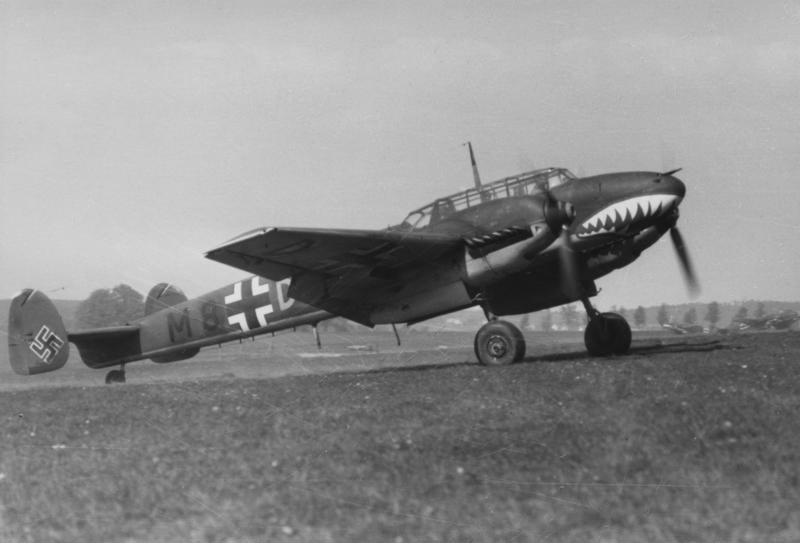
The weakness was already visible to anyone who looked closely. A big twin with two heavy engines in its wings could not roll or turn with a Hurricane or a Spitfire. Its rear gunner had a single machine gun. As long as the Luftwaffe controlled the sky, that mattered little. Over England, it would matter a great deal.
La bataille de Grande-Bretagne
In the summer of 1940 the Bf 110 was ordered to escort bombers over southern England, flying at their speed rather than its own. Tied to the bombers, it lost the speed and height that were its best defence. The worst single day was 15 August 1940, when nearly 30 Bf 110s were shot down, roughly an entire Gruppe; 23 more were lost on 16 and 17 August. Some units were withdrawn from the battle altogether.
Crews resorted to defensive circles, each aircraft covering the tail of the one in front, and by late in the battle the destroyers were sometimes escorted by Bf 109 themselves. Yet the aircraft was not a failure so much as a misuse. It was faster than many contemporaries, carried far more firepower than a single-seater, and later did well as a fighter-bomber in the Balkans, North Africa and on the Eastern Front.
“In Defense of the Messerschmitt Bf 110”: Military Aviation History on the gap between the type’s reputation and its record.
One Bf 110 flight of that era is remembered for reasons that had nothing to do with combat. On 10 May 1941, Rudolf Hess, deputy leader of the Nazi party, flew alone from Augsburg to Scotland in a Bf 110, apparently hoping to broker peace with Britain. He bailed out and was taken prisoner. The aircraft crashed and was wrecked.
A second career at night
By the winter of 1940–41, Bomber Command was attacking Germany at night, and the Luftwaffe needed night fighters fast. The Bf 110 had the range, the endurance, the heavy armament and room for a radar operator. Ground-controlled interception began in 1941, and radar sets followed, at first effective out to about 3.5 km (2.2 miles). From around July 1942, the Bf 110F-4 was the first version designed as a night fighter.
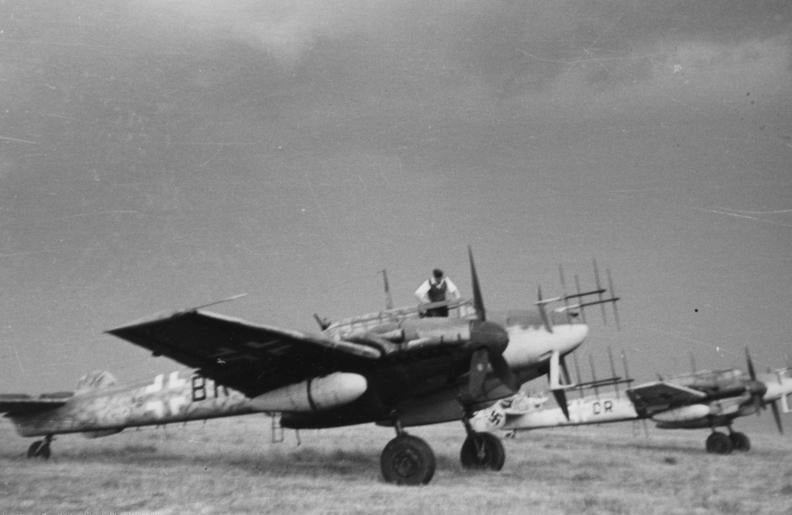
The definitive night fighter was the Bf 110G-4, a three-seater with Lichtenstein radar and, in many cases, Schräge Musik upward-firing cannon for attacking bombers from below, where most RAF heavy bombers such as the Lancaster had no defensive guns. Production of the G-4 alone reached 2,293 aircraft between late 1942 and April 1945, and according to the RAF Museum, 1,525 of all Bf 110s built were delivered in 1944, years after the type was supposed to have been replaced. The Bf 110 remained the Luftwaffe’s principal night fighter until 1944.
Most German night fighter aces flew it at some point. The highest-scoring night fighter pilot of all, Heinz-Wolfgang Schnaufer, flew it exclusively and claimed 121 victories in 164 combat missions. By day, the story ended differently. Bf 110s armed with heavy cannon and rockets attacked American bomber formations over Germany, but in late 1943 and early 1944, as US escort fighters such as the P-51 Mustang roamed ever deeper, their formations were frequently devastated.
Survivors and a verdict
Its intended replacement, the Me 210, was a troubled design, and even the improved Me 410 never fully took over. So the Bf 110 soldiered on to the end. Hungary, Italy and Romania also flew it.
Wartime newsreel footage of Bf 110s attacking ground targets, from the CriticalPast archive.
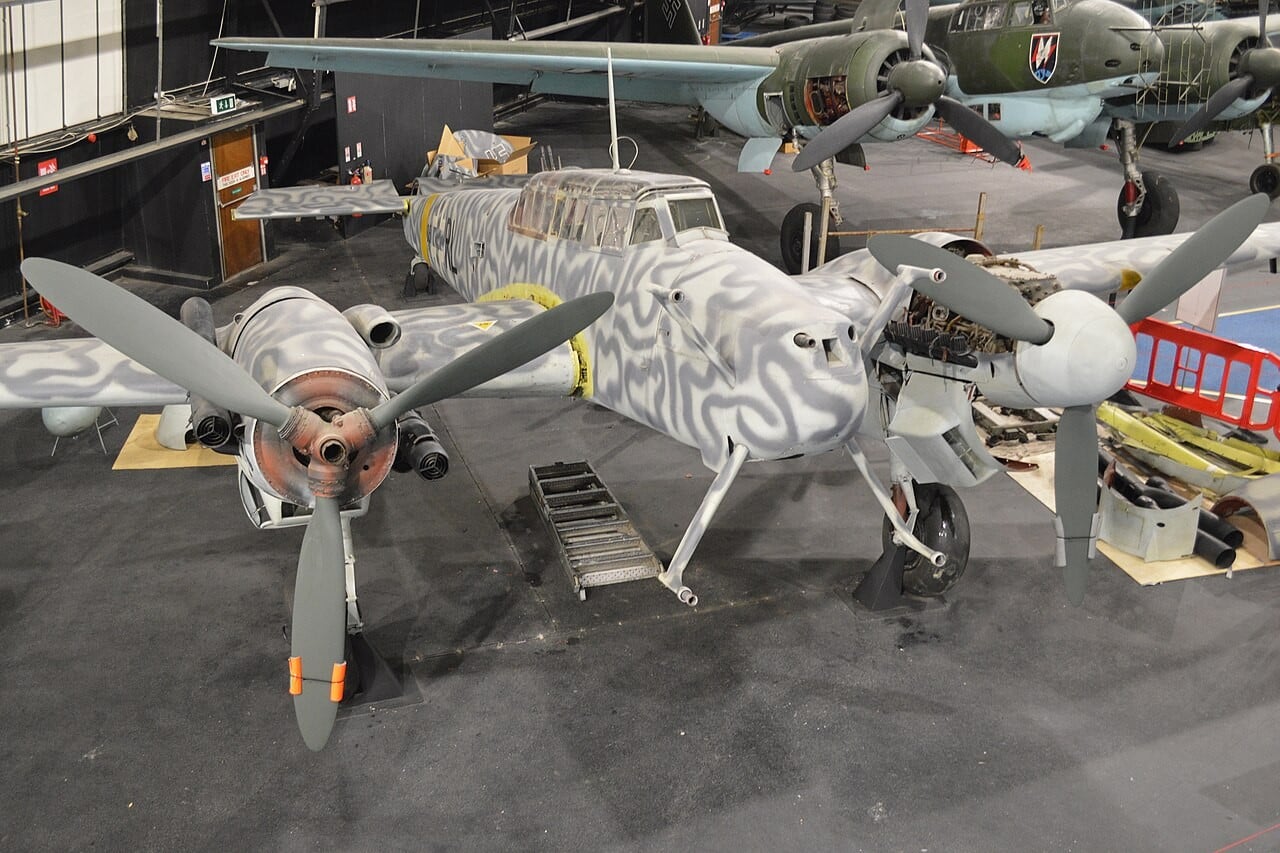
Only two intact Bf 110s are known. One is a Bf 110F at the Deutsches Technikmuseum in Berlin. The other, Bf 110G-4 Werknummer 730301, served with Nachtjagdgeschwader 3 in the night defence of Denmark and northern Germany, surrendered at Grove in Denmark in May 1945 and is now at the RAF Museum London, still carrying its SN-2 radar antennas.
Royal Navy test pilot Eric “Winkle” Brown, who flew one after the war, argued that the type was judged too harshly. He had a point. The Bf 110 lost the battle it was famous for, then won a quieter, longer one in the dark.
Sources: Wikipedia (Messerschmitt Bf 110; Messerschmitt Bf 110 operational history), RAF Museum (Bf 110G-4 730301 individual history and collection notes), HistoryNet, Bundesarchiv

0 Comments