
Supermarine Spitfire
“The Few’s Fighter”
R.J. Mitchell’s elliptical-winged masterpiece — the Merlin-powered fighter that helped win the Battle of Britain, stayed in frontline production before, during and after the Second World War, and remains the most beloved British aircraft ever built.
The fighter that saved Britain
The Supermarine Spitfire was the creation of Reginald J. Mitchell, whose signature contribution was a thin, elegant elliptical wing that minimised drag while leaving room at the root for guns, fuel and undercarriage. Powered first by the Rolls-Royce Merlin V12, the prototype K5054 first flew on 5 March 1936 from Eastleigh near Southampton, and the type entered RAF service in 1938 with No. 19 Squadron at Duxford.
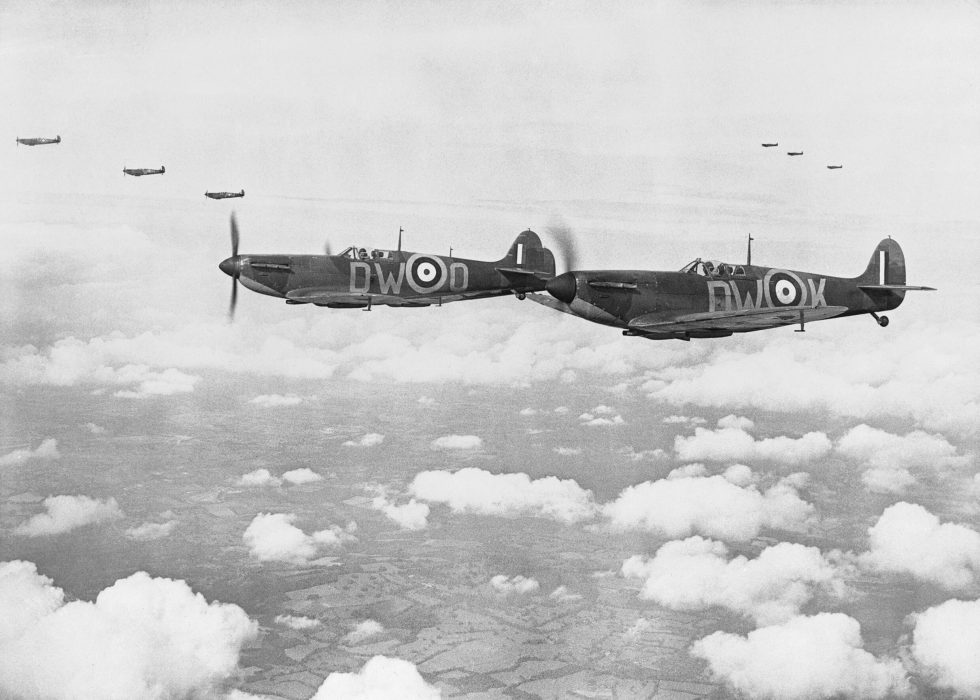
In the summer of 1940 the Spitfire earned its immortality over southern England. During the Battle of Britain the more numerous Hawker Hurricane bore much of the load, but it was the faster Spitfire — a match for the Messerschmitt Bf 109 — that captured the public imagination and became the enduring symbol of British defiance. When the invasion was called off, the Spitfire had become far more than a fighter: it was the machine that, alongside the Hurricane, had saved Britain.
It was built in extraordinary numbers — commonly cited at ~20,300+ airframes (more still with the naval Seafire) — and evolved across roughly 24 principal marks. Uniquely, it was the only Allied frontline fighter in continuous production and development before, during and after the entire Second World War. After Mitchell’s early death in 1937, Joe Smith carried the design through to the final Griffon-engined marks.
01The Spitfire’s numbers: how ~20,300 fighters kept one airframe competitive for a decade
Production totals for the Spitfire are large enough that sources disagree on the exact figure — credible tallies cluster around 20,300 to 20,351 Spitfires, and more when the carrier-borne Seafire is included. Manufacture ran from roughly 1937 to 1947, spanning the whole of the Second World War and beyond.
What makes the Spitfire singular is not just the count but the continuity. Between the Merlin-engined Mk I of 1938 and the Griffon-engined Mk 24, engine power and top speed roughly doubled while the basic airframe stayed recognisably the same. No other Allied fighter was improved so relentlessly, for so long, keeping a 1930s design in the front line into the jet age.
What makes the Spitfire special
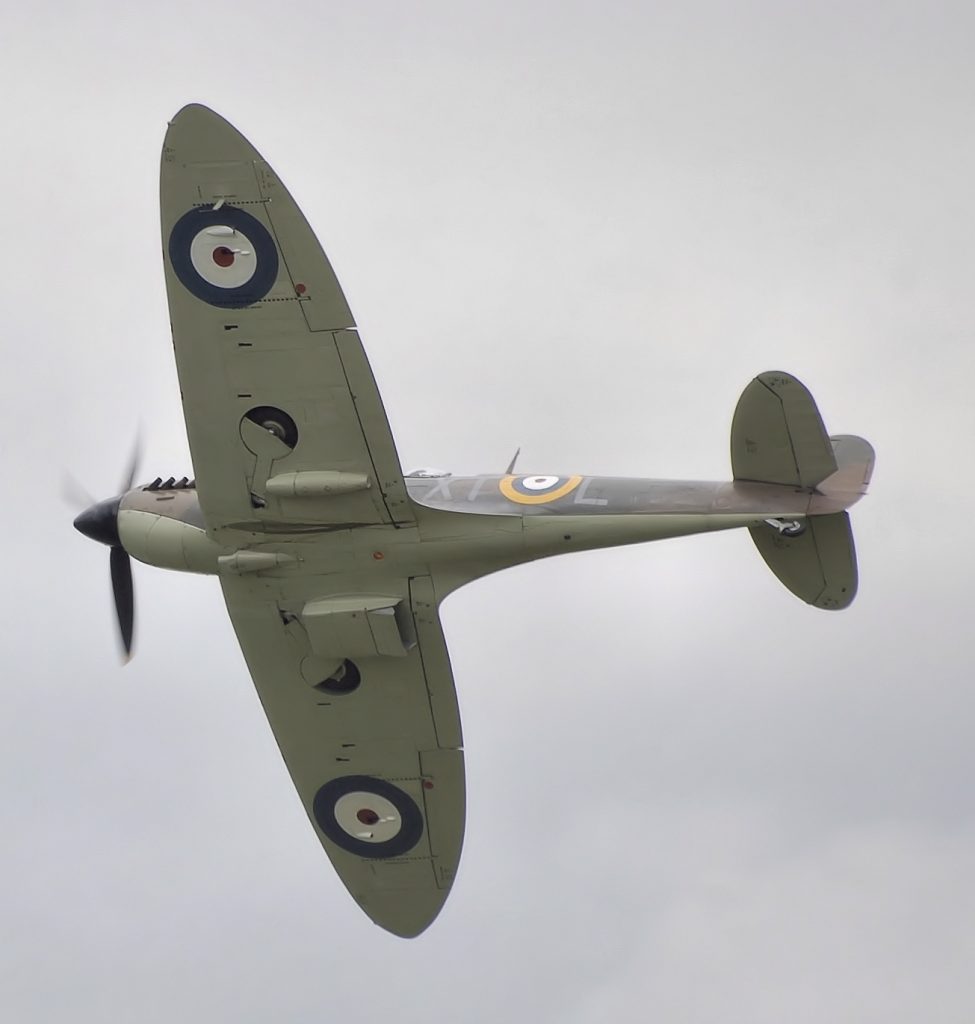
The thin elliptical wing
Mitchell’s elliptical wing combined the lowest possible induced drag for a given lift with a high critical Mach number — letting late-war Spitfires dive to very high speeds — and enough internal volume for guns, ammunition, fuel and the retractable undercarriage. The catch was cost: it reputedly needed roughly three times the man-hours of the Bf 109’s simpler wing.
Rolls-Royce Merlin, then Griffon
The supercharged Merlin V12 grew from around 1,000 hp in the Mk I to about 1,700 hp by the two-stage Mk IX. Later marks adopted the bigger 36.7-litre Griffon delivering over 2,000 hp — nearly double the early Merlin — for the Mk XII, XIV and beyond.
Development across ~24 marks
No other Allied fighter was so continuously improved. Between the Mk I and the Griffon-engined Mk 24, engine power and top speed roughly doubled, keeping the airframe competitive from 1938 into the early jet age — plus dedicated photo-reconnaissance versions and the navalised Seafire.
02The Spitfire’s wing: an ellipse chosen by mathematics, loved by the eye
The elliptical planform was not styling. An elliptical lift distribution gives the theoretically lowest induced drag, and the shape let Mitchell make the wing thin — good for high speed — while keeping enough depth at the root to bury guns, fuel and the undercarriage. That thinness also raised the critical Mach number, so late Spitfires could dive closer to the speed of sound than most contemporaries. The penalty was manufacturing: the compound curves were labour-intensive, reputedly costing about three times the man-hours of a Bf 109 wing. Beauty, here, was pure aerodynamics.
03The Spitfire’s engines: from Merlin to Griffon without losing the shape
Early Spitfires flew behind a roughly 1,000 hp Merlin; by the Mk IX’s two-stage, two-speed engine it made around 1,700 hp. Then came the larger Griffon — over 2,000 hp — for the Mk XII and XIV, adding a snarling swing on take-off from its counter-rotating propeller. The airframe absorbed nearly double the power of the original and stayed a frontline fighter into the jet age, a testament to how much growth Mitchell’s design could take.
Full specifications
Representative figures for the Merlin-engined Spitfire Mk IX; dimensions and performance varied considerably across the type’s ~24 marks.
Spitfire — dimensions & weights
- Crew
- 1 (pilot; the two-seat T Mk IX trainers were postwar conversions, not a wartime variant)
- Length
- 9.12 m (29 ft 11 in) — Mk VB; the Griffon-engined Mk XIV grew to 9.96 m (32 ft 8 in)
- Wingspan
- 11.23 m (36 ft 10 in) with the standard elliptical wing; clipped LF marks 9.80 m (32 ft 2 in); extended high-altitude tips 12.24 m (40 ft 2 in)
- Height
- 3.48 m (11 ft 5 in) tail down, propeller blade vertical
- Wing area
- 22.48 m² (242.1 sq ft) standard wing; about 21.5 m² (231 sq ft) clipped
- Empty weight
- 2,309 kg (5,090 lb) — Mk VB; a Mk XIV was some 700 kg heavier empty
- Loaded weight
- 3,000 kg (6,622 lb) — Mk VB at normal fighter load, guns and full internal fuel
- Max takeoff weight
- 3,039 kg (6,700 lb) — Mk VB; fighter-bomber Mk IX and Mk XVI aircraft carrying bombs and a slipper tank operated several hundred kilograms heavier again
- Internal fuel
- ~386 l (~85 imp gal) in two fuselage tanks ahead of the cockpit — Mk VB. Some late Mk IX aircraft added a rear fuselage tank, and PR marks carried fuel in the wing leading edges instead of guns
Spitfire — performance
- Max speed
- 595 km/h (370 mph) at 6,100 m (20,000 ft) — Mk VB; the Mk IX reached about 657 km/h (408 mph) and the Griffon Mk XIV about 719 km/h (447 mph) at 7,900 m
- Cruise speed
- 435 km/h (270 mph) — Mk VB, maximum weak-mixture cruise at medium altitude; economical cruise for range was considerably slower
- Rate of climb
- 13.2 m/s (2,600 ft/min) at sea level — Mk VB; a low-altitude Mk IX exceeded 20 m/s (4,000 ft/min) and the Mk XIV about 24 m/s (4,700 ft/min)
- Service ceiling
- 11,125 m (36,500 ft) — Mk VB; Mk IX about 13,100 m (43,000 ft), and the pressurised PR Mk XIX worked routinely above 12,000 m
- Range
- ~760 km (~470 mi) on internal fuel — Mk VB. Short legs were the Spitfire's defining limitation; combat radius on internal fuel was only ~200–300 km, which is why it could not escort bombers deep into Germany
- Ferry range with slipper tank
- ~1,600 km (~1,000 mi) with a 90 imp gal slipper tank; the 170 imp gal ferry tank stretched delivery flights further still but was never a combat fit
- Takeoff run
- about 300 m (1,000 ft) of ground roll on firm grass at normal fighter weight; Pilot's Notes figures move with flap setting, surface, wind and weight
- Landing run
- about 300–400 m (1,000–1,300 ft) with flaps down; the narrow-track undercarriage and long nose made the Spitfire unforgiving on the ground, and the naval Seafire inherited the problem onto carrier decks
- Load factor
- about 10 g airframe stress case — the wing was famously strong, and pilots greyed out well before the structure complained. Surviving airworthy aircraft are flown to far gentler limits today
Spitfire — propulsion & systems
- Engine
- Rolls-Royce Merlin 45 single-stage supercharged V-12 — Mk VB. The Mk I flew behind a Merlin II/III, the Mk IX behind a two-stage Merlin 61/66/70, and from the Mk XII onward the larger Rolls-Royce Griffon took over
- Power
- 1,096 kW (1,470 hp) at 2,820 m — Merlin 45, Mk VB. For scale across the family: Mk I Merlin III 768 kW (1,030 hp), Merlin 66 about 1,283 kW (1,720 hp), Griffon 65 in the Mk XIV 1,528 kW (2,050 hp). Power roughly doubled over the type's life
- Propeller
- Three-blade Rotol constant-speed — Mk VB. The Mk I entered service with a two-blade fixed-pitch wooden airscrew before constant-speed units were retrofitted in 1940; the Mk IX used four blades, the Mk XIV five, and some late Griffon Spitfires and Seafires had contra-rotating six-blade units. The Griffon turned the opposite way to the Merlin, reversing the swing on takeoff and catching out converting pilots
- Guns
- 2 × 20 mm Hispano + 4 × .303 in Browning — Mk VB with the B wing. Armament varied by wing type across the family; see the armament section below
- Armour & protection
- Laminated bulletproof windscreen, pilot back and head armour, armoured seat bulkhead and self-sealing fuel tanks — largely absent from the earliest Mk I aircraft, retrofitted during 1940 and standard thereafter
- Wing types
- A, B, C and E — A: 8 × .303. B: 2 cannon + 4 × .303. C (universal): strengthened and belt-fed, able to take eight machine guns, two cannon and four machine guns, or four cannon. E: 2 cannon + 2 × .50 Browning. A separate unarmed D wing filled the leading edge with fuel for the PR marks
- First flight
- 5 March 1936 prototype K5054 at Eastleigh, flown by Vickers chief test pilot Joseph "Mutt" Summers
- Service entry
- 1938 (first deliveries to No. 19 Squadron at Duxford in August 1938)
- Built
- ~20,351 Spitfires of all marks — the total most commonly cited, though sources differ slightly — plus roughly ~2,300–2,600 navalised Seafires on top of that. The Mk V alone accounted for about 6,487 and the Mk IX about 5,656
- Unit cost
- ~£5,000 — the figure quoted to the public by the 1940 Spitfire Fund campaign, and a presentational number rather than an accounting one. Actual early contract prices were higher, on the order of ~£9,000–12,000 per airframe, falling as mass production at Castle Bromwich ramped up. Period costs do not translate cleanly to modern money
- Cost per flight hour
- ~£5,000–10,000 (~US$6,500–13,000) — there is no meaningful military cost per flight hour for a type out of service since the 1950s, so this is the modern warbird figure. It is dominated by the overhaul reserve on a Merlin or Griffon, plus insurance, hangarage and specialist engineering, and it varies widely between operators. Treat it as an order of magnitude, not a quote
04The Spitfire’s numbers, hedged: why the specs vary by mark and source
Quoting a single spec sheet for the Spitfire is misleading, because the type changed so much. Early marks were shorter (some sources cite ~9.12 m) than the Mk IX (~9.47 m), and top speeds climbed from the low 300s of mph in the Mk I to well over 400 mph in the Griffon marks. The oft-quoted wartime unit cost of about £12,600 is an approximation that varied by mark, factory and year. And the total-built figure — commonly ~20,300, sometimes stated as 20,351, more with Seafires — depends on exactly what is counted. Treat every single number here as representative, not definitive.
Supermarine Spitfire armament and payload
The Spitfire entered service with eight rifle-calibre machine guns and left the war carrying 20 mm cannon, .50 Brownings and a 500 lb bomb. Nothing shows the type's ten-year stretch more clearly than its guns — and the wing carrying them was redesigned almost as often as the engine in front of it.
Guns (early marks)
- 8 × .303 in Browning Mk II, four per wing, roughly 300 rounds per gun
- About 15 seconds of total firing time — each gun cycled at around 1,150 rounds per minute
- The pre-war reasoning: a 300 mph fighter would only ever get a fleeting deflection shot, so density of fire mattered more than the weight of each round
- Guns were harmonised to converge at 400 yd at first; squadrons pulled that in to about 250 yd once the spread proved too thin to be lethal
- By 1940 the argument had turned. Against armoured German bombers with self-sealing tanks, many pilots found eight .303s could hit repeatedly without bringing an aircraft down
Guns (cannon-armed marks)
- 20 mm Hispano Mk I, first tried operationally on the Mk IB with No. 19 Squadron in 1940
- The early installation was close to a failure: to fit the thin wing the gun was laid on its side, and the 60-round drum feed jammed constantly under g
- 19 Squadron asked to swap its cannon aircraft back for machine-gun Spitfires in the middle of the Battle of Britain — a rare case of a unit rejecting a heavier weapon
- Belt feed, better mountings and the Hispano Mk II largely cured it; 120 rounds per cannon became the norm
- Late marks paired two Hispanos with two .50 in Brownings at 250 rounds per gun — heavier hitting than the .303s and with far longer firing time than the cannon alone
Wing types
- A wing — 8 × .303 in Browning. Mk I and Mk II
- B wing — 2 × 20 mm Hispano + 4 × .303. The compromise fit, standard on the Mk VB
- C wing — the universal wing: strengthened, belt-fed, and able to carry eight machine guns, two cannon plus four machine guns, or four cannon. Undercarriage legs moved forward slightly
- D wing — the photo-reconnaissance wing. No guns at all; the leading edge became a fuel tank
- E wing — 2 × 20 mm + 2 × .50 in Browning, with the cannon moved to the outboard bay. Mk IXE, Mk XVIE, Mk XIV
- Wing type is why a bare mark number tells you little: a Mk IXC and a Mk IXE were differently armed aircraft
Bombs
- Fighter-bomber marks carried a single 250 lb or 500 lb bomb on a centreline rack
- Later Mk IX and Mk XVI aircraft added underwing racks for 2 × 250 lb
- Maximum bomb load ~450 kg (~1,000 lb) — modest next to a Typhoon, and the Spitfire was never a natural bomb carrier
- Attacks were made in a dive by eye; there was no bombsight worth the name for the job
- Bombs cost speed, climb and range, so squadrons jettisoned them at the first sign of enemy fighters and reverted to being a fighter
Rockets & external stores
- Slipper tanks of 30, 45, 90 and 170 imp gal under the fuselage — the largest was a ferry fit only
- 90 imp gal tanks let Mk V Spitfires fly off carrier decks to reinforce Malta in 1942, one of the type's more remarkable logistical feats
- Rocket carriage was uncommon on Spitfires. RP-3 60 lb rockets belong mainly to late and postwar marks — the FR Mk 18 over Malaya and the Seafire FR.47 — rather than to wartime European operations
- Some late Mk IX and Mk XVI aircraft carried a rear fuselage fuel tank, which shifted the centre of gravity dangerously aft until it had partly burned off
- External stores always cost performance: a Spitfire with a tank and bombs was a noticeably different aeroplane to fly
Reconnaissance fit
- The PR marks flew completely unarmed — guns, ammunition boxes and gun heating all deleted
- That weight and volume went into cameras and fuel instead: split vertical F24 or F52 cameras in the rear fuselage, with oblique installations on some fits
- Wing leading edges were sealed and turned into tanks, giving endurance several times that of the fighter versions
- The PR Mk XI and the pressurised, Griffon-engined PR Mk XIX ranged deep over Germany carrying nothing but film, relying purely on speed, altitude and a high-gloss finish
- A PR Mk XIX flew what is usually recorded as the RAF's last operational Spitfire sortie, over Malaya on 1 April 1954
Battle of Britain interceptor — Mk IA, September 1940
- Merlin III, three-blade constant-speed propeller (retrofitted across the force during 1940)
- A wing: 8 × .303 in Browning, about 300 rounds per gun
- No external stores; ~85 imp gal internal fuel
- Endurance measured in tens of minutes — usable combat time over Kent was often under a quarter of an hour
Fighter sweep — Mk IXC, 1943
- Two-stage supercharged Merlin 66, four-blade propeller
- C wing: 2 × 20 mm Hispano II + 4 × .303
- 45 imp gal slipper tank for Rodeo and Circus operations over northern France
- The mark rushed into service specifically to answer the Focke-Wulf Fw 190
Fighter-bomber — LF Mk IXE / Mk XVIE, 1944–45
- E wing: 2 × 20 mm Hispano + 2 × .50 in Browning
- 1 × 500 lb bomb on the centreline plus 2 × 250 lb underwing
- Clipped wings for roll rate at low level; many aircraft with cut-down rear fuselage and teardrop canopy
- Bombs released in a shallow dive and jettisoned the moment enemy fighters appeared
Almost none of the above is true of every Spitfire. Guns, wing type, propeller, engine, canopy and even wingspan changed from mark to mark and sometimes within a single mark, and squadrons modified aircraft in the field. Where a figure matters — performance, armament, weight — it is worth naming the specific mark and the year.
Supermarine Spitfire variants and marks
Twenty-four marks of Spitfire, plus the naval Seafire, span a decade in which engine power roughly doubled and top speed rose by more than 120 km/h. The airframe that fought over Kent in 1940 and the one that chased V-1s in 1944 share a name and a shape, and not much else.
- Mk I
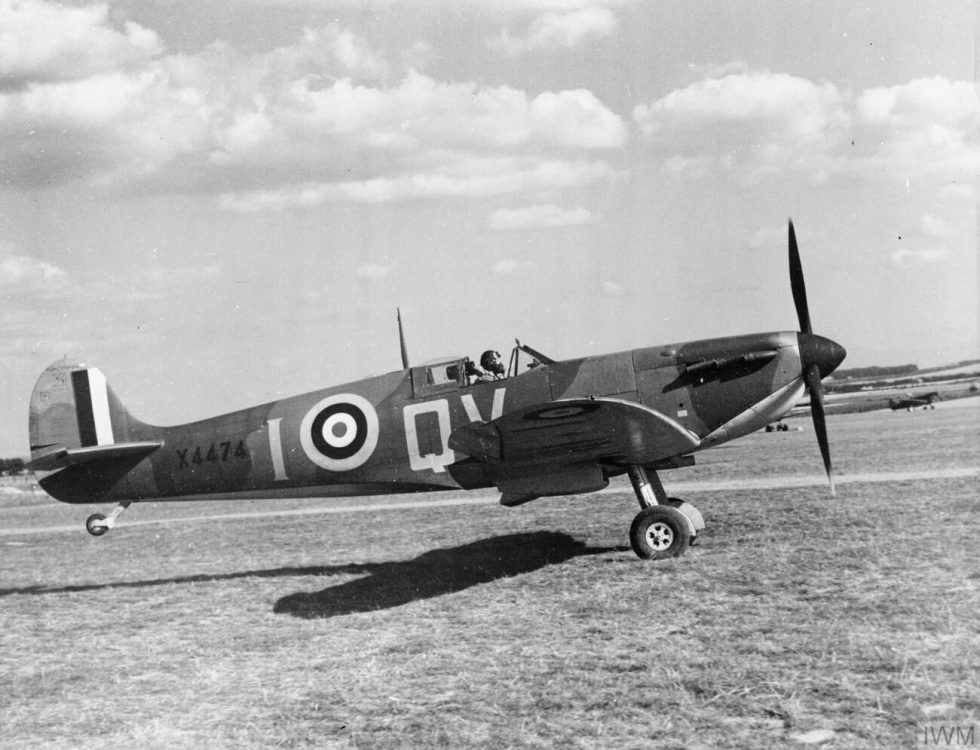
- About 1,583 built. Merlin II/III, A wing with eight .303s. The Battle of Britain Spitfire — early aircraft had two-blade wooden propellers, no armour and no self-sealing tanks, all added under fire during 1940.
- Mk II
- About 921 built. Merlin XII, and the first mark produced in quantity at the new Castle Bromwich shadow factory. Marginally better climb; more significant as proof that mass production of the type finally worked.
- Mk V
- About 6,487 built — the most-produced single mark. A Merlin 45 series engine in a lightly modified Mk I/II airframe. It carried the RAF through 1941–42 and was then badly outclassed by the Fw 190, which forced the next step.
- Mk IX
- About 5,656 built. A Mk V airframe fitted with the two-stage Merlin 61/66/70 as an emergency answer to the Fw 190 — a stopgap that turned into one of the definitive Spitfires and served to the end of the war.
- Mk VIII
- About 1,658 built. The properly redesigned two-stage Merlin airframe that the improvised Mk IX was rushed ahead of: retractable tailwheel, more fuel, refined aerodynamics. Served mainly in the Mediterranean, the Far East and with the RAAF.
- PR marks (PR Mk IV, XI, XIX)
- Unarmed photo-reconnaissance aircraft, both conversions and purpose-builds, with cameras in the rear fuselage and fuel in the wing leading edges. The pressurised Griffon-engined PR Mk XIX (about 225 built) was the last Spitfire in RAF operational use.
- Mk XII / Mk XIV
- The first Griffon marks. The Mk XII (about 100 built) was a clipped-wing low-level interceptor aimed at tip-and-run raiders. The Mk XIV (about 957) put the 2,050 hp Griffon 65 and a five-blade propeller into a lengthened airframe, making it one of the fastest and most effective piston fighters of the war — and an effective V-1 chaser.
- Mk XVI
- About 1,054 built. Essentially a Mk IX with the Packard-built Merlin 266, usually with the E wing, clipped wings, a cut-down rear fuselage and a teardrop canopy. The classic late-war fighter-bomber Spitfire.
- Mk 21, 22 and 24
- The final Griffon Spitfires, with an entirely new wing and heavier four-cannon armament. Built in small numbers and largely postwar; by then the type had reached the practical end of its development.
- Seafire
- The carrier derivative: arrester hook, catapult spools, strengthened structure and, from the Mk III onward, folding wings. Roughly 2,400 built from the Mk IB to the FR.47. The narrow-track undercarriage and long nose that made the Spitfire tricky on grass made the Seafire genuinely difficult on a pitching deck, and deck-landing accident rates were high. Seafires still flew operationally over Korea in 1950.
The Spitfire is retired from military service everywhere and has been for decades — which is why there is no fleet-strength chart on this page. Front-line RAF fighter units gave the type up in the early 1950s; a PR Mk XIX flew what is generally recorded as the last RAF operational Spitfire sortie over Malaya on 1 April 1954, and the RAF's remaining meteorological-flight aircraft were retired in 1957. The Irish Air Corps, which flew Seafire and two-seat Spitfire trainers into 1961, is usually named among the last military operators. Today roughly 50–60 airframes are airworthy worldwide, with many more preserved static in museums and collections. Both counts are approximate: the flying total moves every time a restoration is completed or an accident takes an aircraft off the register.
From Eastleigh to the jet age
First flight
Prototype K5054 makes its maiden flight at Eastleigh on 5 March, flown by Joseph “Mutt” Summers.
Mitchell dies
R.J. Mitchell dies of cancer; Joe Smith takes over design leadership and carries the Spitfire through the war.
Enters service
The Spitfire Mk I joins the RAF with No. 19 Squadron at Duxford.
Battle of Britain
The Spitfire duels Bf 109s over southern England and becomes a national icon.
The Mark IX answer
The Merlin 61-powered Mk IX is rushed into service to counter the Focke-Wulf Fw 190.
The Seafire goes to sea
The navalised Seafire enters Fleet Air Arm service aboard Royal Navy carriers.
Griffon power
Griffon-engined marks (Mk XII, later Mk XIV) reach squadrons with over 2,000 hp.
Production ends
After ~20,300+ built, manufacture winds down; the final Mk 24 is delivered.
Last combat sorties
Spitfires fight in the 1948 Arab–Israeli War; the last RAF operational sortie is generally dated to 1954 (a PR Mk 19 over Malaya).
From the record: twelve Spitfire stories
The Few’s finest machine
The fighter that became a nation’s shield in the summer of 1940.
Read the full story
Mitchell’s dying masterpiece
He perfected the wing while cancer finished him.
Read the full story
The perfect curve
An ellipse chosen by mathematics, loved by the eye.
Read the full story
From Merlin to Griffon
Doubling the horsepower without losing the shape.
Read the full story
PR blue, unarmed and alone
No guns, just cameras — and nerve.
Read the full story
The Seafire goes to sea
A thoroughbred learns to land on a moving deck.
Read the full story
Ride the legend
Two seats, one Merlin, the flight of a lifetime.
Read the full story
The most beautiful fighter
Form and function, impossibly aligned.
Read the full story
Spitfires over Malta
Flown off a carrier to save a besieged island.
Read the full story
The Mark IX answer
When the Fw 190 shocked the RAF, the Mk IX replied.
Read the full story
Last of the piston fighters
Cameras over the jungle into the 1950s.
Read the full story
Twenty thousand strong
The only Allied fighter in the fight from start to finish.
Read the full story
The Spitfire in pictures
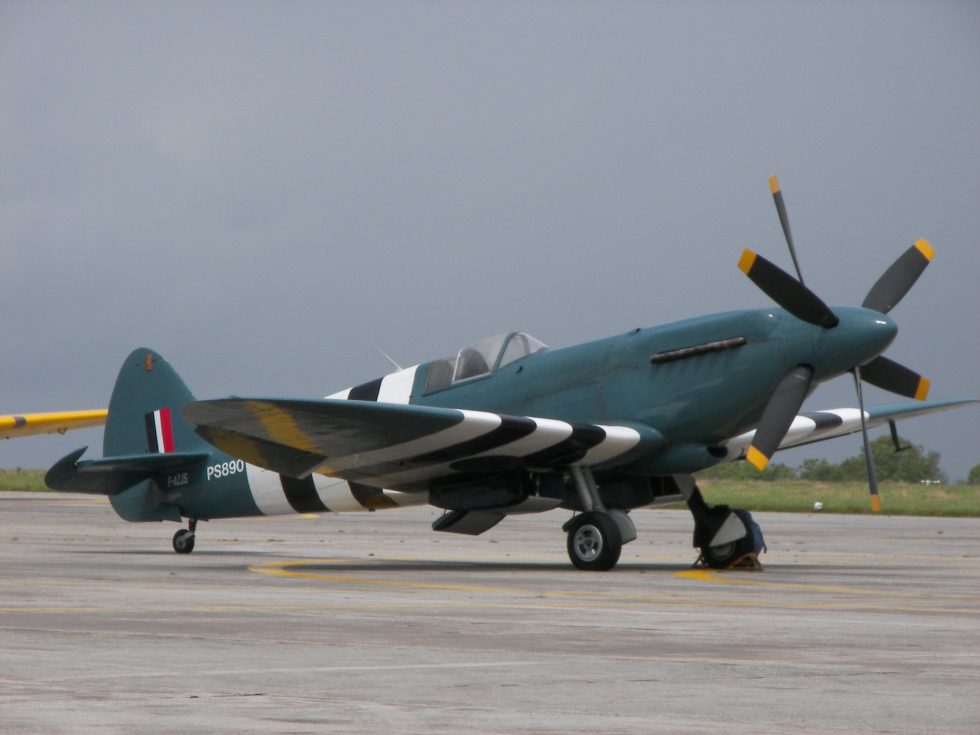
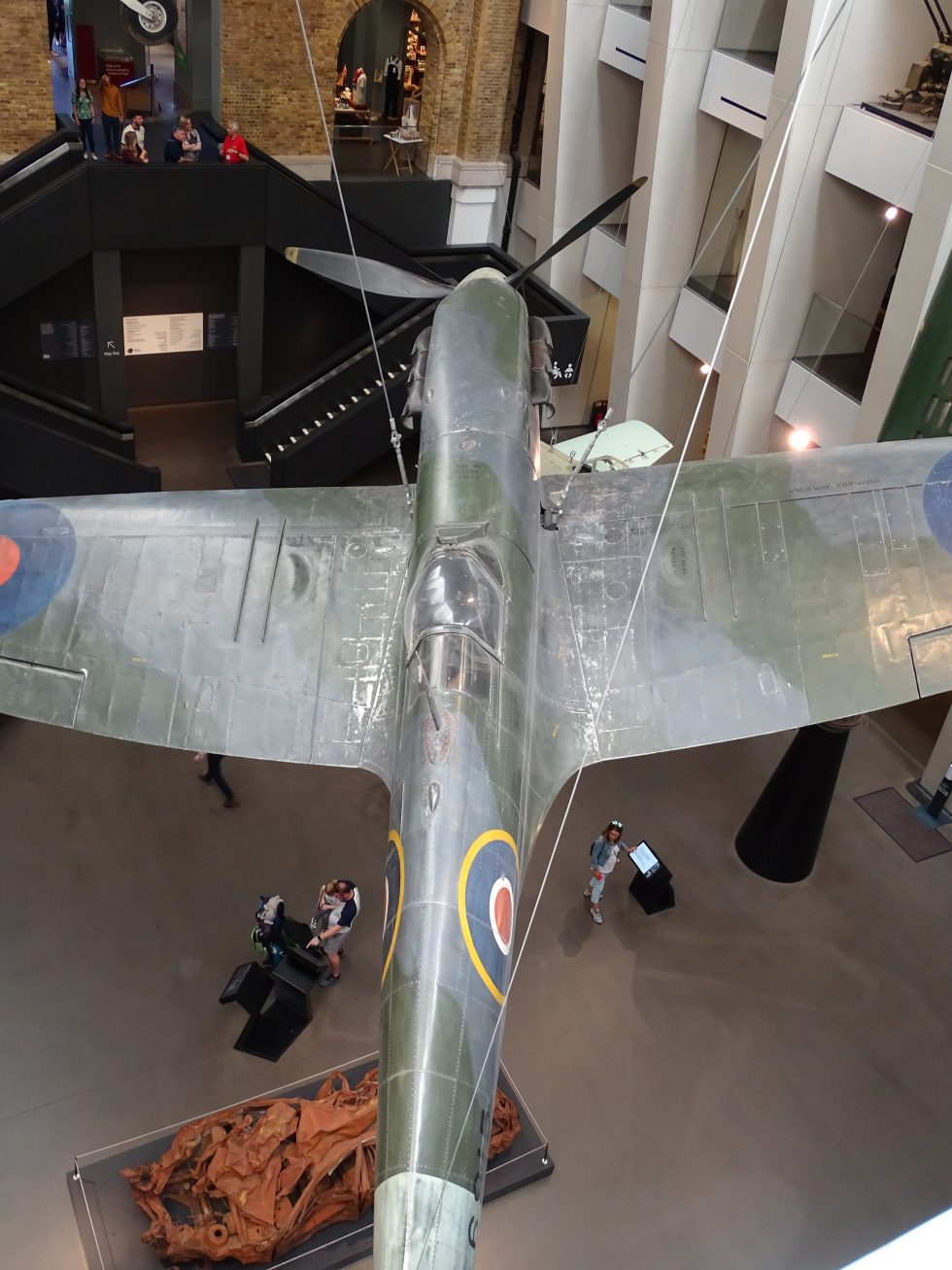
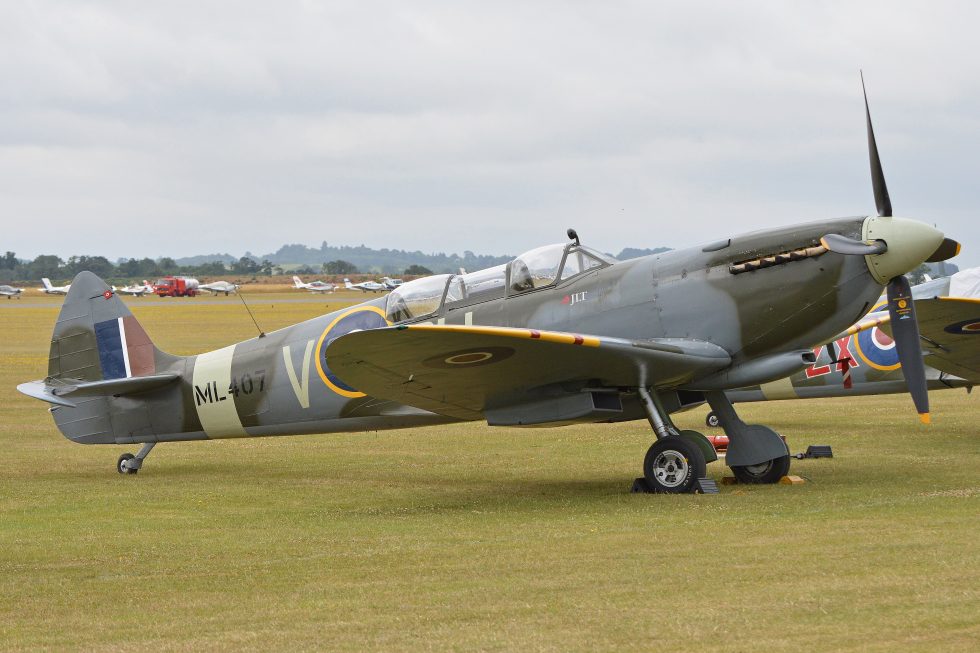
The Spitfire in motion
A hand-picked Spitfire documentary will be embedded here soon.
The Spitfire in motion
Real Engineering — one of the most-watched Spitfire films on YouTube.
Where the Spitfire flew
The fighter that fought the whole war
The Spitfire served from the first months of the Second World War to its end and beyond — Western Europe, the Mediterranean, Malta, North Africa, the Eastern Front, Burma and the Pacific. Ace tallies and “last sortie” dates differ between sources, so treat specific figures as claims, not settled scores. What is beyond dispute is the breadth of its fighting career.
Compare the combat record of every military aircraft. Figures as of July 2026.
Everything people ask about the Spitfire
Can I fly in a Spitfire?
Was the Spitfire fast?
Is the Spitfire still flyable today?
Spitfire vs Messerschmitt Bf 109?
How many Spitfires were built?
Merlin or Griffon — what’s the difference?
Who designed the Spitfire?
What was the Seafire?
You can’t fly the Spitfire.
These, you can.
Some legends only live in museums — others are fuelled and waiting. MiGFlug has put civilians in real military jet cockpits since 2004.
 Fly the L-39 AlbatrosThe world’s most-flown jet trainer — aerobatics included
 Fly the F-104 Starfighter“The missile with a man in it”
 Fly the MiG-21The Cold War’s most-produced jet
 Fly the T-33 Shooting StarAmerica’s first jet trainer
 Fly the DH VampireA piece of early jet history
 Fly the S.211Agile Italian jet trainer
 Fly the MB-326The classic Aermacchi jet
 Fly the MiG-15The Soviet legend of the Korean War
Continue the tour
Every fact, checked
- Imperial War Museums — The evolution of the Supermarine SpitfireDevelopment history, marks and the Battle of Britain role.
- Imperial War Museums — 9 iconic aircraft from the Battle of BritainThe Spitfire’s place among the defining aircraft of 1940.
- RAF Museum — Supermarine Spitfire aircraft historyDesign, service and production overview.
- Encyclopaedia Britannica — SpitfireConcise reference on the aircraft and its significance.
- National Museums Scotland — The story of the SpitfireDesign and cultural legacy of the type.
- Military Factory — Supermarine Spitfire specificationsDimensional and performance data cross-check.
- Goodwood Aerodrome — Spitfire Flight ExperienceTwo-seat Spitfire passenger flights in the UK.
- Boultbee Flight Academy / spitfires.comTwo-seat TR9 Spitfire experience flights in the UK.
- MiGFlug — flights & pricesConfirms the Spitfire is not offered by MiGFlug; lists the jets that are.