
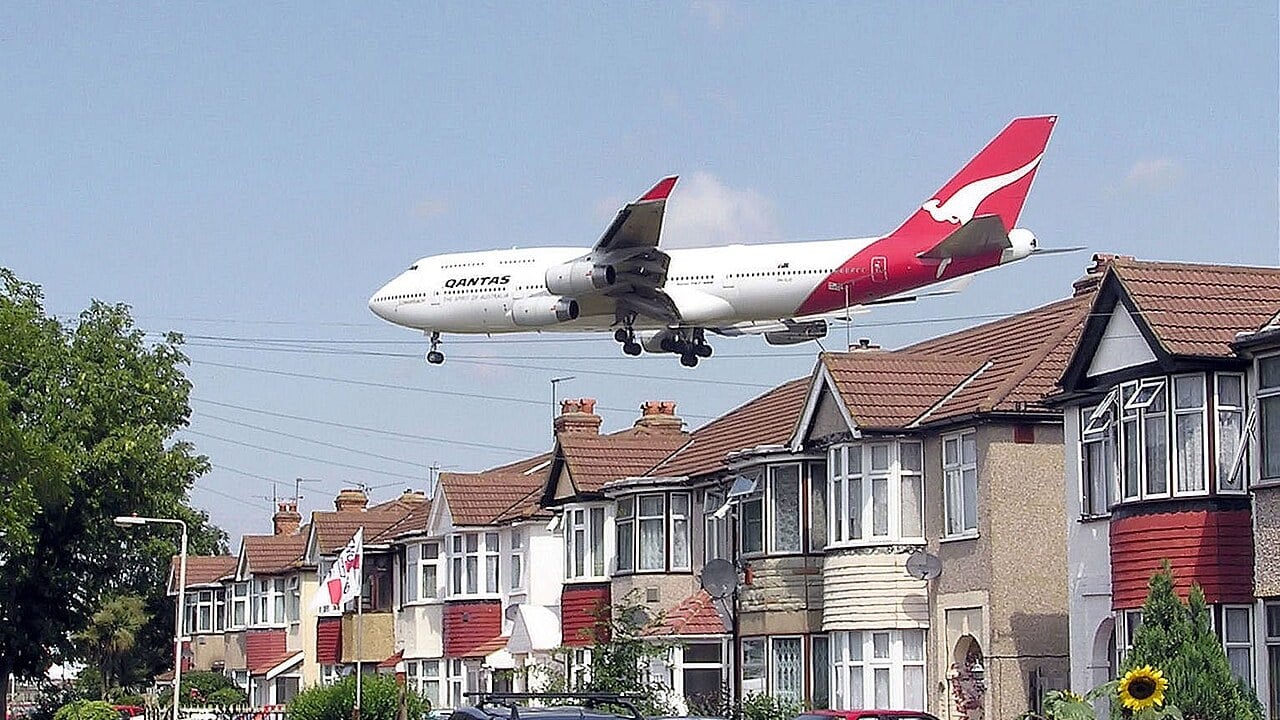
If you live under a flight path, you already know the sound: the rising whine on approach, the rumble that rattles a window, the 5 a.m. departure that arrives a few minutes before your alarm. What you probably do not know is whether it is doing you any harm beyond the irritation. The honest answer is more interesting, and more nuanced, than either airports or campaigners usually admit.
The question is live in Britain. On 10 June 2026 the Department for Transport published the first part of its Aviation Night Noise Effects (ANNE) study, a survey of residents near eight UK airports. The second part, which measures people’s sleep physiologically rather than asking them about it, is due later this year. Here is what the evidence on aircraft noise health effects actually says.
Informations clés
- WHO guideline (2018): Aircraft noise below 45 dB Lden on average and 40 dB Lnight at night; both strong recommendations
- What set 45 dB: Annoyance: about 10% highly annoyed at 45.4 dB Lden (moderate-quality evidence)
- Sleep: 11% highly sleep-disturbed at 40 dB Lnight (WHO); 10% at 44 dB LAeq,8h (UK ANNE survey, 2026)
- Heart: HYENA: 14% higher odds of hypertension per 10 dB of night aircraft noise; WHO rates heart-disease evidence very low quality
- Children: RANCH and NORAH link aircraft noise at school to slower reading, about one month per 10 dB in NORAH
- Biggest source: Road traffic: around 89 million Europeans exposed to 55 dB Lden or more (EEA)
- Suivant: Objective sleep part of the UK ANNE study, expected later in 2026
Annoyance: the best-proven effect
Start with the World Health Organization. Its Environmental Noise Guidelines for the European Region, published in 2018, are the most thorough review of the subject. For aircraft, the WHO strongly recommends keeping average exposure below 45 dB Lden, a yearly day-evening-night average with the evening and night weighted more heavily, and night exposure below 40 dB Lnight.
Here is the first surprise. The 45 dB figure is not driven by heart disease. In the WHO’s own tables, the decisive outcome was annoyance: at 45.4 dB Lden, about 10 percent of people were highly annoyed by aircraft noise, the benchmark the WHO chose. It rated that evidence as moderate quality. That is why the guideline is so far below the DNL 65 line used in the United States, which we explained in our post on Part 150 noise contours and who pays for insulation.
Annoyance sounds trivial, but the WHO treats it as a health outcome in its own right. Germany’s NORAH study around Frankfurt and three other airports found that at all four, more people were highly annoyed by aircraft noise at a given level than older European standard curves predicted.
Sleep: where the night matters
Night is where the evidence gets sharper. The WHO’s 40 dB Lnight value rests on sleep disturbance: in the studies it reviewed, 11 percent of participants were highly sleep-disturbed at 40 dB Lnight. The WHO admits that is well above its own 3 percent benchmark, but it had no reliable acoustic data below that level, so it did not go lower.
Britain’s new ANNE survey points the same way. The researchers found that 10 percent of respondents were highly sleep-disturbed at 44 dB LAeq,8h, an average over the eight-hour night, rising to about 20 percent at 49 dB, where the curve began to flatten. They suggest 44 dB could be treated as the lowest observed adverse effect level for sleep.
NORAH also measured sleep directly. After Frankfurt introduced its night curfew, the average number of aircraft-related awakenings for residents in bed from about 22:00 to 06:00 fell from 2.0 a night in 2011 to 0.8 in 2012. The researchers found that aircraft noise fragmented sleep without shortening total sleep time, and that the odds of an awakening rose by 23 percent for every 10 dB increase in an overflight’s peak level. That is exactly why rules such as Heathrow’s night quota count focus on the loudest individual aircraft, not just the average.
The heart: real signal, weaker evidence
This is where headlines tend to run ahead of the science. Several large studies do find an association between aircraft noise and cardiovascular problems. The six-country HYENA study, published in 2008, looked at 4,861 people aged 45 to 70 who had lived near major European airports for at least five years. It found that each 10 dB increase in night-time aircraft noise was associated with 14 percent higher odds of hypertension.
A 2013 study in The BMJ covered about 3.6 million people living near Heathrow. Areas with the highest daytime aircraft noise, above 63 dB, had 24 percent more hospital admissions for stroke and 21 percent more for coronary heart disease than the quietest areas, at 51 dB or below. The authors were careful: they said residual confounding and ecological bias had to be considered alongside a causal explanation.
When the WHO graded this body of work against strict criteria, it was unimpressed. It rated the evidence linking aircraft noise to ischaemic heart disease as very low quality, and for new hypertension only one study met its criteria, finding no significant increase. NORAH found the cardiovascular effects of road and rail noise more clearly than those of aircraft. The fair summary: there is a plausible signal, especially at night, but it is not yet nailed down.
The BMJ on its 2013 study of aircraft noise and hospital admissions for heart disease and stroke around Heathrow.
Children’s reading: the quiet finding
The most consistent result may be the least discussed. The RANCH study, published in The Lancet in 2005, tested 2,844 children aged nine and ten at 89 schools around airports in the Netherlands, Spain and the UK. Chronic aircraft noise at school was linked to poorer reading comprehension and recognition memory, even after adjusting for social and economic factors.
NORAH found the same pattern in Germany: reading among second graders dropped by about one month for every 10 dB increase in aircraft noise at school. The WHO rated this evidence as moderate quality, with a relevant risk increase at 55 dB Lden.

Why the numbers disagree
Part of the confusion comes from the metrics. Lden and Lnight are annual averages. They are good for mapping and planning, but people do not experience averages: they hear individual events. Two neighbourhoods with the same average can live very different lives if one gets a steady stream of quieter jets and the other a few very loud ones at night. ANNE was designed to test several metrics side by side, from LAeq averages to counts of noisy events and overflights.
Attitude matters too. NORAH found that residents with a positive view of air traffic showed fewer measured sleep disturbances, though the researchers could not tell which way the causation ran. Noise is physics, but how it affects people is partly psychology.
Toronto Pearson explains how the airport measures aircraft noise.
Perspective: roads are the bigger problem
For all the attention airports get, the European Environment Agency is clear that road traffic is the main source of noise exposure across Europe, with around 89 million people exposed to road noise of 55 dB Lden or more. Aircraft affect far fewer people overall, but they hit specific communities hard.
So, does aircraft noise harm you? The best evidence says it certainly annoys, it measurably fragments sleep at night, and it appears to slow children’s reading at noisy schools. Links to heart disease are real enough to take seriously but not yet strong enough to quote as settled fact. The part of Britain’s ANNE study that measures sleep directly could be one of the most important pieces of the puzzle.
Sources: World Health Organization (Environmental Noise Guidelines for the European Region, 2018), UK Department for Transport (ANNE subjective study, 2026), Environmental Health Perspectives (HYENA, Jarup et al. 2008), The BMJ (Hansell et al. 2013), The Lancet (RANCH, Stansfeld et al. 2005), NORAH (Guski et al., ICA 2016), European Environment Agency, Institute of Acoustics
Header photo: Adrian Pingstone / Wikimedia Commons, public domain



0 Comments