
There is a new uncrewed aircraft sitting on an apron in Shaanxi province, and nobody outside China appears to know what it is for.
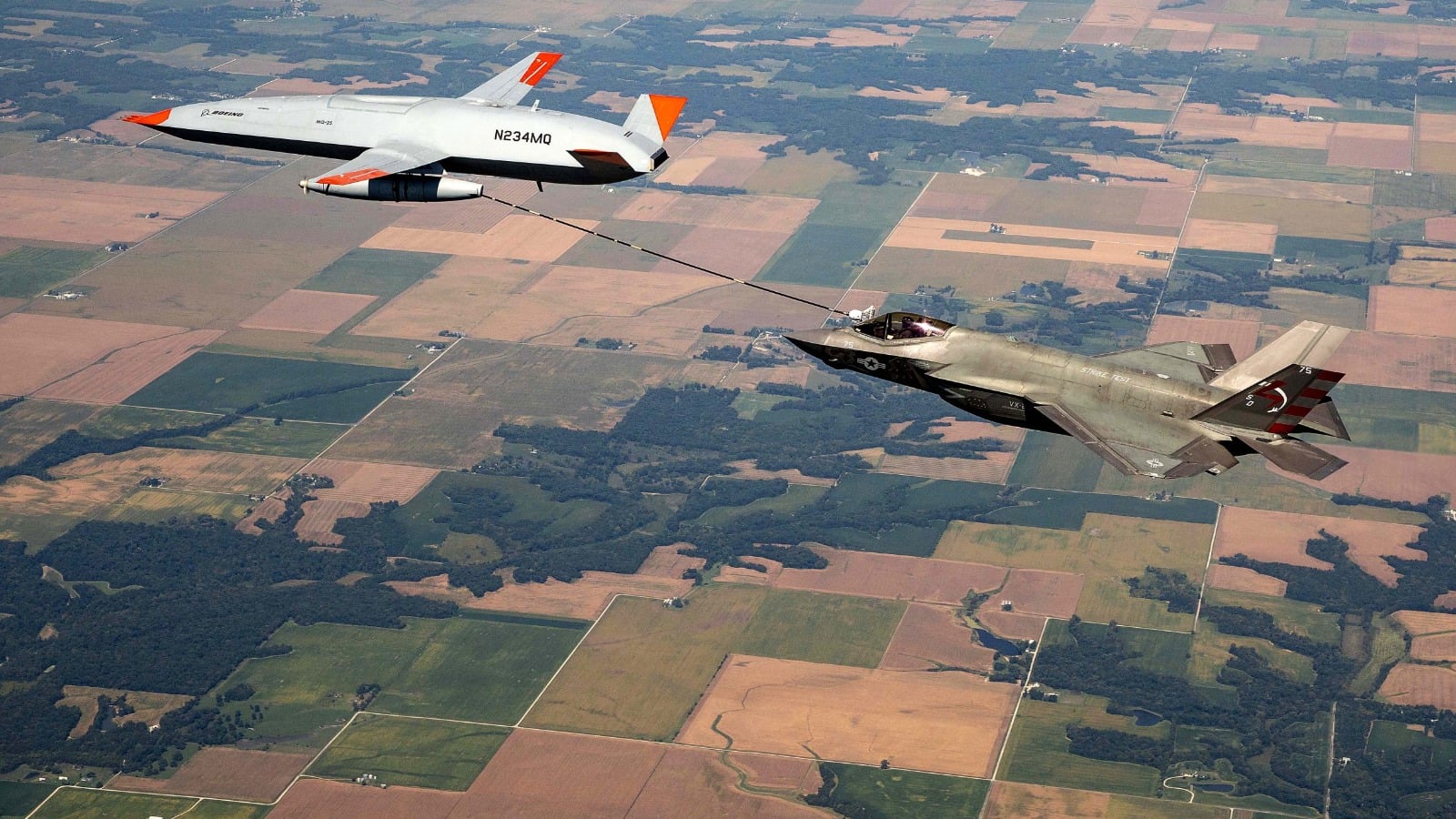
It turned up first in the satellite layer of a consumer mapping app, of all places, and was then run down properly by La zone de guerre, which published commercial imagery of the site on 20 November. The airframe is finished in yellow primer, has a laterally flared V-tail, a dorsal intake and a wingspan of roughly 66 feet. If that sounds familiar, it should: it is in the same class as the US Navy’s MQ-25A Stingray, which is why every analyst who has looked at it has reached for the same comparison.
It is also, on closer inspection, not a copy. The differences are where the interesting part lives.
Quick Facts: the Pucheng drone
Où: Pucheng, Shaanxi province, north-western China — a little-known flight test site next to a general aviation industrial park
Imagery: commercial satellite imagery dated 23 April 2026, obtained and published by La zone de guerre on 20 November 2026
Taille: wingspan about 66 ft, length about 49 ft — roughly 20 per cent smaller than an MQ-25A (about 75 ft by 51 ft)
Configuration: tapered nose, dorsal intake that appears serrated and may split into two channels, laterally flared V-tail
Rôle: unknown. Tanker, ISR, UCAV and collaborative combat aircraft have all been suggested
Fabricant: unidentified. Shenyang Aircraft Corporation has been raised as a possibility, with no confirmation
Also on the apron: a CH-7 stealthy flying wing and a Jiutian jet-powered “mothership” drone
What the Imagery Shows
The aircraft sits at Pucheng Neifu Airport, a field in north-western China that most outside observers could not have named a couple of years ago. It was first noticed in imagery available through Apple Maps, and a separate view showing it on a runway can be found through Bing Maps. La zone de guerre then obtained commercial imagery of the site dated 23 April 2026 and measured the thing properly.
That date matters, and it is worth being straight about it: the photographs are seven months old. What changed this week is that the airframe was identified, measured and put in front of people who can read it. The imagery has been quietly sitting in a public mapping layer the whole time.
Pucheng is not a single runway with one tenant. Apple Maps labels an adjacent area as a national aeronautics industrial base with its own general aviation industrial park, and that park has a smaller runway of its own. The same April imagery caught two other notable aircraft on the ground there: a CH-7 stealthy flying wing, and one of the jet-powered Jiutian “mothership” drones. Whatever Pucheng is, it is busy.
Andreas Rupprecht, a long-standing observer of Chinese military aviation, told La zone de guerre that the site had been largely off the radar until the last year or two, and that several manufacturers appear to have been testing there. He offered a theory about why.
The CFTE is the Chinese Flight Test Establishment at Xi’an, the organisation that has put most of China’s recent crewed combat aircraft through their paces. A dedicated uncrewed annexe elsewhere in the same province would be a tidy arrangement. It is, as Rupprecht says, a theory.
Close to the MQ-25, But Not a Copy
Start with the numbers. The Chinese aircraft measures roughly 66 feet across the wing and 49 feet long. An MQ-25A is about 75 feet by 51 feet. That makes the Pucheng machine around a fifth smaller by dimension, and La zone de guerre draws the obvious conclusion for a tanker: less airframe means less fuel to give away.
The shape diverges in two places that matter. The MQ-25’s forward fuselage is flattened and shovel-like; this one has a more conventional tapered nose, in a different colour from the rest of the yellow-primered airframe, which has prompted speculation that it houses a conical radome. And where the MQ-25 has a flush, carefully blended inlet, this aircraft has a conventional dorsal intake that appears serrated and may split into two channels. If it does split, that could mean two engines rather than one — a reading the article itself flags as speculative.
The V-tail is the one unmistakably familiar feature, laterally flared in much the same way, though possibly with discrete control surfaces rather than the all-moving arrangement on the American aircraft. No refuelling pod, drogue or sensor turret is visible anywhere on the airframe.
That is the most plausible reading on the evidence, and it is still a reading. La zone de guerre lists the alternatives honestly: a true multirole uncrewed combat aircraft, a collaborative combat aircraft flying alongside crewed fighters, or an escort drone whose job is to protect high-value tankers rather than be one. It may not even be carrier-capable. Nothing in the imagery settles it.
Nobody Will Say Who Built It
The manufacturer is unidentified, and Rupprecht is careful to say so. The one thread worth pulling is a sub-scale, propeller-driven demonstrator that Shenyang Aircraft Corporation rolled out in 2025, described in its own ceremony as a surrogate flight-test verification platform. A piston-powered aircraft of broadly similar layout has been filmed flying. Rupprecht thinks the lineage could fit. La zone de guerre is blunt that whether the two are related remains unknown, and that there are no indications they are linked.
This is how most Chinese aircraft programmes reach the outside world now: not through a rollout or an airshow debut, but through a satellite pass, a frame of phone video, or a photograph posted to Chinese social media and picked apart by people who have been watching the same airfields for twenty years. The GJ-11 flying wing and the navalised GJ-21 both arrived in public much the same way.
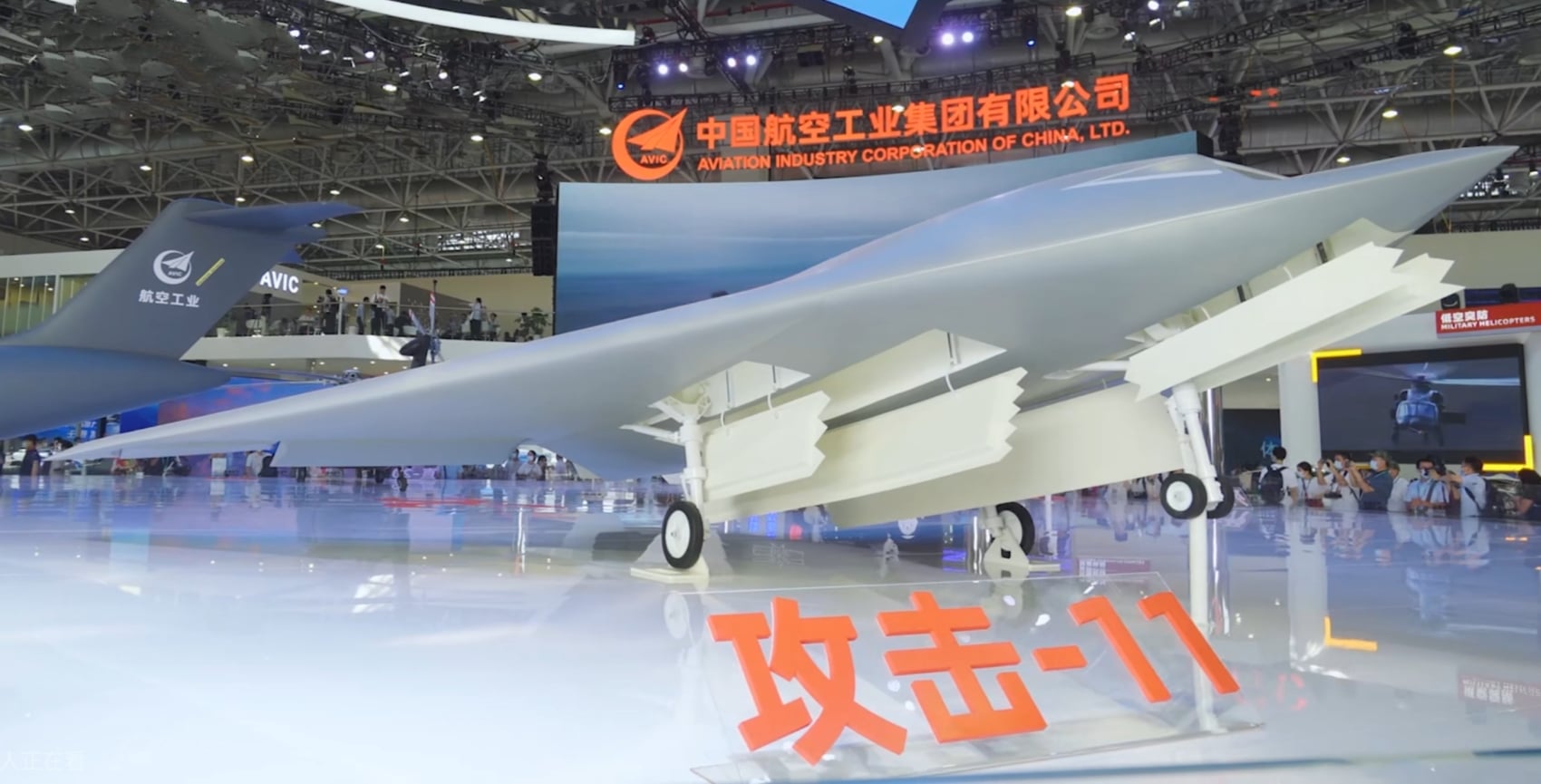
Context helps here. Chinese state media reported in October 2026 that a GJ-21 — a navalised derivative of the GJ-11 — completed a first takeoff and landing from the Type 076 assault ship Sichuan. China is clearly working the carrier-drone problem from several directions at once. Whether the Pucheng aircraft is part of that effort, or something separate, is exactly what the imagery cannot tell you.
What can be said is that an aircraft of this size does not get built as an experiment on a whim. Sixty-six feet of wing, a jet engine and a V-tail is a serious airframe, parked at a test field alongside two other serious airframes, in imagery that has been publicly available since April. The interesting question is not what it is. It is how much else is sitting on aprons nobody has thought to look at yet.
Sources: The War Zone, 20 November 2026, reporting commercial satellite imagery dated 23 April 2026, including quotes from analyst Andreas Rupprecht; Chinese state media as cited by The War Zone.



0 Comments