
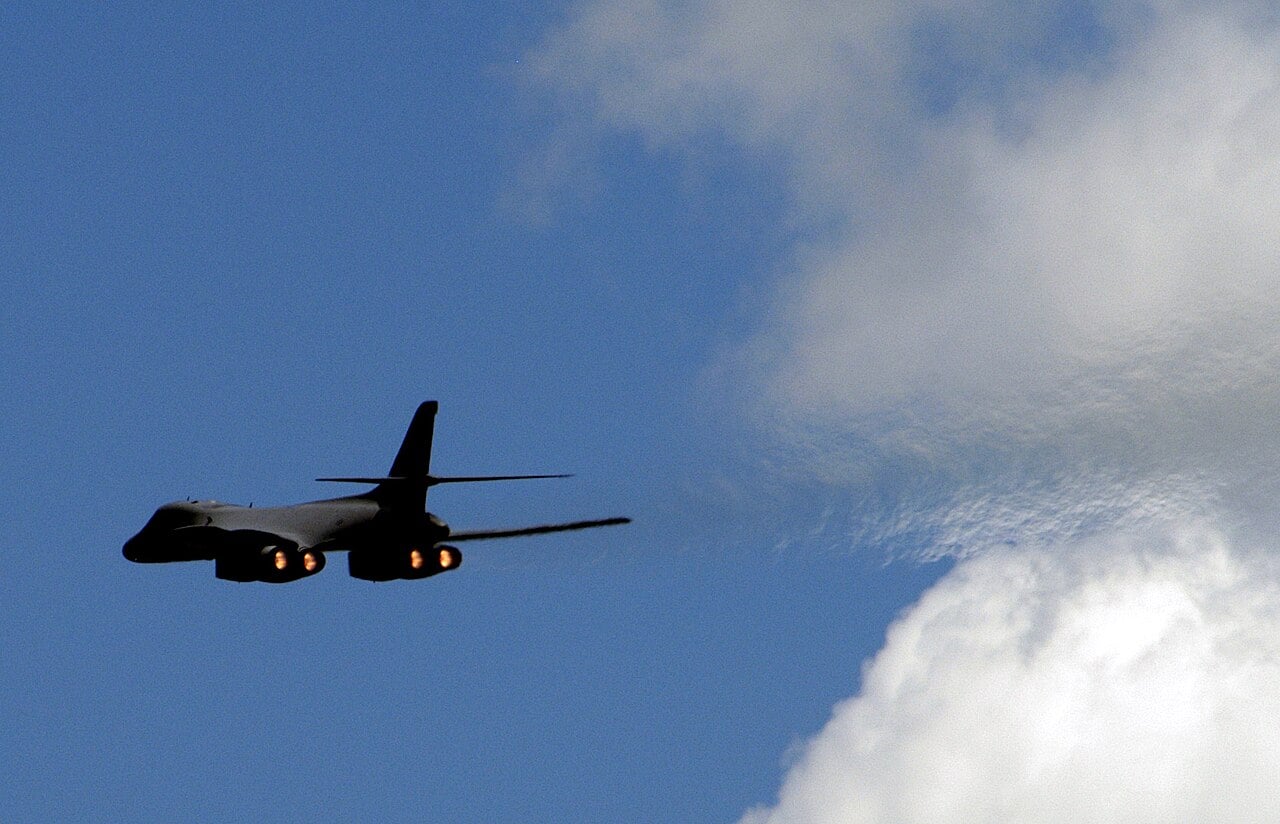
Walk onto a US Air Force flight line and ask someone to point you at a Fighting Falcon and you will get a blank look, then a correction. It is a Viper. The Lancer over there is a Bone. The Stratofortress is a BUFF, and nobody has called the A-10 a Thunderbolt II since roughly the day it was named.
Aircraft get two names. One is decided by a committee and announced at a ceremony. The other is decided by the people who work on the aircraft at four in the morning in the rain, and that is the one that sticks.
Informations clés
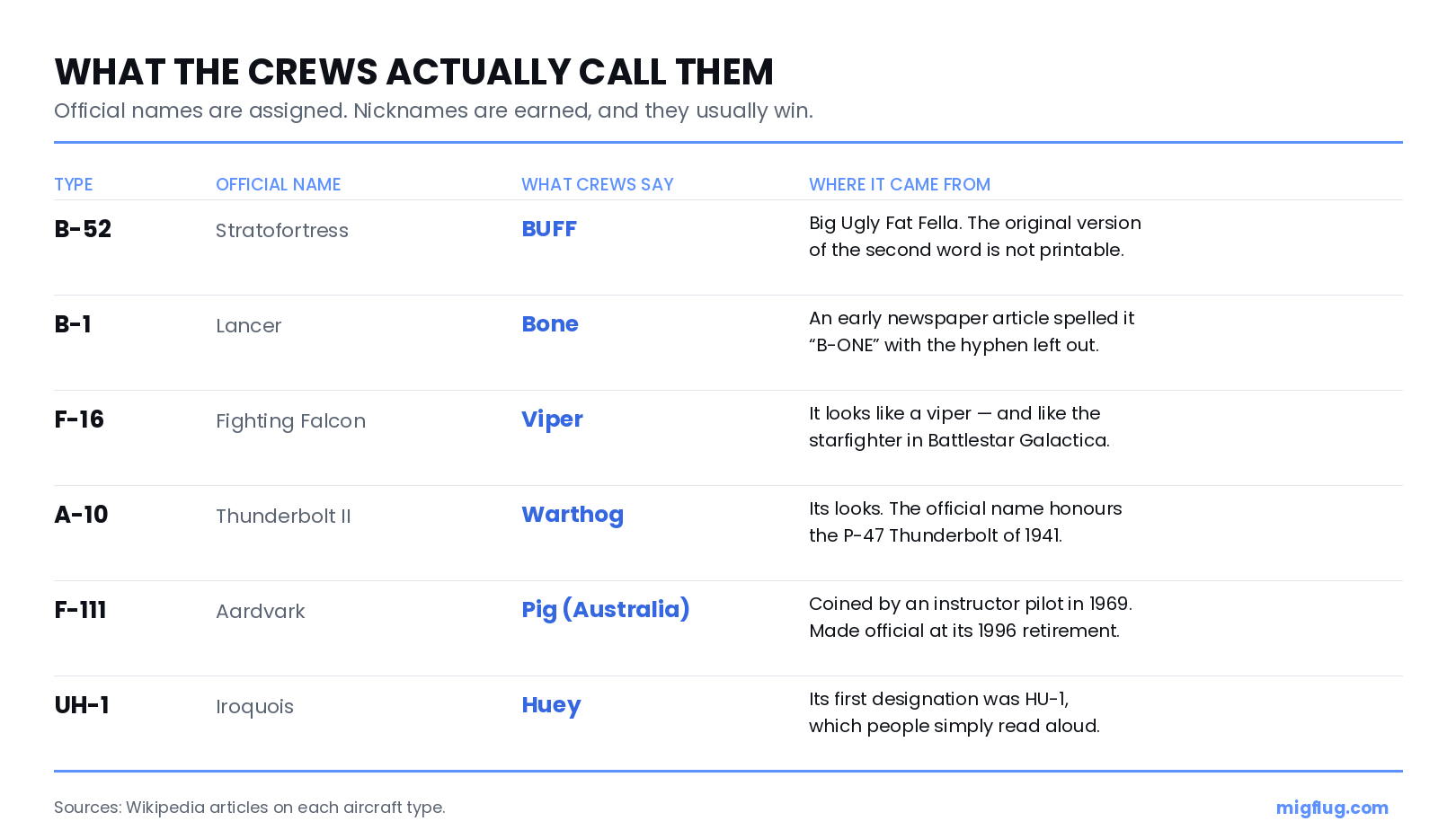
B-52 Stratofortress: BUFF — Big Ugly Fat Fella
B-1 Lancer: Bone — from a misprinted “B-ONE”
F-16 Fighting Falcon: Viper — the snake, and the starfighter
A-10 Thunderbolt II: Warthog, or just Hog
F-111: Aardvark, unofficial from 1969, official from 1996
UH-1 Iroquois: Huey — from the original HU-1 designation
Common thread: The official name is almost never the one in use
Bone: A Typo That Became a Bomber
Le B-1 did not get its official name until 15 March 1990, years after it entered service. By then the crews had already settled the matter, and they did it because of a newspaper.
A sub-editor dropped a hyphen, somebody read BONE out loud, and a hundred-tonne supersonic bomber has been called that ever since. Lancer never had a chance.
BUFF: An Insult That Turned Into Affection
Le B-52’s official name, Stratofortress, is a fine piece of 1950s Boeing branding and is almost never heard. What crews say is BUFF.
The polite expansion is Big Ugly Fat Fella. The original expansion uses a different word in that third position and is not printable here, which has never stopped anyone using it. The point is that the nickname started as mockery of a large, ungainly, slab-sided aeroplane, and then the aeroplane refused to retire for seventy years and the mockery quietly turned into respect.
Viper: Two Origins, Both True
Le F-16 was officially named Fighting Falcon on 21 July 1980. Pilots call it the Viper for two reasons at once: the aircraft does look like a snake from certain angles, all nose and no shoulders, and the Colonial Viper starfighter from Battlestar Galactica was on television at exactly the moment the type entered service.
It is a rare case of a nickname with a documented pop-culture parent. It is also a reminder that these names are set by whoever happens to be twenty-five years old at the time.
Warthog: The Honest One
Le A-10’s official name, Thunderbolt II, is a deliberate piece of lineage. It honours the Republic P-47 Thunderbolt, the enormous ground-attack fighter of the Second World War, and it is a perfectly reasonable name.
Everybody calls it the Warthog anyway, or just the Hog, because of how it looks. There is no clever story here. It is a big, blunt, snub-nosed thing with its engines stuck on like afterthoughts, and the people who fly it named it accordingly and then said it with enormous affection for fifty years.

Aardvark: The Nickname That Won
Le F-111 is the clearest case of all, because the Air Force eventually surrendered.
The type flew for decades without an official name. An instructor pilot, Al Mateczun, started calling it the Aardvark in 1969, on the reasonable grounds that aardvark is Afrikaans for earth-pig and the aircraft has a very long nose. The name spread, the Air Force ignored it, and then on 27 July 1996, at the type’s retirement ceremony, it was officially named Aardvark.
Twenty-seven years to make a joke into a regulation. The Royal Australian Air Force, who flew theirs for another dozen years after that, cut out the middle step and simply called it the Pig.
Huey: The One That Was Never Anything Else
Le UH-1 was officially the Iroquois. Its original designation, though, was HU-1, and people read it the way it looked.
The designation changed to UH-1 in September 1962 under a unified Department of Defense system, which removed the letters the nickname came from. The nickname did not budge. Bell eventually gave in and cast the name Huey onto the anti-torque pedals, which is about as complete a surrender as a manufacturer can make.
Why the Official Names Keep Losing
There is a pattern. Official names are aspirational: Lancer, Falcon, Thunderbolt, Stratofortress. They describe what the procurement office hopes the aircraft is.
Nicknames describe what it actually is to the people standing next to it. They are short, they are usually a little rude, and they are almost always about how the thing looks or what it is like to work on. They also cannot be issued from above, which is precisely why they mean something.
The clearest proof is the F-111. An air force can hold out for twenty-seven years, but in the end it will put the nickname on the certificate, because that is what everybody was going to say anyway.
Sources: Wikipedia (Boeing B-52 Stratofortress; Rockwell B-1 Lancer; General Dynamics F-16 Fighting Falcon; Fairchild Republic A-10 Thunderbolt II; General Dynamics F-111 Aardvark; Bell UH-1 Iroquois).


0 Comments