
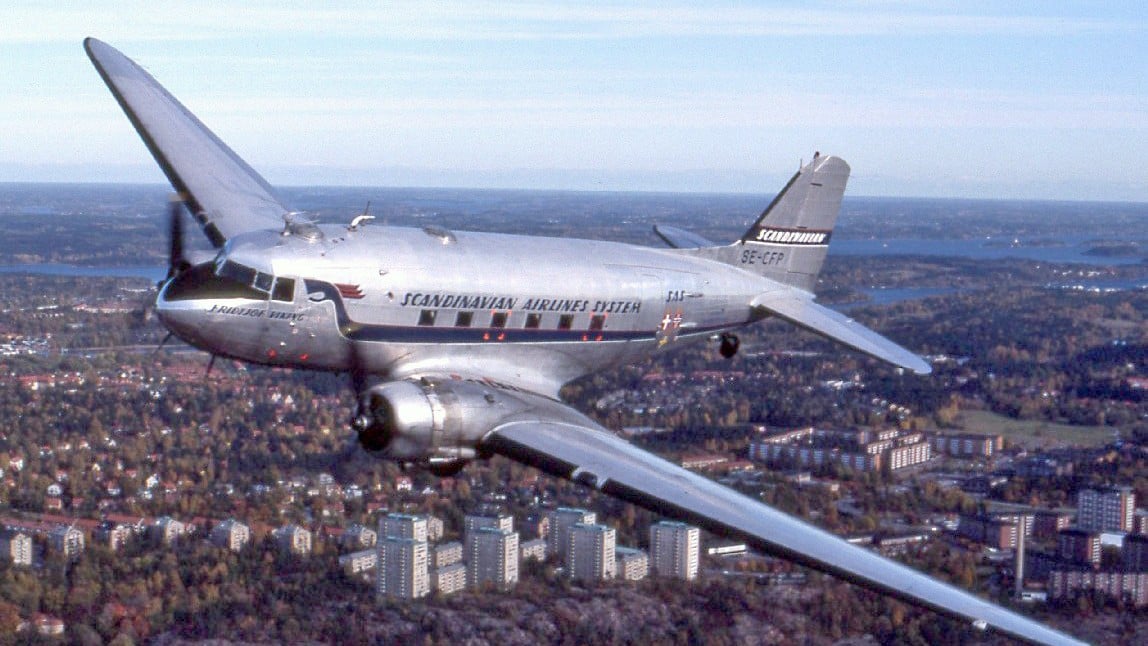
In the mid-1930s, C.R. Smith, the president of American Airlines, picked up the telephone and would not put it down. On the other end was Donald Douglas, who had a perfectly good airliner, the DC-2, and no particular wish to build another. Smith wanted a wider version with sleeping berths to replace American’s slow Curtiss Condor biplanes. By the end of what Douglas historians call a marathon call, Smith had promised to buy 20, and Douglas had agreed.
The result was the Douglas DC-3, and it did something no airliner had managed before: it made money carrying people. Within three years it was carrying almost all of America’s airline passengers, and within ten it had helped win a world war.
Informations clés
Aéronef: Douglas DC-3 (prototype: Douglas Sleeper Transport, DST)
Premier vol : 17 December 1935, piloted by Carl Cover
Entré en service : 26 June 1936, American Airlines
Moteurs : Two Wright R-1820 Cyclone or Pratt & Whitney R-1830 Twin Wasp radials
Passagers : 21 to 32
Gamme: About 1,500 miles (2,400 km)
Construit: 607 civil DC-3s; 16,079 including C-47s and licence-built Li-2s and L2Ds (Wikipedia)
Toujours en vol : Estimated at about 150 in 2023
A sleeper plane that became a day plane
The prototype flew on 17 December 1935, the 32nd anniversary of the Wright brothers’ first flight, as the Douglas Sleeper Transport, fitted with sleeping berths. The day version that followed seated 21 passengers in a cabin wide enough for comfort, on a strong all-metal, multi-spar wing. American Airlines put it into service on 26 June 1936.
Its economics changed the industry. Until then, airlines depended on government airmail contracts to stay in business; passengers were almost a sideline. The DC-3 carried enough of them, cheaply enough, to turn a profit on its own.

By 1938, according to the Smithsonian, 95 percent of U.S. commercial airline traffic was flying on DC-3s, and by 1939 around 90 percent of the world’s airline flights were made by the type or its variants. Rival designs such as the Boeing 247 were left behind almost overnight.
What you didn’t know about the amazing DC-3 (Mentour Now!).
From airliner to warhorse
War turned a commercial success into a legend. As the C-47 Skytrain, the Dakota to the British, and in dozens of other versions, the design became the standard Allied transport of the Second World War. More than 10,000 military C-47s and C-53s were built in the United States. The Soviet Union licence-built nearly 5,000 as the Lisunov Li-2, and Japan built almost 500 as the Showa L2D, so the same airliner flew on both sides of the Pacific war.
C-47s dropped paratroopers on D-Day, flew supplies over the Himalayan “Hump” to China and, in 1948, opened the Berlin Airlift.

Production totals vary with what you count. Wikipedia gives 16,079 airframes including all licence builds; the Smithsonian’s figure is about 13,000. Either way, no other airliner of its era came close.
Why the DC-3 continues to fly decades after the Second World War (Smithsonian Channel).
The only replacement for a DC-3
After the war, thousands of surplus C-47s were converted back into airliners and freighters, and the type became the workhorse of airlines that were just getting started all over the world. The Smithsonian’s own DC-3 flew more than 56,700 hours with Eastern Air Lines before its last commercial flight in October 1952.
Pilots have a saying, quoted on the type’s Wikipedia page: the only replacement for a DC-3 is another DC-3. Some operators took that literally. Basler Turbo Conversions in Oshkosh, Wisconsin, rebuilds old airframes as the BT-67, with Pratt & Whitney Canada PT6A turboprops and a fuselage stretched by 40 inches. BT-67s still land at the South Pole every Antarctic summer.

The number still flying is shrinking, from an estimated 2,000 in 2013 to around 150 in 2023, as parts and maintenance get harder to find. But nine decades after C.R. Smith’s phone call, a DC-3 somewhere is still starting its radials on a cold morning and going to work.
Douglas DC-3: the plane that didn’t want to stop flying (Spark).
Sources: Smithsonian National Air and Space Museum, Wikipedia (Douglas DC-3), Flying magazine, Boeing


0 Comments