
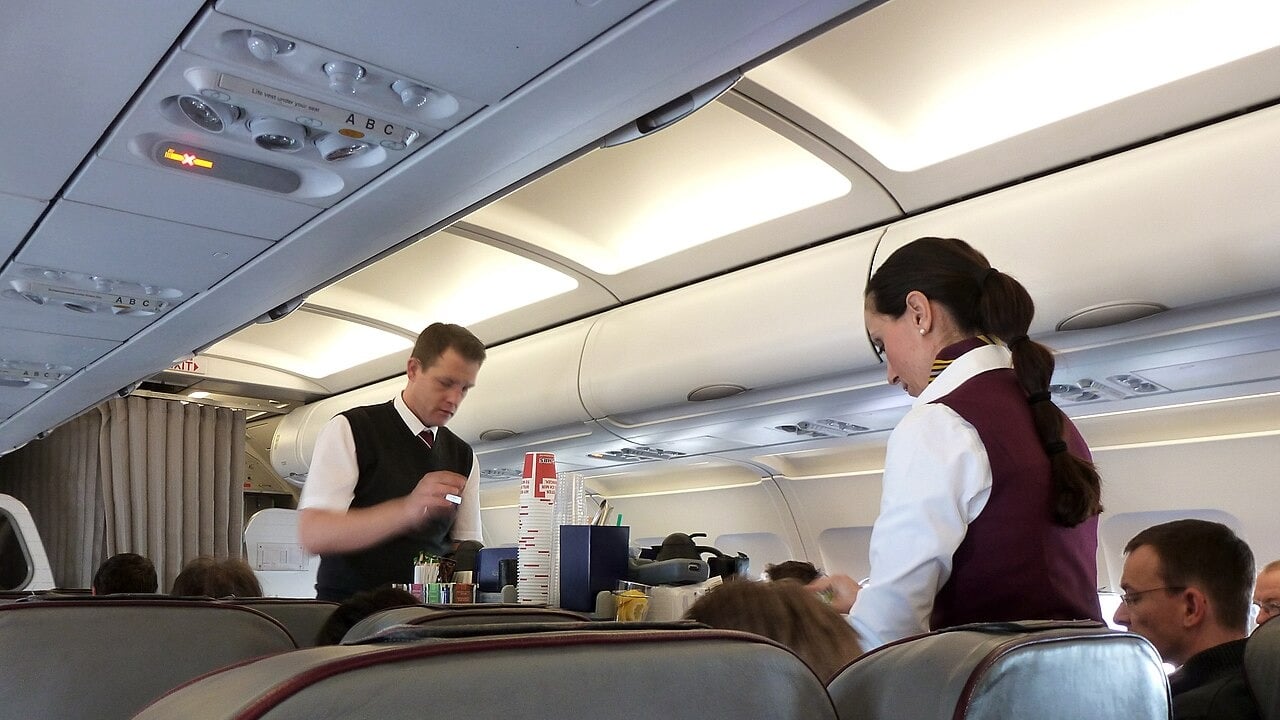
At 05:10 a crew signs in at a domestic base. The duty period starts there, in a crew room, not at the aircraft. Four legs later, after a diversion and a 40-minute gate hold, the same crew is released at 18:40. That is thirteen and a half hours on duty, and it is entirely legal.
Most people assume that whatever rule governs the pilots up front also governs the cabin crew behind them. It does not. The famous modern fatigue regulation, Part 117, was written for flightcrew members and says so in its first sentence. Flight attendants live under a different, older and much shorter rule in a different corner of the Federal Aviation Regulations, and until four years ago that rule let an airline send them back to work on eight hours.
Here is what 14 CFR 121.467 actually requires, what changed in 2022, and why the whole question is back in front of the FAA in 2026.
Quick Facts: US flight attendant duty and rest
Governing rule: 14 CFR 121.467, domestic, flag and supplemental operations
Does Part 117 apply? No. Part 117 covers flightcrew members only
Maximum scheduled duty period: 14 hours, extendable to 16, 18 or 20 with extra cabin crew
Minimum rest after a duty period of 14 hours or less: 10 consecutive hours, not reducible
Minimum rest after 14 to 20 hours: 12 consecutive hours, reducible to 10 if 14 hours follow
Days off: 24 consecutive hours in any 7 consecutive calendar days
Previous minimum: 9 hours, reducible to 8, until the rule changed
Rule effective: 14 November 2022; compliance required 10 January 2023
Part 117 Says “Flightcrew Members”, and That Is the Whole Story
The rule that transformed pilot fatigue management in the United States is 14 CFR Part 117, written after the 2009 Colgan Air accident and effective in 2014. It introduced flight duty period tables that vary by report time and number of segments, cumulative limits, and a genuine scientific basis for all of it.
Its applicability section leaves no room for interpretation. Section 117.1(a): “This part prescribes flight and duty limitations and rest requirements for all flightcrew members and certificate holders conducting passenger operations under part 121 of this chapter.” Flightcrew members. The words “flight attendant” and “cabin crew” do not appear anywhere in that section.
Cabin crew are governed instead by 14 CFR 121.467, which was added to the regulations in 1994 and is, by comparison, a short and blunt instrument. It has no time-of-day adjustment, no segment count, no acclimatisation concept and no cumulative monthly or annual limit on duty. It has a maximum scheduled duty period, a minimum rest period, and a weekly day off.
NBC News on the day the FAA signed the 10-hour rule, October 2022.
The 14-Hour Duty Day, and the Ladder Above It
Section 121.467(b)(1) sets the baseline: no certificate holder may assign a flight attendant to a scheduled duty period of more than 14 hours. A duty period, as the rule defines it in (a), is the elapsed time between reporting for an assignment involving flight time and release from that assignment. Sign-in to release. Not block time, not flight time.
Above 14 hours the regulation does something unusual. It does not forbid longer days. It prices them in extra crew.
A duty period of more than 14 but no more than 16 hours is permitted if the operator assigns at least one flight attendant above the minimum complement required by its operations specifications. More than 16 and up to 18 hours requires two extra. More than 18 and up to 20 hours requires three extra, and is available only where the duty period includes a flight landing or taking off outside the 48 contiguous states and the District of Columbia.
That is the whole ladder: 14, 16, 18, 20, bought with one, two and three additional cabin crew. There is no provision for anything beyond 20 hours.
The practical consequence is that a long day is a staffing decision rather than a safety calculation. An operator that wants an 18-hour duty period on a given rotation does not have to demonstrate that the crew will be fit at hour 17. It has to put two more flight attendants on the aeroplane.
Ten Hours, and the Word That Matters Is “Irreducible”
For a scheduled duty period of 14 hours or less, 121.467(b)(2) requires a scheduled rest period of at least 10 consecutive hours, falling between the end of one duty period and the start of the next. Paragraph (b)(3) then adds a single sentence that is the entire point of the modern rule: that rest period “may not be reduced to less than 10 consecutive hours.”
That sentence is four years old. Before it, the same paragraph required nine consecutive hours, and a separate provision allowed an operator to schedule or cut that to eight, provided the crew member later received at least 10 hours beginning within 24 hours of the start of the reduced rest. The FAA described the old position plainly in the preamble to the final rule: its regulations “require only a nine-hour rest period for these flight attendants, which can be reduced to eight hours in certain circumstances.”
Eight hours is not eight hours of sleep. It is the period from release at the aircraft to sign-in for the next duty, and it contains the crew bus, the hotel check-in, a meal, a shower and the return trip. The gap between the regulatory number and the achievable sleep is where the entire campaign to change it came from.
Congress Wrote the Number, Not the FAA
The 10-hour figure did not emerge from an FAA fatigue study. It was legislated. Section 335(a) of the FAA Reauthorization Act of 2018, Public Law 115-254, signed on 5 October 2018 and codified at 49 U.S.C. 44701 note, directed the agency to modify the rule to ensure that “a flight attendant scheduled to a duty period of 14 hours or less is given a scheduled rest period of at least 10 consecutive hours; and the rest period is not reduced under any circumstances.”
The rulemaking that followed took the better part of four years. The FAA issued an advance notice seeking data in September 2019, a notice of proposed rulemaking in November 2021, and the final rule on 12 October 2022, as Amendment 121-386 under Docket FAA-2019-0770. It became effective on 14 November 2022, with compliance required from 10 January 2023 — four years and three months after the statute that ordered it.
By the FAA’s own count in the final rule, 12 certificate holders were already scheduling 10 hours of rest before they were required to, in several cases because the flight attendants’ union had negotiated it into a collective bargaining agreement first.
The Long Day Still Buys a Shorter Night
The irreducible 10 hours applies only to duty periods of 14 hours or less. Above that, the arithmetic reopens.
Paragraph (b)(7) requires at least 12 consecutive hours of rest after a scheduled duty period of more than 14 and up to 20 hours. Paragraph (b)(8) then allows that 12 to be scheduled or reduced to 10 consecutive hours, provided the flight attendant receives a subsequent rest period of at least 14 consecutive hours, scheduled to begin no later than 24 hours after the start of the reduced rest.
Paragraph (b)(9) closes the obvious loophole. If an operator takes the reduced 10 hours, it may not then schedule that flight attendant for a duty period of more than 14 hours during the 24-hour period beginning with the reduced rest. A short night cannot be followed by another long day.
So the regulation contains two different minimum rest regimes that both land on the number 10, and only one of them is genuinely a floor. After a normal day, 10 hours is absolute. After an 18-hour day, 10 hours is the discounted figure, and the operator pays for it with 14 hours the following night.
What a long-haul duty period looks like from the cabin crew side, start to finish.
What Counts as Rest, and What Quietly Does Not
Three further paragraphs do most of the work in practice, and all three are easy to miss.
Paragraph (a) defines a rest period as a period “free of all restraint or duty” for the certificate holder “and free of all responsibility for work or duty should the occasion arise.” The second half matters: being on call is not rest, even if nothing happens.
Paragraph (b)(12) states that time spent in transportation that the operator requires and provides — to an airport where the flight attendant will serve as a crew member, or home afterwards — is not part of a rest period. The identical provision exists for pilots at 121.471(f). Positioning time is neither duty for the purposes of the duty-period cap nor rest for the purposes of the rest clock. It sits in between.
Paragraph (b)(13) requires the operator to relieve each flight attendant from all further duty for at least 24 consecutive hours during any 7 consecutive calendar days. That is the only cumulative limit in the entire section. There is no weekly duty-hour ceiling, no monthly cap and no annual cap for cabin crew of the kind 121.471 imposes on pilots — 1,000 hours of flight time in a calendar year, 100 in a month, 30 in any 7 consecutive days.
And paragraph (b)(14) provides the release valve every schedule depends on: a flight attendant is not considered to be scheduled beyond the duty limit if the flights were planned to finish inside it but, because of circumstances beyond the operator’s control such as weather, are not expected at departure to arrive on time. The 14 hours is a scheduling limit, not a hard stop that strands an aircraft at hour 14.
The Opt-In Almost Nobody Uses
Paragraph (c) of 121.467 is the part of the rule that rewards reading to the end. An operator may, if it wishes, apply the Part 117 flightcrew limitations and rest requirements to its flight attendants instead, across all of its Part 121 operations.
The conditions are specific. The operator must establish written procedures that apply to all of its flight attendants, that include the Part 117 requirements as appropriate to the operation, and that are approved by the Administrator and referenced in its operations specifications. One condition is unexpected: on-board rest facilities are expressly not required, even though Part 117 rest provisions for pilots assume them. Another adds a flight attendant to the minimum complement for each flightcrew member carried above the number in the aircraft type certificate data sheet.
In other words, the regulation already contains the mechanism to put cabin crew under the modern science-based rule. It simply makes it voluntary.
Europe Drafted It the Other Way Round
The European approach is the clean contrast. EASA’s flight and duty time limitation regime lives in Subpart FTL of Annex III to Commission Regulation (EU) No 965/2012, inserted by Commission Regulation (EU) No 83/2014. Its scope provision, ORO.FTL.100, states that the Subpart “establishes the requirements to be met by an air operator and its flight and cabin crew (aircrew) members with regard to flight and duty time limitations and rest requirements for aircrew assigned to commercial air transport (CAT) operations with aeroplanes.”
Flight and cabin crew, in the same sentence, in the same Subpart. Cabin crew were always inside the European scheme through the definition of a crew member; a 2024 amendment made it explicit on the face of the scope clause.
The European rules even handle the detail the American ones ignore, namely that cabin crew usually report earlier. ORO.FTL.205(c) allows the cabin crew flight duty period to be extended by the difference in reporting time between cabin crew and flight crew, to a maximum of one hour, while the maximum daily figure is still calculated from the flight crew report time.
Where cabin crew actually sleep on an ultra-long-haul sector, and why the rest facility matters.
The 2026 Question: Who Decides When a Flight Attendant Takes a Break
The duty and rest argument is live again, and this time it is not about hours. It is about jurisdiction.
On 6 July 2026 the FAA published a notice of proposed rulemaking titled “Ensuring Passenger Safety by Preempting Duty and Rest Requirements” at 91 FR 40902, under Docket FAA-2026-6739 and RIN 2120-AM27. It proposes to add a new section 121.468 for flight attendants and a new section 117.31 for flightcrew, stating that the federal duty and rest rules preempt state and local laws on the same subject, including meal and rest break requirements.
The trigger is litigation. The NPRM names it directly: recent cases, “most notably Bernstein v. Virgin America, Inc. and Wilson v. SkyWest Airlines, Inc.”, over whether state meal and rest break laws apply to flight attendants. California’s labour code requires meal and rest breaks of a kind that a cabin crew member at 37,000 feet cannot straightforwardly take, and the courts have not spoken with one voice about whether federal aviation law displaces it.
The FAA’s argument in the proposal is that its rules occupy the field, and that a patchwork would be unsafe rather than merely inconvenient: “Conflicting State or local laws would create a complex patchwork of regulatory requirements that would frustrate the Federal regulatory scheme and inhibit aviation safety.” The agency also argues the breaks are preempted by the Airline Deregulation Act of 1978 because of their effect on prices, routes and services.
Comments closed on 4 September 2026. The Association of Flight Attendants-CWA, the Association of Professional Flight Attendants and the International Association of Machinists filed jointly against it. The rule has not been finalised.
Boyd is an outside consultant rather than a party to the rulemaking, and his view is the industry-side case in its shortest form. The unions’ case is the mirror image: that a rest rule which still permits a 20-hour duty period, and which contains no cumulative duty limit at all, is a poor reason to strike down the only break protections some cabin crew have.
What the Rule Actually Tells You
Read 121.467 end to end and a shape emerges. It is a scheduling regulation rather than a fatigue regulation. It constrains what an airline may publish in a roster, with a generous allowance for the day going wrong. It buys long days with bodies rather than with evidence. It contains one genuinely hard number, the 10 consecutive hours after a normal duty period, and that number arrived because Congress put it in a statute in 2018, not because the agency derived it.
Everything else in cabin crew fatigue management — the time of day, the number of sectors, the time zones crossed, the cumulative load across a month — is handled either by a collective bargaining agreement or not at all.
Sources: 14 CFR 121.467, 121.471, 121.391 and 117.1 (Electronic Code of Federal Regulations, current to 25 November 2026); Flight Attendant Duty Period Limitations and Rest Requirements, final rule, 87 FR 61452, 12 October 2022, Amendment 121-386, Docket FAA-2019-0770; Ensuring Passenger Safety by Preempting Duty and Rest Requirements, NPRM, 91 FR 40902, 6 July 2026, Docket FAA-2026-6739; FAA Reauthorization Act of 2018, Public Law 115-254, section 335(a); FAA newsroom release and rule-signing remarks of Acting Administrator Billy Nolen, 4 October 2022; Association of Flight Attendants-CWA statements, 21 October 2021 and 4 October 2022; EASA Easy Access Rules for Air Operations, Part-ORO Subpart FTL, ORO.FTL.100 and ORO.FTL.205; Fox News Digital, 21 September 2026.



0 Comments