

It is shortly after seven in the morning on 19 August 1945, and two aircraft are climbing out of Japan in a way no Japanese aircraft has flown for almost four years. They are Mitsubishi G4M “Betty” bombers, the same type that once torpedoed British battleships and carried kamikaze glide bombs. Today their guns have been removed. Their red roundels are gone, painted over in white, and large dark green crosses stand out on their wings and fuselages.
Aboard are sixteen men led by Lieutenant General Torashirō Kawabe, deputy chief of the Imperial Army General Staff. Four days earlier Emperor Hirohito had announced on the radio that Japan would accept the Allied terms. Now his envoys are flying south to meet the victors. The Americans have given the two bombers call signs drawn from the bitterest defeat of their war: Bataan 1 and Bataan 2.
Waiting for them over the sea south of Kyushu are North American B-25 Mitchells of the 345th Bomb Group, the “Air Apaches”, with P-38 Lightnings above. The two weeks that follow will be told mostly through aircraft: the bombers that carried the envoys, the transports that brought the occupiers, and the hundreds of warplanes that roared over Tokyo Bay when the last signature dried.
Informations clés
- Envoy flight: 19 August 1945, two G4M Bettys, call signs Bataan 1 and Bataan 2
- Delegation leader: Lt. Gen. Torashirō Kawabe, 16 envoys
- Itinéraire: Kisarazu to Ie Shima by Betty, then C-54 to Manila
- First occupation landing: Atsugi, 28 August 1945
- MacArthur lands: Atsugi, 30 August 1945, in his C-54 “Bataan”
- Surrender signed: 2 September 1945, USS Missouri, Tokyo Bay
- Ceremony length: About 23 minutes
- Flyover: Several hundred carrier aircraft and several hundred B-29s (figures vary by source)
Bataan 1 and Bataan 2
The orders came from General Douglas MacArthur himself. In two radio messages on 15 August, as Supreme Commander for the Allied Powers, he told the Japanese to send envoys to his headquarters in Manila. The aircraft that carried them had to be unarmed and painted all white, with green crosses on the sides of the fuselage and on the top and bottom of each wing, easy to recognise at 500 yards. It was to fly south from Cape Sata, the southern tip of Kyushu, to the island of Ie Shima off Okinawa, and to use the code word “Bataan”.
The Japanese asked for more time, and the meeting slipped from 17 to 19 August. According to the Pacific Wrecks research database, the delegates flew from Haneda to Kisarazu, where the two Bettys of the Yokosuka naval air group were waiting. One was a transport version, the other a bomber stripped of its weapons. They took off and headed south-west along the chain of islands below Kyushu.
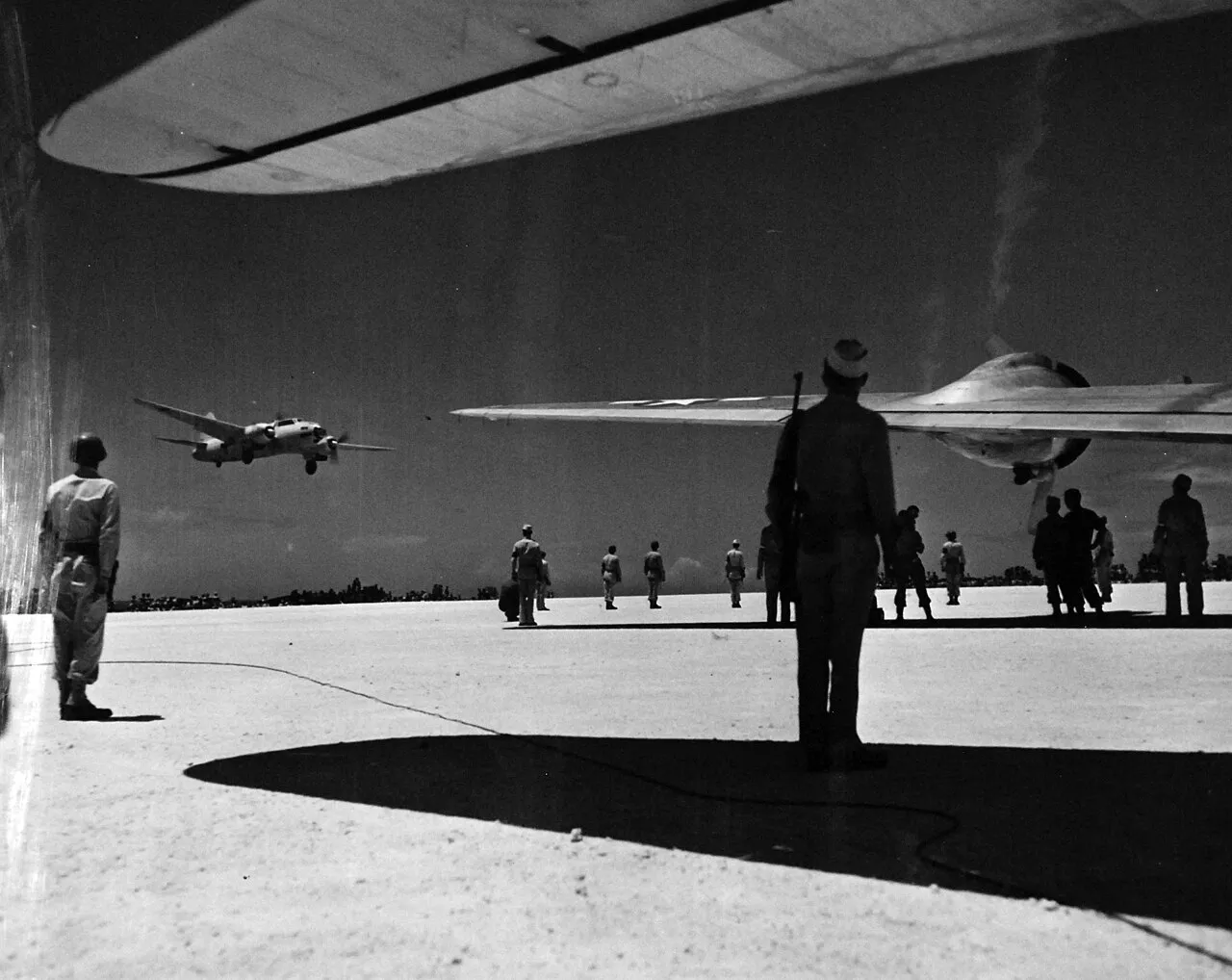
The escort nearly missed them. Six B-25Js of the 345th Bomb Group took off in pairs to find the Bettys. Only two crews, led by Major Jack McClure and Major Wendell Decker, made contact near the island of Suwanosejima. When the Bettys drifted off course, McClure took the lead and shepherded them in. Around 12:40 the first white bomber came down on Ie Shima’s airstrip, landing hard. Hundreds of American servicemen crowded the runway edges to watch.
By C-54 to Manila
On Ie Shima the envoys did not stay long. Military police led them across the field to a four-engined Douglas C-54 Skymaster, the long-range American transport that had become the workhorse of the Pacific air routes. The Naval History and Heritage Command notes that it, too, carried the call letters BATAAN. The delegation landed at Nichols Field outside Manila that evening.
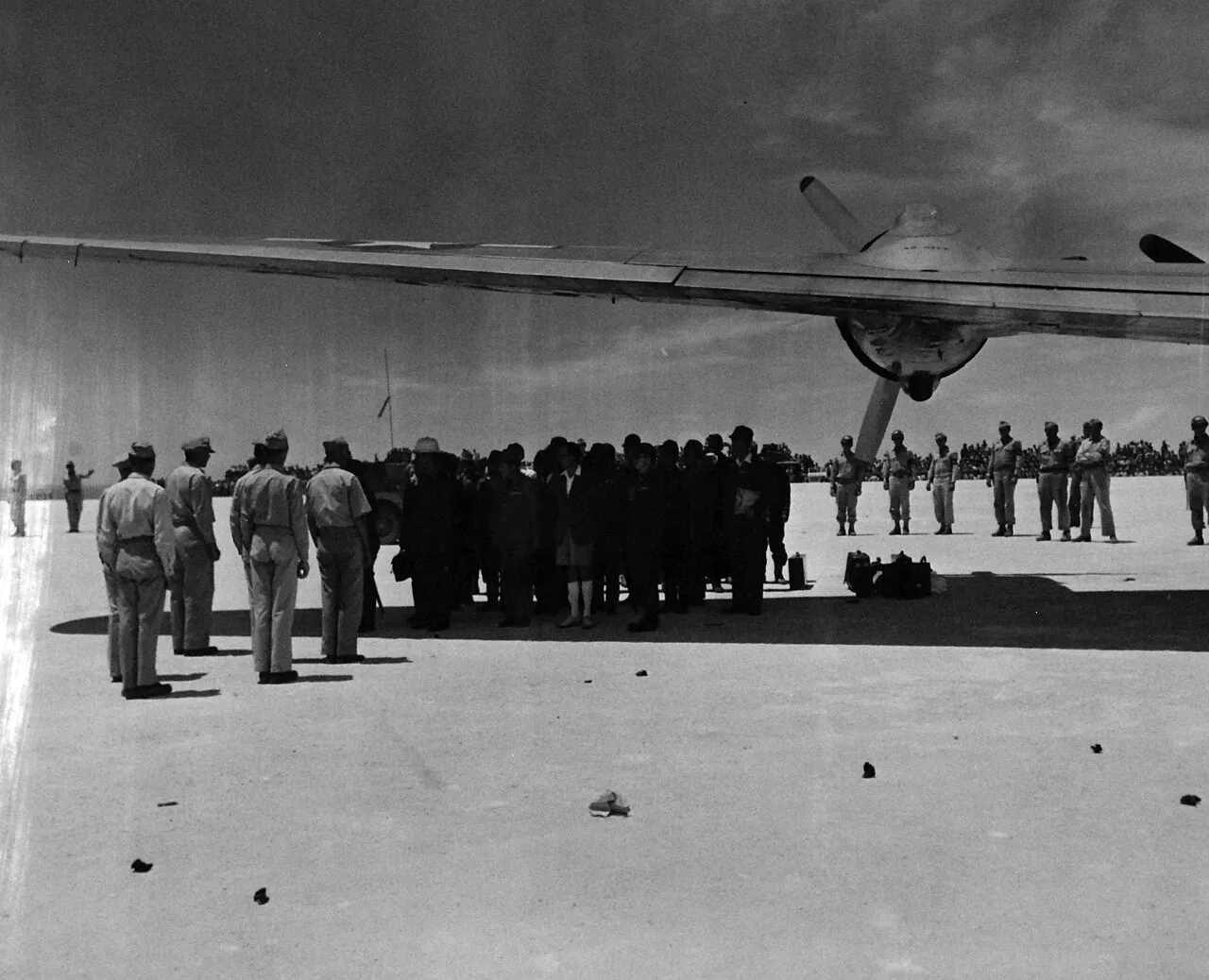
There were no negotiations. In meetings that ran into the early hours of 20 August, MacArthur’s chief of staff, Lieutenant General Richard Sutherland, handed the Japanese the instructions for the surrender and the occupation: where American troops would land, which airfields had to be cleared, and how the Japanese armed forces were to be disarmed. The Japanese won a short delay to the first landings. Then they flew back to Ie Shima to collect their Bettys.
A British Pathé newsreel from August 1945 on the surrender talks in Manila and Rangoon, the first face-to-face meetings between Allied commanders and Japanese envoys. Video: British Pathé.
Out of fuel off the coast of Honshu
The return journey went wrong almost at once. While taxiing on Ie Shima, one Betty slipped off the runway and damaged its landing gear. Its crew had to stay behind for repairs, and that aircraft only flew home on 21 August. The other Betty took off at about 18:40 on 20 August, carrying the envoys and the surrender instructions that Tokyo was waiting for.
Somewhere over the sea it began to run short of fuel. The most common explanation is an error by the American ground crew on Ie Shima, who converted the Japanese request between litres and gallons the wrong way and loaded far less fuel than was needed. Pacific Wrecks also mentions a possible fuel leak. Either way, after midnight the Betty came down in shallow water off Samejima beach on the south coast of Honshu, near Hamamatsu and roughly 130 miles south-west of Tokyo.
Everyone aboard survived unhurt. Local fishermen helped the delegates wade ashore in the dark, carrying the documents that would end the war. Accounts differ on how they covered the last stretch, by train or by an army aircraft from a nearby airfield, but by the morning of 21 August the instructions were in Tokyo. A memorial marker now stands near the beach where the bomber ditched.
The green-cross flights
The Bataan flights were only the beginning. Across the collapsing Japanese empire, thousands of soldiers, sailors and airmen in isolated garrisons had to be told that the war was over, and the quickest way to reach them was by air. For several weeks the Allies allowed Japanese aircraft to fly under the same white paint and green crosses, unarmed and usually with an escort.
According to research published by the Japanese aviation historians of J-Aircraft, these flights fell into two phases. From about 19 August to 12 September they carried surrender delegations and moved surrendering aircraft to assembly points. From 15 September to 10 October they flew general communications and took the surrender details to outlying forces. Green-cross aircraft landed at Mingaladon in Burma on 28 August and on Morotai on 9 September.
Some of the last flights were the strangest. On 18 September 1945 three Zero fighters and a Ki-46 “Dinah” reconnaissance aircraft took off from Rabaul with Japanese pilots at the controls, escorted by six Vought F4U Corsairs of No. 16 Squadron, Royal New Zealand Air Force, and flew to Jacquinot Bay to be handed over. Pilots who had fought each other for years now flew wingtip to wingtip.
Atsugi: an airfield in revolt
MacArthur chose to enter Japan by air, at Atsugi, a naval air base south-west of Tokyo. It was a bold choice. Atsugi was home to the 302nd Naval Air Group, one of the most important fighter units defending the capital. After the emperor’s broadcast, its commander, Captain Yasuna Kozono, refused to accept the surrender. The US Navy’s history of the base records that his pilots vowed to fight on, printed leaflets calling those who accepted surrender traitors, and held the base for about a week before the revolt collapsed.
By the time the Americans came, the base had been made safe in the bluntest way possible. Pacific Wrecks notes that the propellers were removed from the aircraft at Atsugi to stop unauthorised flying. On 28 August, at dawn, Colonel Charles Tench of MacArthur’s staff stepped from a C-47 on to the cratered runway at the head of the advance party. An Army Airways Communications System team under Colonel Gordon Blake followed with radio gear, and by 29 August Atsugi had a working control tower.
On 30 August the main airlift began. From six in the morning C-54s landed with troops of the 11th Airborne Division under Major General Joseph Swing, who secured the field and the road towards Yokohama. Over thirteen days, according to the US Air Force, 1,336 C-54 flights brought in the 11th Airborne, the 27th Infantry Division and the advance elements of MacArthur’s headquarters, without a single fatal accident.
MacArthur steps down from Bataan
MacArthur took off from Okinawa that morning in his own C-54, named Bataan, with B-17s as escort. In the afternoon the silver transport rolled to a stop at Atsugi. MacArthur paused at the top of the steps, in open-necked khaki and sunglasses, his pipe in his mouth, and looked around before walking down. General Robert Eichelberger was waiting on the tarmac with a band of the 11th Airborne.

The ride into Yokohama was less grand. MacArthur’s motorcade of old cars, led by a fire engine, broke down repeatedly on a cratered road. Thousands of Japanese soldiers lined the route with their backs turned, guarding him as they would have guarded the emperor. The general who had escaped from the Philippines in 1942 had arrived in Japan, and he had come by air.
Twenty-three minutes on the Missouri
The surrender itself was signed on Sunday, 2 September 1945, on the deck of the battleship USS Missouri, anchored in Tokyo Bay among some 250 Allied ships. The Navy chose Missouri partly because she was named after President Truman’s home state. The uniform for American officers was set by MacArthur and Admiral Chester Nimitz: open-necked khaki, no ties and no ribbons. In the words recorded by the Naval History and Heritage Command, “We fought the war without ties, we’ll have the ceremony without ties.”
On a bulkhead overlooking the signing table hung a framed flag. It was the 31-star flag that Commodore Matthew Perry had brought into Tokyo Bay in 1853, when his warships forced Japan to open its ports. The Navy had it sent from the Naval Academy Museum in Annapolis, but it was far too fragile to hoist. Because conservators had stitched a protective linen backing to its front, it was displayed from the reverse, with the stars on the right, which is why it looks back to front in photographs of the day.

The eleven Japanese delegates came aboard at 08:56. Foreign Minister Mamoru Shigemitsu, who had lost a leg to a bomb in Shanghai in 1932, struggled up the ladder on an artificial limb with a cane. He and the other civilians wore formal morning dress and silk top hats; General Yoshijirō Umezu, chief of the Army General Staff, led the military officers. They stood in silence before rows of Allied officers and crowds of sailors packed on to every gun turret and ledge.
Just after 09:00 MacArthur stepped to the microphone. His statement was short. He did not speak of revenge but of what might come after.
Shigemitsu signed first, at 09:04, for the emperor and the government; Sutherland had to show him which line to use. Umezu signed for Imperial General Headquarters. Then MacArthur signed as Supreme Commander, with Lieutenant General Jonathan Wainwright, who had surrendered Corregidor, and Lieutenant General Arthur Percival, who had surrendered Singapore, standing behind him. Both had just been freed from Japanese prison camps.

Pens, a misplaced signature and a corrected document
MacArthur used several pens and handed them out as souvenirs, but the sources do not agree on how many. The National WWII Museum says five: one each to Wainwright and Percival, two set aside for the Military Academy at West Point and the Naval Academy at Annapolis, and one he kept. The Naval History and Heritage Command counts six. Another National WWII Museum article says he signed mainly with a Parker Duofold that he later gave to his wife, Jean.
After Nimitz signed for the United States, the representatives of China, Britain, the Soviet Union and Australia followed. Then came Colonel Lawrence Moore Cosgrave of Canada, who had lost an eye in the First World War. On the Japanese copy he signed on the line meant for France, one below his own. Each signer after him used the next available line, and New Zealand’s Air Vice Marshal Leonard Isitt had to sign in the blank space at the bottom.
When the Japanese examined their copy they objected that they could not accept a flawed document. Sutherland sat down at the table, struck through the printed designations that no longer matched, wrote the correct ones by hand and initialled each change. The delegation accepted it. The clean Allied copy went to Washington, was presented to President Truman on 7 September and has been held by the US National Archives since 1 October 1945.
“These proceedings are closed”
The last signature went down at about 09:25. MacArthur stepped back to the microphone for a brief benediction, then ended the ceremony, which had lasted around 23 minutes.
The flyover was meant to start as the curtain fell, but the clouds over Tokyo Bay were heavy. As Air & Space/Smithsonian later reconstructed it, MacArthur leaned towards Halsey and muttered, “Bill, where the hell are those airplanes?” In his memoirs he remembered the next moment rather more grandly.
Out of the haze came the carrier aircraft of Task Force 38: Grumman F6F Hellcats, Corsairs, Curtiss Helldivers and Grumman Avengers, planned to pass at 1,500 feet. Behind them came the Boeing B-29 Superfortresses from the Marianas, whose first crews had taken off at about two in the morning. With clouds hiding their planned altitudes of 8,000 to 14,000 feet, the bombers came in far lower. To make the formation look even larger, the B-29s flew a huge clockwise box so that watchers would see the same aircraft more than once.

How many aircraft flew that day depends on whom you read. The Naval History and Heritage Command gives 450 carrier planes and 600 B-29s. The Smithsonian’s National Air and Space Museum gives 349 carrier aircraft, noting that some sources say 450, and 462 B-29s, with a fifth bomb wing busy dropping supplies to prisoner-of-war camps instead. Even at the lower figures, it was one of the largest formations of the war.
The official 1945 newsreel of the surrender ceremony aboard USS Missouri, from the Universal Newsreel collection, including the signing and the massed flyover. Video: US National Archives.
The Missouri today
For the B-29 crews the war ended as it had been fought, over Japan. In the weeks after the surrender, Superfortresses flew mercy missions dropping food and supplies to 154 prisoner-of-war camps in Japan, China and Korea, according to the National Museum of the US Air Force. The remaining Betty from the envoy flight was later stripped at Kisarazu, damaged by a typhoon and bulldozed into the sea. None of the green-cross bombers survives.
The Perry flag returned to the Naval Academy Museum in Annapolis. USS Missouri served again in Korea and the 1991 Gulf War, and since 1998 she has been moored at Pearl Harbor, a short distance from the sunken USS Arizona, as the Battleship Missouri Memorial. The war in the Pacific began for the United States in that harbour and ended on her deck.

Visitors today can stand on the surrender deck, where a bronze plaque marks the spot of the signing table. Above, the sky over Pearl Harbor is quiet. On 2 September 1945 it was the aircraft that had the last word: white Bettys that carried the envoys, a C-54 that brought MacArthur, and hundreds of warplanes that flew over Tokyo Bay to show the war was finally over.
Sources: Naval History and Heritage Command, H-Gram 053-2: Japanese Surrender (2020), and Surrender of Japan, Tokyo Bay, 2 September 1945 photo collection; US National Archives, Surrender of Japan (1945) milestone document and Japanese Sign Final Surrender newsreel (Universal Newsreel, 1945); National Museum of the US Air Force, Japan Surrenders fact sheet; Smithsonian National Air and Space Museum, Celebrating the End of the War (2 September 2020); Air & Space/Smithsonian, Surrender Spectacle (2020); The National WWII Museum, Full Circle: The Japanese Surrender in Tokyo Bay, September 2, 1945, and Mightier Than the Sword: The Parker Pens That Ended World War II; Kirtland Air Force Base, This Week in History: Occupation of Japan Begins; Commander, Fleet Activities Yokosuka / NAF Atsugi, History of NAF Atsugi; Pacific Wrecks, G4M1 Betty Bataan 2 and G6M1-L Betty Bataan 1, and Atsugi Airfield; Vintage Wings of Canada, Green Cross to Bear; Historic Wings, Surrender Flight to Ie Shima (2015); J-Aircraft.com, The End of the JAAF and JNAF; Arthur Herman, Douglas MacArthur: American Warrior (Random House, 2016); Douglas MacArthur, Reminiscences (1964); Toshikazu Kase, Journey to the Missouri (Yale University Press, 1950); HistoryNet, How a One-Eyed Canadian Almost Ruined the Japanese Surrender; NPR, How One Canadian’s Misplaced Signature Caused a Diplomatic Incident (2 September 2025).


0 Comments